










































‘That guy is our hero,’ Rabbi Josh Bennett said of security director Danny Phillips
Emily Elconin/Getty Images
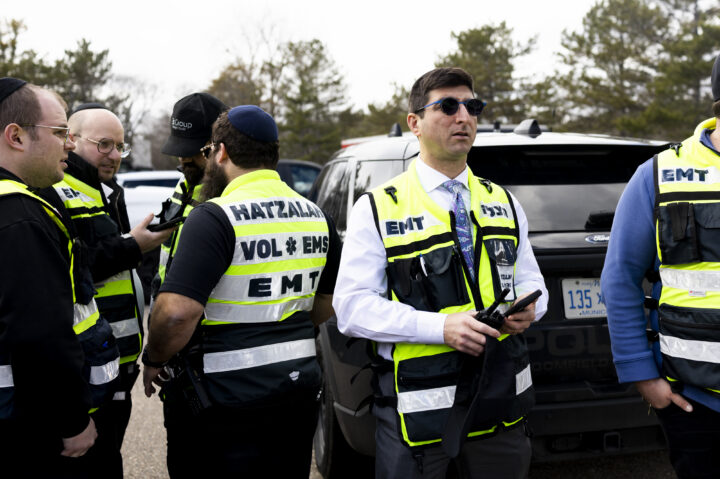
Members of Hatzalah of Michigan, a Jewish volunteer emergency medical service survey the area near Temple Israel following reports of an active shooter on March 12, 2026 in West Bloomfield, Michigan.


 Add JewishInsider on Google
Six weeks ago, Danny Phillips, the director of security at Temple Israel in West Bloomfield Township, Mich., arranged for the FBI to hold an active-shooter training for the congregation, one of the largest Reform synagogues in the county.
That training potentially saved the lives of 140 children and their teachers on Thursday when an assailant rammed a truck full of explosives and weapons into the building.
The education the staff received, the congregation’s rabbi, Josh Bennett, told Jewish Insider, “included the famous ‘run, hide, fight,’ and that’s exactly what our people did. And it’s only because he brought that to the front of mind that we are ready at the moment,” the rabbi continued, referring to Phillips.
The frightening incident unfolded on Thursday afternoon when Ayman Mohamad Ghazali, the brother of a Hezbollah commander who was born in Lebanon and became a U.S. citizen in 2016, breached the suburban Detroit synagogue, while it was filled with preschoolers.
Armed security stationed at the synagogue engaged with Ghazali inside the vehicle, who killed himself after his truck caught fire during the gunfight with security officials. Phillips was the only other person injured during the attack — he was knocked unconscious and remained hospitalized on Sunday, and is expected to make a full recovery.
“That is the guy who is our hero,” said Bennett. Phillips previously spent 28 years working for the Bloomfield Hills Police Department.
“Because of him, not just his heroic actions on Thursday, but the way he has treated the hiring of staff and the training of our teachers and staff, that’s what made a difference,” Bennett told JI. “Yes, he was a hero in the moment and there’s no way to overstate how incredible he was, along with other members of our team who engaged this perpetrator. But it’s bigger than that.”
Rachel Levine, director of Temple Israel’s early childhood center, said she gives tours to prospective families a few times a week “and everyone’s first question is always about security.”
“Every time I tell them, in my life, I have never felt so safe in a building as I do here,” said Levine, who has previously worked at Jewish day schools and public schools, some of which were in downtown Detroit.
“The men that are there to take care of us have really made us always feel like they are taking care of us,” she continued. “I knew [in the] moment [of the attack] that they were going to do what they had to do to make sure that none of us were hurt. And literally, they did.”
Even as community leaders are describing the outcome of the attack as a miracle, Temple Israel, one of the largest Reform congregations in the U.S. with 3,100 families, faces a long road to recovery and rebuilding.
“Our staff and teachers who were in the building are at various levels of coping,” Bennett told JI. “We are putting together professional programs to support people. At the same time we are trying to figure out the rebuilding phase. The building has already been released by the FBI and we’re starting to have insurance walk through and help us understand rebuilding. It’s a massive project. We’re talking about moving our office staff, religious school and nursery school in the interim.”
With the assistance of the FBI and Department of Homeland Security, the community has set up recovery spots for families, which includes support for mental and physical health care, as well as a space for retrieving children’s belongings left behind in the building. Bennett described it as an “emotional site as parents walk in.”
“Everyone is in a tremendous sense of disbelief. I woke up today feeling angry that we are in this position,” added Levine.
But the Temple Israel leaders also noted an “overwhelming” outpouring of support from near and far, including from political leadership in Michigan, some of whom faced criticism over muted responses as the state saw a spate of antisemitic vandalisms after the Oct. 7, 2023, attacks.
“There have been really clear messages against antisemitism at the press conferences [from] both Gov. [Gretchen] Whitmer and Sen. [Elissa] Slotkin (D-MI),” said Bennett. “There were pretty strong words that I have not heard before from leadership. I don’t know what that means in terms of legislation but we feel very protected and supported right now.”
The congregation also leaned on its longstanding relationship with the Chaldean community, Iraqi Christians who immigrated to the U.S. in the 1950s to flee persecution. “They have a huge population in our midst and their community center is directly across the street from us, a major country club,” which served as a reunification point for parents and children on Thursday, said Bennett.
“On Sept. 11 we came together, on Oct. 7 they were in our sanctuary supporting us,” he continued. “They have been unbelievably gracious and gave us their social hall for Shabbat services,” where more than 1,000 people worshipped together on Friday evening, as many more around the world watched via a livestream.
“The outpouring of financial and emotional support from everyone has been at times overwhelming,” said Bennett, who is one of Temple Israel’s seven rabbis.
While the congregation’s adults grapple with trauma from the attack and discuss rebuilding, in a testament to how well security officials, staff and teachers protected the children, Levine recalled a conversation she had with a father who picked up his 4-year-old son from the reunification point.
The boy described the day to his family not as scary, but exciting; full of “fire drills” and police.
“We practice all the time so the kids are not afraid,” said Levine.
With Gvili’s return, no Israeli hostage — living or deceased — is being held in the enclave for the first time since 2014
Amir Levy/Getty Images
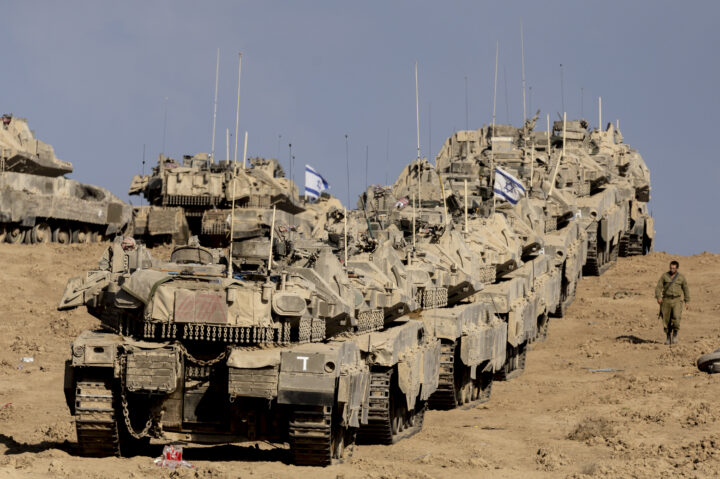
Israeli tanks stationed near the border with the Gaza Strip on September 17, 2025 in southern Israel.
The IDF announced on Monday that it had uncovered the remains of deceased hostage Ran Gvili at a Muslim cemetery in eastern Gaza City and would be bringing them back to Israel for burial — recovering the final hostage of the Gaza war and marking the first time since 2014 that no Israeli captive, alive or deceased, is being held in the enclave.
Gvili, a 24-year-old member of the Israeli Police Special Forces, died in combat while protecting Kibbutz Alumim in southern Israel during the morning of the Oct. 7, 2023 terrorist attacks. His body was then abducted by Hamas and taken into the Gaza Strip where he was buried by the terrorist group.
Dentists and forensic experts deployed to the cemetery were able to identify Gvili’s remains after the IDF had tested hundreds of bodies, according to The Times of Israel. In return, Israel is prepared to hand over at least 15 Palestinian bodies to Gaza’s Health Ministry.
“Following the completion of the identification process by the National Institute of Forensic Medicine, in cooperation with the Israel Police and the Military Rabbinate, IDF representatives informed the family of the deceased hostage Sergeant First Class Ran Gvili, that their loved one has been identified and will be returned for burial,” the IDF said in a statement.
Addressing members of the Knesset on Monday, Israeli Prime Minister Benjamin Netanyahu declared, “My friends, members of the Knesset, a short while ago we returned Ran Gvili, a hero of Israel. I commend the commanders and soldiers of the IDF and the ISA [Shin Bet intelligence agency] for the perfect execution of this sacred mission … We all wore the [hostage] pin, and now that the mission is complete, the time has come to remove it.”
Israeli President Isaac Herzog also thanked those “involved in the operation,” adding that the people of Israel are “moved to tears” and removed his own yellow hostage pin in a video.
“Finally, Ran has been returned home to his family in Israel,” said Herzog. “After many difficult years, for the first time since 2014, there are no Israeli hostages in Gaza. An entire nation prayed and waited for this moment.”
Hamas had held several Israeli hostages for over a decade, including Avera Mengistu and Hisham al-Sayed, who crossed into the Gaza Strip in 2014 and 2015, respectively, and were held alive by the terror group, as well as the remains of IDF soldiers Hadar Goldin and Oron Shaul, who were killed during the 2014 war between Israel and Hamas. All four were returned to Israel in the aftermath of Oct. 7, either through hostage-release deals or recovery efforts by the IDF.
Prior to Gvili’s return, Hamas had been accused of intentionally delaying the release of the Israeli hostages in order to prolong its survival and gain leverage. However, Trump told Axios that the terrorist group helped locate Gvili’s remains.
“[Hamas] worked very hard to get the body back,” Trump said in an interview on Monday. “They were working with Israel on it. You can imagine how hard it was.”
Hamas spokesman Hazem Qassem said that the recovery of the final hostage body proves the group is committed to the terms of the Gaza ceasefire.
“The discovery of the body of the last Israeli captive in Gaza confirms Hamas’s commitment to all the requirements of the ceasefire agreement in the Gaza Strip, including the prisoner exchange,” Qassem said in a statement. “Hamas will continue to adhere to all aspects of the agreement, including facilitating the work of the National Committee for the Administration of Gaza and ensuring its success.”
White House Special Envoy Steve Witkoff announced earlier this month that President Donald Trump’s Gaza peace plan is moving into Phase 2, a shift from a ceasefire and hostage release to the demilitarization of Hamas and reconstruction of the Gaza Strip — a pivot that could be accelerated by the recovery of the last hostage.
Senate Minority Leader Chuck Schumer (D-NY) said in a statement to Jewish Insider, “At long last, after 843 days, the body of Ran Gvili, the last Israeli hostage held by Hamas, is home. It has taken far too long, but finally, all those who fought of the release of hostages can breathe a sigh of relief.”
“I will never forget meeting with the hostage families for the first time in Israel just days after Oct. 7. They have fought bravely and tirelessly for the return of hostages and did not give up until every single hostage was brought home. Today my heart is with all of the hostages, their families, and those who advocated for their return who can finally begin on the path to recovery and healing,” Schumer continued.
Sen. Lindsey Graham (R-SC) also expressed relief for Gvili’s return on social media, noting that the former policeman “epitomizes the heart and soul of Israel.”
“It is with joy and deep sadness that the body of Ran Gvili has been recovered by the Israeli government, allowing him to go home and receive a dignified burial,” Graham wrote. “He fought like a tiger and to the death, taking terrorists down with him. His love for Israel, the one and only Jewish state, consumed his being, and he made the ultimate sacrifice.”
Ted Deutch, CEO of the American Jewish Committee, also welcomed Gvili’s return in a post on X, adding that “healing can begin.”
“This is the moment we’ve prayed and fought for over the last agonizing 843 days,” Deutch wrote. “I’ve come to know so many families of the hostages over the past two years and I hold them all in my heart today.”
Sharabi’s new book, Hostage, tells the story of his kidnapping and 491 days in Gaza
Lev Radin/Pacific Press/LightRocket via Getty Images
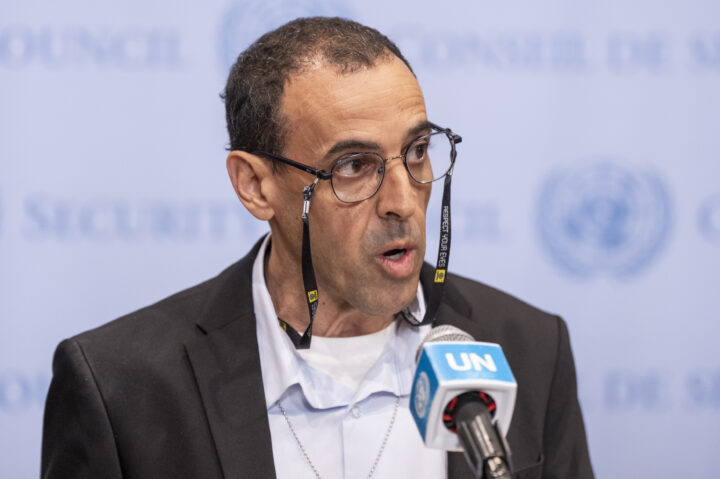
Eli Sharabi speaks to the press ahead of Security Council meeting at U.N. Headquarters.
Freed hostage Eli Sharabi’s new book, Hostage, ends with him visiting the graves of his wife, Lianne, and his daughters, Noiya and Yahel, for the first time after being released from nearly a year and a half of captivity in Gaza, during which he had hoped they were still alive following the Hamas attack on their home in Kibbutz Be’eri on Oct. 7, 2023.
“This here is rock bottom. I’ve seen it. I’ve touched it,” Sharabi writes. “Now, life.”
The memoir tells a horrific story of 491 days of violence, deprivation and starvation.
That final sentence of Sharabi’s memoir — “Now, life” — could sum up his post-captivity self. In an interview with Jewish Insider last month, Sharabi said he was determined to reassert his agency, take action on hostage advocacy and move forward in his life.
Sharabi seemed cheerful speaking about his recovery. He was still slimmer than his pre-captivity self, but no longer as gaunt as he was emerging from the tunnels in Gaza in which Hamas starved him, giving him only a stale pita to eat each day, at most.
“I’m getting stronger every day,” Sharabi said. “I make sure to exercise and have weekly therapy sessions and make sure to take care of myself. I am strong and positive and facing forward.”
Sharabi’s days are filled with meetings around Israel and the world advocating for the remaining hostages to be freed.
“From the moment I got out of Sheba [Medical Center], 10 days after being freed, it has been non-stop action,” he said. “I have a lot of trips abroad, meeting with government officials — presidents, prime ministers, members of parliament, foreign ministers — and a lot of lectures in Israel and around the world, to a lot of Jewish communities. … It’s non-stop, morning to night.”
In his book, he recounts reassuring hostages Alon Ohel, who is still in Gaza, and Eliya Cohen and Or Levy, who have since been released, that he was sure their families were protesting and advocating for their release.
“It was important for Eliya and me to tell Or and Alon, who were more pessimistic about our chances, to get out and thought ‘maybe they forgot us,’” Sharabi recalled. “Eliya and I were very positive and said we had no doubt our families and good friends are not resting for a moment and doing all they could to free us.”
Sharabi said that when his captors would tell him about protests in the streets of Israel, they would say the demonstrations were against Israeli Prime Minister Benjamin Netanyahu, but he and his fellow hostages saw it as “the nation going out to fight for us. It gave us hope.”
When Sharabi was released, he saw that the scale of the hostage advocacy movement was beyond what he had imagined.
“When I got out and understood that it was masses of people in Israel, it excited me,” he said. “I met members of Jewish communities in New York, Chicago, Miami, London, Mexico. I meet Israelis and Jews all around the world and understand what they did all this time. It is very touching. I didn’t expect it at all. I expected my friends and family. I didn’t think that people would have posters of me at their holiday table. It’s heartwarming.”
At home in Israel, however, there have been sharp political divisions about the looming deal to release the hostages in exchange for ending the war in Gaza. Some far-right ministers in Netanyahu’s government oppose President Donald Trump’s plan, which calls to free all 48 remaining hostages — 20 of whom are thought to be alive — within three days, because they call to prioritize defeating Hamas.
“In Israel, everything is political,” Sharabi lamented. “It’s terrible. All of our elected officials, with no exception, are partners in this terrible thing. I think all the people of Israel are sick of everything being political. I think most people in Israel hate this.”
The hostages, Sharabi said, “are not about right and not about left.” His brother, Yossi, was also taken captive and was killed while in Hamas captivity, which the IDF found may have been caused by an IDF airstrike.
Sharabi had an almost paternal relationship with Ohel when Hamas held them captive together in the tunnels under Gaza, and he expressed relief to have seen Ohel in a new hostage video released by the terror group last month.
“He’s amazing,” Sharabi said. “If you told me a week after I met him that he would survive six or seven months alone, after I left him, I would have doubted it. I left him after a very positive process during which he strengthened himself and learned how to survive, that you can’t be nice all the time and can’t be naive. He developed resilience and isn’t shaken by every change and every fear.”
Sharabi emphasized that, while in captivity, it is crucial to “understand that not everything is in our control, but we have the ability to choose how we respond.”
“I’m optimistic that soon we will see [Ohel] united with his family, and soon after, I will reunite with him. I am looking forward to it,” he said.
Sharabi describes his captors in detail in the book. Some were always cruel, while others snuck the hostages extra scraps of food. Some were true extremists, while others appeared to be in Hamas for the money.
“There are no innocent people in Gaza,” he said, “not civilians and certainly not the people in Hamas. In the 52 days that I was aboveground, not in tunnels but with a family in a house, they made sure people outside would not hear or see me, because they thought people would come in and kill me.”
“I recognize that even within Hamas, after spending 24/7 with them for many months and having different conversations with them, I understand who is ideological and who stumbled into it because Hamas controls the financial faucets in Gaza,” Sharabi added. “Does that make them innocent? Of course not. The moment they got the order, I was shackled around my legs. If they were told to shoot me, they would have shot me. … Some did it for money, not ideology, but they starved me, humiliated me and beat me. It doesn’t make them innocent.”
Sharabi also called on the Western world to recognize that Hamas is part of a broader ideology that threatens them, as well.
“I recently got back from 10 days in Australia,” he recalled. “We flew to Canberra to meet the deputy prime minister and foreign minister, both of whom are, at the very least, not pro-Israel. It was important for me to tell them two things.”
“First, disagreements with Israeli policy are fine. I, too, as a citizen, don’t always agree with Israeli policy. That’s what’s good about a democracy… We can say our opinions and disagree. But at the same time, even if they don’t think like Israelis and don’t have to care about me as an Israeli, they are part of the Commonwealth, and my wife and daughters were British and murdered in their homes with their British passports in their hands — the Hamas terrorists knew.”
Sharabi said his captors said to him time after time that “after Israelis and Jews, they will get to France, Britain, America and Spain. The whole world will be Islam.”
Second, Sharabi said he speaks out against antisemitism in his meetings with leaders.
“It cannot be that in 2025, Australian Jews are afraid to go out into the streets. It’s 2025, not 1940. That is [the leaders’] responsibility. They are not speaking out clearly enough against antisemitism. I’m not a politician or a diplomat, so I can say that each one of them is responsible. … Every Jew today is affected by the hate crimes in the world, and that is the responsibility of the government and elected officials,” he said.
Sharabi said his constant activity, including writing his memoir, “has a therapeutic side to it, to deal with [the experience] and not leave it all inside.”
“I don’t like to compare it to the Holocaust, but a lot of survivors didn’t talk, not even to their children,” he noted. “My psychologists, from the beginning, said … they never saw such a huge trauma. It’s not just the captivity, but also the huge loss of my wife, daughters and brother. It’s important to talk. It helps me a lot.”
As to why he doesn’t like to make comparisons between Oct. 7 and the Holocaust, when some Israelis have done so, Sharabi said that during the Holocaust, Jews were “a stateless people, a homeless people, with no government to take care of them.”
“There is a lot of anger in Israel in part because there is a country, there is an address that was supposed to take care of us and our security, and it failed,” he added. “It’s not like the Holocaust, so I don’t like the comparison. There were horrors there that we didn’t see here, like the gas chambers; instead there is a murderous terrorist organization.”
At the same time, Sharabi noted that in the months since his release in February, he has not been exposed to a lot of the details and footage of the Oct. 7 attacks, in which his wife and daughters were among the 132 Israelis murdered in his hometown, Kibbutz Be’eri: “I am being protected like a safe. I haven’t turned on the TV; I don’t watch my own interviews.”
“I have trouble grasping it,” he added.
Even without exposure to the horrors of Oct. 7, speaking and writing about his captivity means going back to the darkest moments of his life, repeatedly.
“I am connected to the pain. I recognize it; I have words for it. Not a day goes by that I don’t cry over it. I hear music on the radio in the car that reminds me of the girls,” he said. “But I also remember them with a lot of smiles, and when I cry, it’s about longing for them, not sadness. I am emotional about the good, when I remember my wife and my girls and their smiles.”
“It’s good for me to talk all the time. It’s important to me. I’m freeing it from my system, instead of leaving it inside,” he added.
Judith Weinstein-Haggai and Gad Haggai were murdered in Kibbutz Nir Oz in the Oct. 7, 2023, Hamas-led attacks in Israel

Hostages and Missing Families Forum
Judy Weinstein-Haggai and Gad Haggai
The IDF found and returned the bodies of U.S.-Israeli citizens Judith Weinstein-Haggai and Gad Haggai, who were killed in the Oct. 7, 2023, Hamas-led attacks, the Israeli Prime Minister’s Office announced on Thursday.
The Haggais were murdered in Kibbutz Nir Oz during Hamas’ onslaught targeting Gaza border communities. Their bodies were held by Hamas, the PMO said.
The couple was on a morning walk when they were shot by terrorists on motorcycles. Weinstein-Haggai called emergency medical services, but the ambulance that was traveling to help them was hit by a rocket, according to her daughter.
Gad was 72 and Judith, a New York native who also held Canadian citizenship, was 70; they are survived by four children and seven grandchildren.
The Weinstein-Haggai family released a statement via the Hostage and Missing Families Forum, saying that their return “is painful and heartbreaking, yet it also brings healing to our uncertainty. Their return reminds us all that it is the state’s duty to bring everyone home, so that we, the families, together with all the people of Israel, can begin the process of healing and recovery … A grave is not a privilege. A grave is a basic human right, without which personal and national recovery is impossible.”
The family called on leaders to “do everything necessary to reach an agreement that will return all 56 remaining hostages — the living for rehabilitation and the deceased for burial.”
Israeli Prime Minister Benjamin Netanyahu thanked the IDF soldiers and Shin Bet fighters who recovered the bodies and added, “We will not rest until we bring all of our hostages home, living and deceased.”
Israeli Defense Minister Israel Katz sent condolences to the Weinstein-Haggai family and said that “the State of Israel is morally and nationally committed to returning our brothers and sisters, living and not living, and we will continue acting with determination until the mission is complete.”
The bodies of two American hostages, Itay Chen and Omer Neutra, remain in Gaza, out of a total of 56 hostages, 20 of whom are thought to be alive.
Please log in if you already have a subscription, or subscribe to access the latest updates.
 Continue with Google

 Continue with Apple