














































































House Foreign Affairs Committee ranking member Greg Meeks said of the Democratic N.J. congressional nominee, ‘I don’t like to talk about somebody I don’t know’
DREW ANGERER/AFP via Getty Images
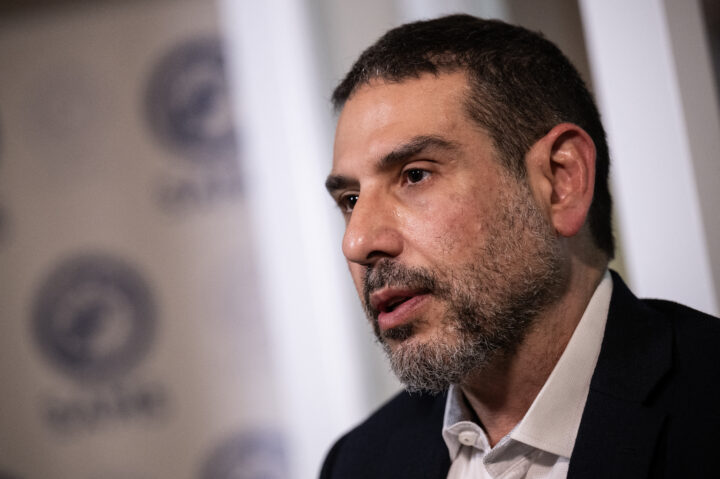
Dr. Adam Hamawy speaks during an AFP interview after meetings on Capitol Hill, in Washington DC, on June 14, 2024.


 Add JewishInsider on Google
Top House Democrats are mostly avoiding questions about Adam Hamawy, the controversial Democratic nominee in New Jersey’s 12th Congressional District, saying they are unfamiliar with his background, including his association with Omar Abdel-Rahman, the terrorist mastermind known as the Blind Sheikh, and his service with a nonprofit organization in Bosnia shuttered as an al-Qaida front group.
A small number of moderate Jewish Democrats have spoken out against Hamawy, expressing concerns about his potential elevation to the House, and frustration with what his and others’ rise signals about the state of the Democratic Party.
House Minority Leader Hakeem Jeffries (D-NY), who congratulated Hamawy on his victory last week — as he traditionally does with most Democratic nominees — sidestepped multiple questions about him in an interview on Fox News’ “The Sunday Briefing” this weekend.
“I haven’t spoken to him, he’s going to have to speak for himself and address these allegations,” Jeffries said in response to a question about Hamawy’s testimony in defense of Abdel-Rahman, before criticizing the administration over the war in Iran and high gas prices.
Asked again, he criticized Republicans for their own controversial comments, and the administration over cost-of-living issues.
Though some Democrats and high-ranking Republicans have raised concerns about Hamawy’s fitness to serve on committees related to national security, Democrats poised to lead some of those committees told Jewish Insider they aren’t familiar with him.
Rep. Greg Meeks (D-NY), the ranking member of the House Foreign Affairs Committee, told JI he hadn’t been following Hamawy’s primary race and hadn’t yet spoken with him.
“I’d have to have a conversation with someone like Bonnie Watson Coleman or somebody that might know him, or tell me a little bit about it before I can say anything in that regard,” Meeks said, referring to the retiring congresswoman whom Hamawy is seeking to replace. “I don’t like to talk about somebody I don’t know, and I’ve not looked at his background or anything else of that nature.”
Rep. Jim Himes (D-CT) declined to comment last week, saying he did not know enough about Hamawy to discuss the situation.
Other Democrats, including Reps. Josh Gottheimer (D-NJ) and Jared Moskowitz (D-FL), have expressed concerns about Hamawy and his election, and Rep. Greg Landsman (D-OH) joined them this week.
“I’m a simple guy, and want leaders that will help us fix this broken economy and keep Americans safe … and who don’t have Nazi tattoos or close ties with convicted terrorists. It’s really not too much to ask,” Landsman told JI.
Rep. Brad Schneider (D-IL) said when asked about Hamawy’s fitness to serve on national security-related committees, “We’ll cross those bridges when we get there.”
“I have concerns about his past associations, and we’ll measure him on what he does, if and when he gets here,” Schneider, a co-chair of the Congressional Jewish Caucus, told JI. “That was a decision the voters of New Jersey made. That’s how our democracy works.”
Hamawy’s campaign has insisted in statements that his “entire career and life have been defined by his patriotism and deep love of this country,” and described his testimony in defense of the Blind Sheikh as his “civic and legal duty,” carried out while Hamawy was a member of the Army.
“At the time, the man in question was one of very few religious figures in what was then a very small Muslim community in New Jersey — he saw him speak in religious settings in his early 20s. Dr. Hamawy condemns that man’s violent rhetoric and actions, and all violence, hatred and terrorism — and he will always. Dr. Hamawy had no contact with this person after they were arrested.”
The campaign has dismissed criticisms of his involvement with Benevolence International, the organization closed down as an al-Qaida front years after he volunteered, as “desperate,” “absurd” and “gross and bigoted.” It has stated that he volunteered to provide medical assistance to victims of the Bosnian genocide, and that Benevolence International was approved at the time by the Bosnian mission to the United States and the United Nations.
‘The lack of transparency calls into question who he really is, and whether or not he's the right person for the 12th Congressional District,’ said Hamawy opponent Mayor Adrian Mapp
Islam Dogru/Anadolu via Getty Images
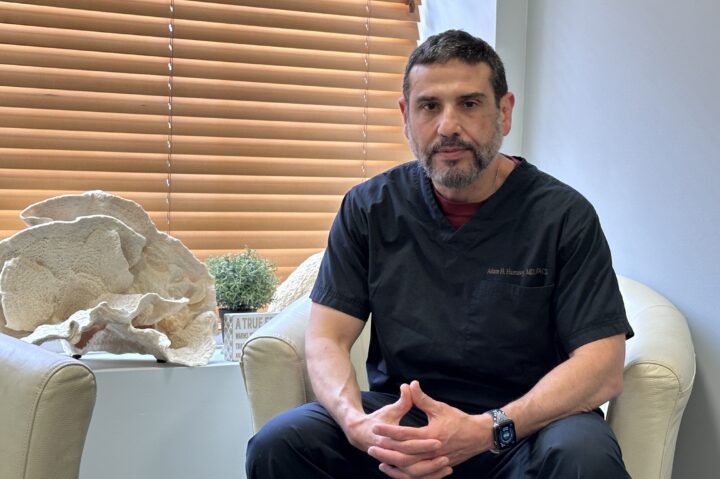
Adam Hamawy, a plastic surgeon, is seen during an exclusive interview at in New York, United States on April 24, 2024.
Several of Adam Hamawy’s opponents in the Democratic primary in New Jersey’s 12th Congressional District are challenging the candidate to explain his ties to Omar Abdel-Rahman, the convicted terrorist known as the Blind Sheikh, as well as his service with a charity later shuttered as a front for al-Qaida years after he volunteered.
Rep. Josh Gottheimer (D-NJ) is now also joining them in seeking more clarity on the first-time congressional candidate’s background.
Many of Hamawy’s other Democratic rivals appeared hesitant to address the military veteran and physician’s past ties to Islamist extremists, with only Mayor Adrian Mapp of Plainfield publicly addressing the weeks-old reporting about Hamawy testifying in defense of Abdel-Rahman.
Mapp told JI he was “shocked” at the news of Hamawy’s time in Bosnia with the Benevolence International Foundation, an al-Qaida-tied group — and disturbed at what he described as the plastic surgeon’s “refusal to be forthcoming” about his involvement with either Benevolence International or his testimony on behalf of the Blind Sheikh.
“Can you explain why you were in Bosnia in association with an entity that was raided, and believed to be a front for al-Qaida? Can you explain that to the American people and especially to the people in the 12th Congressional District?” Mapp posed to his opponent. “The lack of transparency calls into question who he really is, and whether or not he’s the right person for the 12th Congressional District.”
Hamawy has so far dismissed questions about his associations in the 1990s as Islamophobia, but Mapp maintained he had no objection to a Muslim serving in the seat. He added that the 1993 World Trade Center bombing, that Abdel-Rahman was convicted for inspiring, was personal to him, as he said his brother worked as a security guard in the complex at the time.
Brad Cohen, the mayor of East Brunswick, N.J., likewise said Hamawy’s past ties require further explanation.
“Adam Hamawy has never denounced his association with the terrorist responsible for murdering six Americans and injuring more than 1,000. He stuck by a terrorist who called for death to Jews and Christians and to Muslims whom he did not consider radical enough,” Cohen told JI. “Adam has never explained why he traveled to Bosnia with an al-Qaida-linked organization just a year after his mentor tried to bring down the World Trade Center. These are questions that demand urgent answers and it is deeply troubling that Dr. Hamawy has refused to provide them.”
Somerset County Commissioner Shanel Robinson, another candidate in the race, called on Hamawy to explain his relationship with the Blind Sheikh further, while also praising his military service.
“As a fellow veteran I truly appreciate Adam’s service to his country, and know that it speaks to his patriotism. Adam’s relationship with Sheikh Abdel Rahman was thirty years ago, but Adam and I are both asking the people of New Jersey’s 12th Congressional District to select us for positions of authority in the federal government,” Robinson said. “The voters will judge us on our entire adult lives, the choices we have made, and the people we associate with regardless of whether it was 30 days or 30 years ago. Therefore, the voters deserve to hear directly from Adam about this. In the end, it will be up to them to decide.”
Gottheimer emphasized the connections between the Blind Sheikh, al-Qaida and the 9/11 attacks.
“This hits close to home. I represent a lot of families who lost loved ones on 9/11. I also co-chair the Intelligence Committee’s Review of the 9/11 Commission Report,” Gottheimer said. “Based on what I’ve read, I have serious questions and deep concerns about his associations with terrorist organizations and leaders who have attacked America, from the ‘Blind Sheik’ to Al Qaeda. He needs to answer these questions and explain himself to New Jersey voters.”
Rep. Donald Norcross (D-NJ) did not address the substance of the issue, but told JI, “It’s going to be up to the voters in New Jersey’s 12th District to consider these allegations.”
Sam Wang, a Princeton University professor, offered a defense of Hamawy, the only one of his opponents reached by JI to do so.
“At the time that Adam Hamawy was in Bosnia, Muslims were under attack. I take him at his word that he was performing a humanitarian mission. It is consistent with his character,” Wang said.
In a statement, a Hamawy campaign spokesperson said that “these questions have been asked and answered” and said that his “entire career and life have been defined by his patriotism and deep love of this country,” noting his military career and work at Ground Zero after 9/11.
The spokesperson noted that Hamawy was and remained in the military during the time of the Blind Sheikh trial.
“As a witness, he performed his civic and legal duty to testify truthfully under oath and contribute to the system of laws and justice he defended while serving our country in the Army,” the spokesperson said. “At the time, the man in question was one of very few religious figures in what was then a very small Muslim community in New Jersey – he saw him speak in religious settings in his early 20s. Dr. Hamawy condemns that man’s violent rhetoric and actions, and all violence, hatred, and terrorism — and he will always. Dr. Hamawy had no contact with this person after they were arrested.”
The spokesperson also called attacks on his work with Benevolence International in Bosnia, “desperate,” “absurd,” and “gross and bigoted.”
“Dr. Adam Hamawy, as a young medical student and member of the US military, volunteered to provide medical assistance to victims of the Bosnian genocide, per the suggestion the Bosnian mission made to him on how to help via a United Nations approved route,” the spokesperson said.
Several other competitive candidates in the race contacted by JI about Hamawy’s past ties did not respond to requests for comment or declined to comment. No other Democratic members of New Jersey’s congressional delegation — including Sen. Cory Booker (D-NJ) — responded to requests for comments.
Hamawy, boosted by $1.5 million in spending from the anti-Israel American Priorities super PAC, his own strong internal fundraising and unified support from national progressives, has emerged as the apparent front-runner ahead of Tuesday’s primary race.
More moderate candidates have divided the vote, with their support mainly concentrated in their local communities. But a last-minute infusion of nearly $400,000 by a largely unknown super PAC, Project 218, is set to boost Sue Altman, a former progressive organizer and staffer for Sen. Andy Kim (D-NJ), ahead of the primary election on Tuesday. Altman has faced more than $250,000 in attack ads from the Florence Avenue Initiative, a super PAC whose backers are unknown.
After traveling with the ‘Blind Sheikh,’ Hamawy worked with Benevolence International Foundation, later shuttered as an Al-Qaida front
Islam Dogru/Anadolu via Getty Images
Adam Hamawy, a plastic surgeon, is seen during an exclusive interview at in New York, United States on April 24, 2024.
Adam Hamawy’s past relationship with terrorist mastermind Sheikh Omar Abdel-Rahman has loomed over his rapid rise in the race to succeed retiring Rep. Bonnie Watson Coleman (D-NJ).
Their relationship spanned a 1991 road trip the two took together to Detroit, Hamawy’s service as the sheikh’s translator for a press conference in which Abdel-Rahman denied any role in the 1993 World Trade Center bombing and Hamawy’s testimony on the sheikh’s behalf at his 1995 trial, where the Islamist leader was convicted of plotting to carry out a campaign of terrorist attacks in New York City.
But just one year before Hamawy took the witness stand to describe his travels with Abdel-Rahman, the now-Congressional candidate made a different journey with another party entangled in terrorist conspiracies: to Bosnia, with a group subsequently shut down for providing “logistical support” to Al-Qaida.
In a 1996 interview with the Newark Star-Ledger, according to a copy Jewish Insider recovered through an archive of print publications, Hamawy described volunteering in Bosnia during the summer of 1994 with a Chicago-based nonprofit called the “Benevolence International Foundation.”
“I worked in Sarajevo for 10 days and then the rest in Zenica, a large regional center in central Bosnia,” Hamawy, who had just graduated from medical school, told the paper about the five weeks he spent with the organization. “We went out to hospitals around the area and in the mountains to check what supplies they needed and we tried to deliver them.”
Sarajevo and Zenica were the exact cities where Benevolence International maintained its offices — offices that Bosnian authorities raided in 2002, part of a joint effort with U.S. authorities to dismantle the group, which they had identified as a front for Al-Qaida. The 9/11 Commission Report would later identify the foundation’s base in the Bosnian capital as part of the “impressive array of offices [that] covertly provided financial and other support for terrorist activities” that Osama bin Laden established in the early 1990s.
Hamawy, who has scored endorsements from Sen. Bernie Sanders (I-VT) and Reps. Ro Khanna (D-CA), Ilhan Omar (D-MN), Alexandria Ocasio-Cortez (D-NY) and Rashida Tlaib (D-MI) in his New Jersey congressional bid, did not respond to repeated questions about his relationship with Benevolence International and his contacts and activities in Bosnia.
The plastic surgeon has emerged as a frontrunner in the congressional race despite his relationship with the “Blind Sheikh” receiving significant coverage in recent weeks. A 1995 court transcript shows how the then-medical student Hamawy described meeting the Islamist leader in 1991, visiting him at his home and accompanying him on a 13-hour van trip to a conference in Detroit. In the courtroom, he and the sheikh greeted each other warmly, and Hamawy denied a government informant’s claim that Abdel-Rahman had urged the assassination of the then-president of Egypt.
But no other publication has reported Hamawy’s connection to Benevolence International since the Star-Ledger interview in 1996.
According to evidence federal prosecutors proffered in court, and the affidavits of federal agents, the 2002 raids on the Bosnian offices recovered weapons; correspondence between the group’s chief executive, Enaam Arnaout, and bin Laden from the 1980s and 1990s; letters from other Al-Qaida leaders on battles and financial transactions; a photo of Arnaout and bin Laden together; an organizational chart of Al-Qaida; a handwritten list of top donors to the terror organization; copies of never-before-seen documents concerning Al-Qaida’s 1988 founding and its admission policies; and details regarding training camps and Al-Qaida operations in Afghanistan, Pakistan and Sudan.
According to Marko Atila Hoare, a political science professor and historian at the Sarajevo School of Science and Technology, the early 1990s saw a global mobilization of Muslims to aid their co-religionists in the Balkans. Facing a Serbian onslaught, the embattled Bosnian government accepted this support, even though the involvement of foreign Islamic militants would later cause frustration and embarrassment for authorities there.
“A lot of them wanted to go and defend Muslims from non-Muslims persecuting them,” Hoare said, noting that the chaos of war allowed many groups to operate with little scrutiny from officials or the outside world. “You had these organizations like Benevolence, like the Third World Relief Agency, which were operating in this chaotic situation, and some of them were absolute fronts for radical Islamists, and others were ordinary charities. But in these ordinary charities you could also have radicals or extremists infiltrating them.”
Hoare said that not every volunteer who came to the country, even with Benevolence International, was “a hardcore jihadist with terrorist intent.” But among those who took up this “cause celebre in the Muslim world,” as he called it, was Al-Qaida.
The federal evidence file in the case against Benevolence International and Arnaout described how the terror organization deployed a representative to the Balkans in late 1992 on a fact-finding mission for bin Laden, part of a plan “to establish a base for operations in Europe against al Qaeda’s true enemy, the United States.” The materials assert that senior Al-Qaida officials credited Benevolence International with obtaining funds and weapons for the jihadist group, as well as with helping Al-Qaida secure arms for Bosnian militants.
By the time Hamawy arrived, the Syrian-born Arnaout had already been arrested in Croatia on suspicions of weapons smuggling, according to a 2002 handbook from the Austrian National Defence Academy — and then “apparently managed to escape from prison” and continued “forming and supervising the Training Centres” near Zenica (An attorney for Arnaout called this account of his client’s activities “unsupported,” and asserted he lacked the “practical military experience” to carry them out.)
The area near Zenica was where Hamawy reported working in 1994. It was also where the Bosnian Army had recently set up its “El Mujahedin” unit, for foreign fighters who had poured into the warzone, according to the European Court of Human Rights. And among the organizations providing the unit with “funds and assistance,” the court found, was the Benevolence International Foundation.
According to the testimony of FBI agent Robert Walker, Benevolence International was originally the creation of Saudi Sheikh Adel Abdul Jalil Batterjee, a since-sanctioned Al-Qaida financier. The group, Walker attested, operated in tandem with the terror group across multiple nations, providing it with “logistical support.”
“BIF was used in the early 1990s by Usama Bin Laden as a means to transfer money to bank accounts, generally held by purported relief organizations, in countries where al Qaeda members or associates were conducting operations,” the Walker affidavit, which cites multiple confidential informants, reads. “Arnaout was an administrator for Usama Bin Laden who disbursed funds at times on behalf of Bin Laden.”
Arnaout incorporated the Benevolence International branch in the United States in 1992 and served as its chief executive. In 1994, the year Hamawy volunteered with the group, its leadership included Mohamed Loay Bayazid, an alleged Al-Qaida co-founder who sought to secure weapons-grade uranium for the terrorist group. In December of that year, Bayazid was arrested in San Francisco in the company of bin Laden’s brother-in-law, Al-Qaida lieutenant Mohammed Jamal Khalifa.
Walker’s informants also described Arnaout as a “close associate” of Afghan militant commander Gulbuddin Hekmatyar, and the Bosnian office raid turned up video footage of the two men together. The FBI affidavit in turn linked Hekmatyar to Hamawy’s associate and travel companion, the Blind Sheikh Abdel-Rahman — another ally of bin Laden, who also allegedly encouraged his followers to wage jihad in Bosnia.
In 1996, Hamawy told the Star-Ledger he had gotten in contact with Benevolence International through the “Bosnian mission to the United States,” and made no mention of the then-freshly convicted Abdel-Rahman. The article also said his work in Bosnia had occurred “under the auspices of the United Nations High Command for Refugees.” No U.N. agency of this name exists, although there is a High Commission for Refugees, which was unable to confirm that it worked with Benevolence International in Bosnia. Hoare, the historian in Sarajevo, described the U.N.’s work in the country during the war as “corrupted” by local interests and actors, many with ill intent.
Records show that in 1994, the counselor and second deputy ambassador at the Bosnian mission in New York was a New Jersey native named Saffet Catovic. In December 2001, the time of the first federal raids upon Benevolence International’s offices outside Chicago, Catovic was widely quoted as the foundation’s spokesman.
“[The collapsing Bosnian state was] forming these missions in different countries on an ad hoc basis, with what they had, the people they had,” said Hoare, who did not speak directly to Catovic’s case. “It was a very sort of chaotic, ad hoc situation where it was very easy for people to infiltrate missions.”
An imam, Catovic has remained prominent in New Jersey politics and religious affairs, and last fall hosted Hamawy on a YouTube panel discussion of the Gaza conflict. Members of Catovic’s family have donated to Hamawy’s congressional campaign, Federal Election Commission records show.
Catovic did not respond to repeated questions about his contact with Hamawy during his time in the Bosnian mission. Hamawy and his campaign similarly did not answer whether Catovic provided any referral for his work with Benevolence International, or whether the Blind Sheikh had ever referenced the Bosnian conflict in his presence.
Arnaout ultimately pleaded guilty to a racketeering charge in 2003, admitting he had raised money for purported humanitarian purposes and funneled it to the Bosnian military. The Justice Department dropped its terrorism charges, and the judge in the case criticized some of the evidence federal authorities presented as overly reliant on personal associations.
However, the same judge ruled in the Justice Department’s favor in 2019 when it moved to strip Arnaout of his U.S. naturalization status. The prosecutors cited — among other factors — Ernaout’s employment at Benevolence International and the group’s links to Al-Qaida.
In his defense at his denaturalization trial, Arnaout admitted having been “an acquaintance” of bin Laden and Hekmatyar, but continued to deny any ties to terrorist activity. His attorney underscored that the criminal terrorism allegations against him “were never proven.” He entered a settlement agreement with the federal government that remains under seal.
The U.S. Treasury Department and the United Nations Security Council continue to include Benevolence International on their lists of entities sanctioned for terrorist connections, although the group has long since ceased operations. The foundation has been the target of numerous civil lawsuits from parties harmed on 9/11.
On the campaign trail, Hamawy has stressed another part of his volunteer record: his eight years as a U.S. Army officer during the Global War on Terror, which saw him work in a host of military hospitals, including one in Baghdad.
He has referenced his time in Bosnia only glancingly, gently correcting a Turkish state TV interviewer that his work in the Balkans was not through the Army but “another volunteer mission.” He did not mention Benevolence International by name.
He also told a local New Jersey station, “I was in Bosnia early on in ‘95” — which, if accurate, would mean he either spent more time in the country than he acknowledged in the 1996 Star-Ledger interview, or was there during a different period than he described to the newspaper.
But what has given the plastic surgeon such recent prominence has been his volunteer work in the Gaza Strip during Israel’s war with Hamas, including at the European Hospital in Khan Younis. The IDF struck the hospital repeatedly in 2025 to take out an underground Hamas command center that it said operated beneath the medical center.
In multiple interviews in far-left media, Hamawy has denied the existence of such a terrorist post, and insisted to Jacobin that the facility was “a completely benign civilian hospital with no tunnels underneath it.”
The IDF has contradicted his account with footage of subterranean passages, including where it reported recovering the body of Hamas leader Mohammed Sinwar. Hamas subsequently confirmed the killing.
Please log in if you already have a subscription, or subscribe to access the latest updates.
 Continue with Google

 Continue with Apple