









































































Northwestern has received approximately $737 million from the Qatari government in connection with NU-Q operations

Al Drago/Bloomberg via Getty Images
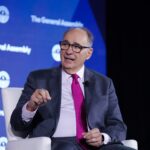
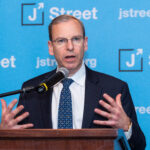
Mung Chiang, incoming president of Northwestern University, during the US Chamber of Commerce's Global Aerospace Summit in Washington, DC, on Sept. 10, 2025.


 Add JewishInsider on Google
Critics of Qatari funding of American universities are watching Northwestern University’s incoming president to see how he handles the school’s upcoming contract renewal for its satellite campus in Doha, Qatar’s capital.
Northwestern’s contract to operate its campus in Qatar (NU-Q) is set to expire at the end of the 2027–2028 academic year. In an interview published May 11 with The Daily Northwestern, the university’s student newspaper, interim President Henry Bienen said the NU-Q review process is “ongoing” and would be left up to the university’s new leadership.
“So I was planning to be in Doha for commencement, and a set of events made it hard for me to do it,” said Bienen, referring to the U.S.’ war with Iran. Bienen served as Northwestern president from 1995-2009 and assumed the role of interim university president in September. He established Northwestern’s Qatar campus in 2008, which has faced scrutiny for faculty ties to Hamas.
“The provost-elect is there now. … [we] are talking about Qatar a lot, and I think it’s fair to say Qatar is very eager that we renew the relationship. So that’s a process of discussion back and forth. And that process is ongoing,” said Bienen. The Doha campus is currently remote, as a security precaution following Iranian missile strikes on the Gulf country.
“Of course, Qatar is a board decision,” continued Bienen. “I have my ideas. I’m positive about the relationship, frankly. I do think at the end of the day, it’s a board issue, and a new president has to sign off on this one. But the conversations are going on. But the wild card is obvious in this fraught area. … There’s just a lot of variables, and nobody can predict with any certainty what the next month will bring, much less the next year.”
On Monday, Northwestern announced the appointment of Mung Chiang as the school’s new president. Members of the Jewish community expressed optimism that Chiang — who assumes the role on July 1 — will leverage the supportive environment he fostered for Jewish students at Purdue University to help combat the antisemitism seen at Northwestern in recent years.
However, questions remain regarding how Chiang will address NU-Q and shape the long-term trajectories of both the Doha and Evanston, Ill., campuses.
The Coalition Against Antisemitism at Northwestern, a group of Northwestern students, faculty, parents and alumni, said in a statement to Jewish Insider that it is “hopeful that President-elect Chiang can help lead a serious, transparent, and institutionally credible review of Northwestern University’s relationship with Northwestern University in Qatar” amid “the increasing federal, congressional, donor and public scrutiny surrounding NU-Q.”
CAAN asserted that Bienen “is materially conflicted with respect to any decision-making process concerning NU-Q and therefore should not serve as the principal decision-maker regarding the future of the Qatar campus. Publicly available disclosures show that Dr. Bienen has served on the advisory board of the Qatar Foundation, the entity that funds and oversees NU-Q.”
Among CAAN’s concerns include “that NU-Q is deeply integrated with Northwestern’s Medill School of Journalism and communications programs.”
“Northwestern has used Qatar Foundation funding to support journalism and communications education through NU-Q, while congressional investigators and outside watchdogs have increasingly questioned whether partnerships involving Al Jazeera and Qatar-backed media ecosystems create risks relating to editorial independence, ideological influence, and institutional neutrality,” CAAN said.
Northwestern has received approximately $737 million from the Qatari government in connection with NU-Q operations, including annual payments reportedly totaling approximately $70 million per year to sustain the campus, according to CAAN.
Brandy Shufutinsky, director of the Foundation for Defense of Democracies’ Program on Education and National Security, pointed to Georgetown University’s Bridge Initiative, a multiyear research project on Islamophobia, which reportedly requires Qatari approval for speakers and programming.
“I’m wondering if Northwestern’s campus in Doha — and even their main campus — [would] have a similar type program where they’re basically handing over final say to the [Qatari] government,” Shufutinsky told JI.
Last year, the House Committee on Education and Workforce released transcripts of an interview with former Northwestern President Michael Schill on the school’s relationship with Qatar. Committee staff noted during the interview that a section of Northwestern’s agreement with the Qatar Foundation, which funds Northwestern’s satellite campus, legally binds staff and students to follow the country’s laws and “social customs.”
“NU, NU-Q, and their respective employees, students, faculty, families, contractors and agents, shall be subject to the applicable laws and regulations of the State of Qatar, and shall respect the cultural, religious and social customs of the State of Qatar,” the agreement reads.
Shufutinsky said she would like to see Chiang address “what does that mean related to gender segregation and women’s rights, considering Qatar is the last Gulf nation to require unmarried women [under age 25] to have a male companion or get male approval if they want to travel.”
“Those values are counter to American social values, customs and norms,” said Shufutinsky. “What does that mean for the girls and women who are studying and teaching on that campus?”
Northwestern did not respond to a request for comment from JI asking if Chiang has indicated his plans for NU-Q.
The questions around contract renewal come as the Iran war is damaging Qatar’s once booming economy, particularly in the oil and gas sector. The country, one of the world’s wealthiest nations, could need to reevaluate foreign partnerships to cut spending.
A report released Tuesday shows dozens of established American universities are also nearing financial trouble.
That leads to a bigger question, said Shufutinsky. “Are these universities becoming so dependent on foreign dollars that they are unable to function, and does that mean they’re going to be willing to turn a blind eye to things like human rights abuses?”
The Georgia Solidarity Network and Reps. Esther Panitch and Houston Gaines spearheaded the effort after a report was released documenting Qatari funding of Georgia’s public schools

Julia Beverly/Getty Images
The Georgia State Capitol building is seen on July 08, 2025 in Atlanta, Georgia.
Following a report spotlighting Qatari funding in Georgia public schools, the state’s General Assembly became the first in the country to pass legislation requiring the disclosure of foreign government funding in statewide K-12 schools.
The Foreign Funding Transparency and Accountability Act, HB 1379, requires public school districts, public universities and technical colleges to report funding of $10,000 or more from foreign countries or entities, naming specifically Qatar and Saudi Arabia — the two largest foreign funders of American universities.
The bill — which passed both chambers of the Assembly earlier this month and now awaits Republican Gov. Brian Kemp’s signature — was spearheaded by Democratic state Rep. Esther Panitch, the only Jewish member of the Georgia Statehouse, as well as Rep. Houston Gaines and the pro-Israel Georgia Solidarity Network.
In January, the Foundation for Defense of Democracies published a report showing that the Qatari royal family’s U.S. philanthropy arm, Qatar Foundation International, had spent at least $281,000 on education in Georgia — including K-12 teacher trainings, Arabic textbooks for young students and student trips to Qatar.
Panitch told Jewish Insider she tweeted the findings, only to be surprised by a direct and hostile response from the Qatari ambassador to the U.S. and his deputy chief of mission on X, who allegedly told her she was spreading misinformation “like you people always do.”
“Why did they care what a legislator from Georgia thinks? It was weird. I started engaging back and this went on for days,” said Panitch. The back and forth eventually resulted in her involving the FBI. “The moment he responded to me was the moment I knew FDD was on to something right,” she said.
“We were all caught off guard after [the Oct. 7, 2023, terrorist attacks]. I think Qatar had a lot to do with the responses on college campuses. Parents had no idea that some of their kids were being radicalized. I hope we get more answers, but this will definitely help,” continued Panitch.
The Georgia Solidarity Network, a two-year-old bipartisan political action committee supporting pro-Jewish and pro-Israel causes, proposed legislation crafted by co-founder Alli Medof, which Panitch filed a couple weeks after the report’s release.
“We didn’t want to make it loud and attract the attention of people who might object,” Panitch told JI. “I didn’t want Qatar to come in and hire a lobbyist. We went to committees and didn’t get much pushback.”
There was, however, some pushback from colleges and schools “in an operational sense, asking how they are supposed to carry this out,” said Panitch.
The bill also faced scrutiny in the state Senate, according to Panitch, who said some lawmakers “didn’t seem to care that Qatari money had seemingly resulted in teachers saying that [late Hamas leader] Yayha Sinwar was to be commended or that suicide bombing is okay.”
Ultimately, the bill passed the Senate 31-20 and the House 139-16. Kemp has 40 days to sign the bill into state law. If he doesn’t veto it, it goes into law automatically.
“I wouldn’t presume anything” in terms of whether the governor will sign the bill, said Panitch, adding she has not heard anything that implies he would veto it.
A second bill establishing a K-12 statewide Title VI coordinator, also crafted by the Georgia Solidarity Network, simultaneously passed. The bill authorizes the withholding of state funding from institutions that fail to correct violations within 30 days — an enforcement mechanism absent from comparable laws in Tennessee, Oklahoma and California.
The legislative session also secured $3 million in state security funding for the rest of 2026 for nonprofit organizations at elevated risk of attack, with an additional $5 million budgeted for Fiscal Year 2027.
“The Title VI bill was kind of similar because we were also dealing with schools and universities,” Panitch told JI. “There was a part that mentioned antisemitism that we ended up taking out. The preamble still mentions antisemitism but we didn’t want anyone to think this was only for the Jews. It was the Jewish community that brought it forward because we’ve been dealing with this, but essentially it’s a civil rights bill for kids and everyone wants to protect their kids, so it passed, not difficultly.”
Six months ago, foreign funding transparency was “not on the roadmap or priority list” of many Georgia legislators, GSN co-founder David Zalik said. There was already evidence of foreign funding in university systems, he said, but “when we went back to the legislators and showed them documentation [regarding the same for K-12], they were stunned and surprised.”
Following the legislative session, Zalik sees the bill as “a model” for adoption beyond the Peach State.
“Other leaders in other communities reached out,” he told JI. “We crafted new language that other states want to emulate. Georgia is a state that clearly takes this very seriously.”
Medof added, “We’re incredibly proud of the impact this is going to make, and not just on the Jewish community. I think every one of these measures are going to improve the quality of life of students and Georgians. Foreign funding impacts curriculum, ideology, faculty and research [for all students]. It’s not just anti-Jewish or anti-Israel, it’s anti-American ideology that’s coming in. The more we can do to shine a line on that, the better it is for all Georgia students.”
Please log in if you already have a subscription, or subscribe to access the latest updates.
 Continue with Google

 Continue with Apple