













































































‘Your antagonism toward Israel has remained steadfast,’ Michael Morris wrote. ‘Your vote continues to demonstrate a lack of support for the Jewish state’
Chip Somodevilla/Getty Images
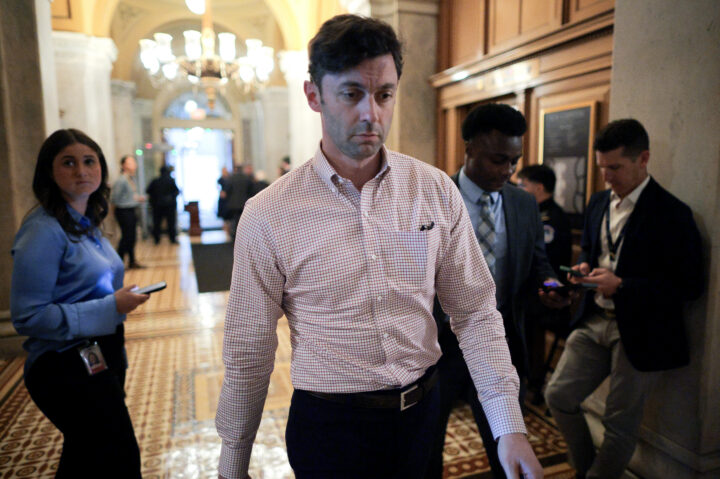
Sen. Jon Ossoff (D-GA) heads for a vote at the U.S. Capitol on June 01, 2026 in Washington, DC.


 Add JewishInsider on Google
The publisher of the Atlanta Jewish Times penned an open letter to Sen. Jon Ossoff (D-GA) on Wednesday pressing the senator over his repeated votes to block U.S. military sales to Israel, accusing Ossoff of failing to support Israel and of misrepresenting his positions to his Jewish constituents.
“I apologize for being blunt, but please, stop lying to me and your constituents. I hear you claim, over and over again, that you support Israel — that your support is ‘ironclad,’” Michael Morris wrote in the letter. “It is not. You vote against Israel on the Senate floor in Washington, then come home to Georgia and make this untruthful claim.”
The open letter is the latest expression of frustration with the Jewish first-term senator, who is up for reelection in November, from prominent leaders in Georgia’s Jewish community. Others have told Jewish Insider they feel that they have no good options in November’s midterm, between Ossoff, whose stances on Israel have frustrated them, and Rep. Mike Collins (R-GA), whose rhetoric and ties to antisemitic and far-right figures have raised alarms.
“Your antagonism toward Israel has remained steadfast,” Morris wrote to Ossoff, highlighting his repeated votes for measures led by Sen. Bernie Sanders (I-VT) to cut off weapons sales to Israel. “Your vote continues to demonstrate a lack of support for the Jewish state.”
Ossoff’s Senate campaign did not immediately respond to a request for comment.
Morris said in the open letter that Ossoff’s support for Israel is only reliable on nonbinding rhetorical measures supporting Israel’s right to defend itself or condemning Hamas.
“But when a bill offers Israel tangible strategic support — munitions, rifles, bombs, military and financial assistance — your record is abysmal, and you throw Israel under the bus,” Morris said. “You are with Israel on the votes that cost you nothing, and against it on the votes that actually matter. All that heartfelt sympathy is smoke and mirrors.”
He said that supporting measures to stop arms sales to Israel is not consistent with a pro-Israel stance.
And he questioned whether Ossoff’s pro-Israel message, delivered to Jewish constituents, has remained consistent in front of other crowds, like the Muslim community.
“You campaigned as a supporter of Israel. You were elected to stand with our allies. You continue to claim that you support Israel. Demonstrate your support with your vote on the Senate floor,” Morris wrote. “If instead you choose to keep voting against Israel, at least do not come home and obfuscate your vote — own your record. Because if you are not telling us the truth about this, Senator, I am left to ask: what else are you not telling us?”
Advocates say the pattern — agents advising cuts to Jewish names, editors going silent on Israeli-themed submissions — deepened sharply after the Oct. 7 attacks

Getty Images
Books
Meg Keene, an established nonfiction author who has sold more than 150,000 copies of her two books offering tips for wedding planning, couldn’t find a publisher for her first novel — not because of the writing, she said, but because it was “too Jewish.”
Keene said she was advised by one agent to cut anything Jewish from the manuscript unless it drove the plot, including changing a character’s name because Yael read as Israeli. The book, written soon after the Oct. 7, 2023, terrorist attacks in Israel, about a Jewish woman’s long-distance relationship with a boyfriend in Tel Aviv, was never published.
Keene is one of a growing number of professionals who have announced in recent weeks the launch of their own Jewish publishing companies, aimed at fulfilling a need for frustrated authors who say they’ve hit the same wall: agents advising them to cut Jewish names and references to Israel, editors going silent on submissions that once would have been fast sales and a mounting sense that the industry’s embrace of the #ownvoices storytelling trend — a hashtag used to amplify the work of diverse and minority voices — has an unspoken exception for Jewish writers.
Keene recently announced the launch of Meg Keene Books, her own imprint at Wicked Son Press, a Jewish publisher known mostly for right-leaning nonfiction. The company plans to release four to six fiction books a year, from romance to thrillers, selected by Keene and the Wicked Son founders, with the goal of elevating Jewish voices.
“Earlier this year I got to the point where I realized I didn’t have anything left to lose,” Keene told Jewish Insider. “Jews were having all these conversations behind the scenes but it felt like whoever came forward was going to destroy their career. I felt like I was in a position — because of my past in digital publishing and connection to editors, I knew how to do it. So many authors couldn’t sell their first book. At least I had a track record, I could say I was a successful author and be taken seriously.”
“PEN America’s recent blog post about the targeted harassment of Jewish and Israeli authors and literary institutions is an important acknowledgment of this problem,” Ari Ingel, executive director of Creative Community For Peace, told JI. “At the same time, many in our community believe that acknowledgement came only after a long period in which prominent incidents involving Jewish and Israeli writers did not receive the kind of timely and forceful public defense expected from a leading free-expression organization.”
While discrimination against Jewish authors has been reported for years, industry professionals say it became more apparent and accepted after Oct. 7 and the ensuing Israel-Hamas war.
In 2024, the Palestinian Festival of Literature published a petition signed by Irish author Sally Rooney and more than 1,000 others, which stated that, “We cannot in good conscience engage with Israeli institutions without interrogating their relationship to apartheid and displacement.” More recently, the free speech organization PEN America published a report detailing interviews with more than 30 Israeli and Jewish writers and literary professionals describing a widening cultural isolation.
“PEN America’s recent blog post about the targeted harassment of Jewish and Israeli authors and literary institutions is an important acknowledgment of this problem,” Ari Ingel, executive director of Creative Community For Peace, told JI. “At the same time, many in our community believe that acknowledgement came only after a long period in which prominent incidents involving Jewish and Israeli writers did not receive the kind of timely and forceful public defense expected from a leading free-expression organization.”
There is no reliable industry-wide figure showing what percentage of Zionist or Jewish authors have been dropped, although Keene has collected data specifically on Jewish fiction publishing, which found that between 2023 and 2024, there was a 76% decline in fiction deal announcements to large presses that mentioned Jews, Judaism or Israel. “Publishing decisions are generally confidential and are rarely explained to involved parties,” said Ingel. “But the evidence points to a recurring and increasingly documented pattern rather than a handful of isolated cases.”
“What we are seeing is a form of a silent boycott set in, with authors being dropped or their projects not being picked up by editors, publishers, agents and publicists, sometimes not because of anything they had said about Israel, but because they were told that it was not the right time for a Jewish-themed book,” Ingel said. “[New] publishing ventures of this kind are necessary in the current climate.”
Howard Lovy with Canary Publishing and Jessica Kasmer-Jacobs with Blueprint Literary are among several others also launching new literary agencies for Jewish and Israeli authors.
Lovy, a former editor at Jewish Telegraphic Agency, said he started noticing Jewish exclusion in the industry before Oct. 7, with a novel he wrote several years ago.
“A publisher and agent kept saying, ‘We value diversity and we want under-represented voices,’ and it didn’t take me long to figure out that they did not mean Jews. We were not considered marginalized voices and it becomes a self fulfilling prophecy: We become marginalized because of this perception that we’re over-represented,” he told JI.
“Then Oct. 7 happened and in my work as a book editor and as a Jewish author and advocate, people came to me telling me their stories about how they were canceled or their agents suddenly wouldn’t return their calls. They’ve been asked to take the Jewish content out, or if there’s an Israeli character make it something else.
“No one publisher can pick up the slack for canceled and excluded authors; it’s literally going to require building an entire new industry,” said David Bernstein. “So we’re doing everything we can to not only encourage new entrants, but also to leverage our decades of publishing expertise to give them a leg up and to help build sustainable businesses. We’ve got a lot of things in the works behind the scenes that will change the game entirely.”
“It’s hard to prove a negative, to say because they’re Jewish this happened. But I have a lot of anecdotal evidence,” he said.
Lovy said the mission of Canary “is going to be finding the books that have been rejected elsewhere because of their Jewish or Zionist content,” though the press has not signed any authors yet.
“That doesn’t mean explicitly Zionist, it could mean anything,” he continued. “The criteria I’m looking for right now is whether this is something the mainstream literary world rejected that otherwise has literary merit. That’s going to be top of my list. We’re on a mission to amplify these voices that have been silenced.”
The new companies follow the 2020 launch of publishing company Wicked Son, co-founded by David Bernstein and Adam Bellow.
“We were operating out of a sense of civic responsibility to rebuild the Jewish reading public; for Jewish authors, opportunities to publish were widespread and often lucrative,” Bernstein told JI. “Obviously all of that changed in the last couple of years as we’ve all seen the rising antisemitism in publishing and other arts and media. What’s heartening is that, mirroring our own renewed energy to build a thriving, independent Jewish publishing world, so many others are joining the fight as well.
“No one publisher can pick up the slack for canceled and excluded authors; it’s literally going to require building an entire new industry,” said Bernstein. “So we’re doing everything we can to not only encourage new entrants, but also to leverage our decades of publishing expertise to give them a leg up and to help build sustainable businesses. We’ve got a lot of things in the works behind the scenes that will change the game entirely.”
“It’s not just a matter of publishers, it’s a matter of the entire pipeline,” Jewish literary consultant and advocate Erika Dreifus said. “It’s a matter of writers feeling empowered to attend conferences and classes and to write their Jewish stories in supportive spaces. Then it’s a matter of agents being willing to look at those stories and take them on. Then it’s a matter of the books being covered in pre-publication trade reviews, which I have noticed are not necessarily including certain narratives and certain authors. That’s how reviewers find out about books. Everything has a drip-down effect.”
Jewish literary consultant and advocate Erika Dreifus described the wave of new ventures as “wonderful,” but cautioned against reading it as a comprehensive fix for what ails Jewish authors.
“There’s certainly more writers out there who would love to be published than there are going to be slots, even with these new publishing houses. I welcome the developments and I’m eager to see what they’ll all be doing,” she told JI.
The deeper problem, she said, extends beyond the number of publishers willing to take a chance on Jewish stories.
“It’s not just a matter of publishers, it’s a matter of the entire pipeline,” Dreifus said. “It’s a matter of writers feeling empowered to attend conferences and classes and to write their Jewish stories in supportive spaces. Then it’s a matter of agents being willing to look at those stories and take them on. Then it’s a matter of the books being covered in pre-publication trade reviews, which I have noticed are not necessarily including certain narratives and certain authors. That’s how reviewers find out about books. Everything has a drip-down effect.”
She also called on the Jewish philanthropic world to “take a look” at helping to build the ecosystem “even beyond these publishers.” (Lovy declined to provide details on how his company will be funded, but said it has a funder who gave enough seed money to get it going.)
“Already within the Jewish philanthropic world, a miniscule fraction of funding goes to arts and culture to begin with. How much of that goes to individual initiatives?” said Dreifus.
“It’s all a big problem and challenge. We need to do a lot more,” she added. “This is an encouraging step, but if it’s just going to be publishers shouting into the wilderness, that may not be ultimately as positive a development as one would hope.”
Citing Rabbi Diana Fersko’s framework for how Jews have historically responded to antisemitism — stay and fight; leave and build something new; or do nothing — Dreifus said after witnessing this for two decades, she is personally worn out by the “stay and fight” approach. She’s now focused on supporting new, welcoming spaces for Jewish stories rather than fighting within existing institutions, although she credited groups like the Jewish Book Council for trying to work both the “stay and fight” and “build something new” angles at once.
Naomi Firestone-Teeter, CEO of JBC, told JI that “Jewish authors thrive when publishers are willing to take a chance on them. Publishers thrive when their books can reach readers. And the Jewish community thrives when it has access to high-quality Jewish literature with diverse voices and perspectives.”
“Authors need opportunities across the full spectrum of publishing, from major houses to independent presses. We believe that the existence of a wide range of publishers promotes a healthy ecosystem for Jewish literary excellence,” she said. “Part of our role is to demonstrate to publishers that there is a real, engaged audience for Jewish books and ideas.”
Jews in the industry have noted a double standard as major publishing houses continue to publish authors with viewpoints hostile to Israel or Jews.
Publishing giant Simon & Schuster, Ingel noted, recently published prominent Palestinian-American author Susan Abulhawa, who has repeatedly used terms such as “parasites,” “demons,” “ghouls” and “monsters” to describe Jews.
“The point is not that Abulhawa’s books should be banned or she should be silenced. The point is that an industry willing to platform such extremism is not showing the same courage when it comes to merely platforming Jewish, Israeli and Zionist writers telling any story,” said Ingel.
There’s another part of the equation that’s equally critical — sales after a book is published.
Firestone-Teeter pointed to her group’s program called Nu Reads, a bi-monthly book subscription service. “In less than a year, Nu Reads has grown to nearly 2,500 subscribers; this is significant, when, by some accounts, close to 90% of titles released by major publishing houses sell fewer than 2,000 copies,” said Firestone-Teeter.
But for authors who want their books on store shelves, “that’s gonna be an issue,” said Lovy.
Lovy edited a Judith Magazine April report that found many independent bookstores refuse to include Jewish and Zionist authors. Last week, Nashville indie bookstore Bell Bird Books canceled a planned book launch event for Jewish author Alyssa Rosenheck’s memoir, White. Blonde. Jew.: A Call to End Extremism, Speak Up, and Reclaim Center, after an online pressure campaign accused the store of promoting Zionism, according to statements from the author and the store’s owner.
“It’s ironic because that pushes readers to Amazon to get the books,” said Lovy. “Everybody wants to support the local indie bookstore but that’s hard to do when they’re silencing Jewish and Zionist voices. I don’t see that as an impediment but more that we can work around it to make them still become best-sellers.”
Even as she champions the new wave of Jewish-focused press, Keene said she still hopes there’s room for Jewish authors within mainstream publishing houses.
“Jews have a long history of founding companies when we’re shut out and then turning them into serious businesses, so I don’t think this is ghettoization,” she said. “I think this is the beginning of businesses starting that will be very significant. That said, should we still be pursuing publishing and representation with the big five [Penguin Random House, HarperCollins, Macmillan Publishers, Hachette Book Group and Simon & Schuster]?”
“Yes. I want them to change. I haven’t seen proof they will, but I don’t think we should stop trying.”
Publisher of Drop Site News pushes conspiracy theory about a California Jewish family-owned business
In a social media post, Nika Soon-Shiong, citing unverified online claims that the U.S. and Israel had targeted pistachio warehouses in Iran, singled out Stewart and Lynda Resnick, owners of the Wonderful Company
Ramsey Cardy/Sportsfile for Web Summit via Getty Images
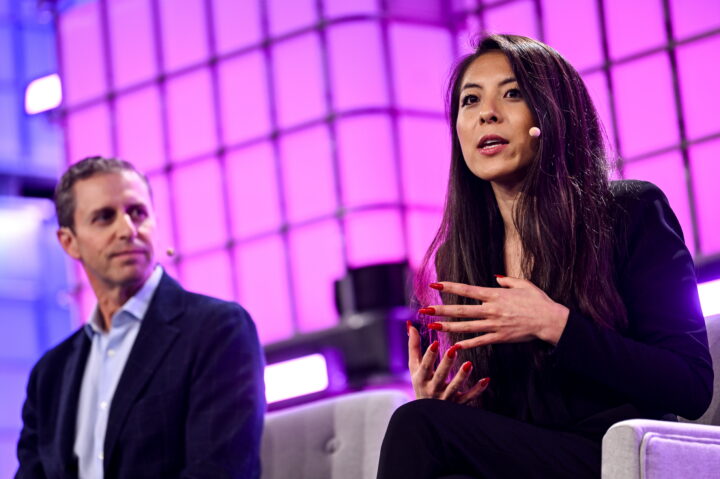
Dropsite News founder and publisher Nika Soon-Shiong spoke at the New Media Summit during day one of Web Summit 2025 at the MEO Arena in Lisbon, Portugal.
Nika Soon-Shiong, the publisher of Drop Site News who is also the daughter of Los Angeles Times owner Patrick Soon-Shiong, is circulating conspiracy theories seeking to tie a California-based Jewish couple behind a major pistachio processor to the recent U.S.-Israeli military strikes in Iran.
In a recent social media post that drew more than 1 million views, Soon-Shiong, citing unverified online claims that the United States and Israel had targeted pistachio warehouses in Iran this month, singled out Stewart and Lynda Resnick, the billionaire owners of the Wonderful Company, which grows and processes a large percentage of California’s pistachios as well as other products including almonds and mandarin oranges.
“The Resnick family’s Beverly Hills-based pistachio empire stands to gain,” she said of the alleged attack on Iranian pistachio warehouses. “You won’t believe the backstory,” she added, linking to the teaser for a recently released documentary she helped distribute called “The Pistachio Wars,” which seeks to implicate the Resnicks’ business interests, ties to hawkish think tanks and pro-Israel philanthropy in a shadowy effort to drive American hostility toward Iran and isolate its pistachio market.
There is little dispute that U.S. trade embargoes as well as steep tariffs on Iran — once a major pistachio producer — helped American competitors dominate the market after the 1979 Iranian hostage crisis. But the documentary has faced skepticism for overstating cherry-picked evidence to support a narrowly tailored argument suggesting that U.S. pistachio growers hold blame for American hostility toward Iran’s nuclear ambitions.
In addition to promoting the documentary on X, Soon-Shiong, a fierce critic of Israel, also pointed to the Resnicks’ contributions to what she called “Israeli military-linked groups from 2015–2022,” well before the current war began in February, while highlighting their donations to progressive causes, in keeping with their record of contributions primarily to Democrats.
She concluded by referring to their widely scrutinized use of California’s water supply, claiming they “stole” the scarce resource “in a series of secretive meetings two decades ago.”
In a separate post last year, she said the Resnicks’ pistachio business “underpins the California water crisis, the IDF and the propaganda war against Iran.”
Soon-Shiong, whose father is a biotech billionaire who took control of The Los Angeles Times in 2018, has also been outspoken in her criticism of other American companies with ties to the Jewish state.
In the 2024 presidential election, she disclosed in a statement, refuted by the Times, that she personally intervened in order to block the paper’s endorsement of former Vice President Kamala Harris — a decision she said had been motivated by her opposition to the Biden administration’s support for Israel and “openly financing genocide” in its war with Hamas in Gaza.
Late last year, Soon-Shiong shared the stage as a speaker at the Doha Forum in Qatar with Neil Patel, the co-founder and CEO of the Tucker Carlson Network, during a panel discussion focusing on “Media Power and the Search for Truth.”
Soon-Shiong, 33, became the publisher of Drop Site News, a media startup that regularly features hostile coverage of Israel and sympathetic interviews with Hamas leadership, in September 2025, voicing admiration of its Gaza coverage.
“For media institutions that downplayed genocide, ignored apartheid and fail to cover America’s role in foreign wars,” she explained at the time, “the verdict of history will be merciless.”
Drop Site launched in July 2024 with an 8,000-word interview with two senior Hamas leaders in an article described as an “exclusive” conversation with officials from the terrorist group about “their motivations, political objectives and the human costs of their armed uprising against Israel.” Since then, the outlet has gained a reputation of credulously reporting on Hamas’ claims and repeating the group’s propaganda.
More recently, the site has faced scrutiny for publishing a Palestinian journalist in Ireland who called for violence against Israelis and an Irish pro-Israel commentator in particular, among other controversial claims.
Please log in if you already have a subscription, or subscribe to access the latest updates.
 Continue with Google

 Continue with Apple