














































































Critics falsely assert the provision would merge the U.S. and Israeli militaries or otherwise compromise U.S. sovereignty and control of the U.S. military
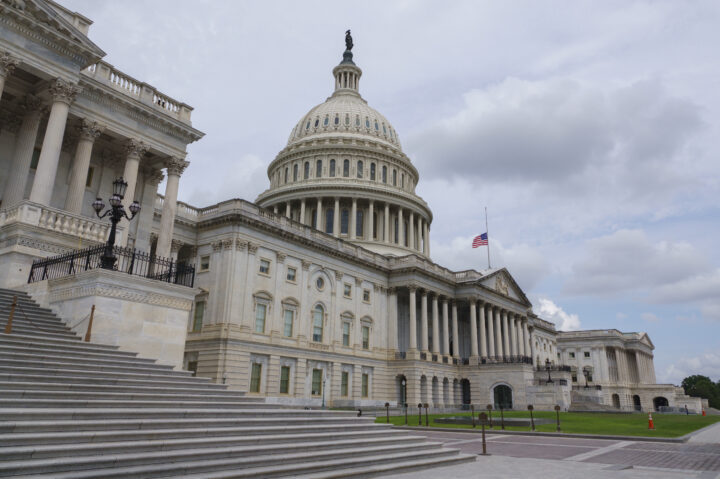
Kevin Carter/Getty Images
U.S. Capitol building on July 12, 2026 in Washington, DC.


 Add JewishInsider on Google
A provision in the draft 2027 National Defense Authorization Act that aims to coordinate and enhance cooperation between the U.S. and Israeli militaries has proven to be a significant source of controversy among Democrats, with even some senior lawmakers who defended the provision on its merits flipping against it under pressure.
And, as Congress will have only months to pass the NDAA when it returns from recess after the November elections, the provision may face some resistance from Republican lawmakers as well — an indication of skepticism of the U.S.-Israel partnership building among the GOP base as part of the debate between hawks and isolationists.
“There’s nobody here who’s more of an ardent supporter of Israel’s right to exist and ability to defend themselves, but I don’t think we should integrate our military with anybody, not even the Bahamas,” Sen. Bernie Moreno (R-OH) told the far-left outlet Drop Site News earlier this year. His office has declined to provide further comment.
Critics falsely assert the provision would merge the U.S. and Israeli militaries or otherwise compromise U.S. sovereignty and control of the U.S. military.
Rep. Lauren Boebert (R-CO) also expressed opposition to the provision, and claimed that the White House and Pentagon wanted the provision removed from the bill. Neither have expressed such a view publicly, but did not respond to requests for comment.
Some in the far-right online sphere have previously criticized the provision.
Two other senators aligned with the restrictionist foreign policy wing of the party, Sens. Eric Schmitt (R-MO) and Josh Hawley (R-MO) — who have also generally been strong supporters of Israel — were also noncommittal.
“I know there was a House version that was a little more controversial, but we’ll take a look,” Schmitt told Jewish Insider in late July. His office did not respond when asked if his stance has changed since then.
“Let’s see what happens with the NDAA. That’s going to be a long wait, I think,” Hawley told JI in early August. “I don’t know what version is going to come to us.”
Yet Sen. Jim Banks (R-IN), who has sought a “middle path” on foreign policy between internationalism and restrictionism, while urging Republicans not to label each other “isolationists,” expressed strong support for the provision.
“I think [the concerns are] overblown. That cooperation is important. It’s cooperation that’s always existed,” Banks told JI. “I’m sure we’ll have a thorough debate on that one when it gets to the floor, but having served myself, I know how important that relationship is. Strengthening that relationship is more important than ever.”
Sen. Roger Wicker (R-MS), who chairs the Senate Armed Services Committee, told JI in August he has not been concerned about Republican opposition to the provision. “I haven’t been worried about that, no,” Wicker said at the time. He declined to answer additional questions on the subject, and his office did not respond to follow-up questions.
The five-year extension of the Iran Sanctions Act of 1996 was included into the hard-fought bill at Trump’s urging

Tim Graham/ Getty Images
U.S. Capitol Building
The Senate on Tuesday advanced a major Russia sanctions package, negotiated and championed by Sen. Lindsey Graham (R-SC) before his death, to which lawmakers added a provision extending longstanding sanctions on Iran, currently set to expire at the end of the year.
The addition of the five-year extension of the Iran Sanctions Act of 1996 to the package is a relatively minor change to the hard-fought bill, which will extend a key piece of the U.S. economic pressure campaign on Iran and address President Donald Trump’s late-stage demands that threatened to upend a bipartisan agreement.
Lawmakers have been working for years on a bipartisan basis to extend the Iran sanctions past 2026 and they have been extended on a bipartisan basis in the past.
“We are proud to announce an agreement on legislation to stop purchasers of Russian oil and gas from fueling Putin’s war machine and to continue restricting the Iranian regime’s ability to support terrorism and build its nuclear program,” Sens. Jim Risch (R-ID), Richard Blumenthal (D-CT), Darline Graham (R-SC), Katie Britt (R-AL), Jeanne Shaheen (D-NH) and Roger Wicker (R-MS) said in a joint statement on Tuesday. “There is no greater way to honor Senator Graham’s legacy than to move forward with this bipartisan agreement, and we look forward to today’s vote.”
The bill advanced by an 86-12 procedural vote. Sens. Bernie Sanders (I-VT), Elizabeth Warren (D-MA), Maggie Hassan (D-NH), Jon Ossoff (D-GA), Lisa Blunt Rochester (D-DE), Andy Kim (D-NJ), Mazie Hirono (D-HI), Ed Markey (D-MA), Alex Padilla (D-CA), Ron Wyden (D-OR) and Rand Paul (R-KY) voted no.
Blumenthal, the lead Democrat on the bill, had initially reacted negatively to Trump’s efforts to include Iran sanctions, warning against further changes to the bill, which took months to negotiate.
The bill “was the result of painstaking, sometimes painful negotiation involving leadership here, the White House, the U.S. trade representative over many months. I personally would like to see it passed as is,” Blumenthal said earlier this month after Trump initially began pushing for changes. “There may be other provisions that are worthwhile which should be passed separately.”
Asked Tuesday about the decision to add the Iran sanctions provisions, Blumenthal told Jewish Insider, “Darline Graham asked us — asked me — to do it. And by the way, that Iran provision was in the bill as originally written, so restoring it was a pretty simple yes.”
Blumenthal also told reporters that, during a closed-door meeting with senators shortly before the vote, Ukrainian President Volodymyr Zelensky emphasized the role that Ukrainian drone technology has been playing in assisting the U.S. with defending its bases from Iranian attacks.
Prominent House Democrats have raised concerns about the bill, which provides tariff authority to the administration to target importers of Russian oil, concerns shared by some of the bill’s Senate opponents, even as some of them expressed strong support for Ukraine. Critics worry that the bill would allow Trump to impose punishing tariffs on the U.S.’ European allies, but Democratic supporters insist that the authority is carefully tailored and limited.
Alexandria Paolozzi Moore, the senior director of government relations at FDD Action, said the extension is “a critical, bipartisan win. ISA is a foundational tool for countering Iran’s WMD proliferation, ballistic missile program, and support for terrorism.”
Former U.S. Ambassador Daniel Shapiro called the provision largely ‘unremarkable,’ countering claims from the extremes that it would mark a surrender of U.S. sovereignty

Zack Frank
Capitol Building
A relatively routine provision that aims to facilitate expanded U.S. cooperation with Israel in the House’s draft of the 2027 National Defense Authorization Act has fueled outrage from the far left and far right, with some prominent figures making inaccurate claims that the provision would subjugate the U.S. military to Israel or otherwise compromise U.S. sovereignty.
The turmoil appears to have begun with an article published in the isolationist Quincy Institute’s Responsible Statecraft journal that claimed the legislation “would all but fuse the two countries’ armed forces together.”
The backlash has gained widespread attention, from current and former lawmakers, anti-Israel commentators and even a celebrity news account with more than 3.5 million followers on X — an unusual series of events for the wonky annual defense policy bill.
Critics are objecting to a provision in the bill, the “United States-Israel Defense Technology Cooperation Initiative,” which aims to expand and accelerate joint U.S.-Israel technological development and industrial cooperation; allow the U.S. to quickly adopt proven Israeli technologies; and promote joint training exercises, information sharing and co-production in areas including defense manufacturing, anti-tunneling, air- and missile-defense and various advanced technologies.
But the U.S. already has established cooperative programs in Israel in many of the areas enumerated in the bill, set up in previous years’ NDAAs and defense budget bills, without much fanfare — so the sort of cooperation laid out in the bill is hardly new, unprecedented or a significant change.
The language also closely hews to bipartisan legislation in both chambers, the U.S.-Israel FUTURES Act, which has 46 co-sponsors in the House and 11 in the Senate. Those bills aim to leverage U.S. and Israeli technology and innovation to assist in the defense of both countries.
“This provision promotes ongoing, and in some ways, expanded cooperation between the United States and Israel in developing key military technologies. It is quite unremarkable,” Daniel Shapiro, a former U.S. ambassador to Israel and senior Pentagon official who is now a distinguished fellow at the Atlantic Council, told Jewish Insider. “Those describing it as promoting ‘integration’ between the U.S. and Israeli militaries are making a mountain out of a molehill. But these days, there are a lot of people trying to make molehills into mountains in this arena.”
Critics on both sides of the aisle are mobilizing against the legislation.
Rep. Thomas Massie (R-KY) suggested that the legislation would undermine American sovereignty and vowed to introduce an amendment to strip it out of the bill if it makes it through the committee process.
Rep. Ro Khanna (D-CA), who sits on the Armed Services Committee, said he’ll try to remove the provision during the committee markup later this week. “Trump can’t kill the Massie/Khanna partnership no matter how much he posts on Truth Social,” Khanna said.
“Looking forward to posting that roll call vote from the Armed Services committee,” Massie responded. “Maybe they’ll go ahead and strip the provision instead of taking the vote, now that people are on to them.”
Anti-Israel commentators have also seized on the provision.
“This is what complete capture to a foreign government looks like and there hasn’t been a single shot fired,” former Rep. Marjorie Taylor Greene (R-GA) declared.
Former State Department official Josh Paul, an anti-Israel activist, claimed the provision would “intertwine our military with Israel’s” and give Israel “incredible leverage over America’s own defense priorities.”
The condemnation of this provision also foreshadows potential objections to future efforts to shift the U.S.-Israel relationship away from direct aid and toward jointly funded cooperative programs.
Indeed, Paul highlighted that likely shift as a reason to oppose this provision in a video on the subject.
In addition to the new cooperation provision, the NDAA draft includes language extending the U.S. weapons stockpile in Israel, counter-tunneling cooperation programs and counter-drone cooperation programs through 2029.
It authorizes $50 million for cooperative programs in emerging technology, as well as $100 million for each of the counter-drone and counter-tunneling programs and an annual $300 million for cooperative air defense systems including Iron Dome. All of that funding would still have to be appropriated separately.
It also praises the U.S. relationship with Jordan and urges efforts to expand cooperation with Amman, including on integrated air- and missile-defense systems and cybersecurity cooperation efforts.
Democrats are likely to push a range of other amendments related to the war in Iran at Thursday’s markup.
Notably, the bill backed by House Republicans also includes several provisions designed to hamstring isolationist-minded moves by the Trump administration, including limiting troop drawdowns from Europe and South Korea. It would also freeze construction of the “Trump-class” battleship until the technology is better developed.
Please log in if you already have a subscription, or subscribe to access the latest updates.
 Continue with Google

 Continue with Apple