














































































The vice president didn’t address the podcaster’s platforming of antisemitic guests, but noted his differences with Carlson over Trump and the Michigan Senate race
Kevin Dietsch/Getty Images
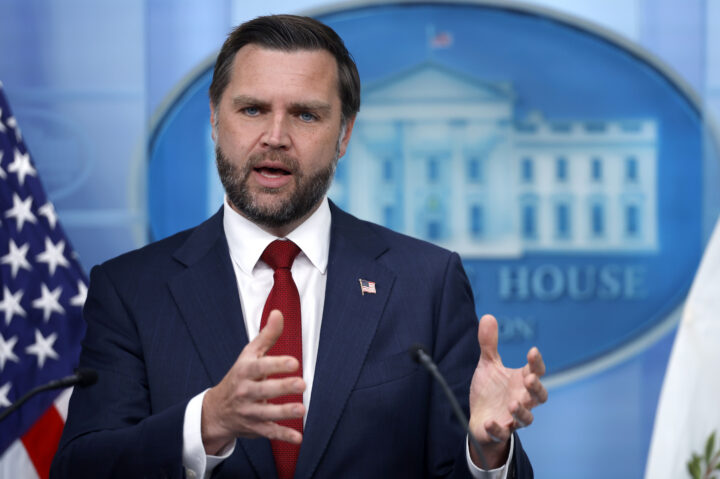
Vice President JD Vance speaks during a news briefing in the Brady Press Briefing Room at the White House on Sept. 3, 2026 in Washington, DC.


 Add JewishInsider on Google
Vice President JD Vance defended his friendship with antisemitic podcaster Tucker Carlson at a White House press briefing on Thursday, saying that he would not “play the game where I throw friends under the bus because I have political disagreements with them.”
Vance made the comments after being asked to respond to the concerns raised by his continued association with the far-right commentator and accusations that he has been “avoiding addressing a lot of these issues,” as Carlson has increasingly used his show to promote antisemitic conspiracy theories and Holocaust denial.
Vice President JD Vance defended his friendship with Tucker Carlson at a White House press briefing, saying that he would not “play the game where I throw friends under the bus because I have political disagreements with them.”
— Jewish Insider (@jewishinsider) September 3, 2026
Read more: https://t.co/GeViZuaJUL pic.twitter.com/r7nYHYBOEe
While Vance criticized Carlson’s attacks on President Donald Trump and his recent comments expressing support for Democratic nominee Abdul El-Sayed over former Rep. Mike Rogers (R-MI) in Michigan’s Senate race, he did not mention Carlson’s extreme rhetoric and views.
“Look, I’m not avoiding addressing anything. Everybody knows that Tucker Carlson and I are friends,” Vance said. “I think it’s very obvious that Tucker has said some things that I disagree with.”
The vice president acknowledged his friendship with Carlson again before urging all Americans to maintain their personal relationships regardless of political disagreements, explaining that his “attitude towards this” was shaped by his and Second Lady Usha Vance’s experience on the campaign trail in 2024.
“I remember when I became the vice presidential nominee, one of the hardest things for me personally is not when people attacked me, but when people attacked my wife, including friends of hers who knew her heart, who knew what a good person she was,” Vance said. “I remember thinking to myself, ‘What a travesty it is that in the United States of America we let political disagreements define who our friends are going to be and not going to be.’ So yeah, Tucker is a friend of mine.”
“Tucker is a friend despite the fact that we disagree on a number of things. And I’m not going to play the game where I throw friends under the bus because I have political disagreements with them. I think that is a terrible place for the United States to go,” he said.
“If you have a disagreement with somebody politically, even over a deeply held issue, you should still be friends with that person, because the whole republic depends on people of different perspectives being able to talk to one another. That’s how I try to live my life, and I encourage everybody else to do the same.”
Secretary of Defense Pete Hegseth emphasized the strike was limited in nature and not aimed at regime change in Iran
Yasin Ozturk/Anadolu via Getty Images
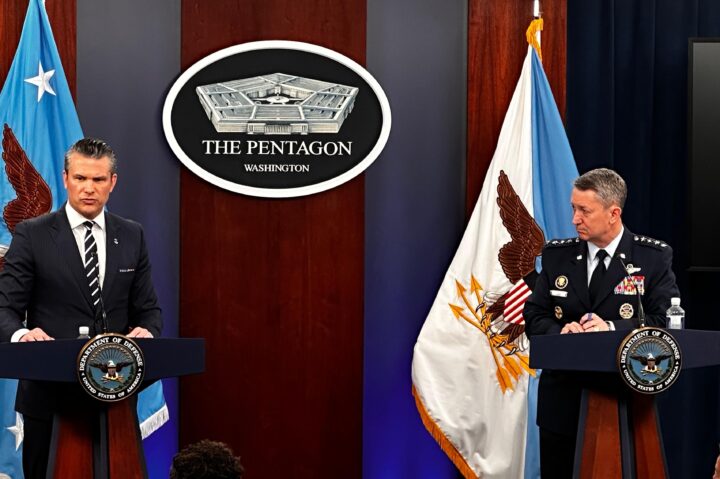
Secretary of Defense Pete Hegseth (L) and Chairman of the Joint Chiefs of Staff Air Force Gen. Dan Caine (R) attend press conference at Pentagon in Washington, United States on June 22, 2025.
Gen. Dan Caine, the chairman of the Joint Chiefs of Staff, said on Sunday morning that the U.S. operation in Iran overnight had hit all of its planned targets and that initial assessments showed that the strikes had inflicted extensive damage on Iran’s nuclear facilities. But Caine said that a full assessment of whether the Iranian nuclear program had been fully destroyed would take more time.
Speaking alongside Caine at a Pentagon press briefing, Secretary of Defense Pete Hegseth emphasized that the strike was limited and strictly targeted at Iran’s nuclear program and was not designed to prompt regime change. He added that the U.S. continues to seek peace with Iran.
“Final battle damage will take some time, but initial battle damage assessments indicate that all three sites sustained extremely severe damage and destruction,” Caine said. Pressed on whether Iran retains any nuclear capability, Caine said that a full assessment “is still pending, and it would be way too early for me to comment on what may be there.”
Hegseth added that the U.S. believes it “achieved the destruction of capabilities” at the Fordow nuclear facility, which he described as the “primary target.”
The operation, dubbed Midnight Hammer, involved seven B2 stealth bombers which dropped a total of 14 bunker-buster bombs on Fordow and Natanz, accompanied by more than two dozen cruise missiles fired at Esfahan. Officials described Fordow as the primary U.S. target.
More than 100 other aircraft were involved in support capacities, and Caine said that Iran did not fire a single shot at U.S. forces or even deploy its fighter jets during the operation.
Plans for the strike were kept to a limited number of officials, and the U.S. conducted a deception effort to disguise its preparations. Caine said that Israeli operations over the past week had helped pave the way for the U.S. strike but Israel was not directly involved in the overnight operation.
Hegseth said that congressional leaders were notified about the strike after U.S. aircraft had left Iranian airspace.
He stressed that the strike “did not target Iranian troops or the Iranian people” and reiterated that Trump continues to seek peace with the Iranian regime.
“The United States does not seek war,” Hegseth said. “But let me be clear: We will act swiftly and decisively when our people, our partners or our interests are threatened. Iran should listen to the president of the United States and know that he means it every word.”
He emphasized that the operation was “most certainly not open-ended” but that the U.S. would “respond if necessary.”
Hegseth said the U.S. had sent public and private messages to Iran to ask its leaders to come to negotiations.
“They understand precisely what the American position is, precisely what steps they can take to allow for peace, and we hope they do so,” he continued.
Asked about whether U.S. assessments or intelligence about the status of Iran’s nuclear weaponization effort had changed since March, when Director of National Intelligence Tulsi Gabbard said Iran was not actively building a nuclear weapon, Hegseth did not specifically contradict Gabbard.
“I would just simply say that the president has made it very clear he’s looked at all of this, all of the intelligence, all of the information, and come to the conclusion that the Iranian nuclear program is a threat, and was willing to take this precision operation to neutralize that threat in order to advance American national interests,” Hegseth said.
Caine said that U.S. forces throughout the region had stepped up measures to protect U.S. forces from retaliation.
“Our forces remain on high alert and are fully postured to respond to any Iranian retaliation or proxy attacks, which would be an incredibly poor choice. We will defend ourselves. The safety of our service members and civilians remains our highest priority,” Caine said.
Please log in if you already have a subscription, or subscribe to access the latest updates.
 Continue with Google

 Continue with Apple