



































































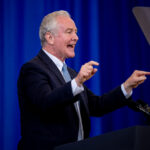







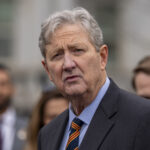


Adam Hamilton called Israel’s war in Gaza ‘irresponsible and unjust’ but said he does not believe Israel’s intent ‘is to wipe out a group of people'
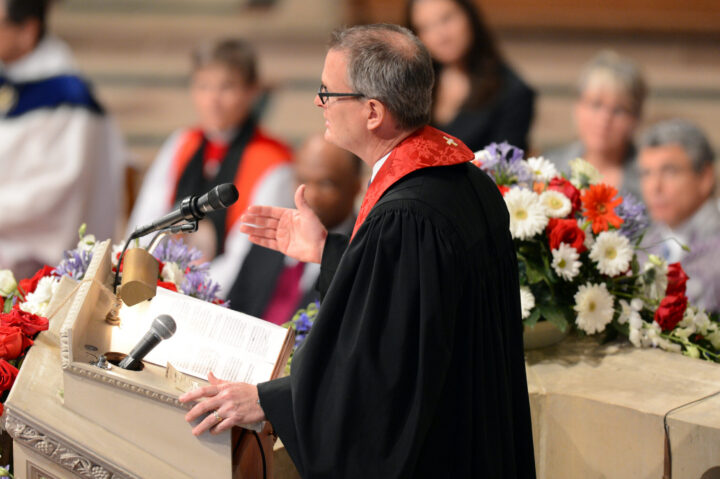
SAUL LOEB/AFP via Getty Images
Rev. Adam Hamilton, speaks as former President Barack Obama attends a prayer service at Washington National Cathedral on January 22, 2013 in Washington, DC.


 Add JewishInsider on Google
Adam Hamilton, the Democratic nominee in Kansas’ Senate race running against Sen. Roger Marshall (R-KS), said in a Politico video interview that he wants to end offensive aid to Israel, but disagreed with characterizations of the war in Gaza as a genocide.
The comments are a signal of how unpopular Democrats believe U.S. support for Israel has become even in ordinarily deep-red states. The Cook Political Report rates the Kansas Senate race as “lean Republican,” making it unexpectedly competitive. Recent polling has shown a tight race and, in some cases, a narrow lead for Hamilton.
“I don’t want my tax money being used for weapons that are going to be dropped on hospitals, destroying entire communities,” Hamilton, a Methodist pastor, said. Pressed on whether he would vote to stop weapons transfers, he said “not all weapons transfers,” carving out an exemption for defensive weapons.
“I want to make sure that Israel is safe and I want them to stop dropping bombs on innocent people, and I don’t want them to drop the bombs that my taxes paid for on innocent people,” he said. “Hamas needs to go, I think Hamas is horrible, but I think we have to do better and I think it is a humanitarian crisis.”
He said that the “wreckage, the ruin” in Gaza “can’t be how we solve our problems,” and called it “irresponsible and unjust.”
"I wouldn't use the word 'genocide.' … because it stops the conversation."
— Jewish Insider (@jewishinsider) October 2, 2026
Adam Hamilton, the Democratic Senate candidate in Kansas, spoke to Politico about how even though he thinks what Israel has done in Gaza is both "irresponsible" and "unjust," he thinks genocide is the… pic.twitter.com/GPKCVLQh64
At the same time, Hamilton said that he would not describe the war as a genocide because “genocide implies an intent to destroy an entire group of people. I don’t think that is Israel’s intent, is to wipe out a group of people.”
And, he continued, the word “stops the conversation. It’s a triggering term. I understand why people want to use it because I would say these actions feel genocidal, but I don’t believe that’s the right word to use to describe what’s happening to further any conversations that are going to happen between — in solving this problem.”
Hamilton said he’d been to Israel and the West Bank “probably a dozen times” and taken over 2,000 people there. He said he “care[s] deeply about the Palestinian people and I care about the Jewish people in Israel.”
He said Israel “has a right to exist in safety and security and they are an ally.” He said that he condemns both the Oct. 7, 2023, Hamas attacks and the war in Gaza.
Plus, Riyadh's self-inflicted Houthi headache
(KENZO TRIBOUILLARD/AFP via Getty Images)
A picture taken on July 1, 2022 in Brussels shows the frontpage of "Politico" newspapers.
Good Wednesday morning.
In today’s Daily Kickoff, we look at Politico’s attack on a Jewish aide to U.S. Ambassador to Israel Mike Huckabee, which was published on Yom Kippur, and talk to Seattle Jewish leaders about their concerns regarding rising antisemitism in the city. We report on a call from Jewish leaders in Michigan for former Vice President Kamala Harris to appeal to Abdul El-Sayed, the state’s Democratic Senate nominee with whom she campaigned, on his rhetoric on Israel and antisemitism, and talk to experts about the challenges, some self-inflicted, facing Saudi Arabia as it deals with ongoing attacks by the Houthis in Yemen. Also in today’s Daily Kickoff: Sen. Jacky Rosen, Palmer Luckey and Zibby Owens.
Today’s Daily Kickoff was curated by JI Executive Editor Melissa Weiss, with assists from Tamara Zieve and Danielle Cohen-Kanik.
Today’s Agenda
The U.N. General Assembly’s high-level week continues today in New York. Iranian President Masoud Pezeshkian is slated to address the gathering during this morning’s session.
The Trump administration’s Board of Peace is expected to unveil its $2.45 billion Gaza reconstruction and governance plan today at a meeting of its members. The 66-project proposal, a Board of Peace official told Axios, “shows how to stand up a government from nothing, an economy from shambles and a territory from disaster.”
UJA-Federation of New York, the Jewish Community Relations Council of New York, Conference of Presidents of Major American Jewish Organizations, the New York chapters of the Anti-Defamation League and American Jewish Committee and the Israeli American Council are among the groups holding a rally near the U.N. this evening calling on world leaders to scale up efforts to address antisemitism.
In Washington, American Friends of Lubavitch is hosting its annual Lamplighter Awards dinner. This year’s honorees include U.S. Holocaust Memorial Council Chairman Jeff Miller and Sen. Ted Cruz (R-TX).
Elsewhere in Washington, the Anti-Defamation League is bringing survivors of antisemitic attacks to Capitol Hill for meetings with legislators.
The Senate Armed Services Committee is holding a classified briefing this morning with CENTCOM head Adm. Brad Cooper.
One Thing To Know
Schmear campaign
On Monday morning — as Jews around the world marked Yom Kippur — Politico published a pointed attack targeting David Milstein, an observant Jew who serves as senior advisor to U.S. Ambassador to Israel Mike Huckabee, labeling his actions as a “national security threat” while failing to provide evidence for the claim.
In a recent WhatsApp message sent to wedding invitees, Milstein, who lives in Israel, wrote that those who wanted to give a “monetary wedding gift” in either “U.S. dollars or Israeli shekels” to the couple could do so through a provided QR code, Politico’s Adam Wren reported.
Politico’s Monday morning flagship newsletter “Playbook” led with the story, accompanied by the subject line: “Huckabee’s ‘walking counterintel red flag’” — using Milstein’s wedding message as a hook to cite anonymous intelligence sources who labeled him a national security threat.
An individual with knowledge of the situation told Jewish Insider that Wren messaged Milstein just before 7 p.m. ET on Sunday — or 2 a.m. local time on Monday in Israel, where Milstein was observing Yom Kippur — to inform him the story would run the following morning.
The Big Reads
CANARY CALL
Two of Seattle’s top Jewish leaders are sounding the alarm about the costs of ignoring rising antisemitism, offering up their own city as a “canary in the coal mine” — a warning of how Jewish communal apathy can allow individual acts of discrimination to slowly erode Jewish life. “I’ve been stunned by the effort to erase the Jewish community in so many parts of civic life across the country,” Joe Schocken, one of the authors of a new eJewishPhilanthropy op-ed laying out the stark warning, told Jewish Insider’s Danielle Cohen-Kanik in an interview last week. “I’ve been deeply involved in many aspects of the Jewish community, and sadly steeped in Jewish history. That this effort to push the Jewish community out, this effort to scapegoat the Jewish community, has happened so quickly is just stunning to me.”
VEEP APPEAL
Michigan Jewish leaders on Tuesday urged former Vice President Kamala Harris — who is set to campaign with the party’s Senate nominee, Abdul El-Sayed, in Michigan this week — to appeal to El-Sayed on issues related to antisemitism and Israel, Jewish Insider’s Marc Rod reports. The group of Jewish leaders, writing to Harris under the banner of the Nonnegotiable Michigan campaign, said that they are longtime supporters of her and the Democratic Party, and called on her to press El-Sayed to accept the five demands on Jewish issues and Israel that the Nonnegotiable campaign has presented.
Michigan maneuver: Michigan Attorney General Dana Nessel announced that she is endorsing El-Sayed after having previously voiced reservations over his views on Israel and antisemitism, JI’s Emily Jacobs reports.
RIYADH’S RECKONING
Saudi Arabia is facing an escalating Houthi offensive along the Red Sea coast and direct attacks on its own territory, in what regional analysts describe as a turning point in Riyadh’s conflict with the Iran-backed terror group — and a crisis they say was created in part by Riyadh’s own miscalculations. Regional analysts told Jewish Insider’s Matthew Shea that Saudi Arabia’s current position stems in part from its failure to strategically prepare during a yearslong pause in fighting. Experts say that Riyadh’s rift with the United Arab Emirates has also weakened the anti-Houthi coalition in Yemen, making the challenge more daunting.
The Rundown
DAMASCUS DIARIES
UNGA UNFILTERED
CANDIDATE CALCULATIONS
BOOKSHELF
supper club
partnership pitch
money matters
POLAND IN FOCUS
ON THE HILL
On Our Radar
● The Live Briefing. Word on the street, clips, podcasts and quick updates — the items we’re tracking all day in our Live Briefing on the app (on Apple and Android) and website.
President Donald Trump signed a commission establishing Secretary of State Marco Rubio as national security advisor, a position Rubio has held in an acting capacity for more than a year following U.S. Ambassador to the U.N. Mike Waltz’s departure from the role; Rubio is the first secretary of state since Henry Kissinger to hold both roles simultaneously…
The U.S. proposed a $5 billion investment — to be matched by Saudi Arabia, the United Arab Emirates, Qatar, Bahrain, Kuwait, Oman, Iraq and Jordan — in a new fund to rebuild energy infrastructure across the region that had been damaged or destroyed during the war with Iran…
Iraqi Prime Minister Ali al-Zaidi pledged to disarm the Iran-backed militias operating in Iraq by June 2027 as Baghdad faces pressure from the Trump administration to take a stronger stance against the groups and as Tehran seeks to deepen its control in the region…
Palmer Luckey’s Erebor Bank is moving toward an expansion into Syria, a move that would help to reintegrate Damascus into global financial systems…
Yasser Abbas, a son of Palestinian Authority President Mahmoud Abbas, attempted to circumvent a State Department ban on Palestinian officials entering the country by using his Canadian passport to try to board a flight to the U.S.; Abbas was denied boarding due to a failure to produce requisite entry documents…
The New York Times interviews Rep. Alexandria Ocasio-Cortez (D-NY) about her 2028 plans, including whether she plans to seek reelection to her House seat, challenge Senate Minority Leader Chuck Schumer (D-NY) for his Senate seat or pursue a White House bid; the New York Democrat told the Times of a presidential bid, “If I were to run in this cycle, and not win, I would be done”…
A superior court judge in California ruled that the Oakland Unified School District must take substantive steps to address antisemitism in the district, determining that the northern California district did not fully comply with a California Department of Education directive to implement corrective measures in the district’s schools…
RedBird IMI CEO Jeff Zucker will make a cameo in the upcoming A24 film “Primetime,” which looks at the 2000s-era “Dateline” investigation series “To Catch a Predator” and its host, Chris Hansen…
The Art Institute of Chicago will return a 1913 Jean Metzinger oil painting to the descendants of the work’s Jewish owner, after the work was forcibly sold by the Nazis in 1940 following the German invasion of the Netherlands…
The man accused of opening fire outside a synagogue in Belleville, Canada, on Sunday died from injuries sustained during an exchange of gunfire with police outside of the building; the man, 29-year-old Sean Ward, was a military veteran who had espoused antisemitic conspiracy theories blaming Jews for the COVID-19 pandemic…
U.K. police said that they foiled an “imminent” attack on the Manchester Jewish community following the arrest of two men just prior to Yom Kippur; the arrests came after a year after two Jewish men were killed during an attack on a synagogue in the city during Yom Kippur…
An Argentine court charged seven Iranians and one Lebanese national — all of whom remain at large — in connection with the 1994 bombing of the AMIA Jewish community center in Buenos Aires in which 85 people were killed and more than 300 injured…
Microsoft named Ohad Jassin, the company’s corporate vice president, as the head of its research and development center in Israel; Jassin will assume the role in November, succeeding Michal Braverman-Blumenstyk…
Singer Boy George announced an upcoming concert in Tel Aviv, slated for Nov. 4; the performance comes nearly a decade after the artist’s last trip to Israel, when he performed at the same venue in 2017…
Worthy Reads
Find more Worthy Reads in our Live Briefing via our app (on Apple and Android) and website.
Different Collateral Damage: In The Wall Street Journal, former Israeli hostage Omer Shem Tov responds to the recent film “NAZA,” a film about civilian deaths in Gaza resulting from the Israel-Hamas war whose title was taken from the term for collateral damage. “A dead Palestinian child isn’t made less dead by a statistic. But neither should we ignore what Israel risked to reduce that number. If Israel had cared less about NAZA, perhaps I would have come home sooner. Fewer Israeli soldiers might have died. Fewer hostages might have died. But more Palestinians would have.” [WSJ]
A House Divided, Again: The Atlantic’s Graeme Wood does a deep dive into the challenges facing Israeli voters ahead of next month’s elections, amid resurgent tensions between the country’s religious and secular communities. “The ambition of every gourd is to escape ephemerality, outlast its predecessors, and leave Israel less hapless than Jonah and more shaded from the scorching threats that go along with being a nation-in-progress. The parties fill a niche in a bewilderingly diverse ideological ecosystem … Better to stop trying to figure out who is right and just try to figure out how to get along. That pragmatic exasperation is the starting point of liberal democracy.” [TheAtlantic]
Picture of the Day
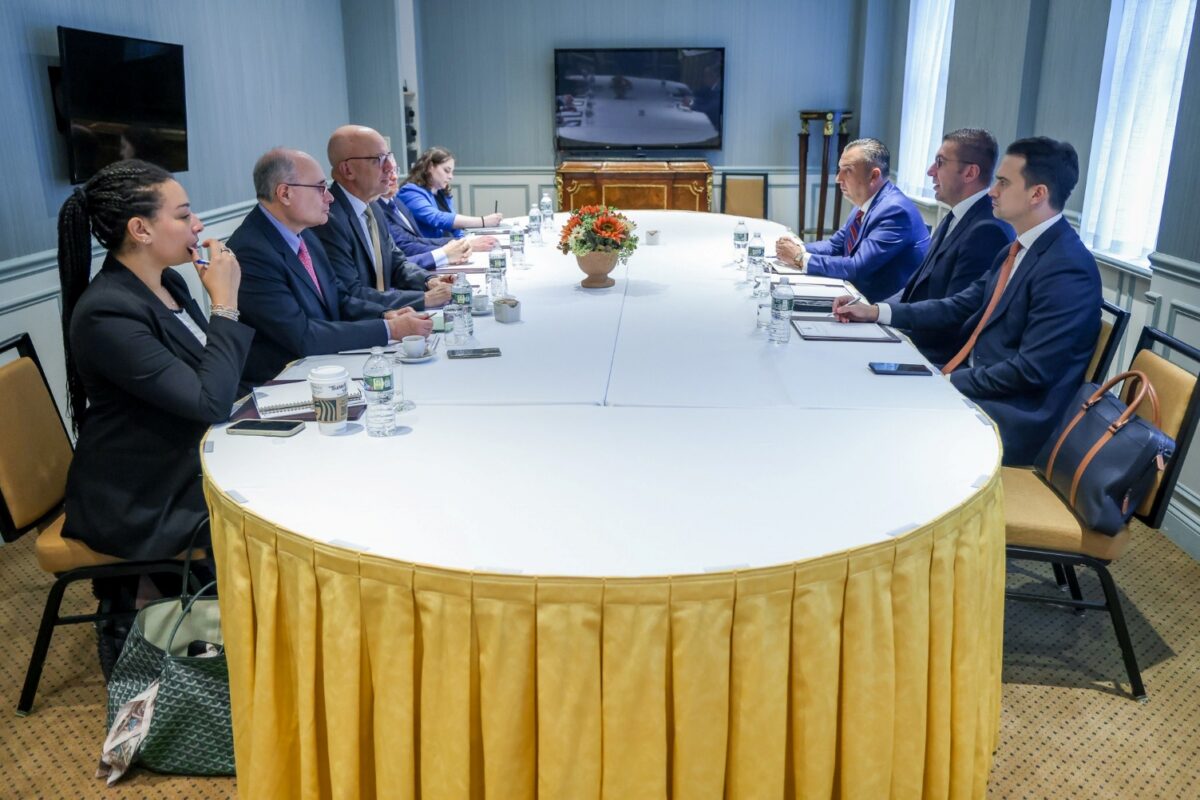
American Jewish Committee CEO Ted Deutch (third from left) met on Tuesday with North Macedonia Prime Minister Hristijan Mickoski (center right) on the sidelines of the U.N. General Assembly high-level week, one of dozens of sit-downs AJC officials are holding with leaders from more than 70 countries during the week — the group’s annual “diplomatic marathon.” Read more from JI’s Marc Rod here.
Birthdays

Eli Dershwitz, three-time Olympic saber fencer, he was the first American to claim gold in saber at the World Fencing Championships, turns 31
Rabbi Shubert Spero, pulpit rabbi in Cleveland for more than 30 years, then a professor at Bar-Ilan University, turns 103
Richard Bergman, Sarasota Jewish Federation executive
Julio Iglesias, Spanish singer, he has sold more than 300 million records and performed at more than 5,000 concerts for over 60 million people, turns 83
David Harris, CEO of the American Jewish Committee from 1990-2022, turns 77
Mark J. Dollinger, president at Trendlines America
Josh Fidler, co-chairman and COO of Chesapeake Realty Partners, he is also a founding partner of Boulder Ventures
Colin M. Winston, former deputy director of policy and government affairs at AIPAC
Seth Frisch, founder and director of Lerhaus/The New Shul of America
Jay Scott Greenspan, actor, famous for his role as George Costanza on “Seinfeld” and known professionally as Jason Alexander, turns 67
Darryl Nirenberg, U.S. ambassador to Romania
Marc Lasry, co-founder and CEO of hedge fund Avenue Capital Group and the co-owner of the NBA’s Milwaukee Bucks until 2023, turns 67
Angela Maddahi, past president of Sinai Temple in Los Angeles, now a rabbinic student at the Ziegler School
Sheryl W. Kimerling, former vice chair of the Jewish Federations of North America, she is the president of the Birmingham (Ala.) Jewish Federation
Jonathan Peled, Israel’s ambassador to Italy, turns 65
Oren Zeev, Israeli American venture capitalist and head of Zeev Ventures, turns 62
Kristen Silverberg, former U.S. ambassador to the EU, now president and COO at the Business Roundtable, turns 56
Naomi Seligman, chief strategy officer at Whistleblower Aid
Jay Feldman, executive director of the Alpha Epsilon Pi Foundation
Joshua Foer, author of two best-selling books and co-founder of the nonprofit Sefaria, turns 44
Michael Schmidt, two-time Pulitzer Prize-winning Washington bureau reporter for The New York Times, turns 43
Gabriella Schwarz, principal designer at Google DeepMind
Abby Glassberg, VP of sales at Idomoo Personalized Video
Naomi Chaya Kutin, record-setting powerlifter, turns 25
Politico casts David Milstein as a national security threat, citing a wedding invitation that offered guests a way to give customary gifts in dollars or shekels

JIM WATSON/AFP via Getty Images
Two Politico coffee mugs rest on a table during the Politico Playbook Breakfast at the Newseum in Washington, DC, November 28, 2012.
On Monday morning — as Jews around the world marked Yom Kippur — Politico published a pointed attack targeting David Milstein, an observant Jew who serves as senior advisor to U.S. Ambassador to Israel Mike Huckabee, labeling his actions as a “national security threat” while failing to provide evidence for the claim.
In a WhatsApp message sent to wedding invitees, Milstein, who lives in Israel, wrote that those who wanted to give a “monetary wedding gift” in either “U.S. dollars or Israeli shekels” to the couple could do so through a provided QR code, Politico’s Adam Wren reported.
Politico’s Monday morning flagship newsletter “Playbook” led with the story, accompanied by the subject line: “Huckabee’s ‘walking counterintel red flag’” — using Milstein’s wedding message as a hook to cite anonymous intelligence sources who labeled him a national security threat.
An individual with knowledge of the situation told Jewish Insider that Wren messaged Milstein just before 7 p.m. ET on Sunday — or 2 a.m. local time on Monday in Israel, where Milstein was observing Yom Kippur — to inform him the story would run the following morning.
Wren did not respond to a request for comment as to the timing of the story’s publication.
Milstein’s defenders were quick to speak up on his behalf. “If there is a ‘scandal!’ blame me and his actual friends for wanting some direction on how to honor him,” Huckabee wrote on X.
Sen. Ted Cruz (R-TX), for whom Milstein previously worked, accused Politico of having “repeatedly published antisemitic dual loyalty conspiracy theories about American Jews serving in the Trump administration.”
In its reporting, Politico failed to explain federal ethics rules regarding gifts, including wedding presents, from friends. According to the State Department’s published guidelines on financial disclosures, examples of items an employee may typically accept without prior approval under the gift rules, include “Gifts that are clearly motivated by a family relationship or personal friendship rather than the position of the employee,” while “Friendships formed in the course of performing official Department business will generally not meet this standard.” The guidelines note, “Even where prior approval is not required, employees are encouraged to raise questions about the permissibility of gifts with their supervisors or L/EFD.”
The State Department did not respond to a request for comment from JI regarding its policies on gifts and whether it would conduct an investigation following the Politico report.
Additionally, giving monetary wedding gifts is customary in Jewish circles — important context absent from the Politico report.
This isn’t the first time in recent months that Politico has made some questionable editorial judgments with its coverage of Israel and antisemitism.
A day after the killing of Turning Point USA founder Charlie Kirk, Wren published an interview with far-left streamer Hasan Piker in which he unironically asked the streamer, “How do we heal the discourse?” — with no mention of Piker’s own contributions to “the discourse” (which have included comments that the U.S. “deserved” 9/11, that Orthodox Jews were “inbred” and, often, that Israelis should be treated as Nazis).
Later in the interview, Piker, a man who has dehumanized Israelis to his audience of millions, was asked, “How do you maintain your humanity, Twitching and then absorbing images like the ones that you saw today, and just being in an increasingly digital world?”
The Beltway publication in March also twisted a quote from Sen. Cory Booker (D-NJ), who criticized progressive activists who single out AIPAC donations as a unique problem — in noting that he was swearing off donations from all political action committees. Politico wrote that his response defending AIPAC from criticism was, in its view, a sign that he was “breaking up” with the pro-Israel group.
The unfolding situation in Maine comes amid a broader trend in American politics in which immoral or questionable behavior by one’s peers has at times been ignored or obfuscated to serve a perceived 'greater good'
(CJ Gunther/Getty Images)
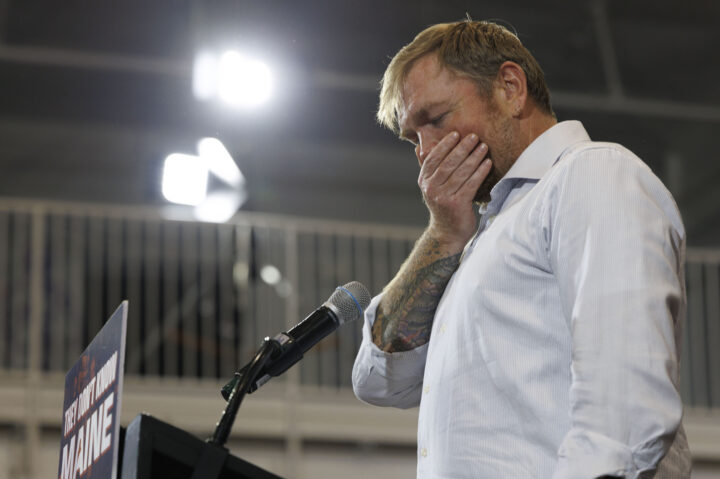
Democratic U.S. Senate candidate Graham Platner speaks at his Primary Election event on June 9, 2026 in Blue Hill, Maine.
When an ex-girlfriend of Graham Platner told Politico in a story published on Monday that the Maine Democratic Senate candidate had raped her in 2021 after entering her home while heavily intoxicated, she said she did so because the response to a recent New York Times report on Platner’s past dubious behavior had focused on discrediting Lyndsey Fifield, one of the women who featured prominently in the story, over her ties to the GOP.
Jenny Racicot, a Democrat, hadn’t wanted to go public with the rape accusation (which she had shared off-record with the Times), in part because she and Platner were largely politically aligned. “One of the reasons I didn’t come forward sooner was, the huge moral conflict that I had between supporting his politics, but not supporting him as a person,” Racicot told Politico. “My part of the story [in the NYT] was just a read-over,” Racicot said. “And the story was Lyndsey, and the accusations of her being politically motivated.”
The unfolding situation in Maine comes amid a broader trend in American politics in which immoral or questionable behavior by one’s peers has at times been ignored or obfuscated to serve a perceived “greater good” of electing a political ally despite their failing moral standards.
In recent years, both major parties have increasingly tolerated conduct that would have once been considered disqualifying — even as the #MeToo movement briefly changed the nature of the discourse. Similar arguments have surfaced across political controversies over the last decade (including against President Donald Trump), with supporters of embattled candidates and officials insisting that policy positions outweigh personal conduct and dismissing allegations as politically motivated.
In a short span of time, the 2017 rallying cry of “Believe women” gave way to “Believe women whose politics align with ours” — a mindset that extended to the widespread denial of Hamas’ sexual violence during the Oct. 7, 2023, terror attacks and against the Israeli hostages kept in captivity in Gaza.
But yesterday’s Politico report, which prompted calls from Platner’s most prominent backers — including Rep. Ro Khanna (D-CA) and Sens. Elizabeth Warren (D-MA) and Ruben Gallego (D-AZ) — for him to end his bid, may mark the point at which previous defenses of the Maine Democrat become politically untenable.
Since shortly after the launch of his campaign, Platner — a virtual unknown before last summer — has faced numerous controversies, from his tattoo of an SS totenkopf to Reddit comments praising Hamas tactics to the revelation that he exchanged inappropriate messages with numerous women despite being married. The Wall Street Journal reported last month that Platner’s vetting process — normally a weeks-long process — took place in a matter of days, expedited by Platner’s top strategist and done at a fraction of the cost of a standard background check, which likely would have flagged at least some of these issues.
Yet none of those allegations proved politically fatal — and Platner ended up winning the Democratic primary with 72% of the vote. Platner’s defenders echoed the rhetoric of many of Trump’s early backers: that the party establishment had targeted him, that the media had unfairly covered the incidents and that a candidate’s positions, rather than their personal lives, should be on the ballot.
Unlike Trump, who was weeks away from his 2016 presidential victory when the infamous “Access Hollywood” tape leaked, Platner had only recently clinched his party’s nomination after Gov. Janet Mills ended her bid. He can still be replaced on the ballot, provided he exits the race by next Monday, though any new candidate will face a much more difficult battle against Sen. Susan Collins (R-ME) in what had been the Democrats’ best hope for a pickup and control of the Senate.
Now, the question is whether American politics still has a meaningful threshold beyond which partisan leanings give way to concerns about character and ethics — or whether that threshold has simply become much higher than it once was.
Senate leaders threatened to withhold funding from the race if Platner remains the nominee, while several of his progressive backers rescinded their endorsements
Laura Brett/Getty Images
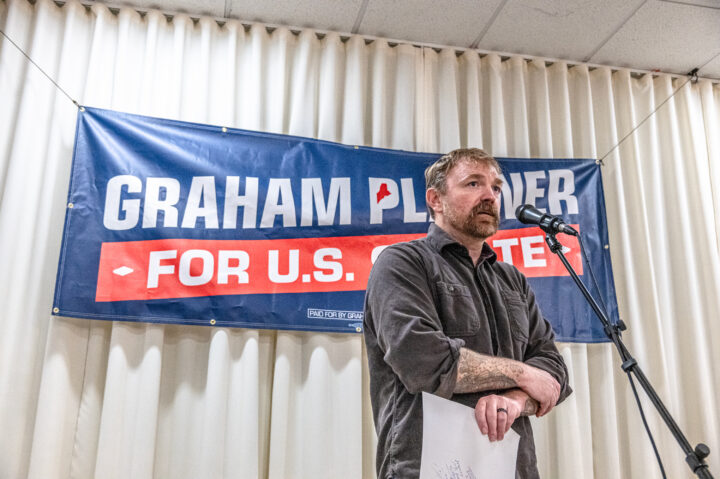
Democratic U.S. Senate candidate Graham Platner speaks to voters at a town hall at the Elks Lodge 188 on June 7, 2026 in Portland, Maine.
Democratic leaders coalesced around calls for Maine Senate candidate Graham Platner to withdraw from the race on Monday following a Politico report in which an ex-girlfriend of Platner’s accused the Democrat of sexual assault, an account the outlet backed up with her correspondence and other interviews.
Platner denied the allegation outright but said in a video statement that he’s “mindful of the political reality it will inflict” and would be “taking the time to reflect on the best path forward.” If Platner voluntarily drops out by July 13, the Maine Democratic Party would have until July 27 to pick a replacement to appear on the ballot.
Senate Minority Leader Chuck Schumer (D-NY) and Sen. Kirsten Gillibrand (D-NY), the chair of the Democratic Senatorial Campaign Committee, said in a joint statement that Platner should withdraw, and that the DSCC would not invest financially in the Maine Senate race if Platner remained the nominee.
“The allegations reported today are incredibly disturbing — violence, abuse and sexual assault are absolutely unacceptable,” Schumer and Gillibrand said. “Graham Platner needs to immediately withdraw as the Democratic nominee for Senate and allow Maine Democrats the opportunity to choose a new candidate who can defeat Susan Collins.”
Schumer and Gillibrand had offered tepid support for Platner in the wake of previous scandals he has weathered on the campaign trail.
Senate Majority PAC, the Senate Democratic super PAC, said in a statement that Platner should withdraw and that the PAC would be “redirecting resources away from the Maine Senate race.” The group said the race would be winnable “if Platner is not on the ballot.”
The Maine Democratic Party’s leadership also called on Platner to end his candidacy.
“Over the past several weeks, multiple women have made serious, credible allegations against Graham Platner. Today’s statements take those allegations even further,” party leaders said in a statement. “Maine Democratic Party leadership is calling on Graham Platner to withdraw as the Democratic nominee for U.S. Senate.”
The party leaders said it’s “essential that we refocus this campaign” on defeating Sen. Susan Collins (R-ME) and the Trump administration.
Maine Statehouse Speaker Ryan Fecteau, a Democrat, also called on Platner to drop out, saying it’s clear that he cannot win the seat.
Several prominent progressives who had previously defended and supported Platner, even through his previous scandals and controversies — including his now-covered Nazi tattoo and domestic abuse allegations — also said that the latest sexual assault allegations were a breaking point.
Sen. Elizbeth Warren (D-MA) said that there can be “no tolerance for sexual assault” and that “the best path forward is for Graham Platner to step aside.”
“I’ve been very clear that sexual assault or violence against women is a red line. These allegations are very serious and credible. Graham Platner should drop out from the race. I am withdrawing my endorsement,” Rep. Ro Khanna (D-CA) said on Monday evening.
Sen. Ruben Gallego (D-AZ) called the allegations “troubling and deeply serious” and likewise rescinded his endorsement.
Sen. Ed Markey (D-MA) said, “The allegations reported against Graham Platner are deeply disturbing and must be taken seriously. I cannot support his candidacy.”
Sen. Martin Heinrich (D-NM) similarly rescinded his endorsement and called for Platner to step aside.
Some of Platner’s prominent media boosters also said that they wanted to see him pull out of the race or otherwise criticized him.
“Platner needs to drop out ASAP — these are awful, credible allegations,” said Jon Favreau, co-host of “Pod Save America.” “It’s now abundantly clear that he just hasn’t been honest about his past and can’t be trusted as a candidate for office.”
Sens. Bernie Sanders (I-VT), one of Platner’s most prominent progressive backers, has not yet addressed the latest allegations.
The End Citizens United PAC also pulled its support for Platner, as did the Sanders-linked Our Revolution, though the group warned “the Democratic establishment: this is not your opening.” TrackAIPAC also pulled its endorsement of Platner.
Rep. Haley Stevens (D-MI), who is running for U.S. Senate in Michigan, also condemned Platner, who campaigned alongside her primary rival, Abdul El-Sayed.
“The allegations against Graham Platner are extremely troubling and completely unacceptable,” Stevens said. “There should be no room for this conduct in the U.S. Senate or any public office. Graham Platner must step aside.”
Numerous other Democratic Senate candidates followed her. El-Sayed, in a statement, did not unequivocally call for Platner to withdraw.
Speculation has already turned to who might replace Platner on the ballot, with many pointing to logger and former state Senate President Troy Jackson, a former gubernatorial candidate who finished third in the 2026 primary, as an alternative choice with a similar background and politics to Platner.
Jackson also campaigned alongside and supported Platner, something that could hinder his electoral prospects.
Jackson was endorsed by the Maine Democratic Socialists of America in his gubernatorial bid.
Former acting Centers for Disease Control Director Nirav Shah, who finished second in the primary, has also been floated as a potential replacement and has reportedly expressed interest.
Maine Gov. Janet Mills, the favored candidate of the Democratic establishment who suspended her campaign for the seat before the primary, could also see a second wind.
A recent poll also tested “Grey’s Anatomy” star and Maine resident Patrick Dempsey’s popularity in the state, as well as Secretary of State Shenna Bellows, who also ran in the gubernatorial primary; state Sen. Joe Baldacci; former House candidate Jordan Wood; Rep. Chellie Pingree (D-ME); former state Rep. Sara Gideon, who lost to Collins in 2020; former Rep. John Baldacci (D-ME); Attorney General Aaron Frey; and former Rep. Mike Michaud (D-ME).
State Sen. Baldacci said that the party “can’t handpick a replacement candidate without some process involving all Democrats” in the state.
Retiring Rep. Jared Golden (D-ME), who had been eyed by Democrats as a potential recruit for the seat, said last month that he was not interested in replacing Platner on the ballot.
Darializa Avila Chevalier railed against Democratic leaders and U.S. veterans, and co-hosted a podcast with Oct. 7 cheerleader
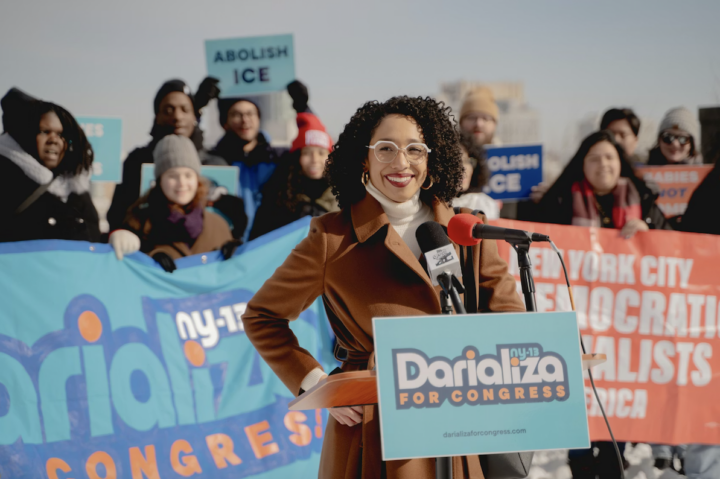
CAMPAIGN PAGE
Darializa Avila Chevalier
New York City Mayor Zohran Mamdani’s favored candidate to topple Rep. Adriano Espaillat (D-NY) has a history of extremist sentiments — with commentary assailing Israel, interracial relationships, “white liberals” and the U.S. flag and military.
Inflammatory posts by Darializa Avila Chevalier, that have received coverage in the New York Post, Politico, and AM New York, include: lambasting Black and Arab men for “fetishizing ugly colonizer women,” boasting of wiping her hand on the American flag, attacking former President Joe Biden as a “rapist,” declaring “f*** [Vice President] Kamala Harris,” demanding “No more police at all ever,” asserting Mayor Bill de Blasio “hates Black people” and is “a piece of shit” and calling American military veterans “child murderers” guilty of “war crimes.”
Jewish Insider reviewed additional tweets, including one announcing “I can’t stand white liberals” and another questioning whether watching a film with Israeli American actress Natalie Portman — a longtime critic of Israeli government policies and its leadership — would constitute “breaking the boycott.”
Her Twitter bio at the time of the latter tweet in 2019 was “how communist of you” and included the hashtag #FreePalestine. At the time, Avila Chevalier co-hosted a podcast called “They Are Just Deportees” with John Jay College instructor Nick Rodrigo, who attracted attention following the Oct. 7, 2023, Hamas attacks on Israel when he offered multiple shout-outs at a rally to the Palestinian terrorists who murdered, sexually assaulted and abducted Israeli civilians.
“Shout out to the resistance! The resistance storming that wretched border wall on Oct. 7. They are doing their resistance and they are freeing themselves and in turn freeing us,” he said at the event.
Avila Chevalier herself later became a leader of Columbia University’s 2023 anti-Israel encampment movement.
Avila Chevalier did not respond to a question from JI about whether she agreed with this statement, or to any queries for this article. The Miami native recently told CNN, however, that she has “grown considerably” since writing many of her past posts.
But the candidate’s profile on The Story Graph, a social site page that allows users to share their reading habits, indicates an interest in the Popular Front for the Liberation of Palestine, a U.S.-designated Marxist terrorist group that participated in the 2023 assault. The page lists her as “Currently Reading” Primo Levi’s Survival in Auschwitz — and also The Trinity of Fundamentals, a novel by Wisam Rafeedie, a prominent PFLP member who once ran the organization’s publishing house.
The tome was translated and published by 1804 Books, an arm of the People’s Forum, itself part of Shanghai-based financier Neville “Roy” Singham’s international network of pro-China, pro-Russia, pro-Iran nonprofits.
Her “Recently Read” page, meanwhile, lists two books by PFLP spokesman Ghassan Kanafani. During Kanfani’s tenure, the PFLP became notorious for masterminding the slaughter of Israeli citizens and Puerto Rican Christian pilgrims at Lod Airport in 1972, and subsequently pioneering the terrorist practice of skyjacking.
Avila Chevalier is the latest and last of Mamdani’s endorsed congressional candidates, who also include Assemblymember Claire Valdez — seeking to succeed retiring Rep. Nydia Velazquez (D-NY) — and former city Comptroller Brad Lander, who is challenging Rep. Dan Goldman (D-NY). Primary day is June 23.
‘Nobody should work for Axel Springer despite the essentials or in disagreement with one of the essentials,’ the company’s CEO told Politico staff on Monday

Krisztian Bocsi/Bloomberg via Getty Images
Flags outside the Axel Springer SE headquarters in Berlin, Germany, on Friday, July 12, 2024.
Mathias Döpfner, the CEO of Politico’s parent company, Axel Springer, doubled down in defense of the German publishing giant’s corporate values while addressing criticism from Politico’s editorial staff on Monday, suggesting to journalists that if they do not feel fully comfortable with a mission statement that includes support for Israel’s right to exist and other principles known as “the essentials,” they should find work elsewhere, according to audio of the discussion obtained by Jewish Insider.
“Nobody should work for Axel Springer despite the essentials or in disagreement with one of the essentials,” Döpfner said on a 40-minute call that also included feedback from Politico executives who expressed alignment with the CEO. “If the essentials are not attractive, if the essentials are not a magnet, if the essentials are not a reason why to work for this company, I can only recommend to work for other companies.”
“There are many options where values do not play such a role — or where other values play a role,” he added, citing NGOs, “financial investors” and “other publishers.”
His comments received no pushback and even some tacit backing from Politico leaders who participated in the meeting, including Jonathan Greenberger, the outlet’s incoming editor-in-chief who takes the helm on Friday; John Harris, the company’s founder and outgoing editor-in-chief; and Goli Sheikholeslami, its CEO.
The meeting came in response to a letter sent by Politico staffers to Greenberger on Friday, accusing Döpfner of using the outlet “to promote his political agenda” and raising concerns that two opinion pieces he wrote for the publication “risk undermining” its “reputation as an impartial news source.”
The letter referred, among other things, to opinion articles in which Döpfner exhorted Europe to stand with the United States and Israel in their war with Iran and said that European aid to Palestinians helped fund terrorists, while arguing that the continent was “on the wrong side of history” in pausing assistance to Israel. The letter and subsequent conversation was first reported by Semafor on Monday, which characterized the meeting as company leadership being receptive to staffers’ concerns.
In his remarks to Politico staffers, Döpfner said he found elements of the letter “a bit disturbing,” and vowed to “write more in the future, not less,” for the widely read Beltway news site, insisting his personal views do not reflect or influence the outlet’s editorial line.
“The thing that honestly irritated me most,” he explained on the call, taking issue with one of the letter’s complaints, “is that you said in the latest piece, ‘he refers to Iran as the aggressor that was systematically pursuing nuclear weapons,’ and you think that is misleading and irresponsible to publish that without clarification, and that in our style book, we refer to Iranians’ retaliation.”
Such a characterization, he countered, may in fact have been too understated to convey his argument in his March opinion piece.
“If you’re saying that one should not say that the Iranian leadership, the mullahs, are aggressors, you may be right,” Döpfner said. “The wording is more a euphemism. We should rather say they’re terrorists, or they are mass murderers. That would be more appropriate, given the kind of spread of terrorism with Iranian proxies from Hezbollah, Hamas, Houthi and other terrorist organizations. I think to position that as an aggressor is a mild version of what it is.”
He added that the letter had led him to suspect that “we may have very fundamental disagreement on the perception of fundamental values of democratic and open society models, but perhaps that then opens the room for discussion.”
If the Green Party in England is “saying Zionism is racism,” he continued, “I just want to make it very clear that we think Zionism is, and that is the official definition, Israel’s right of self-determination and of its right to exist as a safe haven for Jews” who have “almost been extinct during the Holocaust.”
“If that is something that somebody wants to question, then we are really reaching the very fundamental principles of our values,” Döpfner reiterated to the staff. “And that then may lead simply to the decision that, because we are very transparent about it, it is then an individual decision whether Axel Springer and somebody who has so fundamentally different beliefs is really a good fit.”
Later in the discussion, Döpfner fielded a question from a reporter who said that the description of Iran as an aggressor seeking nuclear weapons “didn’t meet the standards we’re expected to adhere to in our own reporting,” arguing that if Politico journalists were to use such language in their own news stories then “we would be asked to asked to back it up.”
Döpfner stressed that he did not feel it was necessary to muster evidence to support a point he viewed as self-evident. “I think you have to qualify or prove arguments or points if they are new or if they are debatable,” he said. “But for me at least, these two facts — that the Iranians are working on the nuclear bomb and that they are aggressors for decades — are so obvious, so proven for many times, they are almost — it’s like saying America is the biggest democracy in the world.”
“I don’t have to prove that,” he said. “That was my point. But also that is a room for debate. Why not?”
His remarks on the call underscored ongoing editorial frictions between Axel Springer and its flagship U.S. news property, which it acquired in 2021 for more than $1 billion amid an aggressive foray into international markets. While Politico’s staffers are not contractually required to uphold the essential values that have long been central to Axel Springer’s mission, Politico has appeared to chafe against such principles, particularly on supporting Israel’s right to exist, which its parent company describes as “non-negotiable” on its website.
“Nobody has to sign the essentials. The signing is a symbolic act. We don’t need that,” Döpfner said in the meeting. “More important is that employees of Axel Springer feel attracted [to] these very fundamental values.”
Some Politico staffers had reportedly expressed suspicion of Axel Springer’s values shortly after the outlet had come under its new ownership five years ago — presaging recent concerns voiced by anti-Israel activists after Axel Springer acquired The Daily Telegraph.
In recent weeks, Politico has drawn criticism for publishing a sympathetic profile about Francesca Albanese, the United Nation’s special rapporteur for the Palestinian territories, a fierce critic of Israel who has used antisemitic tropes. The journalist who wrote the story also came under scrutiny after now-deleted posts about the “Jewish lobby” had surfaced.
The outlet also provoked controversy last month over its decision to publish a political cartoon that invoked several antisemitic tropes while criticizing the U.S.-Israeli war with Iran. It depicted President Donald Trump and Republican lawmakers wearing blood-stained Jewish prayer shawls while seated in a waterfall-bound boat with Israeli Prime Minister Benjamin Netanyahu, whose nose was elongated. It also featured a blood-covered bag of money, among other stereotypes suggesting that the United States had been duped into joining Israel in attacking Iran by Jewish political and financial interests, a classic antisemitic trope.
The cartoon was removed amid backlash, replaced by an editor’s note that said it did not meet Politico’s editorial standards.
Döpfner, who received the Israeli Presidential Medal of Honor last October and has frequently warned about rising antisemitism in the aftermath of Hamas’ Oct. 7, 2023, terror attacks, has not publicly weighed in on such issues at Politico.
Politico did not respond to a request for comment on Tuesday.
“We appreciate internal discussions like this, because they help to clarify our principles on editorial independence and our non-negotiable values, which we call the Essentials,” a spokesperson for Axel Springer said in a statement to JI.
During the call on Monday, Döpfner broadly emphasized that the essentials represent “societal values” that define the “intellectual constitution of the company.” He said the support for Israel that is enshrined in its company-wide values “does not mean that you do not criticize the Israeli government, which happens every day.”
“But our values are clear,” Döpfner explained. “They are very transparent, transparent for our readers, transparent for our employees, and only those who feel very much attracted by the values should work for us.”
For his part, Greenberger, who was named editor-in-chief last month, defended what he described as Döpfner’s commitment to Politico’s editorial independence in comments at the beginning of the call. “He’s not going to tell me what to do,” he said of the CEO. “He’s a resource, and I appreciate that.”
Greenberger also endorsed the essentials as “our corporate values” that can “coexist” with Politico’s reporting. Referring to Axel Springer’s eponymous founder, an anti-communist and pro-Israel advocate who died in 1985, he said the company was created “in the rubble of World War II” and that its values reflect that history, including “support for the Allied partnership that defeated Nazism and Israel’s role as a safe haven for many of the people the Nazis tried but failed to exterminate.”
Such values “do not bar us from reporting critically about Israel or about NATO or about free trade,” Greenberger added. “In fact, they require critical coverage of it.”
“A lot of things are going to change,” Greenberger said during the meeting. “I hope that that’s exciting to you. I hope you want to join me in helping our journalism travel further and faster, in harnessing this disruption out there in the world to our benefit.
“But I know that some of you may say, as you take stock. that that doesn’t sit right, and that it doesn’t feel like it is something that will make you happy,” he continued. “What I say behind closed doors I’ll say to all of you right now: I’m a very firm believer that we do our best work where we are happy, where we feel fulfilled, where we feel aligned with the organization that we work for.”
He encouraged staffers on the call to “take stock at this moment and ask” themselves whether they are as “excited about this next chapter” as he is. “I hope the answer is yes.”
Ambitious Democrats are still trying to figure out a political message that manages to keep pro-Israel voters within their coalition while reacting to the dramatic shift in public opinion towards the Jewish state within their base
Kyle Mazza/Anadolu via Getty Images
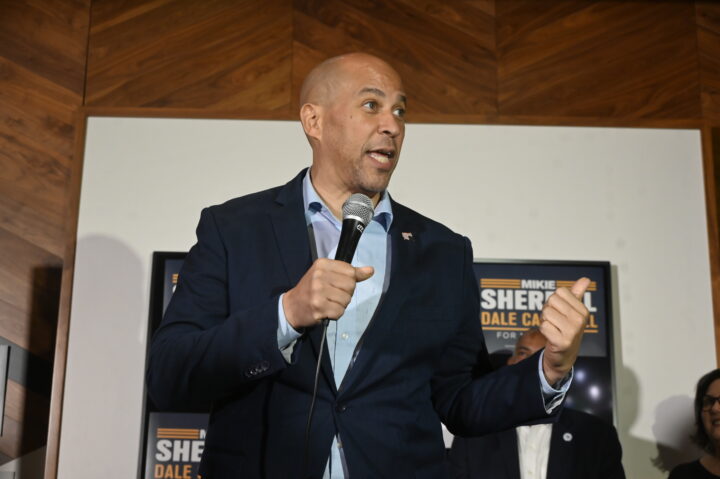
Sen. Cory Booker (D-NJ) speaks at a get out the vote rally in Camden, New Jersey, United States on November 2, 2025.
You would think the media wouldn’t need to twist Democratic candidates’ views on Israel, given the challenges pro-Israel supporters are already facing within the party. But in a Politico story suggesting that Democrats are running away from AIPAC, the publication misrepresented the views of two leading presidential contenders — and ignored the latest pro-Israel comments made in its own pages by a top-tier candidate.
The story leads by noting pro-Israel Sen. Cory Booker (D-NJ) said he’s not taking PAC money from anyone and then twists his comments to suggest that he had shifted his views on AIPAC or his support for Israel. The omission (buried at the end of the story) is particularly egregious because in the same interview, Booker told Politico that he was troubled by the “singling out of AIPAC” compared to other American advocacy groups.
“Somehow, AIPAC seems to be drawing a lot of attention, and that’s problematic to me,” Booker said. That doesn’t sound like an example of someone turning on the pro-Israel advocacy group.
The story then cites Pennsylvania Gov. Josh Shapiro, one of the leading supporters of Israel in the party, as someone who’s flip-flopping on AIPAC for noting that as a governor, he’s never taken or solicited money from AIPAC. (Which is true, as a matter of fact, because AIPAC only spends money in federal races, not statewide campaigns.)
But that narrow, semantic statement was taken as evidence that Shapiro has changed his tune, when in reality he’s been speaking on left-wing podcasts in defense of the Jewish state, testing a measured, pro-Israel message as he mulls over a presidential campaign.
And perhaps most notably, the story avoids referencing Politico’s own interview with California Gov. Gavin Newsom published the same day, where he backtracked from his anti-Israel comments on the “Pod Save America” podcast earlier in the month. In the interview, Newsom said he “revere[s]” Israel and is “proud to support the state.” And he walked back his earlier comments that seemingly called Israel an apartheid state, saying he was only referencing a column by the New York Times’ Tom Friedman. This latest article appears to fit a pattern of anti-Israel content from Politico that stands in contrast to the pro-Israel stance of its parent company, Axel Springer.
To be sure, Newsom has been carefully calibrating his remarks to different audiences, and has distanced himself from AIPAC lately, in a shift from his longtime support for a close U.S.-Israel relationship. But his latest favorable comments towards the Jewish state — clearly intended as cleanup from his overly zealous criticism just weeks before — is a sign that Democratic candidates are still calibrating their views, not embracing the anti-Israel activists.
The reality is that ambitious Democrats are still trying to figure out a political message that manages to keep pro-Israel voters within their coalition while reacting to the dramatic shift in public opinion towards the Jewish state within their base.
And while it may be easy for Democrats to look at the polling and use AIPAC as a convenient boogeyman, the reality is that by embracing an anti-Israel worldview, candidates will end up dealing with the baggage that comes with the movement — from associating with antisemitic podcasters to championing Senate candidates that had Nazi-linked tattoos. That’s where the polling doesn’t fully reflect the implications of any anti-Israel shift within the party.
It’s a reminder of how so many Democrats running for president in 2020 looked at the polling reflecting the party zeitgeist of the moment and embraced a whole panoply of radical views, from defunding the police to embracing government-funded benefits for undocumented immigrants. That sudden shift to the far left, backed up by the primary polling of the moment, still haunts the party to this day.
It’s why most of the opposition against Israel is still confined to progressive spaces, as more mainstream Democratic candidates try to figure out how to balance concern over Israel’s right-wing government with support for the country itself. The Politico story, in its haste to declare waning support for Israel within the party, instead got nuanced responses that didn’t fit the narrative.
Please log in if you already have a subscription, or subscribe to access the latest updates.
 Continue with Google

 Continue with Apple