










































































The potential terrorist attack against Temple Israel is a reminder of the consequences of what can happen when antisemitism is allowed to become normalized in our society

JEFF KOWALSKY/AFP via Getty Images
Families leave after being reunited outside Temple Israel synagogue after an assailant rammed his truck into the building in West Bloomfield, Michigan, a suburb of Detroit, on March 12, 2026.


 Add JewishInsider on Google
It’s a testament to the level of security, staff preparation and good fortune that a potential terrorist attack against Temple Israel in suburban Detroit was foiled yesterday. The fact that no one other than the heavily armed perpetrator was killed after driving a vehicle filled with explosives into a synagogue filled with preschoolers, counts as something of a miracle.
It’s also a reminder of the consequences of what can happen when antisemitism is allowed to become normalized in our society, moving unchecked through our social media feeds and political discourse, all amid the record levels of hate crimes committed against Jews simply for their identity.
Even as politicians are reflexively speaking out against antisemitism in the aftermath of the attack, it’s hard to forget the poisonous rhetoric many on the extremes have advanced that could easily activate a lone-wolf extremist to commit an unspeakable crime.
On the hard left, opposition to Israel’s war in Gaza has morphed into accusations of genocide, attacks against AIPAC as a uniquely sinister organization, conspiracy theories that Israel tricked the U.S. into war with Iran and euphemizing the support of terrorism as merely being “pro-Palestinian.”
Rep. Ro Khanna (D-CA), who has emerged as one of his party’s leading anti-Israel voices as he mulls a presidential campaign, had the audacity to say he “stands with” antisemitic streamer Hasan Piker — along with New York City Mayor Zohran Mamdani, who has refused to condemn “globalize the intifada” rhetoric and anti-Israel Democratic Senate candidate Graham Platner — during the Michigan synagogue terror attack.
Former Obama deputy national security advisor Ben Rhodes and his “Pod Save America” colleagues are now declaring that anyone who supports the Iran war — a group that may well include some Jewish Democrats in Congress who are sympathetic to the operation’s aims, even if they have reservations — should be primaried, and have no place within the Democratic Party.
On the hard right, extremist podcasters are broadcasting the most undiluted antisemitism in media since the days of Father Coughlin in the 1930s. Tucker Carlson has devoted much of his show to promoting conspiracy theories about Jews, while other social media influencers have found that attacking Israel and questioning Jewish influence is a ticket to building a niche audience in online spaces. Gatherings of young right-wingers have all too often become cesspools of anti-Jewish hate.
Sen. Ted Cruz (R-TX), who has emerged as a leader in speaking out against right-wing antisemitism, cautioned that Republicans may be losing the fight to contain the scourge — especially among a younger generation of conservatives.
All this is happening amid relative bipartisan silence towards the social media companies that often profit through division, using tech-tailored algorithms to feed extreme content to unsuspecting audiences. It’s no coincidence that polls indicate dramatic levels of antisemitism and extremist views from the youngest Americans, who are marinating in echo chambers instead of reading the headlines dispassionately from newspapers, as the generation before them did.
That the only fatality from yesterday’s attack in West Bloomfield Township, Mich., was the assailant is a testament to the time, energy and money that the Jewish community, with some federal assistance, has dedicated to ensuring security for its many institutions across the country. The FBI’s recent active shooter preparedness drill held for clergy and staff at the synagogue undoubtedly led them to be prepared in that fraught moment Thursday.
But a strong defense — hardening security for Jewish institutions — requires a complementary offense, in leaders confronting rising extremism whenever it rears its ugly head. It shouldn’t take the avoidance of a mass casualty event to get candidates across the political spectrum to start speaking out against antisemitism, as Platner did on Thursday.
We saw some signs of growing courage from political leaders this week in calling out the hate emanating from their fringes. Cruz, who called Carlson “the single most dangerous demagogue in this country,” at an antisemitism conference this week co-sponsored by the Republican Jewish Coalition and National Review, was joined by Sens. Tom Cotton (R-AR) and Jim Banks (R-IN) in speaking out against anti-Jewish hate.
The moderate Democratic think tank Third Way directly confronted Khanna on Thursday for his praise of Piker and other anti-Israel figures in the party. “Our side has a real antisemitism problem too that too many Democrats are failing to face squarely,” Third Way VP Matt Bennett bluntly told JI, in one of the few public intraparty acknowledgements about the growing threat.
The country feels like it’s at a boiling point, with few institutional leaders providing the guardrails necessary to contain growing extremism and hate. We saw on Thursday where unchecked extremism leads. It will take leaders to put principles ahead of political expedience for the wave of antisemitism to subside.
As state Sen. Jeremy Moss, a Democrat who represents the district where the attack took place, wrote: “When I was growing up, antisemitism was primarily in history books and black and white film reels. Today it was in real color right up the road at Temple Israel … This is a fire that will take all of us to snuff out.”
Republican and Democratic lawmakers express hope that the new feature will expose the level of foreign involvement in domestic online political discourse
Subaas Shrestha/NurPhoto via Getty Images
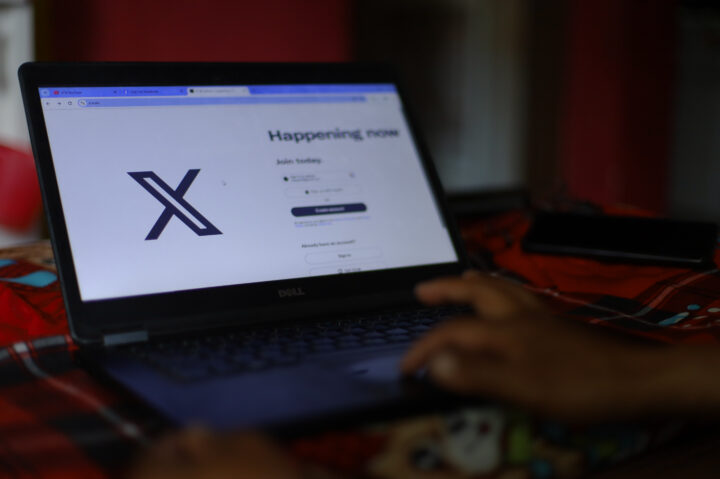
A Nepali X (formerly Twitter) user opens the mobile app on September 4, 2025, following the announcement of the government to ban the social media platform in the Himalayan nation.
Republican and Democratic lawmakers alike are cheering the implementation of X’s new location feature this week — allowing users to see what countries accounts are operating from — with some expressing hope that the move will expose the level of foreign involvement in domestic online political discourse.
Lawmakers on both sides of the aisle touted the new feature as a useful way to identify if an account commenting on U.S. political matters could potentially be a foreign actor.
The new feature has exposed a variety of far-left and far-right accounts engaging in U.S. political discourse and spreading antisemitic and anti-Israel sentiments as they operate from various foreign countries.
Rep. Don Bacon (R-NE) said the information gleaned from the platform’s new feature crystalized the degree to which “foreign interests are trying to spread” antisemitic ideas in the United States. “The evidence is insightful,” Bacon, who is leading a bill with Rep. Josh Gottheimer (D-NJ) aimed at addressing antisemitism on social media, told Jewish Insider.
“On one hand I’m glad much of the antisemitism poison is not coming from the U.S., but it is alarming that so many foreign interests are trying to spread that poison by pushing it in the U.S. and masquerading as Americans,” the Nebraska Republican continued. “We need to keep informing Americans that much of the antisemitism is coming from abroad.”
Several lawmakers argued that the feature would help with the broader effort to prevent worsening domestic partisan divides, especially those fueled by U.S. adversaries.
“Foreign adversaries have spent years flooding social media with hate-filled and antisemitic propaganda to divide Americans,” Sen. James Lankford (R-OK), the GOP co-chair of the Senate Bipartisan Task Force for Combating Antisemitism, told JI. “Americans deserve to know which accounts are run from abroad so we know the true source of these narratives.”
Rep. Tom Suozzi (D-NY), who represents a Trump district and has been critical of X owner Elon Musk, said in a statement, “I have always suspected that many anti-Israel, antisemitic, Jew hate accounts are promoted by our adversaries.”
“Beijing, Moscow and Tehran know they cannot defeat us economically or militarily, so they exploit controversial issues, like Israel and antisemitism, and try to divide,” Suozzi told JI. “We must defend America by pushing back on external adversaries seeking to divide us internally.”
Others noted in statements to JI that ensuring transparency from major social media platforms was a necessary step in combating the rise in online antisemitism.
“Transparency on social media is crucial to fighting misinformation and antisemitism online. We’ve seen cases of foreign actors like Russia, China and Iran attempting to use these platforms to sow division and spread hate,” Gottheimer told JI. “I am glad they implemented this change and hope they will work with Congress to take steps to fight antisemitism and prevent malicious foreign influence.”
Rep. Laura Friedman (D-CA), who led a letter to Defense Secretary Pete Hegseth in July about X’s AI program Grok expressing antisemitic and pro-Nazi ideas, told JI in a statement, “This transparency is an important step. No matter what side of the aisle you’re on, bad actors spreading antisemitic narratives to divide Americans is a real threat. There’s much more tech companies should do to expose and stop this manipulation.”
Other Republicans also commented on the new feature this week.
Sen. Ted Cruz (R-TX), who has become a leading voice targeting right-wing antisemitism, posted on X on Tuesday that “America-hating foreign bots are at it again,” in response to a tweet from an account that is based in South Asia, according to the new location feature.
Former U.S. Ambassador to the U.N. Nikki Haley tweeted her support for the new service, writing on Tuesday, “I have long said foreign actors are using social media to poison our politics and divide Americans. The location feature on X is a huge win for transparency and American security. Other social media platforms should do the same.”
Please log in if you already have a subscription, or subscribe to access the latest updates.
 Continue with Google

 Continue with Apple