












































































The president predicted a four to five week timeline for the military campaign against Iran in several interviews over the weekend
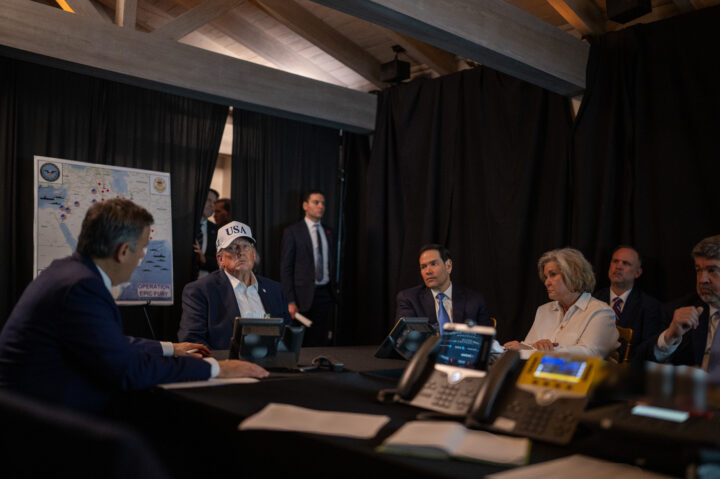
Daniel Torok/White House via Getty Images
President Donald Trump oversees "Operation Epic Fury" at Mar-a-Lago on February 28, 2026 in Palm Beach, Florida.


 Add JewishInsider on Google
President Donald Trump said over the weekend that Iran’s new leadership has made overtures to restart diplomatic negotiations with the U.S. — which he plans to accept — after Iranian Supreme Leader Ayatollah Ali Khamenei was killed during Israeli and U.S. strikes in the country.
Still, the president warned that strikes would continue until their objectives had been achieved.
Trump made the comments while speaking to The Atlantic on Sunday morning, one of a series of interviews he gave after launching a joint military operation against Iran alongside Israel on Saturday. The president has been touting Operation Epic Fury to journalists as an immediate success, arguing that the removal of Khamenei and 47 others in senior Iranian leadership has provided a window for diplomacy as the U.S. military operation swiftly advances.
“They want to talk, and I have agreed to talk, so I will be talking to them,” Trump told The Atlantic. “They should have done it sooner. They should have given what was very practical and easy to do sooner. They waited too long.”
The commander-in-chief declined to say when he plans to begin engaging with the Iranians, instead noting that most of the Iranians involved in past negotiations with the U.S. are now deceased.
“Most of those people are gone. Some of the people we were dealing with are gone, because that was a big — that was a big hit,” Trump said. “They should have done it sooner. They could have made a deal. They should’ve done it sooner. They played too cute.”
Asked if he was willing to extend the bombing campaign in order to support a popular uprising in Iran, should it unfold, the president was similarly coy, telling the outlet: “I have to look at the situation at the time it happens … You can’t give an answer to that question.”
In a video posted to his Truth Social platform on Sunday afternoon, however, Trump spoke directly to the protesters, calling upon “all Iranian patriots who yearn for freedom to seize this moment, to be brave, be bold, be heroic and take back your country. America is with you. I made a promise to you, and I fulfilled that promise. The rest will be up to you, but we’ll be there to help.”
Further illuminating his thinking, Trump wrote on Truth Social on Saturday shortly after the killing of Khamenei, “We are hearing that many of their IRGC, Military, and other Security and Police Forces, no longer want to fight, and are looking for Immunity from us … Hopefully, the IRGC and Police will peacefully merge with the Iranian Patriots, and work together as a unit to bring back the Country to the Greatness it deserves. That process should soon be starting.”
“The heavy and pinpoint bombing, however, will continue, uninterrupted throughout the week or, as long as necessary to achieve our objective” of world peace, he wrote.
In an interview on Saturday evening with CBS News’ Robert Costa, Trump said he believes that the joint U.S.-Israeli attacks on Iran that killed Khamenei made diplomacy “much easier now than it was a day ago, obviously, because they are getting beat up badly.”
As for the military operation itself, Trump suggested in subsequent conversations on Sunday with The Daily Mail and The New York Times that the U.S. could be involved for another four to five weeks.
“It’s always been a four-week process. We figured it will be four weeks or so,” Trump told the U.K. tabloid. “It’s always been about a four week process so — as strong as it is, it’s a big country, it’ll take four weeks or less.”
He repeated the four to five week timeline in interviews with Axios’ Barak Ravid on Saturday and The New York Times on Sunday.
“I can go long and take over the whole thing,” Trump told Ravid by phone, “or end it in two or three days and tell the Iranians: ‘See you again in a few years if you start rebuilding [your nuclear and missile programs].’”
Trump later predicted to Ravid that, “In any case, it will take them several years to recover from this attack.”
Senate Intelligence Committee Chairman Tom Cotton (R-AR) echoed the president’s predictions, telling CBS’ “Face the Nation” on Sunday that Trump has “no plan for any kind of large-scale ground force inside Iran.”
“The president has been clear that what we should expect to see is an extended air and naval campaign that’s designed not only to continue to set back Iran’s nuclear ambitions, but most importantly, to destroy its vast missile arsenal, many more missiles than the United States and Israel have air defenses combined, as well as the missile launchers and its missile manufacturing capability,” said Cotton, one of the president’s more hawkish GOP allies on Capitol Hill.
“Now obviously one risk of that kind of campaign is that an aircraft could be shot down, and the president would never leave a pilot behind,” he continued. “So no doubt we have combat search and rescue assets in the region that are prepared to go in and extract any downed pilot. But barring that kind of unusual circumstance, the president has no plan for any kind of large-scale ground force inside of Iran.”
Canada and Australia immediately offered support; European leaders signaled changing views amid Iran’s indiscriminate attacks in the region
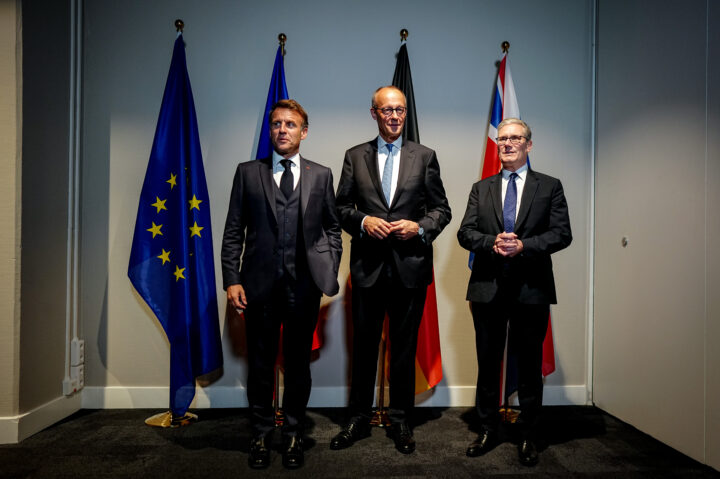
Kay Nietfeld/picture alliance via Getty Images
French President Emmanuel Macron (l-r), German Chancellor Friedrich Merz (CDU) and Keir Starmer, Prime Minister of Great Britain, meet in The Hague at the delegation hotel on the sidelines of the NATO summit for trilateral talks in the E3 format.
President Donald Trump’s decision to launch a military campaign against Iran has earned unexpected support from Western leaders who have otherwise sparred with Trump, particularly on trade policy. Canada and Australia, both of which are led by liberal parties, robustly backed the strikes that began on Saturday morning.
“We support the United States acting to prevent Iran from obtaining a nuclear weapon and to prevent Iran continuing to threaten international peace and security,” Australian Prime Minister Anthony Albanese said in a statement on Saturday.
Canadian Prime Minister Mark Carney, speaking to reporters during a trip to India, also threw his support behind the U.S.: “Canada supports the United States acting to prevent Iran from obtaining a nuclear weapon and to prevent its regime from further threatening international peace and security,” he said.
Meanwhile, three powerful European allies known as the E3 — France, Germany and the United Kingdom — were more circumspect after the military campaign began, with British Prime Minister Keir Starmer, French President Emmanuel Macron and German Chancellor Friedrich Merz calling on Saturday for nuclear negotiations to resume.
But by late Sunday, as Iran doubled down on its campaign of retaliation against American and Western assets across the Middle East, the E3 nations inched toward support for Washington with a statement strongly calling on Iran to cease its “indiscriminate and disproportionate missile attacks.”
“We call on Iran to stop these reckless attacks immediately. We will take steps to defend our interests and those of our allies in the region, potentially through enabling necessary and proportionate defensive action to destroy Iran’s capability to fire missiles and drones at their source,” the E3 leaders said. “We have agreed to work together with the U.S. and allies in the region on this matter.”
Three servicemembers have been killed and five seriously injured, CENTCOM said
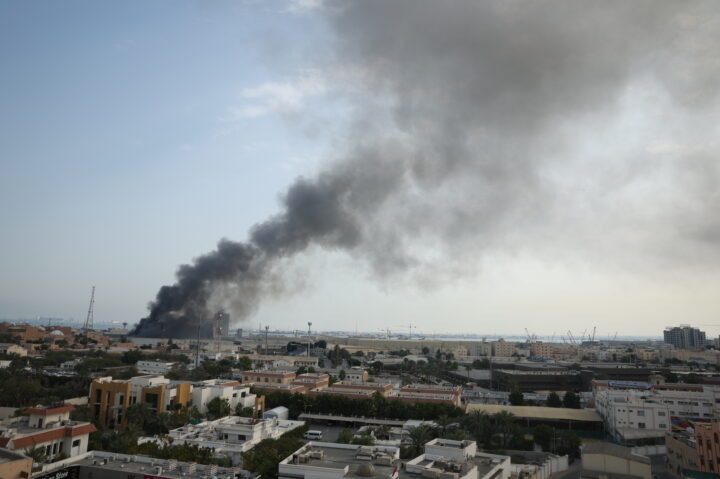
Stringer/Anadolu via Getty Images
Smoke rises after Iran launched a missile attack targeting the headquarters of the U.S. Navy's Fifth Fleet in Manama, Bahrain, on February 28, 2026.
Three U.S. servicemembers have been killed since the start of hostilities with Iran on Saturday, CENTCOM announced on Sunday morning, with five more seriously wounded.
In addition, several others “sustained minor shrapnel injuries and concussions — and are in the process of being returned to duty,” the statement read, without details of where the injured troops were located or when the fatal strikes occurred.
They are the first U.S. casualties in the war, which the U.S. has named Operation Epic Fury and Israel, which is jointly conducting strikes with the Americans, has named Operation Roaring Lion. Eleven people — all civilians — have been killed in Israel.
Three people have also been killed and 58 injured in the United Arab Emirates, its defense ministry said Sunday, amid Iran’s strikes around the Gulf.
CENTCOM also announced Sunday that U.S. forces struck an Iranian warship at the beginning of the operation, which is “currently sinking to the bottom of the Gulf of Oman.”
A missile hit in Beit Shemesh killed at least nine people on Sunday; two died in Tel Aviv late Saturday
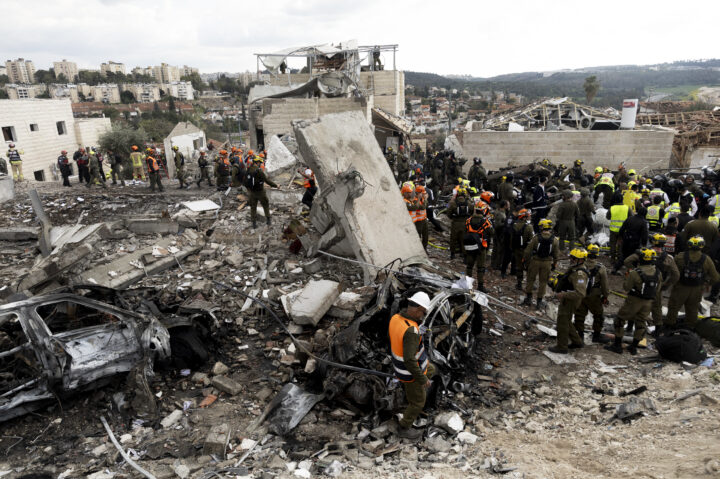
Amir Levy/Getty Images
Israeli emergency and rescue personnel recover casualties from an Iranian missile site on March 1, 2026 in Beit Shemesh, Israel.
At least nine people were killed in an Iranian missile strike on a residential neighborhood in Beit Shemesh, about 35 miles west of Jerusalem, the Israeli emergency medical service, Magen David Adom, reported on Sunday, bringing the Israeli death toll from the war with Iran launched a day earlier to 12.
Another 28 people, including young children, were injured, with two in serious condition.
The missile barrage on the mostly Orthodox Jerusalem suburb directly struck a public bomb shelter under a synagogue, among other sites.
Yehuda Shlomo, an MDA EMT, said that when he arrived on the scene, he saw “heavy structural damage, smoke in the air and a great deal of chaos with dozens of frightened casualties emerging from the damaged buildings.”
Another EMT, Tzvi David, said that he rescued a woman in her 60s trapped under a slab of concrete and that firefighters extricated three children from a locked room.
Photos and videos taken by MDA show buildings destroyed to their foundations, others heavily damaged, and burned-out cars.
IDF International Media Spokesperson Lt.-Col. Nadav Shoshani posted on X that “since the beginning of Operation ‘Roaring Lion’ the Iranian regime has been targeting civilians, we know that this is their strategy. In their recent attack they killed many civilians in the community of Beit Shemesh. The Iranian regime is a terror regime.”
“I send my deepest condolences to the families. We will continue to do everything we can to remove these capabilities from this bloodthirsty terror regime,” Shoshani stated.
Late Saturday night, a missile strike in the Tel Aviv area killed two women, one a Filipina caregiver aged 32 and the other aged 68 who died of respiratory issues while moving to a shelter, and injured 121 people.
A 102-year-old man in Ramat Gan, east of Tel Aviv, also died after falling down the stairs on his way to a protected space during an incoming missile siren, Ichilov Hospital announced Sunday.
About 40 buildings in Tel Aviv sustained damage from the missile strikes, with one deemed uninhabitable, the municipality stated. Over 200 residents were evacuated to hotels in the city.
The most heavily damaged building did not have its own safe room and most residents had evacuated to a public bomb shelter, Israel’s Home Front Command said.
Israeli President Isaac Herzog visited the impact site in Tel Aviv and called on the people of Israel and the region to “stay strong.”
“This is a historic effort to change the trajectory in the Middle East to a different future — a future of peace,” Herzog said. “We’ve been confronted by an empire of evil for a generation.”
Iranian Supreme Leader Ayatollah Ali Khamenei, whom Israel killed on Saturday, “spent a whole generation taking his people’s resources and directing them towards terror, bloodshed, pain and horror. And what we are doing here, together, all the allies, the United States, leading this effort … towards a vision of peace in the region,” Herzog said.
Meanwhile, security tightens in NYC as NYPD and Gov. Hochul boost presence around Jewish and Iranian institutions
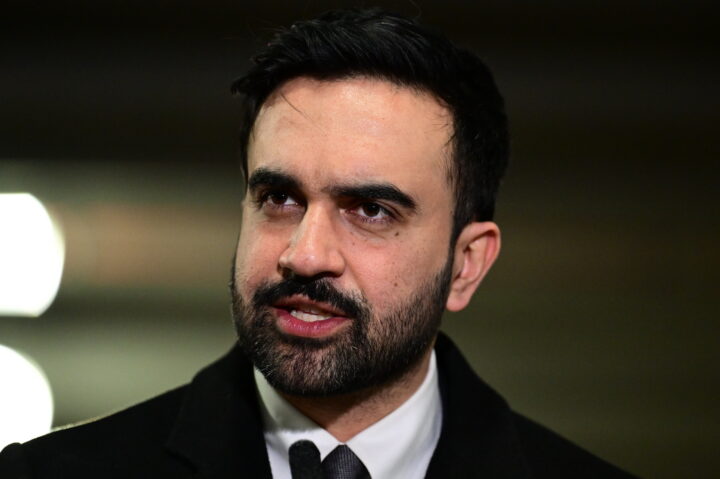
Kyle Mazza/Anadolu via Getty Images
New York City Mayor Zohran Mamdani
New York City Mayor Zohran Mamdani slammed joint U.S.-Israeli airstrikes on Iran in a statement Saturday — without placing fault with Tehran in his reaction.
Mamdani released a statement that reiterated his police department’s earlier pledge to boost local security, and also attacked Israel and the United States for “an illegal war of aggression.” But unlike other Democrats who have spoken out against the air campaign, he mentioned neither the atrocities committed by the Iranian regime against its own citizens, nor President Donald Trump, with whom he met just days ago.
“Today’s military strikes on Iran — carried out by the United States and Israel — mark a catastrophic escalation in an illegal war of aggression. Bombing cities. Killing civilians. Opening a new theater of war,” he wrote. “Americans do not want this. They do not want another war in pursuit of regime change. They want relief from the affordability crisis. They want peace.”
The NYPD declared Saturday morning it was “closely monitoring” the situation in the Middle East and working with federal and international law enforcement. It further promised pre-emptive steps to increase security at potential targets, though it did not indicate whether it was aware of any specific threat.
“As is our protocol and out of an abundance of caution, we will be enhancing patrols to sensitive locations throughout the city, including diplomatic, cultural, religious, and other relevant sites,” the department tweeted.
The NYPD did not respond to queries about specific actions, but videos on social media showed members of the department’s Counter-Terrorism Task Force at Manhattan’s iconic Temple Emanu-El as well as outside the Iranian consulate.
Gov. Kathy Hochul similarly vowed that she would deploy state troopers to guard vulnerable sites, even as she said “there were no specific, credible threats to New York.” She noted the impending start of Purim Monday night as cause to coordinate with the leaders of the Jewish community.
“State Police are increasing their presence at religious, diplomatic, and cultural sites statewide in coordination with federal, state, and local law enforcement partners,” the Democrat wrote in a statement. “Additionally, in advance of the Jewish holiday of Purim, State Police remain alert and have already begun outreach to religious organizations to offer support.”
Meanwhile, organizations affiliated with China-based left-wing tech tycoon Neville Roy Singham — known for promoting geopolitical narratives favorable to Beijing and its allies in Moscow and Tehran — including the People’s Forum and CODE PINK kicked off a protest against the strikes in Times Square on Saturday afternoon.
Joining them, according to promotional materials, are the Democratic Socialists of America, the Palestinian Youth Movement, and the National Iranian American Council, known as the country’s de facto lobbying group in the United States.
Netanyahu: Attacks were Israeli Air Force’s largest flyover in history
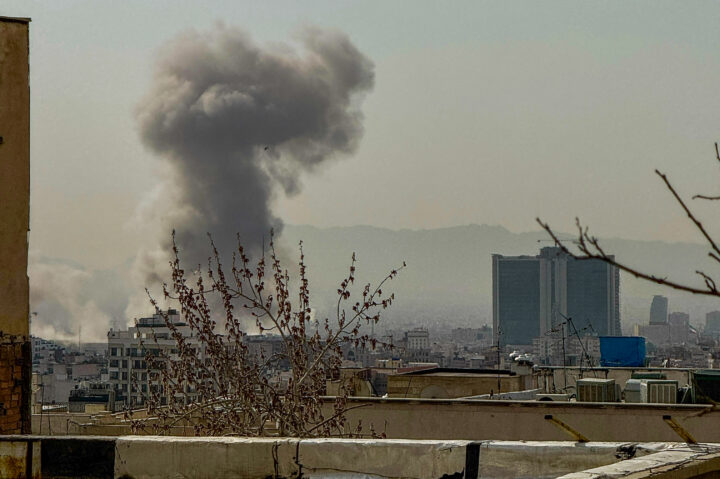
Mahsa / Middle East Images / AFP via Getty Images
A plume of smoke rises over Tehran after a reported explosion on February 28, 2026.
The U.S. and Israeli militaries planned attacks on Iran for months, marking “unprecedented cooperation,” Lt.-Gen. Eyal Zamir, the IDF’s chief of staff, said on Saturday, hours after the launch of what Israel has called Operation Roaring Lion and the U.S. has called Operation Epic Fury.
“In recent months, under the direction of the political leadership, I have led — in coordination with my counterparts, the chairman of the Joint Chiefs of Staff and the commander of CENTCOM — a deep and comprehensive joint operational planning process. This reflects unprecedented cooperation between the IDF and the United States military,” Zamir said.
An IDF official speaking on condition of anonymity said that the two militaries “worked for thousands of hours” to increase its target bank “by hundreds of percent.”
The plan centered on “an intelligence effort … to identify an operational opportunity at the moment when senior regime officials would convene,” the official said. The IDF struck three such gatherings simultaneously and killed “several senior figures.”
Israeli Prime Minister Benjamin Netanyahu confirmed in a video statement that one of those targets was Ayatollah Ali Khamenei, Iran’s supreme leader, saying that the IDF likely killed him.
“Today, in a surprise attack, we destroyed Iranian Supreme Leader Ali Khamenei’s compound in the heart of Tehran,” he said. “For three and a half decades, this tyrant sent terror throughout the world, immiserated his nation and worked all the time on his plan to destroy Israel.”
“That plan is gone and there are many signs that the tyrant is gone,” Netanyahu said. President Donald Trump later confirmed the news.
Netanyahu said that Israel plans to hit “1,000 terror sites” in the coming days.
Directing his remarks at the people of Iran, Netanyahu said, “Soon your moment will come in which you must go out on the streets … Help has arrived and now the time has come for you to unite for a historic mission … to bring down the regime and ensure your future.”
The strikes on Iran’s missile array and air-defense systems by 200 fighter jets were the Israeli Air Force’s largest-ever flyover, the IDF Spokesperson’s office said.
The IAF fighter jets struck 500 targets throughout western and central Iran, such as one in Tabriz, which was used for Iran’s surface-to-surface missiles. Another strike targeted an advanced SA-65 aerial-defense system near Kermanshah in western Iran, the IDF said.
The IDF sent warnings via social media to Iranian civilians living near weapons production and military infrastructure facilities: “Dear citizens, for your safety and well-being, we urge you to immediately evacuate these areas and remain outside of them until further notice. Your presence in these locations puts your lives at risk.”
Iran launched missiles and attack drones at Israeli population centers throughout the day, including ones that include cluster munitions, the IDF said.
“Cluster weapons are designed to disperse over a large area and maximize the chances of a harmful strike. Iran goes to great lengths in trying to maximize harm to Israeli civilians,” Nadav Shoshani, the IDF international media spokesperson, stated.
Zamir said that Operation Roaring Lion is “a significant, decisive, and unprecedented operation, to dismantle the capabilities of the Iranian terrorist regime — capabilities that constitute an ongoing existential threat to the security of the State of Israel. This is an operation to secure our existence and our future here, in the land of our forefathers, for generations to come.”
Since last year’s Operation Rising Lion, as the IDF called the 12-day war with Iran, “the radical Iranian terrorist regime has not abandoned its vision or its hostile intentions to advance its plan to destroy Israel. It has continued to promote its nuclear project, restore and accelerate ballistic missile production, and destabilize the region through the funding and arming of terrorist proxies,” Zamir said.
The IDF chief of staff also tied the operation to the holiday of Purim, which begins on Monday night, and celebrates the Jews of the Persian empire overcoming an attempted genocide.
“The Book of Esther teaches us that responsibility for our destiny rests first and foremost in our own hands — in courage, initiative, unity and the willingness to fight for our right to live here in freedom and in peace,” Zamir said. “Soldiers and commanders of the IDF… carry with you the vision of our forefathers.”
Shoshani wrote in a blog post that the timing of the operation was due to “a dangerous acceleration in [Iran’s] capabilities,” including long-range missile production and continued proxy funding.
“Israel reached a point where the threat was no longer ‘developing,’” Shoshani wrote. “The threat was direct and imminent.”
The objective of the strike, Shoshani said, was to “fundamentally reduce and degrade Iranian terrorist regime capabilities, eliminating long-term existential threats to the state of Israel.”
The IDF also called up 70,000 reservists to serve on Israel’s borders, the West Bank and Gaza to stop any infiltration attempts, as well as search and rescue forces prepared to go to the site of any Iranian missile strikes.
Israelis throughout the country spent the day going in and out of safe rooms and bomb shelters at the sound of air raid sirens, which blared more frequently in Israel’s densely populated center, reflecting the area Iran targeted.
IDF Home Front Commander Maj.-Gen. Shay Kleper said that “past experiences prove that the public’s strict following of protocol has saved many lives. The grit and responsibility of everyone is a key element in countering the threat.”
Israeli Foreign Minister Gideon Sa’ar spoke about Israel’s decision to strike Iran and the operation’s objectives with 17 of his counterparts, in phone calls to Argentina, Austria, Germany, India, Italy, Hungary, the Czech Republic, Latvia, the European Union, France, Canada, Australia, Ecuador, Greece, Ethiopia, Singapore and North Macedonia.
Please log in if you already have a subscription, or subscribe to access the latest updates.
 Continue with Google

 Continue with Apple