







































































The GOP Michigan Senate nominee said, ‘When people tell you who they are, believe them’
Getty
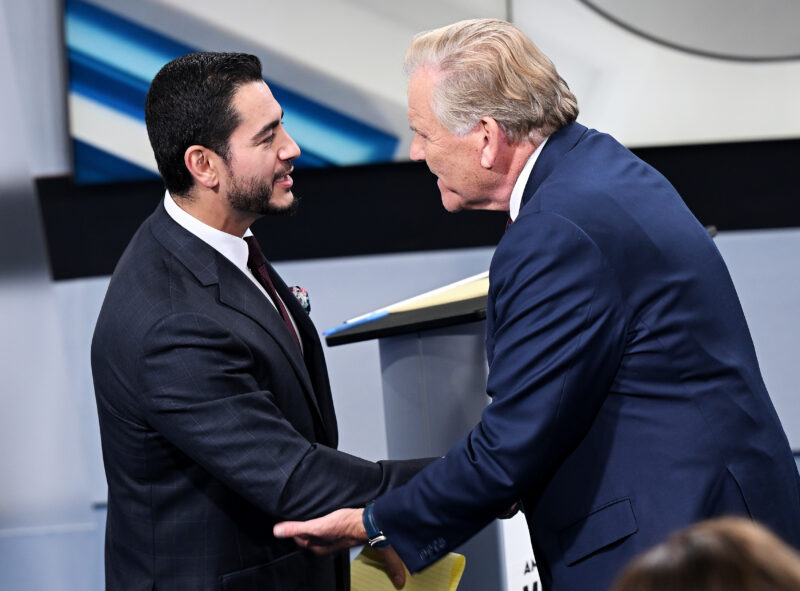
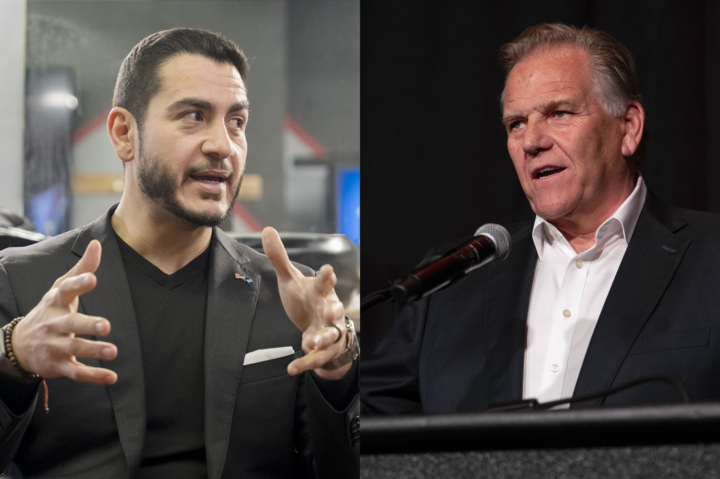
Michigan Senate candidates Abdul El-Sayed and Mike Rogers.


 Add JewishInsider on Google
Former Rep. Mike Rogers, the Michigan Republican nominee for Senate, issued a statement Wednesday commemorating the third anniversary of Hamas’ Oct. 7, 2023, attacks on Israel and bashing his Democratic opponent, Abdul El-Sayed, while El-Sayed remained silent.
El-Sayed’s rhetoric and stances on Israel and other issues of concern to the Jewish community have been heavily scrutinized, and he is facing significant skepticism from traditional Jewish Democrats in Michigan, as some community leaders and elected officials say they plan to sit out the Senate race or support Rogers.
El-Sayed’s campaign did not respond to multiple inquiries from JI about whether he planned to issue a statement on the Oct. 7 anniversary, and has not shared any such statement publicly.
“Three years ago today, the world witnessed in horror the worst massacre of Jewish people since the Holocaust,” Rogers said. “This dark day is a sad reminder that evil exists all around us. And how we respond to evil determines how much it grows.”
Rogers went on accuse El-Sayed of stoking hate and violence, pointing to a fundraising message his campaign sent on the second anniversary of the Oct. 7 attacks criticizing Israel (his campaign has said it was sent in error); criticizing El-Sayed for campaigning with Hasan Piker, who has been dismissive of the attacks; and issuing a widely criticized statement following the terrorist attack on Temple Israel in West Bloomfield, Mich.
“Hate like that has no home in Michigan,” Rogers continued. “You have my work, I will always stand proudly alongside Michigan’s Jewish community, against terrorism, and for Israel’s right to defend itself. We must root out antisemitic hate in all forms — because when we say ‘never again,’ we must mean it.”
Rogers later called out El-Sayed for not issuing a statement.
“Radio silence from Abdul El-Sayed about the anniversary of the Oct. 7 attacks. … I wish I could say this is shocking,” Rogers said in a late-afternoon post on X. “When people tell you who they are, believe them.”
House Minority Leader Hakeem Jeffries said that U.S. policy in the Middle East ‘must change dramatically’ to ensure long-term peace
Nathan Posner/Anadolu via Getty Images
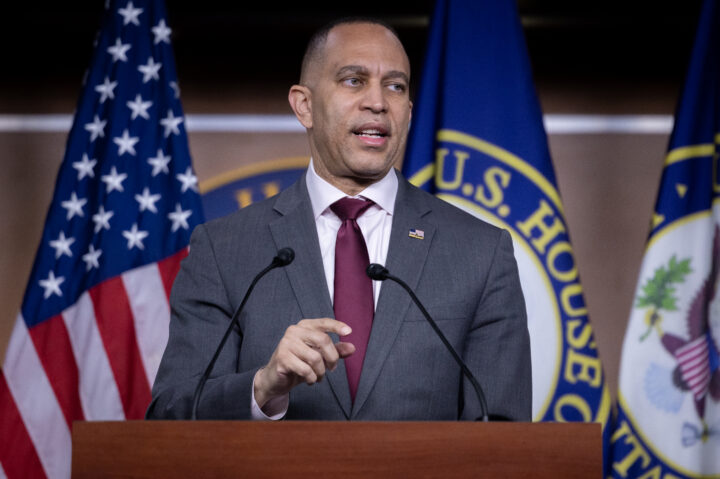
House Minority Leader Hakeem Jeffries (D-NY) speaks during his weekly press conference at the U.S. Capitol in Washington, DC on March 19, 2026.
On the third anniversary of the Oct. 7, 2023, Hamas attacks on Israel, House Minority Leader Hakeem Jeffries (D-NY) said that U.S. policy in the Middle East “must change dramatically” to ensure long-term peace.
He was joined by fellow senior congressional Democrats in calling for shifts in policy by the U.S. and Israel.
Jeffries said in a statement that, since the Oct. 7 attacks, “considerable suffering has plagued the Middle East. The horrific death of Palestinian civilians, destruction of civil society and devastation in Gaza is reprehensible and can never be allowed to happen again.”
He argued that, in order to permanently end the violence between Israel and the Palestinians, “for the good of the Israeli and Palestinian people, American policy in the region must change dramatically.”
Jeffries said that the U.S. must “commit to the creation” of a Palestinian state as well as “support a new generation of Palestinian leaders” and end the “egregious settler violence” by Israelis in the West Bank.
At the same time, Jeffries mourned and expressed solidarity with those who lost loved ones on Oct. 7 and those still recovering, including the former hostages. He also emphasized the surging wave of antisemitism since the Hamas attacks.
“The Jewish people are in a constant struggle for survival, as has been the case for thousands of years,” he said, adding that the U.S. must remain committed to Israel’s right to exist as well as removing Hamas from power and ending terrorism in the region.
In his own statement, Rep. Adam Smith (D-WA), the ranking member of the House Armed Services Committee, appeared to call out Israel for continued fighting in the region while also recognizing the victims of the Oct. 7 attacks and their loved ones.
“Further chaos, destruction, and violence is not the answer and will not make Israel safer,” Smith said. “Israel must work with the United States and partners in the region to bring this conflict to an end and find a way ahead that creates a sustainable, safe, and prosperous future for Israelis and Palestinians alike.”
Sen. Chris Coons (D-DE), generally a staunch supporter of Israel who has recently discussed his shifting stance on U.S. policy toward the Jewish state, said in a video statement that Israel’s military goals have been achieved and its approach should shift.
Coons is in line to be the top Democrat on the Senate Foreign Relations Committee next year.
“Israel has largely achieved its military goals, its objectives in Gaza and West Bank. Hamas has been beheaded and driven underground at great human cost to Palestinian civilians and a future two-state solution,” Coons said. “It’s now time to work tirelessly to find a path to lasting peace and adjust security for all.”
Coons also emphasized that the “wounds” to Israel from the attacks may never heal and recounted his meetings with the families of hostages.
Jewish groups condemned Mamdani for amplifying rhetoric they said puts Jewish New Yorkers at risk — on a day of mourning for victims of Hamas attacks
Michael Nagle/Bloomberg via Getty Images
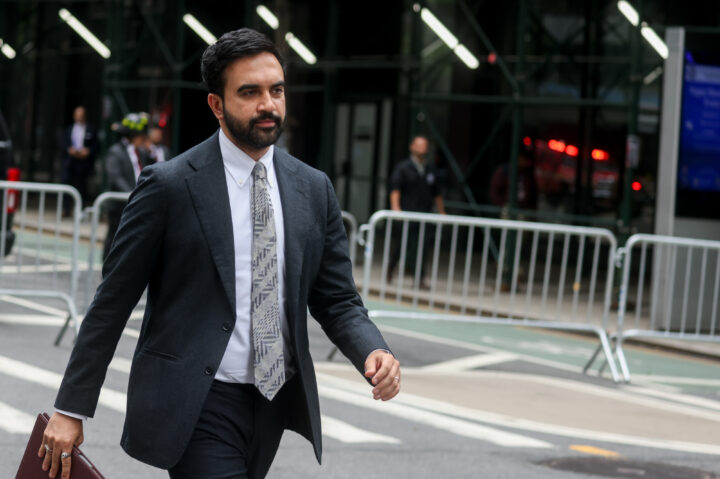
Zohran Mamdani, mayor of New York, arrives to speak to members of the media in New York, on July 7, 2026.
New York City Mayor Zohran Mamdani observed the third anniversary of the Oct. 7 attacks on Israel with a statement that opened with a denunciation of Hamas and the “horrific war crimes” it committed that day, but spent most of its length excoriating the Israeli response — drawing fierce criticism from mainstream Jewish organizations.
“We grieve alongside our many friends and neighbors who still carry that unthinkable loss,” the top of the statement concludes — before launching into the main body of his remarks attacking Israel. “The suffering did not begin nor end that day. It instead continued through the Israeli government’s devastating, ongoing genocide in Gaza,” it continues.
The mayor then launched into a litany of familiar criticisms of the Israeli military campaign in Gaza and of U.S. support for the Jewish state in a passage more than twice as long as his comments on Hamas and its victims.
“Many New Yorkers are reckoning with this unbearable grief, and we mourn alongside them — all while knowing that our tax dollars fund these war crimes,” the statement continues. “Three years later, we must refuse to accept a world in which occupation and apartheid continue, where war crimes are met with impunity, and our federal government continues its complicity with every arms shipment.”
The mayor concluded his statement with a call “to honor the dead, we must fight for a world in which every person can live with freedom, safety, and dignity.”
The decision to devote the bulk of his statement commemorating the deadliest day for Jews since the Holocaust to attacking Israel infuriated leading Jewish religious civic leaders.
“Today should have been a day for New York to stand with the victims of October 7, their families, and all those still living with the trauma of Hamas’s barbaric attack,” UJA-Federation of New York said in statement. “Instead, Mayor Mamdani chose to respond to the grief of Jewish New Yorkers by advancing false and inflammatory attacks against Israel — not only inappropriately shifting the focus away from the victims of Hamas’s cruelty, but also placing Jewish New Yorkers at risk.”
The Conference of Presidents of Major American Jewish Organizations also released a statement, saying, “Mayor Zohran Mamdani chose this solemn day to advance his familiar attacks on the Jewish state. There is a time for debate over Middle East policy. The anniversary of the October 7 massacre is not that time. Exploiting a day of profound grief to accuse Israel of genocide dishonors the memory of those who were murdered, deepens the pain of survivors and hostage families, and further alienates Jewish New Yorkers at a moment that should unite us in remembrance.”
“Mayor Mamdani cannot give Jewish New Yorkers even a single day to mourn without gaslighting us and appropriating the trauma of Oct. 7,” Rabbi Marc Schneier of the Foundation for Ethnic Understanding said in a statement, re-upping longstanding concerns that the mayor’s constant criticism of Israel feeds into the city’s spike in antisemitic hate crimes under his leadership. “His rhetoric fuels hostility toward Jewish New Yorkers. Today, he could have honored the victims and promoted peace and prosperity for Israelis and Palestinians. Instead, he chose to incite hatred.”
Andrew Gross, New York regional director for the American Jewish Committee, also criticized the mayor for what he described as injecting politics into a solemn occasion.
“Today is about the 1,200 lives stolen on October 7, 2023, the 251 who were taken hostage, and the countless others who were terrorized by Hamas and continue to be haunted by the violence inflicted on them, their families, and an entire country that day,” Gross wrote in a statement to Jewish Insider. “It is not about the mayor or his efforts to advance a false political narrative. His decision to use October 7 to promote slander against the Jewish state and amplify rhetoric that puts Jewish New Yorkers at greater risk is especially painful and egregious.”
Anti-Defamation League CEO Jonathan Greenblatt, meanwhile, highlighted that the mayor’s statement made no reference to “Jews,” repeating a frequent criticism that Mamdani does not recognize or appreciate that many of the people he represents feel an affinity to Israel as a nation — even as he frequently and explicitly identifies New Yorkers of Palestinian background with events in Gaza and the West Bank.
“You are weaponizing a day meant for mourning the worst massacre of Jews since the Holocaust to recycle your usual antizionist talking points,” Greenblatt wrote to Mamdani on X. “The city with the largest Jewish population outside Israel deserves a mayor who can honor the dead without exploiting them.”
The mayor’s schedule indicated the mayor will attend first a vigil for the Oct. 7 victims before he “meets with Palestinian New Yorkers” on Wednesday. His office did not provide additional details.
JI reported in March that Mamdani’s wife liked multiple posts on Instagram celebrating the Oct. 7 attacks.
Ironically, Mamdani’s statement on X also prompted an outpouring of antisemitic commentary from the site’s users suggesting he was controlled by Jewish interests.
Analysts say Israel's enemies are weakened, but warn of unresolved wars, strained ties with Arab neighbors, growing international isolation and a failure to learn the lessons of Oct. 7

MENAHEM KAHANA/AFP via Getty Images
Israeli soldiers clean the gun of a tank at a position near Israel's border with the Gaza Srip on May 4, 2025.
On the third anniversary of the Oct. 7, 2023, Hamas-led terror attacks on Israel, the Jewish state’s borders are more secure, but there are still dangers looming and lessons to be learned, according to military and national security analysts.
Dan Diker, president of the Jerusalem Center for Security and Foreign Affairs, told Jewish Insider on Tuesday that Israel “is in a better place in terms of its security.”
“Kinetically, militarily, in counterterrorism and on the battlefield, we are in a much better place,” he said. “We have defensible borders. That’s an important point. It’s not only in Judea and Samaria [the West Bank], but we have them 10 kilometers deep into Lebanon, security zones in [Syria] up to 20 kilometers, and some strategic depth in Gaza. We have multi-border strategic depth that we need to survive, and a consensus that we’re not going anywhere.”
“We are safer and more secure than we were three years ago,” said Yaakov Katz, author of While Israel Slept: How Hamas Surprised the Most Powerful Military in the Middle East. “Iran is significantly weaker, and its nuclear program is significantly weaker. Hezbollah is a fraction of what it was and Hamas is a fraction of what it was.”
The wars of the last three years “created amazing opportunities on all fronts,” Katz said. “We can create new alignments, agreements and security arrangements like never before. But that requires political will and courage. … It could be that this will go to waste.”
Katz expressed concern that there has been “no resolution” to any of the conflicts that emerged since Oct. 7.
Israel’s enemies “are weaker today, but they will rebuild, like they always do,” he said, “and the threat will return and emerge stronger and bigger if there isn’t some kind of end strategy.”
Diker argued that “the shock and awe of the intelligence collapse on Oct. 7 has shaken Israel’s political, military, intelligence and security echelons to their core. It intuitively created a greater sense of modesty and self-criticism about the ‘conceptzia,’” the Hebrew term for groupthink in the defense establishment ahead of the attacks.
One of the misconceptions that allowed the Oct. 7 attacks to take place, Diker said, was an overreliance on technology, for which Israel’s current, multi-front military presence is correcting.
“We can withdraw to international lines once [Iranian] terror proxies are disarmed, but … we are the only ones who can disarm them. They will never do it on their own and no one else will do it. The thought that we didn’t need to have a division or many brigades of soldiers in Gaza was false,” he added.
Diker said that Israel’s concept of national security relied in recent decades on deterrence, early warning, decisive victory and defense, but that since Oct. 7, it has added a new pillar: prevention.
“We are crouched and ready to pounce and destroy any sign of enemy movement, as opposed to waiting to respond to enemy fire or malign action. I think that prevention pillar is evident in Israel’s massive use of force against Tehran, its courage in initiating very daring counterterrorism strategies, like the beeper strategy [against Hezbollah], which was very high-risk and high-value,” he said.
Katz, however, said that the government has not learned some of the important lessons of Oct. 7.
“The refusal to properly investigate and study what went wrong puts us in a bad position, because we can repeat these mistakes,” he said. “Example in point, the FlyDubai [near-hijacking] had similar contours to how [the Oct. 7 attacks] happened. There was a belief that everything will be OK, and some other guy is in charge. In the end, no one was in charge and something that could have been prevented was not.”
Ksenia Svetlova, a former Knesset member and executive director of the Regional Organization for Peace, Economics and Security, said that “tactically, [Israel is] in a better situation, because we mostly took care of Hamas and Hezbollah. They’re not at the gates anymore.”
However, she warned that Israel’s strategic position has declined because of regional weaknesses.
“Oct. 7 and the Iran war showed [Arab allies’] weaknesses,” she said. “The Gulf states couldn’t defend themselves [against Iran] and America is not rushing to defend them. The only one defending itself and them is Israel, and there are some things the Emiratis are doing. Overall, we see the Arab Middle East’s weakness, and two non-Arab countries are setting the tone, Iran and Turkey. And our alliances are with the Arab states, not Iran and Turkey.”
Those countries saw how Gulf states behaved in the last year, and are factoring that in. Svetlova said, “We’re in a worse situation because they were exposed.”
At the same time, she noted that no Arab state with which Israel has diplomatic relations cut off those relations or closed its embassy in Israel, which some did in past conflicts.
“There are deep interests that these relationships are based on, and they are the best and only way to build the relations,” Svetlova said. “Hamas and Islamic fundamentalist extremists are a shared enemy. … We have a lot to offer and [Arab allies] have a lot to offer.”
However, she warned against taking those relationships for granted.
“We have the strongest, broadest and most significant relations with the UAE,” Svetlova said, but pointed out that Abu Dhabi did not celebrate the anniversary of the Abraham Accords this year. “It’s not because they don’t value the accords … but everything this government does in the West Bank creates tensions.”
Svetlova noted that Israel’s consistently peaceful borders in the past three years were the ones with Egypt and Jordan, countries with which Israel has peace agreements.
But those countries were destabilized by the war, she said, pointing to weekly demonstrations in Jordan for nearly two years. She said that Jerusalem’s handling of the war in Gaza, such as its calls for residents of Gaza to be able to emigrate via Egypt, harmed the relationship.
“It will take years to rehabilitate relations with our neighbors,” Svetlova said. “We could have taken advantage of the opportunity to bring those around us closer. Instead, we are eating away at the security of our friends, countries like Jordan that shot down Iranian missiles and cooperate with the U.S., and weakening our own security.”
Israel’s international standing has shifted dramatically in the West, as well.
“There’s no question that three years after Oct. 7, Israel finds itself more isolated than before,” Katz said. “Any of the sympathy or solidarity that it benefited from and enjoyed in the immediate aftermath of the Oct. 7 attack has long disappeared.”
Katz said Israel may face unprecedented challenges as a result, in terms of economic sanctions, isolation, resolutions in international institutions and charges in international courts.
“This is a whole new front that Israel today is currently completely unprepared for. If, for example, European countries as well as the United States start to sanction banks, financial institutions and construction companies, this could start to impact every person who lives in Israel,” he added.
Diker warned that Israel must do more to counter nonmilitary attacks, lest they further damage Israel’s national security.
“The major challenge now is fighting the weaponization of genocide against our people. That hasn’t been solved [and] that is really hurting us,” he said. “The notion that Israel is an apartheid genocidal state means something far-reaching and very dangerous … [that] anybody who is amenable to Israel or supports Israel is all of a sudden a supporter of genocide, which means the enemies of Israel go after [them].”
Diker said that while there is a widespread public consensus that there is a major nonmilitary element to the war — “economic, political, social, academic and in the media, not just public diplomacy or PR problems” — the government has not taken that aspect seriously enough.
“We are in a better situation because we understand, and I think we are trying to convince our allies, that this is part and parcel of an Islamic war on the West,” he said. “This is such an important part of our national security.”
However, he added, “Israel has yet to publicly declare that the non-military multidimensional Iranian, Russian, Chinese, Turkish, Qatari ideological warfare and political warfare is officially a national security threat. Until that happens, the budget and prioritization that Israel must assign to this war won’t be there. That’s why we keep getting it wrong.”
Diker suggested that Israel adopt hybrid warfare, a phrase often used to refer to Russian influence campaigns.
“All versions of nonmilitary warfare have to be embraced, collected and mobilized against our enemies,” Diker said.
With an acrimonious election set for the end of the month, politicians have been placing blame on each other, the security establishment and beyond for the failures of Oct. 7, but no state commission of inquiry has been formed to investigate.
“The same leaders responsible for the greatest failure are still in their position,” Katz lamented. “There’s no culture of accountability in Israel. You can say it doesn’t make a difference, but I think it does.”
Katz noted that the societal and political issues that divided Israel before Oct. 7 have not been resolved, and that poses an additional danger to Israel.
“Oct. 7 was the clearest example that when you have no social cohesion, you are going to pay a real price on a national security level,” he said. “Oct. 7 happened after five elections in 3.5 years, and a year of judicial reform that ripped the country apart. … All those fissures in society, all those issues remain and have gotten even bigger: Haredi [conscription in the IDF], judicial reform, ‘yes Bibi,’ ‘no Bibi,’ left, right, the Palestinian question. Everything is still there.”
Michael Needham said the 9/11 attacks and Oct. 7 were flashpoints in an ongoing ‘battle between civilization and barbarism,’ at an event commemorating the third anniversary of the Hamas attacks
Marc Rod
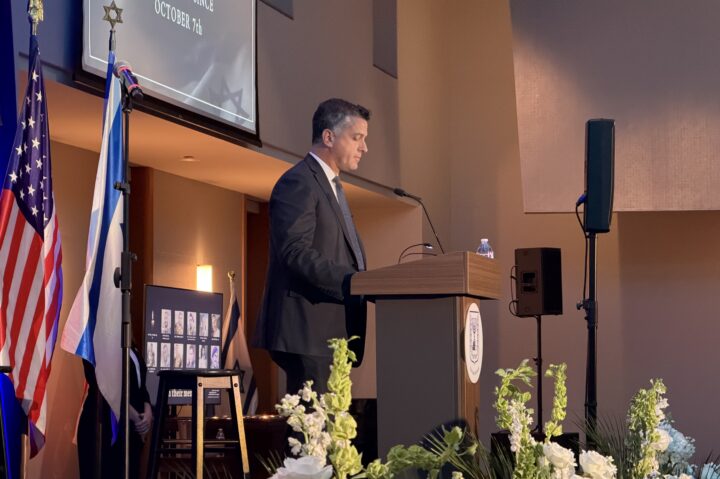
Michael Needham, the deputy U.S. national security advisor, addresses an event organized by the Israeli Embassy in Washington to commemorate the third anniversary of the Oct. 7 Hamas-led terror attacks, Oct. 5, 2026
Michael Needham, the deputy U.S. national security advisor, said on Monday that the Oct. 7, 2023, Hamas-led attacks on Israel and their aftermath are part of a shared civilizational war pitting the United States, Israel and other allies against enemies of the West.
The Oct. 7 attacks were met with praise and “gleeful celebration of inhuman barbarism, savagery and death” both in Gaza and around the world, Needham said in remarks at an event organized by the Israeli Embassy in Washington to commemorate the third anniversary of the attack.
“What was clear then is that each of our countries is locked in a battle between civilization and barbarism,” Needham said. “That the war between the people of Israel and the terrorists of Hamas is a war that is playing out in various forms, here in the United States and in Europe and across the whole of the Western world.”
He said that the 9/11 attacks and Oct. 7 are just a few flashpoints in that ongoing war.
“The question that all of us face is not merely whether we are on the side of civilization; it is what cost are we willing to pay to defend it?” Needham said. “For the people of Israel, this is not a hypothetical question; it is one you have answered in full. In the aftermath of Oct. 7, the people of Israel revealed themselves to be a nation whose citizens were willing to answer the call, to lay down their lives if necessary, when their country needed them.”
Needham described that spirit as the essence of patriotism, to stand up for one’s nation “precisely when it calls on him to sacrifice the things that he holds most dear.”
“The forces of barbarism worship death; they seek it out as an end unto itself. Those who choose to defend civilization may be willing to die for our cause, but it is only because we love and value life that we choose to sacrifice everything to defend it,” Needham said. “Over the last three years, the people of Israel have chosen life to fight and suffer and sacrifice for it, and civilization will continue to prevail so long as our nations are blessed by heroes.”
Needham described Israeli Ambassador to the U.S. Yechiel Leiter — who remains in Israel caring for his son, who was critically injured in an attack last month while serving in the West Bank — and his family as a “living testament” to that spirit of patriotism. Leiter lost another son who was killed in November 2023 while serving in Gaza.
The event, hosted by Washington Hebrew Congregation, also featured a candle lighting by Bureau of Alcohol, Tobacco, Firearms and Explosives Director Robert Cekada, remarks by Israeli Deputy Chief of Mission Nevo Barchad and a former spokesperson for the Israeli Defense Forces, as well as a musical performance by musician Gilad Segev and his group, Project Heroes, which commemorates victims and heroes of Oct. 7.
The audience of several hundred included American Jewish leaders, other administration officials, military officials and international diplomats, among others.
Like Needham, Barchad emphasized that the ideology of Hamas was “glorified even in the free world.” He said that Leiter had been hoping to speak about the way that anti-Israel and antisemitic hate has proliferated through schools, social media, courtrooms, government and more.
“Facts don’t matter anymore,” Barchad said. “Hamas’ attempted genocide was minimized, and immediately Israel stood accused of genocide. Israel is then accused of deliberately starving Gaza, no matter how much humanitarian aid we facilitated into the strip.”
He also emphasized the role that Iran and Hezbollah had played in supporting the Oct. 7 attacks.
“Together with America, our greatest ally, we have worked to dismantle the threat,” Barchad said, adding that going forward, Israel must dismantle terrorist groups rather than attempt to constrain them; must work to reform education in the Palestinian territories to stop indoctrination; and cannot overlook attempts to delegitimize Israel in the United Nations, online, on college campuses and in Congress.
“We now know that many Western leaders do not understand that appealing to their domestic political bases by vilifying Israel threatens their own societies, just as it threatens ours,” he said. “The West and moderate Muslim countries must confront terrorism by pursuing terrorists, designating terrorist organizations, disrupting their funding and prosecuting those who support or enable them.”
But he also said that the attack and the ensuing war have shown the strength of Israelis and the Israeli youth — “the greatest generation of Israelis ever” — and that Israel’s enemies cannot destroy it or its “resolve, courage or resourcefulness.”
The bill introduces a new version of the provision put forward by House Republicans last year that would withhold funding for the United Nations secretariat

Anna Moneymaker/Getty Images
Rep. Mario Diaz-Balart (R-FL) speaks at a press conference following their weekly caucus meeting in the U.S. Capitol Building on July 19, 2022, in Washington, D.C.
Republicans on the House Appropriations Committee, in their draft 2027 funding bill for the State Department, are again aiming to leverage U.S. funding to the United Nations and other foreign programs to seek accountability for involvement by U.N. employees and others in the Oct. 7, 2023, attacks on Israel.
They made similar efforts during the 2026 government funding process, but the provisions were ultimately excluded from the final 2026 funding bill.
The bill introduces a new version of the provision put forward by House Republicans last year that would withhold funding for the United Nations secretariat — the U.N. management headed by the secretary-general — until the U.N. agrees to waive privileges and immunities for United Nations Relief and Works Agency employees or employees of other U.N. entities in cases involving gross violations of human rights, acts of terrorism, support for terrorism or other serious criminal conduct.
The move is an effort to respond to findings that UNRWA employees took part in the Oct. 7 attacks on Israel and subsequently were involved in holding hostages and engaging in other terrorist activity in Gaza.
The provision also withholds any funding for any entities that fail to comply within 90 days with U.S. inspector general requests related to projects and programs in Gaza, the Oct. 7 attacks or support for terrorism.
“The bill also includes a provision to help provide justice for victims murdered in the October 7 terrorist attacks, including 50 American citizens, by requiring full accountability for the UNRWA staff involved in this vicious attack,” Rep. Mario Díaz-Balart (R-FL), who chairs the subcommittee with jurisdiction over the bill, said at a Thursday meeting. “In addition, the bill includes a new provision cutting off funds to any international organization that refuses to cooperate with inspector general investigations into whether October 7 terrorists are on its staff.”
Under the 2026 funding bill, 10% of U.S. funding to the U.N. and its agencies is conditioned on the State Department’s certification that the recipients of that funding are taking credible steps to counter anti-Israel bias, informing donors when aid has been diverted or destroyed and implementing policies to vet staff for terrorist affiliations, among a range of unrelated reforms.
In the new bill, House Republicans proposed increasing that to 15% of the funding in question.
More broadly, the bill would leverage U.S. foreign aid by tying aid levels to cooperation with various U.S. priorities, including recipients’ U.N. votes and their efforts to oppose U.S. adversaries, maintaining a provision first implemented in 2026.
It cuts funding for the U.N. by $1.8 billion, including slashing all funding for the U.N.’s regular budget, as well as cutting nearly $1 billion from humanitarian assistance programs generally.
It maintains the now-multiyear provision banning U.S. support for the UNRWA, as well as enhanced vetting and oversight procedures for assistance to the West Bank and Gaza. And it bans U.S. funding for the U.N. Human Rights Council and its Commission of Inquiry investigating Israel, the International Criminal Court and the International Court of Justice.
The bill eliminates a previous provision allowing the administration to waive a ban on U.S. aid to U.N. agencies or bodies led by states that support terrorism.
Overall, the bill cuts an additional $2.69 billion from the State Department budget — 6% of its 2026 funding — while maintaining the annual $3.3 billion military aid for Israel.
The bill adds a new provision prohibiting the admission or resettlement in the U.S. of any foreign national from Gaza.
It maintains bans on any effort to move the U.S. Embassy in Israel out of Jerusalem, or to establish any other U.S. diplomatic facility in Israel’s capital. It also maintains existing prohibitions and restrictions on U.S. aid to the Palestinians, and a ban on the taxation of U.S. aid, a provision crafted in response to Palestinian Authority policies.
It continues the U.S. weapons stockpile in Israel for an additional year, through 2029.
Regarding Iran, the bill would maintain bans on any Iran nuclear agreement that is not submitted to Congress for review, and would bar the revocation of the Islamic Revolutionary Guard Corps’ terrorism designation.
The bill would allow for continued U.S. aid to the Lebanese Armed Forces — which some Republicans argue should be cut off if Beirut’s military continues to fail to comply with its obligation to disarm Hezbollah.
House Republicans are seeking to strip out longstanding human rights conditions on a portion of the proposed $1.3 billion in U.S. military aid to Egypt, an effort that the Senate has previously rejected — though those conditions have habitually been waived by both the Trump and Biden administrations. It instructs the State Department to seek a multi-year Memorandum of Understanding with Egypt on military aid. The bill also includes $125 million in other national security aid to Egypt.
It would provide $845.1 million in budget support and $425 million in military aid to Jordan.
It fully defunds the U.S. Agency for Global Media — which, under previous leadership, faced criticism for a slow response to the protests in Iran — instead providing $540 million for a new “International Communications Activities” program requested by the president.
Mohamed Abdou also praised the May 2025 assassination of two Israeli Embassy employees outside of the Capital Jewish Museum in Washington

Getty Images
Street view of New York University NYU in Greenwich Village Manhattan.
Mohamed Abdou, a former Columbia University professor terminated for praising Hamas and advocating for jihad following the Oct. 7, 2023, terrorist attacks in Israel, is scheduled to speak at an event organized by New York University students on Tuesday.
According to an Instagram flyer posted by Shut It Down NYU, a non-registered coalition of anti-Israel NYU students, faculty and staff, Abdou’s lecture — titled “The Student Movement is Dead. What Now?” — is the latest in a campus discussion series, the “Death to the Akademy” tour. His talk will evaluate the “successes and failures of the post Al Aqsa Flood [Oct. 7 attacks] student movement for Palestine,” according to the flyer, which features promotional art that depicts keffiyah-clad terrorists holding guns.
“NYU strongly condemns the brazen use of threatening language, as well as the imagery of violence in promotional posts for this event,” Wiley Norvell, senior vice president for university relations and public affairs, told Jewish Insider. “The group sponsoring the event is not an organization affiliated with the university, nor are the event or the invited speaker in any way supported by NYU. We are investigating several potential university policy violations associated with these posts.”
The event post does not identify a location for the event. As of Monday night, it was unclear whether the event will be held on campus or not.
“Let us engage in jihad,” Abdou said in March, addressing Union Theological Seminary students by video. In the clip, he praised the May 2025 assassination of two Israeli Embassy employees outside of the Capital Jewish Museum in Washington. He went on to glorify the gunman, Elias Rodriguez, saying he “took action” against “two Zionists,” and encouraged students to similarly “be a threat.”
Abdou was one of several Columbia University faculty members named by Rep. Elise Stefanik (R-NY) during her April 2024 questioning of then-President Minouche Shafik. Stefanik asked Shafik about Abdou’s position at the university after he posted on social media on Oct. 11, 2023, “I’m with Hamas & Hezbollah & Islamic Jihad.” Shafik responded, “He will never work at Columbia again.”
At Columbia, Abdou — who was active in Columbia’s anti-Israel encampment protesting the Gaza war — taught a class in the Middle East studies department called “Decolonial-Queerness and Abolition in SWAN” in the spring 2024 semester, a graduate-level course on “(neo)colonial/(neo)imperial Euro-American informed modernity,” according to the course description.
“I believe in an Islam that hates America,” Abdou wrote in a Substack piece last summer.
The suit invokes two U.S. laws that provide civil remedies to victims of international terrorism

Christian Ohde/McPhoto/ullstein bild via Getty Images
Gavel and scales of justice
The Anti-Defamation League filed a new lawsuit on Thursday on behalf of more than 140 U.S. victims of the Oct. 7 attacks alleging that several different terrorist groups carried out the attacks with material support from U.S.-designated state sponsors of terror: Iran, Syria and North Korea.
The suit comes a year after a similar suit by the ADL targeting Iran, Syria and North Korea, but it relies on an additional statute to seek compensation for the American victims of the attacks, which left 1,200 people dead. The suit also includes more plaintiffs than the original case.
The new case names the terror groups — Hamas, Palestinian Islamic Jihad, the Popular Front for the Liberation of Palestine, the Democratic Front for the Liberation of Palestine, the Al-Aqsa Martyrs Brigade, the Palestinian Mujahideen Movement, Hezbollah and the Popular Resistance Committees — and invokes two American laws that provide civil remedies to victims of international terrorism.
“The victims of the October 7 massacre deserve justice, accountability and redress,” ADL CEO Jonathan Greenblatt said in a statement. “This lawsuit seeks to do that by holding those responsible for the carnage accountable, from the state sponsors who provided the funding, weapons and training to the terrorist organizations who carried out these unspeakable atrocities.”
ADL brought the lawsuit with Crowell & Moring, a law firm that has helped victims in terrorism cases including the bombings of the U.S. Embassy in Beirut in the 1980s and the bombing of UTA flight 772 in 1989. The firm obtained billions of dollars in judgments in those cases.
“State sponsors of terrorism should not be able to avoid the consequences of their heinous acts by hiding behind the proxies they materially support,” Crowell partner Aryeh Portnoy, the lead counsel on the case, said in a statement.
The parents of Yona Brief, an IDF soldier who was severely injured on Oct. 7 and died as a result of his wounds more than a year later, said they hope the lawsuit will help deter future attacks.
“We believe it is critical that those responsible for the horrific terror inflicted that day are held accountable in a court of law, to ensure the record is clear as to who helped support, plan and carry out the violence that day,” David and Hazel Brief said in a statement. “We are hopeful that this type of litigation will help prevent attacks like these in the future, so that no other families have to go through losing a loved one as a result of such violence.”
Please log in if you already have a subscription, or subscribe to access the latest updates.
 Continue with Google

 Continue with Apple