














































































The House speaker said he wants negotiations to play out before passing judgment
Andrew Harnik/Getty Images
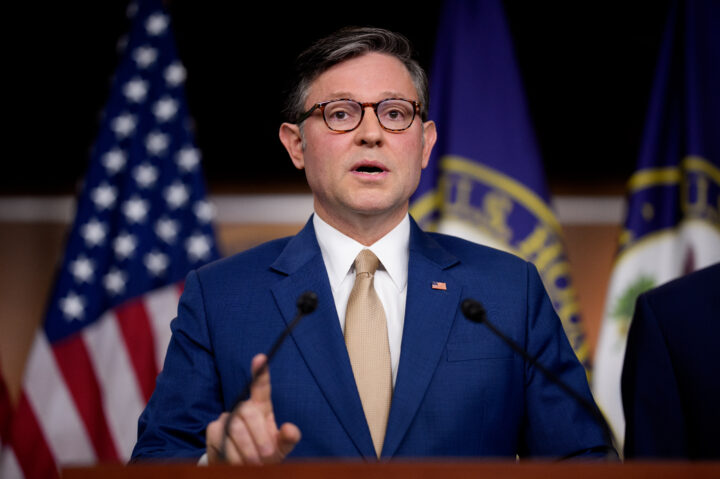
Speaker of the House Mike Johnson (R-LA) speaks during a news conference on Capitol Hill on October 20, 2025 in Washington, DC.


 Add JewishInsider on Google
Breaking with many Senate Republicans who have expressed skepticism about various elements of the Trump administration’s memorandum of understanding with Iran, House Speaker Mike Johnson defended the deal on Tuesday.
House Republicans returned to Washington on Tuesday for the first time since the deal with Iran was finalized.
“We need to keep forward with good progress, the details are still being negotiated, so I’m not going to prejudge,” Johnson said.
“There’s a lot of moving parts right now,” Johnson said, when asked whether he has concerns about the lifting of oil sanctions under the agreement, as he did for the Obama administration’s 2015 nuclear deal. “It is something the Trump administration is working around the clock on. I trust that they’re going to come to a lasting solution on that. The world desperately needs it and we do as well.”
When pressed, he said that he has “always been a supporter of strong sanctions against Iran” but added that there’s “a lot of moving parts to this” and that he’s “not going to tell the administration how to negotiate that.”
Johnson added that he is “heartened to see” gas prices decreasing and the Strait of Hormuz reopened.
While several Republican defense hawks in the Senate have criticized the administration’s deal with and concessions to Iran, others say they want to see the full effects of the agreement and the potential outcome of negotiations first.
Sen. Kevin Cramer (R-ND) said at an Orthodox Union luncheon on Tuesday that he is currently weighing in privately with Republican leadership and the White House about his views on the deal, “in the hopes that at the end of all of this, that Israel is in a better neighborhood, and I believe that … can happen.” He said he would speak out publicly if “appropriate.”
Other hawkish Republicans have pointed blame for the deal away from the president himself.
‘If you can't stand against that, you don't stand for a f***ing thing,’ the former Obama admin official said
Cheriss May/NurPhoto via Getty Images
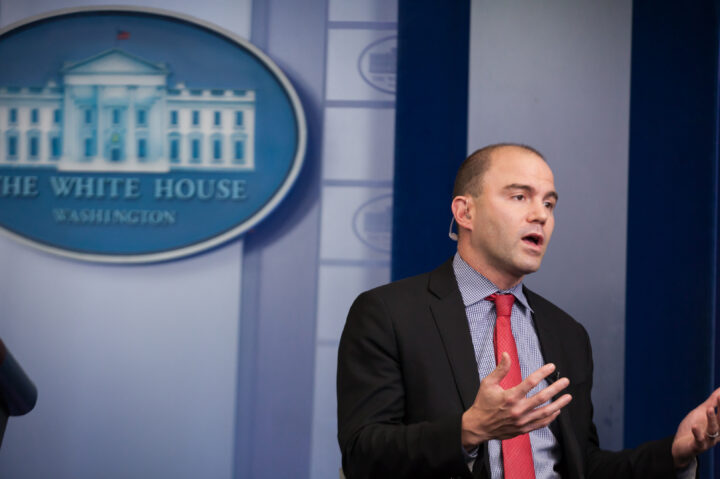
Ben Rhodes, then-deputy national security advisor to President Barack Obama, participates in an interview with press at the White House in on Wednesday, December 14, 2016.
A former top Obama administration foreign policy official said on Wednesday that any Democratic lawmakers who vote to support U.S. strikes on Iran should be primaried.
“If you vote for the funding of this war, you should be primaried. I don’t want you in the Democratic Party,” said Ben Rhodes, co-host of the “Pod Save the World” podcast and former deputy national security advisor under President Barack Obama.
He was referring to Reps. Greg Landsman (D-OH), Henry Cuellar (D-TX), Jared Golden (D-ME) and Juan Vargas (D-CA), the only four Democrats to vote against a war powers resolution last week that sought an immediate end to the U.S. military campaign in Iran.
Rhodes, who was one of the biggest boosters of the 2015 Iran nuclear deal and a leading Israel critic on the left, said the Democratic Party should have a big tent — but that support for President Donald Trump’s actions in Iran falls outside of that tent.
“I would like to have a big tent in this party. I think there should be people with different ideas of how to get health care, different ideas of taxation,” Rhodes said to co-host Tommy Vietor. “To me, this is not a left-center issue. This is a right and wrong issue. Morally, what do we stand for as Democrats?”
Rhodes suggested that Democrats who cast a vote in support of the war are doing so because of donor pressure.
“How is anybody going to trust you to fight for their health care if you’re too afraid to cast a vote, that someone might call you weak or some donor might call you and complain?” Rhodes asked. “If you as a Democrat can’t say that I am against a war and I’m not going to fund a war that is being launched by an authoritarian president, illegally, with no rational basis that is explained to the American people, that has already unleashed these consequences, if you can’t stand against that, you don’t stand for a f***ing thing.”
Jon Favreau, Jon Lovett and Ben Rhodes are listed on the host committee for an upcoming fundraiser for the Michigan Senate candidate in Hollywood
Bill Pugliano/Getty Images
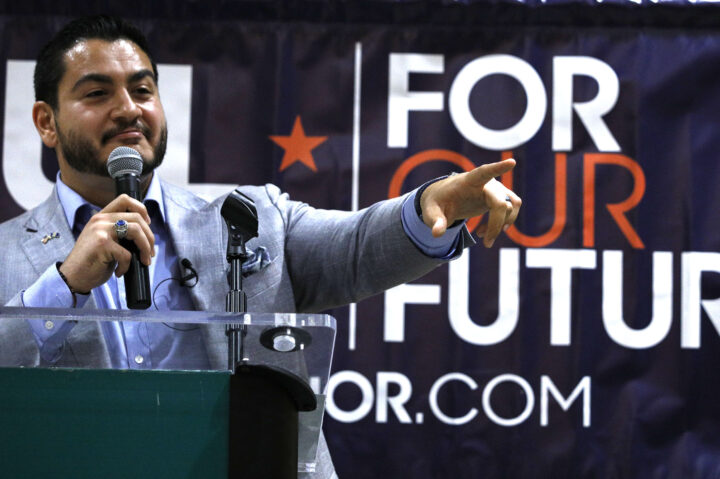
Michigan Senate candidate Abdul El-Sayed, in a 2018 campaign appearance with Rep. Alexandria Ocasio-Cortez at a rally on the campus of Wayne State University July 28, 2018 in Detroit, Michigan.
Former Obama administration officials and Crooked Media hosts Jon Favreau, Jon Lovett and Ben Rhodes are hosting a fundraiser in Hollywood, Calif., on Thursday for Abdul El-Sayed, a far-left, anti-Israel candidate running in the Democratic Senate primary in Michigan.
El-Sayed, a physician and former director of the Wayne County Department of Health, has made his criticisms of Israel a centerpiece of his campaign, criticizing other candidates in the race as being insufficiently hostile to the Jewish state.
Favreau, Lovett and Rhodes, on their “Pod Save America” and “Pod Save the World” podcasts, have also emerged as a vocal force against Israel and AIPAC in the Democratic Party, and have boosted prominent anti-Israel candidates in other hot-button primaries, including Maine’s Graham Platner.
Other listed members of the host committee for the fundraiser include Noah Redlich, Ed Redlich, Sarah Timberman, Harper Simon, Mindy Schultheis and Jeff Strauss and No Democrat Left Behind, a “progressive populist” group.
Ben Rhodes, Tommy Vietor shaped the story of the Iran nuclear deal. Now they’re trying to turn Democrats away from Israel

BRENDAN SMIALOWSKI/Getty Images
White House Deputy National Security Advisor Ben Rhodes speaks to reporters in the briefing room of the White House, April 7, 2015.
Former Obama administration officials Ben Rhodes and Tommy Vietor took to social media over the weekend to attack Israel and slam the American Israel Public Affairs Committee, asking how it’s possible to “trust Democrats to fight for anything” if they take money from the pro-Israel lobby group.
The anti-Israel activism from the Democratic influencers is a public example of the intense lobbying taking place in party circles and how progressive foreign policy officials such as Rhodes who have long been deeply critical of Israel are pushing to turn humanitarian concerns in Gaza into a more permanent split between the Democratic Party and Israel.
They’ve especially directed their ire at AIPAC, which played a key role in Democrats electing some moderate candidates supportive of a close U.S.-Israel alliance to office last year.
The left-wing commentators who host a weekly foreign policy podcast, “Pod Save the World,” decried AIPAC for a post on X where the organization said that “food, medicine and aid are IN Gaza. The @UN won’t distribute it.”
Rhodes said AIPAC is “spreading lies. The Israeli government is starving Palestinians and everyone knows it. How can we trust Democrats to fight for anything if they take money from people who lie like this about starving kids,” the former Obama deputy national security advisor posted on Friday.
Vietor, a former spokesman for Obama and the National Security Council, posted a recent clip from “Pod Save the World” where Rhodes said, “If you think you can continue to take money from AIPAC, whether you’re Hakeem Jeffries or Chuck Schumer or whomever, AIPAC is part of the constellation of forces that have delivered this country into the hands of Donald Trump and Stephen Miller.”
“And you cannot give them a carveout,” Rhodes continued. “And we need to have this fight as a party because these are the wrong people to have under your tent. I’m usually a big-tent person, but the kind of people who are supporting Bibi Netanyahu and Donald Trump, I don’t want them — my leaders of my political party — like, cozying up to those people.”
During his time at the White House, Rhodes was one of Obama’s closest advisors and masterminded the public relations push behind the 2015 Iran nuclear deal. He told The New York Times in 2016 that he “created an echo chamber” of experts who would feed reporters positive analyses of the deal. “They were saying things that validated what we had given them to say,” Rhodes stated.
Rhodes was a strident critic of Israel and Prime Minister Benjamin Netanyahu, reportedly earning himself the nickname of “Hamas” in the White House. In his 2019 book The World as It Is: A Memoir of the Obama White House, Rhodes wrote that Israel was “driven by the settler movement and ultra-Orthodox emigres” and that Netanyahu used “political pressure within the United States to demoralize any meaningful push for peace, just as he used settlements as a means of demoralizing Palestinians.”
As Obama’s spokesman, Vietor’s personal views on Israel were less public. Since leaving government though, he has frequently lambasted Israel on the podcast and on social media, posting earlier this month that Israel is “trying to globalize the ethnic cleansing.”
The podcast hosts were highly critical of the Biden administration for, in their view, not doing enough to pressure Israel, with Vietor calling the Democratic president’s “handling of Netanyahu” and the war in Gaza “disastrous.”
Vietor also dismissed the recent U.S. and Israeli strikes on Iran’s nuclear infrastructure as “failed,” saying that Trump and Netanyahu both lied about the success of the operation. Rhodes again took the opportunity to critique his party, saying that “Democrats afraid to stand against Trump on Iran — for fear of AIPAC or being called weak — are showing Americans that they won’t stand up for them when it’s hard.”
Rhodes told The New York Times in 2019 that “the Washington view of Israel-Palestine is still shaped by the donor class. … We’re one moment away from this changing, once someone breaks through the fear factor.”
Obama’s former national security advisor disagreed with David Petraeus, John Bolton over the effectiveness of the strikes

Win McNamee/Getty Images
Former National Security Advisor Susan Rice speaks at the J Street 2018 National Conference April 16, 2018 in Washington, D.C.
Susan Rice, who served as national security advisor during the Obama administration’s nuclear deal with Iran, sharply criticized President Donald Trump’s decision to strike Tehran’s nuclear program while defending the 2015 agreement during a panel discussion on Monday at the Aspen Institute’s Ideas Festival.
Rice, who was on stage with former Trump administration National Security Advisor John Bolton and former CIA director David Petraeus, disagreed with her two colleagues that Trump’s Iran strikes were largely a success.
“I think the resort to military action when diplomacy had not been exhausted was a strategic mistake,” Rice said. “And the reality is, and we’re back to this point today, only diplomacy and a negotiated settlement can ensure the sustainable and verifiable dismantling of Iran’s nuclear program. You need inspectors on the ground. You need verifiable constraints that are very significant, and you don’t achieve that by ripping up the 2015 nuclear agreement and replacing it with nothing.”
Rice joins a chorus of former Obama and Biden administration officials who have criticized Trump’s decision to strike Iran’s nuclear facilities, despite many experts concluding the damage to the program was significant. IDF Chief of Staff Eyal Zamir, for instance, said that “based on the assessments of senior officers in IDF Intelligence, the damage to [Iran’s] nuclear program is … systemic … severe, broad and deep, and pushed back by years.”
Last week, former Secretary of State Tony Blinken wrote an op-ed in The New York Times: “The strike on three of Iran’s nuclear facilities by the United States was unwise and unnecessary. Now that it’s done, I very much hope it succeeded.”
At the Aspen Ideas Festival last week, former Biden administration National Security Advisor Jake Sullivan told moderator Fareed Zakaria: “We still need a deal because Iran still has, it appears, stockpiles of enriched uranium, still has centrifuge capacity, even if the installed centrifuge capacity has been destroyed or damaged or who knows what, and still has know-how and therefore still has the possibility of reconstituting its program.”
Bolton, on the same panel as Rice, argued that the time was ripe for military action against Iran.
“I think the regime is weaker than at any point since the 1979 revolution,” Bolton said. “But I think we will never have an opportunity this good to remove not just the nuclear program but the Iranian support for terrorism, which dates back to 1979 when they seized our embassy employees and it went downhill from there.”
Bolton outlined several ways in which Iranians are dissatisfied with the regime, including economic stagnation and state of women’s rights in the country.
“The answer is regime change. But in the meantime, we want to make sure that there aren’t any even possible successful efforts by Iran to do something with what they have,” Bolton said.
Turning to Israel’s war in Gaza, all members of the panel argued that Israel needed to shift its strategy to successfully eliminate Hamas. Bolton said that, despite successfully degrading the terror group’s organizational structure, Israel had not successfully fulfilled all of its war goals, which include eliminating Hamas and securing the release of all the hostages.
Bolton argued that an additional objective of the war should be to “provide a better future for the Palestinians without Hamas in their lives. The only way you can achieve all four of these is … by going in and conducting a comprehensive civil military counterinsurgency campaign. You clear every building floor room and block all the tunnel entrances, let the people that belong there back in with biometric ID cards, and then you have an entry control point to the rest of Gaza. With security, anything is possible.”
Peter Orszag, now the CEO of Lazard, urged party leadership to do more to confront growing extremism from within

SAUL LOEB/AFP via Getty Images
Peter Orszag (L), director of the Office of Management and Budget (OMB), attends a meeting with President Barack Obama (R) at the White House on June 29, 2010.
Former Obama administration OMB Director Peter Orszag, the CEO of Lazard, sounded an alarm Thursday morning over the leftward direction of the Democratic Party, especially when it comes to its handling of antisemitism.
He spoke out on CNBC after far-left state Assemblyman Zohran Mamdani won the Democratic nomination for New York City mayor.
“I’m saddened to say the Democratic Party is becoming increasingly antisemitic and anti-capitalism… Turning away from your principles and towards antisemitism never works,” Orszag said on CNBC’s “Money Movers” this afternoon.
He went on: “The Democratic candidate for mayor has embraced the global intifada idea. The DCCC has distributed fundraising emails from a senior Democratic operative [James Carville] saying Jewish donors [are] only interested in tax cuts. The senior leadership in the party seems to have cognitive dissonance on Israel. It’s problematic.”
Orszag has been a major figure in the Democratic Party for years, most prominently serving in the Obama administration as director of the Office of Management and Budget.
As antisemitism increases, he said that he had expressed these concerns to Democratic leadership, including House Minority Leader Hakeem Jeffries (D-NY) and Senate Minority Leader Chuck Schumer (D-NY), who has faced his own challenges navigating the ideologically divisive New York City mayoral race.
“I think the New York mayoral race is only part of the broader question. I think the Democratic Party needs to decide what it stands for,” Orszag said. “It needs to decide what its moral principles are and that includes [regarding] antisemitism.”
When asked about how Lazard would respond to a Mamdani mayorship, he said the bar for the company leaving was “very high” and would depend on what policies are implemented.
Shapiro said that the attack likely ends nuclear talks and raises questions about if and when the U.S. would strike Iran directly and whether Iran will sprint to nuclear breakout

Michael Brochstein/SOPA Images/LightRocket via Getty Images
Dan Shapiro, former ambassador of the United States to Israel, at the American Zionist Movement/AZM Washington Forum: Renewing the Bipartisan Commitment Standing with Israel and Zionism in the Capitol Visitor Center in Washington, D.C.
Daniel Shapiro, a deputy assistant secretary of defense under the Biden administration, U.S. ambassador to Israel under the Obama administration and senior fellow at the Atlantic Council, said in an interview with Jewish Insider on Friday morning that Israel’s strikes against Iran’s nuclear facilities would likely halt any further efforts toward a diplomatic solution to Iran’s nuclear program.
Shapiro also said that major questions ahead for the region will be if and under what circumstances the U.S. would directly join Israeli strikes on Iran, and whether the strikes prompt Iran to attempt to make a sprint to a nuclear bomb.
This interview has been edited for length and clarity.
Jewish Insider: What are your biggest takeaways from these strikes?
Shapiro: These strikes lay bare the depth of Iran’s miscalculation following Oct. 7. Just stack it up: their top proxy in Lebanon, Hezbollah, is gone or deeply damaged. The Assad regime has gone. Their own state-to-state attacks against Israel in April and October were pretty ineffective, and then Israel did significant damage in response last October.
But since the state-to-state taboo has been broken, Israel demonstrated last night that it has full penetration of the Iranian system and the ability to wreak havoc across the system. Iran really has never looked weaker, and its ability to respond meaningfully is going to be tested.
So far, they haven’t mustered a very effective response. I’m sure they will. They will continue to respond, but the first wave of 100 or so UAVs was not very effective.
Now the story doesn’t end here. Israel’s already conducting additional attacks. Iran is going to be very motivated to try to sprint to a nuclear breakout at one of their hardened underground facilities. And the United States, I’m sure, is going to assist Israel with defense against any retaliation.
But the prospect of a diplomatic resolution that President Trump very much wanted, that would end Iranian enrichment, I think, is pretty much dead, and it’s more likely that he’ll be faced with a decision on whether to use the U.S. capabilities to destroy Iran’s underground nuclear facilities and to prevent an Iranian nuclear weapon.
So that’s a big decision that may be still ahead, and could be the type of dilemma that splits his advisors, his political base, and probably will raise accusations from some corners that Israel is trying to drag the United States into the war.
JI: Let’s say the U.S. doesn’t get involved and doesn’t strike those facilities … What are the implications of that?
DS: The United States has unique capabilities to deal with the underground, deeply hardened sites. It could mean, if the United States is not involved, that those sites survive and are the place where Iran would be, if they chose, trying to execute their nuclear breakout.
That doesn’t mean that’s the only way to address those sites, and so if Israel is intent on really eliminating any threat of a nuclear Iran, it may turn to other methods … I think it’s going to be probably a very intense conversation between Netanyahu and Trump about the pros and cons of U.S. participation.
JI: Do you think that this is going to prompt Iran to move to nuclear breakout?
DS: I think they’re going to be very motivated to try to sprint to a breakout. They’ve often always seen their nuclear program as a pillar of the regime’s survival … If they’re looking for a way to gain a deterrent that would preserve what can be preserved, there’d be a strong case within their system to try to sprint to achieve a nuclear weapon. But there’s also chaos in their leadership right now, because so many of the top leaders were killed last night. So I don’t think that’s a decision that’s necessarily being made immediately.
JI: As we’re looking ahead to potential Iranian retaliation, [how do you think] some of the other states in the region are going to respond? So far, it seems like Jordan [intercepted some] of that first wave of drones … Do you think we’ll see the same sort of coordinated regional response effectively in defense of Israel like we saw last April?
DS: I think countries will act to defend their own airspace and their own assets. I think generally, they will not want to be advertised as participating in a defense of Israel, per se. But that doesn’t mean, even in defending their own airspace, they don’t in some way participate. …
But I think most of the countries want to distance themselves from this action … They want to not give Iran any motivation or excuse to attack them or to associate them with the strikes … I suspect in private rooms, there’s probably some cheering going on in Arab capitals when they’ve seen the extent of the damage to the Iranian military.
JI: How do you read the response we’ve been seeing from the Trump administration so far?
DS: I think President Trump wanted more time to pursue his diplomatic initiative and to try to reach an agreement. And so I think this was not his preference to have this action take place this soon.
However, it’s inconceivable Israel didn’t provide some forewarning, and if he didn’t give a firm red light, he probably gave sort of a yellow light. Israel may have argued that Iran was taking, or had taken, or was on the verge of taking some new steps that would shorten the already very short distance to nuclear breakout, or would advance their weaponization research. …
The initial statement from Secretary Rubio was intended to make clear that the United States was not a direct participant, and to try to dissuade Iran from responding in any way against the United States, and to warn them that if they did, it would be a very, very heavy price. …
The big question ahead, as I mentioned at the beginning, is, would the United States, under any circumstances, participate in strikes against Iran? And if so, what would be the trigger for that? Would it be the appearance that Iran is trying to do a nuclear breakout at the Fordow facility? Would it be in response to any kind of Iranian action against U.S. bases?
JI: In an alternate history where Joe Biden or Kamala Harris are in the White House, how do you think they would have handled this? Would they have given the same “yellow light?”
DS: I think it’s impossible to answer the hypothetical without knowing more about the information that Israel may have presented.

Iranian Ministry of Foreign Affairs/Anadolu via Getty Images
Iranian Deputy Foreign Minister Abbas Araghchi meets with Italian Foreign Minister Antonio Tajani in Rome, Italy on April 19, 2025, as the second round of nuclear talks between Iran and the United States begins in the Italian capital, following the first round held in Oman.
Good Tuesday morning.
In today’s Daily Kickoff, we look at the state of the New York City mayoral race two months before the Democratic primary, and talk to former Obama administration officials about the Trump administration’s pursuit of a nuclear deal with Iran. We report on the firing of the Columbia Journalism Review’s executive editor in part over his concerns over the blurring of lines between activism and journalism, and cover the Anti-Defamation League’s new audit of antisemitic incidents. Also in today’s Daily Kickoff: Rep. Haley Stevens, Pierre Poilievre and Eden Golan.
What We’re Watching
- Secretary of State Marco Rubio and Middle East envoy Steve Witkoff are slated to meet this morning with Qatari Prime Minister Mohammed bin Abdulrahman Al Thani in Washington.
- The Vatican announced that the funeral for Pope Francis will be held on Saturday. President Donald Trump said that he and First Lady Melania Trump will attend, marking the president’s first overseas trip of his second term.
- Israeli Prime Minister Benjamin Netanyahu will convene the security cabinet this evening to discuss U.S.-Iran talks and Iran’s nuclear program.
- Israeli National Security Minister Itamar Ben-Gvir is in the U.S. this week for a multicity trip that includes events and meetings in Miami, Washington and New York.
- The National Press Club postponed a press conference featuring leaders of the Middle East Broadcasting Networks, which had been slated to take place this morning.
What You Should Know
In two months, New York City Democratic voters will head to the polls to vote for the candidate who will likely be the city’s next mayor. The primary, featuring former New York Gov. Andrew Cuomo and a cast of lesser-known local Democrats, will be one of the first tests for the party over its direction in the new Trump era, Jewish Insider Editor-in-Chief Josh Kraushaar writes.
The race pits a pragmatic, established figure in Cuomo, who has high name recognition but plenty of baggage stemming from allegations of sexual misconduct that led him to resign from the state’s governorship. One of his emerging opponents is a charismatic far-left candidate, state Assemblyman Zohran Mamdani, who, as The Free Press puts it, “wants to turn the Big Apple into a Havana on the Hudson.” Cuomo has been a pro-Israel stalwart, while Mamdani represents the Democratic Socialists of America wing of the party that is virulently anti-Israel.
There are many other candidates in the race, but few who are presenting the ideologically moderate profile that Cuomo brings to the table. Most are trying to capture the activist energy of the AOC wing of the party, even if their specific policy positions on local issues vary. This, despite the fact that the New York City electorate moved decidedly to the right in the 2024 elections, with working-class voters in particular rejecting the leftward drift of the party.
Polls have shown Cuomo with a significant advantage, but with elevated unfavorable ratings. A recent Siena poll conducted for the AARP found Cuomo leading Mamdani 34-16% on the first ballot, and by a substantial 64-36% margin at the end of the ranked-choice voting process. The poll found him dominating voters over 50 with 42% of the vote (with the next-closest challenger, Scott Stringer, only polling at 9% with older voters), but actually trailing Mamdani with younger voters between the ages of 18-49.
A separate statewide Siena poll, conducted in March, found Cuomo with just a plus-12 favorability (51-39% fav/unfav) among Democratic voters in the Empire State. Like many traditional Democratic figures, even as a front-runner, he’s struggling to win support among the younger voters whose anti-establishment views are disrupting the party.
The primary election will come as Democrats are trying to figure out the party’s future direction amid a humiliating defeat last November. The results showed that progressivism was a turnoff to swing voters, especially among nonwhite working-class voters that once made up the base of the party in cities like New York. Despite the Trump administration’s disruptiveness in its first months, there hasn’t been the same level of rallying against the White House, compared to the surge of activism after President Donald Trump’s first election.
Indeed, the moderates have the electoral momentum at their back. San Francisco Mayor Daniel Lurie, running on a Bloomberg-style technocratic message of competence over ideology, unseated a progressive incumbent last November. Two pragmatic pro-Israel Democrats ousted two of the most radical members of Congress, former Reps. Cori Bush and Jamaal Bowman, in primaries. Last week’s mayoral election in Oakland, Calif. — one of the most progressive cities in the country — nearly featured an upset from a moderate insurgent against former Rep. Barbara Lee (D-CA).
At the same time, the energy in the party has remained on the left’s side. Sen. Bernie Sanders (I-VT) and Rep. Alexandria Ocasio-Cortez (D-NY) have been rallying crowds to their side since the election, in one of the few displays of grassroots enthusiasm since November. Senate Minority Leader Chuck Schumer (D-NY), a political pragmatist at heart, drew the ire of many in his party for not initiating a government shutdown in protest of the president’s policies. Newly elected DNC Vice Chair David Hogg, a 25-year-old left-wing activist, is getting attention for backing primaries to incumbent Democrats in safe seats.
June’s New York City primary will be the biggest test of whether the loud left-wing activism actually reflects the sentiment of a majority of Democratic voters. It didn’t in the last mayoral race, where Eric Adams ran as the moderate, pro-law-and-order Democrat and prevailed over candidates who were more progressive.
If the left can’t make it in a Democratic primary in Gotham, it will have trouble making it anywhere else — especially when the biggest battlegrounds for the party will be for general election voters in much redder constituencies.
tehran tango

As nuclear negotiations between Washington and Tehran continue this week, foreign policy hawks who opposed the 2015 Joint Comprehensive Plan of Action are worried about the prospective nuclear deal, which former U.S. Ambassador to the U.N. Nikki Haley dubbed “Obama 2.0” on Saturday. They aren’t wrong to spot the similarities between what President Donald Trump’s team is reportedly negotiating now and what former President Barack Obama achieved a decade ago. Several left-leaning national security experts who served in the Obama administration and were staunch advocates for the JCPOA are now cautiously cheering on the emerging potential outline of Trump’s deal as his team shuttles between Rome and Oman for negotiations with the Iranian, Jewish Insider’s Gabby Deutch reports.
Catching up: “It’s hard not to take a jab at Donald Trump for walking away from the nuclear deal in the first place, because I think if we get to a deal it’ll probably be something pretty similar,” said Ilan Goldenberg, who served as an Iran advisor at the Pentagon in Obama’s first term and then worked on Israeli-Palestinian issues under former Secretary of State John Kerry. “I have a lot of other things that I can disagree with him on, but if he wants to do the right thing here, I’ll support that.”
SHE’S RUNNING

Rep. Haley Stevens (D-MI) announced Tuesday morning that she’s entering the Democratic primary for Michigan’s open Senate seat, setting up an intraparty showdown in one of the most consequential battleground states in the country, Jewish Insider’s Marc Rod and Josh Kraushaar report. Stevens is a leading contender for the seat of retiring Sen. Gary Peters (D-MI). She will be facing state Sen. Mallory McMorrow and Abdul El-Sayed, who led the Wayne County Department of Health, Human and Veterans Services. Former Michigan House Speaker Joe Tate, a former NFL player, is also seriously considering a run.
Jewish community perspective: Stevens is a favorite within the state’s Jewish community for her outspoken support for Israel and condemnation of high-profile antisemitic incidents at a time when many Michigan Democrats have pandered to anti-Israel activists. She represents a sizable Jewish community in the Detroit suburbs with which she forged a strong relationship in part during her successful primary campaign against then-Rep. Andy Levin (D-MI). But pro-Israel groups also view McMorrow as a reliable ally, and are more concerned with blocking the candidacy of El-Sayed, a Bernie Sanders-endorsed progressive who supports cutting off aid to Israel.
antisemitism audit

Jews in America faced more than 25 anti-Jewish incidents per day last year — more than one per hour. All told, as the war in Gaza raged on and campus protests exploded across the country, 2024 saw the largest number of reported antisemitic incidents on record, with over 9,000 incidents of antisemitic assault, harassment and vandalism in the U.S., according to the Anti-Defamation League’s annual Audit of Antisemitic Incidents, which was released on Tuesday, Jewish Insider’s Haley Cohen reports.
Driving force: It is the highest level recorded since the ADL first began collecting data in 1979. 2024 also marked the first year that Israel- and Zionism-related incidents made up a majority of all occurrences (58% of the total). “In 2024, hatred toward Israel was a driving force behind antisemitism across the U.S., with more than half of all antisemitic incidents referencing Israel or Zionism,” Oren Segal, the ADL’s vice president of the ADL Center on Extremism, said in a statement.
courtroom clash

Harvard University filed suit against the Trump administration on Monday in response to its multibillion-dollar cuts to the university — which came in part due to what the White House perceives as a failure to combat the rise of antisemitism that has roiled the Ivy League’s campus since the Oct. 7, 2023, terrorist attacks. The filing, which argues that the funding freeze violates the First Amendment by “imposing viewpoint-based conditions on Harvard’s funding,” comes one day after the Trump administration reportedly planned to cut another $1 billion in federal grants and contracts from Harvard, Jewish Insider’s Haley Cohen reports. The administration had already cut $2.2 billion last week and has put a total of $9 billion of its funding under review.
What they’re saying: An April 11 letter from the Trump administration called for reforms to Harvard’s governance structure, its hiring of faculty, its admissions policies and its approach to antisemitism, with stringent federal reporting requirements — demands were expected to be implemented by August. In the 51-page complaint filed in federal court in Massachusetts, Harvard’s lawyers wrote that “the tradeoff put to Harvard and other universities is clear: Allow the Government to micromanage your academic institution or jeopardize the institution’s ability to pursue medical breakthroughs, scientific discoveries, and innovative solutions.”
BACKLASH BEAT

After being let go from his post as executive editor of the Columbia Journalism Review last week, Sewell Chan pinned the firing — which he called “hasty” and “ill-considered” — in part on a recent interaction he had with a staff member “passionately devoted” to activism in support of Gaza on Columbia’s campus, Jewish Insider’s Haley Cohen reports.
Chan’s statement: Chan wrote that he was informed last Monday of complaints from staff regarding three separate interactions in the past weeks during which he gave what he described as “fair and critical feedback rooted in editorial rigor.” Among those communications, according to Chan, included a talk with a fellow who was “passionately devoted to the cause of the Gaza protests at Columbia.” The student journalist had written an article about the “recent detention of a Palestinian graduate student” for a publication that he had previously covered for CJR. Chan did not disclose the name of the student or the publication. “I told him there was a significant ethical problem with writing for an outlet he had just covered,” Chan wrote, adding that the other two interactions involved letting go a staff member who “declined” to come into the office and write at least one story a week, despite the journalism school’s attendance policy; as well as a second conversation with an editor working on a “sensitive” investigation about sexual harassment.
HUCKABEE IN THE HOLYLAND

U.S. Ambassador to Israel Mike Huckabee conveyed a message to the growing isolationist camp on the American right as he submitted his diplomatic credentials on Monday in Jerusalem: Maintaining close relations with Israel and countering the Iranian nuclear threat are beneficial to Americans. “The Iranian regime and all the hostility it has inflicted on the world for 46 years continues to threaten not only the peace of Israel but the peace of the United States,” Huckabee said in the ceremony at the residence of Israeli President Isaac Herzog, Jewish Insider’s Lahav Harkov reports. “Iranians have always said, ‘Death to Israel,’ and chapter two is ‘Death to America’… Israel is the appetizer, and the United States is the entree.” He added, “We care deeply about the threats that face Israel because those are also the threats that face our country.”
Two-way street: “It’s also important for Americans to know that, while we hope to be a good friend of Israel and provide assistance when we can, I never want Americans to think that we Americans are not greatly benefitted by our partnership with our ally Israel,” the ambassador stated. “We benefit dramatically in the sharing of intelligence, in the sharing of technology and in the sharing of agricultural innovation that Israel has led the world in creating.”
Worthy Reads
No Endgame in Sight: The Washington Post’s David Ignatius posits that both Israeli Prime Minister Benjamin Netanyahu and Hamas are refusing to take serious steps to reach the end of the war because such a deal would endanger each of their holds on power. “Wars end when public opinion demands peace. And there are new demands from Palestinians and Israelis alike to break the logjam and move toward a new ceasefire and hostage release. The anti-war protesters aren’t a majority on either side, but they illustrate the bitterness and exhaustion this conflict has produced. Thousands of Palestinians courageously joined anti-war protests in Gaza last month, according to Associated Press reporters there. … The awful truth at the center of this conflict is that Netanyahu has never had a plan for what happens when it’s over. He wants a Gaza that’s not governed by Hamas or reoccupied by Israel, but he refuses to create a pathway for eventual Palestinian governance because this would rupture his right-wing coalition.” [WashPost]
Job Insecurity: The Atlantic’s Rose Horowitch looks at the challenges facing Ivy League presidents, following Columbia University’s announcement that it would begin a search for the school’s next leader after the departure of its third president in as many years. “With declining trust in higher education, campuses fractured over the Israel-Hamas conflict, and a White House eager to wage populist war on elites (a White House run, incidentally, by Trump, a University of Pennsylvania graduate, and Yale Law alumnus J. D. Vance), the job of elite college president, formerly considered difficult but prestigious, has become, on many campuses, impossible and thankless. Presidents are charged with leading an inflexible organization made up of autonomous and competing constituencies through a period that requires immediate change. But they can’t do anything without angering either parents, students, professors, donors, administrators, or Trump. Any false step might cost them their position. … Universities searching for new presidents are now prioritizing candidates who can play politics on a national level — candidates with political acumen and crisis-management experience.” [TheAtlantic]
Split Screen: Tablet’s Park MacDougald looks at the ideological fights at the Pentagon that have fueled for the recent upheavals within the department. “We are not witnessing an ‘internal fight; within MAGA, because there is no MAGA beyond Trump. Instead, [writer Lee] Smith wrote, ‘What we’re seeing … is an external faction trying to attach itself to MAGA in order to strangle Trump’s America First foreign policy.’ With that faction now openly attacking the administration and making common cause with its enemies to undermine the administration, the only question is how much longer Trump can put up with it.” [Tablet]
Word on the Street
President Donald Trump is backing Defense Secretary Pete Hegseth amid discord within the Pentagon, investigations into leaks and security breaches and the departures of numerous senior Pentagon officials in recent weeks…
The House Committee on Education and the Workforce summoned DePaul University President Robert Manuel to testify in its upcoming hearing on campus antisemitism next month…
A federal jury found Nadine Menendez, the wife of former Sen. Bob Menendez (D-NJ), guilty of bribery and obstruction charges tied to money and gold bars her husband received while in office; Menendez will be sentenced in June, the same month her husband is slated to start his 11-year prison term…
In The Wall Street Journal, former White House staffer and presidential historian Tevi Troy looks at the history of Hollywood figures advising Democratic presidential candidates following the release earlier this month of Chris Whipple’s Uncharted: How Trump Beat Biden, Harris and the Odds in the Wildest Campaign in History…
Canadian Conservative Party leader Pierre Poilievre suggested that if his party wins the country’s upcoming elections, the government will consider funding cuts to universities that don’t act to address campus antisemitism…
Jason Horowitz, the Rome bureau chief for The New York Times, reflects on the time he spent covering and traveling with Pope Francis prior to the pontiff’s death earlier this week…
A new report from the Claims Conference found that 70% of the remaining 200,000 Holocaust survivors in the world will die in the next decade; the median age of survivors is 87…
Israeli cybersecurity startup Cyvore Security emerged from stealth mode with an initial investment of $2.5 million…
Shin Bet head Ronen Bar alleged in an affidavit that Israeli Prime Minister Benjamin Netanyahu had demanded Bar display personal loyalty to Netanyahu; among other scathing allegations, Bar, whom Netanyahu is attempting to dismiss, said that the prime minister had ordered him to spy on Israelis involved in anti-government protests…
Israeli Finance Minister Bezalel Smotrich told an Israeli radio station that bringing the hostages home was a secondary war aim to destroying Hamas…
Israel canceled the visas for 27 left-wing French lawmakers who had been slated to travel to the country this week, citing an Israeli law that allows for the revocation of visas to travelers who could act against the State of Israel…
An Israeli man is missing and feared dead after being filmed tussling with at least one shark off the coast of Hadera…
Palestinian media reported that Syrian officials arrested two senior leaders of Palestinian Islamic Jihad based in Syria…
Anne Neuberger, who served as deputy national security advisor for cyber and emerging technology in the Biden administration, was named the Frank E. and Arthur W. Payne Distinguished Lecturer at the Center for International Security and Cooperation at Stanford University…
Sociologist Herbert Gans, whose research focused on American society in the second half of the 20th century, an interest he attributed to the absence of culture in Germany, from which he escaped as a child, died at 97…
Pic of the Day

Eden Golan released the music video for her new song, “Pieces.”
Birthdays

Real estate developer and principal owner of the NFL’s Minnesota Vikings, Zygmunt “Zygi” Wilf turns 75…
Calgary-based CEO of Balmon Investments, Alvin Gerald Libin turns 94… Co-founder of Human Rights Watch and formerly national director of the ACLU, Aryeh Neier turns 88… English journalist and former anchor of BBC Television’s “Newsnight,” Adam Eliot Geoffrey Raphael turns 87… Conductor and professor of music at Boston University, Joshua Rifkin turns 81… Former longtime mayor of Madison, Wis., Paul R. Soglin turns 80… Managing director emeritus of Kalorama Partners, D. Jeffrey (“Jeff”) Hirschberg… Former chief economist at the World Bank, Sir Nicholas Herbert Stern turns 79… President and chief investment officer of Alphabet Inc. and its subsidiary Google, Ruth Porat turns 68… Three-time Pulitzer Prize-winning investigative reporter for The Washington Post, Sari Horwitz turns 68… NYC area accountant, he is a partner at EisnerAmper LLP, Edward Lifshitz… Chicago-based philanthropist who serves as president of the National Ramah Commission, Arnie Harris… New Zealand native now serving as the CEO of Australian-based job-board SEEK, Ian Mark Narev turns 58… Founder and editor of the data-journalism and research initiative themadad, Shmuel Rosner turns 57… NYC-based attorney, member of Kriss & Feuerstein LLP, Jerold C. Feuerstein turns 57… News director of The Forward, Benyamin Cohen turns 50… Russian and Israeli public figure, media manager and an art dealer, Yegor Altman turns 50… Member of the Knesset for the National Unity party, Yehiel Moshe “Hili” Tropper turns 47… Tel Aviv-based deputy bureau chief for The Wall Street Journal, Shayndi Raice… Managing director of external communications for the Jewish Federations of North America, Niv Elis… CEO of OpenAI, Sam Altman turns 40… Associate at Skadden, Arps, Slate, Meagher & Flom, Zachary Krooks… Competitive ice dancer, Elliana Pogrebinsky turns 27…
Please log in if you already have a subscription, or subscribe to access the latest updates.
 Continue with Google

 Continue with Apple