







































































White House Press Secretary Karoline Leavitt said the deal, which was already signed, is ‘still being finalized’
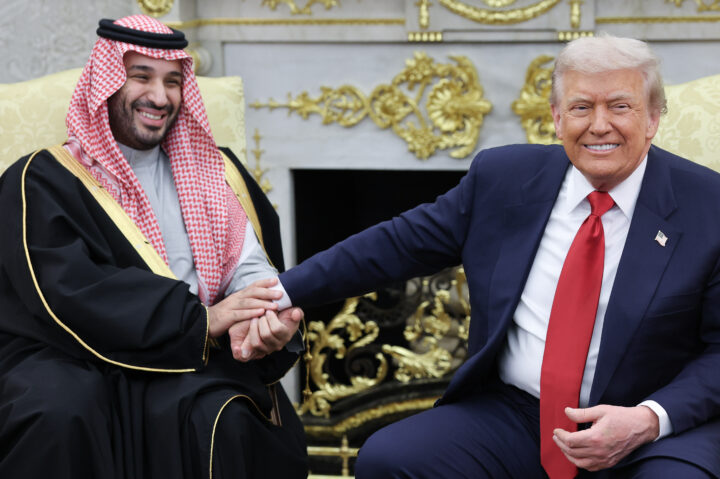
Win McNamee/Getty Images
President Donald Trump (R) meets with Crown Prince and Prime Minister Mohammed bin Salman of Saudi Arabia during a bilateral meeting in the Oval Office of the White House on November 18, 2025.


 Add JewishInsider on Google
The new civilian nuclear cooperation agreement already signed between the U.S. and Saudi Arabia is now contingent on Riyadh joining the Abraham Accords, President Donald Trump announced on Thursday morning.
The president’s Truth Social post — in which he said the deal is “totally subject” to Saudi Arabia normalizing relations with Israel, a provision not previously disclosed by the administration — was quickly affirmed by the White House.
“Yes, this deal with Saudi Arabia, the energy deal, is contingent on this condition as far as the president is concerned,” White House Press Secretary Karoline Leavitt said during a press briefing on Thursday. “So we’ll continue to talk with our Saudi counterparts to get the deal finalized, and hopefully see them joining the Abraham Accords very soon.”
It appeared that Trump thought to add the provision only after the signing ceremony, which took place on Wednesday afternoon between Energy Secretary Chris Wright and Saudi Energy Minister Prince Abdulaziz bin Salman.
Asked if Trump had spoken to Saudi Crown Prince Mohammed bin Salman about it, Leavitt said, “As you know, the president just put out this statement a few hours ago. I don’t believe he’s had a call with MBS in the hours since.”
The new addition may have thrown a wrench in the agreement: Leavitt said the deal is “still being worked out,” despite already having been signed by the parties, and “will eventually, hopefully, be finalized with the condition that the president spoke about this morning.”
Leavitt also said she did not believe the provision was requested by Israeli Prime Minister Benjamin Netanyahu.
Senior Democrats urged caution in any deal that would allow the Gulf kingdom to enrich uranium

Jemal Countess/Getty Images for Fair Share America
Sen. Richard Blumenthal speaks at a rally at the Capitol on April 10, 2025 in Washington, DC.
Democratic lawmakers are expressing concerns about the administration’s apparent moves toward a nuclear deal with Saudi Arabia that would allow the kingdom to enrich uranium, lacking the safeguards that were included in a similar nuclear cooperation deal with the United Arab Emirates.
There had previously been bipartisan support in Congress for including such safeguards, including intrusive International Atomic Energy Agency inspections, under an “additional protocol” of the Nuclear Nonproliferation Treaty, and the “gold standard” commitment of renouncing nuclear enrichment and reprocessing included in the UAE deal. Even Energy Secretary Chris Wright last year denied that the U.S. would allow Saudi enrichment.
Asked about the situation this week, Democrats — across a broad ideological spectrum — expressed concerns, while Republicans generally avoided commenting, saying they weren’t familiar with the administration’s apparent plans.
“I think we should be extremely cautious and scrutinize — very exactingly — any deal with Saudi Arabia that provides nuclear know-how or fuel, and certainly it has to be a part of a broader agreement for normalizing relations with Israel that expands the Abraham Accords,” said Sen. Richard Blumenthal (D-CT).
“It can’t be a separate action, apart [from] everything else that’s going on, where we need Saudi cooperation,” Blumenthal continued.
Sen. Mark Kelly (D-AZ) told JI he wasn’t aware of the terms of the proposed deal, but said that there is a “whole range” of what enrichment can entail.
“You see this with Iran,” he said. “We gave them, in the 1970s, the ability to do medical-grade enrichment. [There is a] big difference with that and enriching uranium up to 90% have the ability to then make a weapon. I haven’t looked at the proposal. I think we’ve got to be generally very careful about how we transfer this technology.”
Sen. Ed Markey (D-MA) last week accused the administration in a statement of “caving to Saudi demands and … writing a recipe for disaster with its plan to give nuclear-weapon-wannabe Saudi Arabia nuclear technology without the strongest safeguards.” He said Congress should block the deal in order to prevent a nuclear arms race in the Middle East.
Rep. Brad Sherman (D-CA), a vocal critic of efforts to allow Saudi Arabia to enrich, re-introduced legislation on Tuesday requiring a congressional vote of support for an agreement with Saudi Arabia, saying in a statement, “Any nuclear agreement with Saudi Arabia must include ironclad nonproliferation protections. … Without the strongest safeguards, we risk fueling nuclear proliferation in one of the world’s most volatile regions.”
He has previously warned that a Saudi nuclear program could ultimately be turned to target Israel should the kingdom’s stance change or the ruling family fall from power.
Previously, lawmakers on both sides of the aisle have demanded the same “gold standard” commitments from Saudi Arabia that the U.S. received from the UAE, with both the chair and ranking member of the Senate Foreign Relations Committee affirming that stance last year.
Sen. Jim Risch (R-ID), the committee chair, said last year that any nuclear deal with Saudi Arabia “has to” include the “gold standard.” He did not provide a comment this week.
Asked by JI about the latest developments, several Senate Republicans said they had not been following the situation and largely declined to comment.
A group of nine Jewish House Democrats last year also raised concerns about efforts to move toward a nuclear deal with Saudi Arabia unless “explicitly … tied to the Kingdom’s recognition of Israel and normalization of relations between the two countries.”
Andrea Stricker, a research fellow and deputy director of the nonproliferation program at the Foundation for Defense of Democracies, told JI that Israel should be “worried” about a potential nuclear deal between the U.S. and Saudi Arabia, describing it as a “stunning reversal” of longstanding U.S. policy.
She noted that the decision to disregard typical safeguards is cause for concern, warning that completing such a deal can have unpredictable consequences down the line.
“We can’t control how the Saudis will use enrichment and reprocessing in the future, even if they are a partner today,” said Stricker. “With weak safeguards in place, Riyadh could duplicate the technology and set up covert fuel-making plants for nuclear weapons.”
Jonathan Ruhe, a fellow at the Jewish Institute for National Security of America, said that Saudi Arabia cannot be trusted with a nuclear deal, adding that it is “bad politics” for the U.S. to “demand that Iran end enrichment while possibly partnering up with its rival’s enrichment program.”
“It also sends the wrong message to partners like the UAE that signed up for the gold standard deal with the United States, which rightly prohibits such activities,” Ruhe added. He warned that such a deal could “set off a regional proliferation cascade,” from actors such as Iran, Turkey and Egypt.
Simon Henderson, a senior fellow at The Washington Institute for Near East Policy, said the United States faces a delicate balancing act: pursuing a deal that could carry long-term proliferation risks while also trying to prevent Saudi Arabia from turning to rival powers for nuclear cooperation.
“The United States is trying to do what is arguably impossible: allow Saudi Arabia to acquire American civil nuclear technology while hoping that it isn’t used as a cover for being able to make an atomic bomb,” Henderson said.
Henderson downplayed concerns that the prospective deal is not explicitly tied to Saudi-Israel normalization, telling JI that normalization is “delayed rather than dead.” He also dismissed the notion that a civil nuclear agreement with Riyadh would pose a threat to Israel.
“Iran is the threat to Israel, not Saudi Arabia,” Henderson said. “Even without formal relations, Riyadh and Jerusalem are on the same page on many issues.”
The administration notified lawmakers last year that it is moving toward a nuclear deal with Riyadh, potentially lacking safeguards around Saudi enrichment
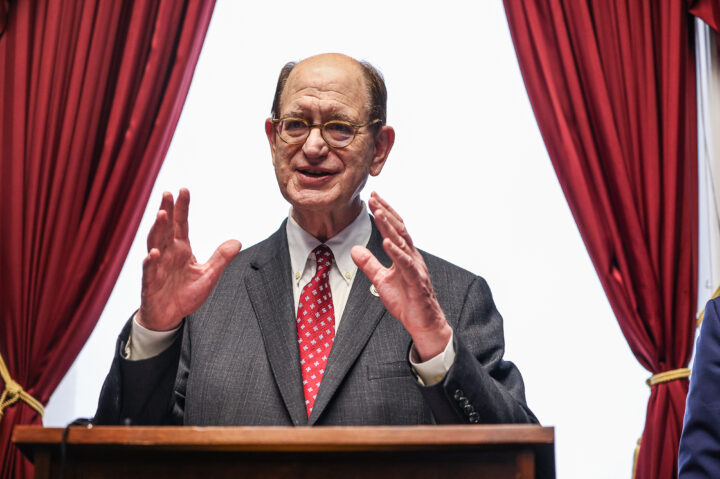
Valerie Plesch/Bloomberg via Getty Images
Rep. Brad Sherman, a Democrat from California, during a news conference.
Rep. Brad Sherman (D-CA) said Tuesday that he’s pushing for legislation to require an affirmative congressional vote prior to the U.S. reaching any nuclear deal with Saudi Arabia, following a notification from the administration to Congress indicating that it is moving toward a deal that could allow Riyadh to enrich uranium for civilian purposes.
Sherman has been a longtime opponent of nuclear cooperation with Riyadh, warning that a Saudi civilian nuclear program would be the first step toward a nuclear weapon that could one day be turned against Israel. The White House announced plans for a nuclear cooperation agreement with Saudi Arabia in November during a Washington visit by Saudi Crown Prince Mohammed bin Salman.
Such a deal had previously been coupled with Saudi normalization with Israel, as had advanced weapons sales to the kingdom, but the Trump administration has de-linked those initiatives.
Sherman said during a hearing of the House Foreign Affairs Committee on Tuesday that the administration notified some House Republicans in November of plans to forge a nuclear deal with Saudi Arabia.
The notification procedures, which do not include specific terms of a potential deal, suggest that that Saudi Arabia will not be required to agree to more intrusive International Atomic Energy Agency inspections (known as the “additional protocol” to the Nuclear Nonproliferation Treaty) or “gold standard” safeguards — which would require Saudi Arabia to agree not to enrich or reprocess nuclear material — used for the U.S. nuclear cooperation agreement with the United Arab Emirates.
Those “gold standard” safeguards, which would make it more difficult for Saudi Arabia to repurpose a civilian nuclear program for military purposes, have been a baseline expectation for some lawmakers in earlier rounds of nuclear talks with Saudi Arabia.
The text of the congressional notification was shared with and published by the Arms Control Association earlier this month. While the notification does not specifically state that the agreement will allow for Saudi enrichment, it includes language stating that the deal will employ “additional safeguards and verification measures to the most proliferation-sensitive areas of potential nuclear cooperation … (enrichment, conversion, fuel fabrication, and reprocessing).”
Sherman said that the administration had failed to properly notify congressional Democrats of its plans, as required under law, and that no Democrat on the committee was aware of the report before February.
“We’ve got to look at whether we want a nuclear cooperation agreement with Saudi Arabia that does not have the safeguards that we negotiated with the UAE,” Sherman said.
He said he’s collecting support for a bill he originally introduced in 2019 with Secretary of State Marco Rubio, then a senator, to require the affirmative support of Congress for any nuclear deal with Saudi Arabia.
“I think Sen. Rubio was wise, perhaps sometimes wiser than Secretary Rubio, and I hope that all members will join me in that effort,” Sherman said.
Please log in if you already have a subscription, or subscribe to access the latest updates.
 Continue with Google

 Continue with Apple