











































































The lawmakers warned of a lack of safeguards in the deal to prevent Riyadh from obtaining a nuclear weapon

Tom Williams/CQ-Roll Call, Inc via Getty Images
Rep. Gregory Meeks (D-NY)


 Add JewishInsider on Google
A group of House Democrats introduced a resolution on Thursday to block the U.S. nuclear agreement with Saudi Arabia, citing the lack of safeguards in the deal applied in previous agreements with other U.S. allies and arguing that the deal paves the path toward a Saudi nuclear weapon.
Under procedural rules, the Democrats should be able to force votes on the resolution, which seems likely to pick up support from most Democrats and potentially a handful of Republicans.
Given the tight margins in each chamber, the resolution could — but is far from guaranteed to — pass, but is unlikely to meet the two-thirds majority needed to override a presidential veto, should the administration push ahead anyway.
“This U.S.-Saudi nuclear agreement dangerously departs from decades of nonproliferation standards and presents considerable risks,” Reps. Greg Meeks (D-NY), Brad Sherman (D-CA), John Garamendi (D-CA) and Don Beyer (D-VA) said in a joint statement. The four lawmakers are leading the resolution against the nuclear deal. Meeks is the ranking member of the House Foreign Affairs Committee.
They emphasized that the deal does not require Saudi Arabia to commit not to enrich or reprocess energy or to agree to enhanced International Atomic Energy Agency inspections under the Additional Protocol.
The deal specifically arranges for a mechanism for potential nuclear enrichment inside Saudi Arabia, in a U.S.-managed facility, while also not ruling out independent Saudi enrichment activity.
“A region already gripped by conflict and escalation does not need another nuclear power,” the lawmakers continued, highlighting that Crown Prince Mohammed Bin Salman has been clear that Saudi Arabia would seek a nuclear weapon if Iran obtains one and that Riyadh has been expanding its ballistic missile capacity.
“Handing Saudi Arabia enrichment capacity under these conditions — even with the stipulations included in the agreement the administration has shared with Congress — isn’t just reckless nonproliferation policy, it’s an invitation to a nuclear arms race in the Middle East,” the lawmakers said.
Blocking the deal would likely require a veto-proof majority — assuming the admin is fully committed to pursuing the agreement — which would be a tough lift with many Republicans likely to follow Trump’s lead
Win McNamee/Getty Images
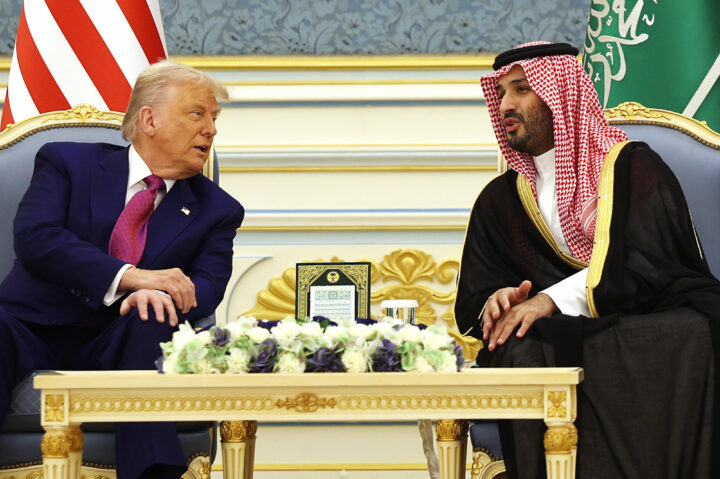
President Donald Trump meets with Saudi Crown Prince Mohammed bin Salman during a “coffee ceremony” at the Saudi Royal Court on May 13, 2025, in Riyadh, Saudi Arabia.
The Trump administration this week submitted the civilian nuclear deal it signed with Saudi Arabia to Congress for a legally mandated review period — during which time Congress could, theoretically, vote to block the deal.
Of most concern for lawmakers, the agreement would reportedly allow for nuclear enrichment inside Saudi Arabia, which critics warn could provide a path toward a Saudi nuclear weapon and set off a race for nuclear enrichment and arms around the region or even the world, with other U.S. allies demanding similar privileges.
Once the administration submits the deal to Congress, it is subject to a 90-day consultation and review period, during which the House and Senate foreign relations committees are expected to hold hearings and recommend to the full Congress whether to approve the deal.
Congress can vote during that period to pass a joint resolution of disapproval, which would block the deal from going into effect.
But ultimately, blocking the deal would likely require a veto-proof majority — assuming the administration is fully committed to pursuing the agreement even if Congress objects — which would be a tough lift with many Republicans likely to follow President Donald Trump’s lead.
At the same time, there has historically been widespread concern and skepticism about Saudi nuclear enrichment from both sides of the aisle, so the deal is likely to face intense bipartisan scrutiny.
Democrats have voiced particularly strong objections to the nascent agreement. Concerns about the deal are numerous: that it is not apparent how reliant it is on normalization with Israel; that it doesn’t include the same nonproliferation safeguards in place for the United Arab Emirates; that it could set off a race for enrichment; and that it could be tied to the personal or business interests of Trump or his associates.
Trump asserted, after the deal was already signed, that it wouldn’t move forward without a Saudi agreement to normalize relations with Israel. But the deal is continuing to move through the congressional approval process anyway.
Further inflaming tensions, Democrats on the relevant committees have accused the administration of sidestepping required notification procedures earlier this year to alert Congress that a deal was under negotiation. Democrats said that the notification was provided to Republicans only, and that they didn’t find out about it until months later.
Yet some Democrats have indicated they might end up getting behind the deal in the interest of supporting the U.S.-Saudi relationship.
Republicans, in late July as details of the deal began to leak out, took a more sanguine approach, largely supporting the deal and arguing that the enrichment provisions, as reported, would only allow the kingdom to enrich to levels necessary for civilian nuclear power and would be carried out by an American company.
Yet at least a few Republicans seem likely to approach the deal with more hesitance, raising concerns about global nuclear proliferation.
Thus far, key lawmakers largely aren’t commenting on the deal, as Congress remains on August recess. Sen. Ed Markey (D-MA) is one of the few who has weighed in so far, emphasizing that Secretary of State Marco Rubio previously opposed Saudi enrichment and urging Congress to reject the deal.
Bottom line: There’s likely to be an intense fight on Capitol Hill over this deal leading into the midterms and the end of the congressional session. But if the Trump administration wants it to go into effect, it probably will.
Rep. Brad Sherman warned that nuclear enrichment technology could fall into the hands of a malign regime
Kevin Carter/Getty Images
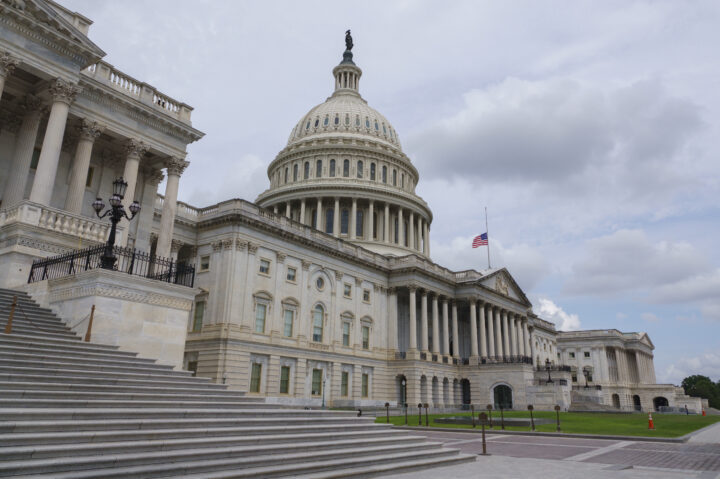
U.S. Capitol building on July 12, 2026 in Washington, DC.
Congressional Democrats are lining up in opposition to the Trump administration’s reported nuclear agreement with Saudi Arabia that could allow Riyadh to enrich uranium for civilian purposes, while Republicans are mostly supportive of the effort.
Critics have long warned that any civilian nuclear enrichment in Saudi Arabia could open the path for the country to obtain nuclear weapons at a later date and that it runs the risk of a nuclear enrichment race in the Middle East.
The reported deal would allow the construction, by U.S. companies, of an enrichment facility in Saudi Arabia, insulating the enrichment to some degree from the Saudi government, though that is unlikely to placate skeptics who worry that the technology could fall into malign hands in the event of a change in regime, or be used by the Saudi government for weaponization purposes.
It does not require Saudi Arabia to agree to enhanced oversight and inspections under an International Atomic Energy Agency “additional protocol,” which other U.S. nuclear deals such as the one with the United Arab Emirates have mandated.
“I have talked to Crown Prince Mohammed bin Salman about this on a number of occasions and both of us have been in agreement that an appropriate nuclear agreement would be in the best interest of both of our countries. Idaho is the birthplace of nuclear energy, so this matters deeply to me,” Sen. Jim Risch (R-ID), the chairman of the Senate Foreign Relations Committee, said in a statement to Jewish Insider. “I look forward to seeing the details of the agreement and working with the Administration to review it.”
Sen. James Lankford (R-OK) emphasized that, if the deal emerges as reported, the enrichment would be carried out by an American company.
“Saudi Arabia has been going after nuclear power for a while, there’s a big difference between nuclear power and nuclear weapons, with the amount of enrichment with the technology,” Lankford told JI. “Most countries that actually have nuclear power don’t enrich their own uranium, but the opportunity to be able to have our companies and entities doing it is significant.”
Sen. Mike Rounds (R-SD) told JI that he would be concerned if Saudi Arabia were to enrich to levels higher than necessary for civilian nuclear power uses, “but if they’re talking about just enriching it to the point where you can use it for nuclear power plant, I don’t have a problem with that. Somebody needs to do that, and it would be better to be us than anybody else.”
Rounds’ logic echoes concerns that if the U.S. did not agree to allow Saudi Arabia to enrich, it would instead pursue a deal with China or Russia.
Sen. Chuck Grassley (R-IA) told reporters, “as long as they’re a friend of the United States, [the deal is] OK.”
Sen. John Cornyn (R-TX) said he’s not sure “what to make of [the deal] yet” but argued that Saudi Arabia would not “necessarily … ask our permission” if it ultimately decided it wanted to enrich uranium or pursue a nuclear weapon.
“If Iran is trying to get a nuclear weapon, they’re going to do what they need to do to defend themselves,” Cornyn told JI. “But I know this is civilian nuclear for energy purposes, which generally we’ve encouraged and condoned with India, with a number of other countries, if they want to do it strictly for that. But I would think that would require some inspections and transparency by the IAEA and others.”
Sen. John Kennedy (R-LA) was the most skeptical of the Senate Republicans who spoke to JI but said he wasn’t sure at this point where he lands on the deal, expressing worries about global nuclear proliferation.
He said that he’s concerned that American allies and enemies will, as a result of rising tensions around the world, conclude they need to develop nuclear weapons of their own.
“I worry about nuclear proliferation in the Middle East, Japan, South Korea. The leaders of those countries love their countries and they love their people, and they wouldn’t be doing their job if they didn’t at least think about it,” Kennedy said. “That’s why we need to get this Middle East situation under control, as well as the war between Russia and Ukraine.”
Democrats, meanwhile, are largely opposed to the deal as publicly reported. Under the law governing nuclear agreements with foreign countries, Congress can pass a resolution to block such deals, though even if such a resolution were to pass, it would be subject to a presidential veto.
Sen. Richard Blumenthal (D-CT) told JI that he remains opposed to any nuclear deal with Saudi Arabia separated from the normalization of relations with Israel, an arrangement that the Biden administration had been pursuing.
“It should be part of normalization of relations, a broader agreement, rather than an isolated one-off,” Blumenthal said. “I have yet to see any of the details. I haven’t been informed officially, but my feeling continues to be that the paramount goal should be normalization of relations, recognition of Israel, the peace and stability of the region, and that aid to Saudi Arabia in establishing nuclear power should be included in that larger deal.”
Asked whether he would support a legislative effort to block the agreement, Blumenthal said that he would “pretty surely oppose the deal” — pending details — because of the lack of a broader normalization agreement.
Rep. Brad Sherman (D-CA), a longtime critic and skeptic of the prospect of Saudi nuclear enrichment, demanded prompt congressional hearings on the issue at a House Foreign Affairs Committee hearing on Wednesday morning.
He warned, as he has in the past, that nuclear enrichment technology could fall into the hands of a malign regime — as U.S. weapons did with the fall of the shah in Iran in 1979. “We have no idea who’s going to be running Saudi Arabia ten years from now,” Sherman said.
Sherman argued that Saudi Arabia should not be allowed to enrich if the U.S. is going to war to prevent Iranian enrichment, suggesting that the deal is being driven by a financial windfall for an American company.
He urged Congress to advance a resolution of disapproval, and noted that he worked with Secretary of State Marco Rubio when he was a senator to advocate for legislation that would have required affirmative congressional approval for a nuclear deal with Riyadh.
Sen. Mark Kelly (D-AZ) told JI that he has “some issues” with the deal as presented, relating to the enrichment provisions.
“Their own ability in the future to possibly enrich uranium is something we put guardrails in place for other countries. UAE being considered the gold standard that took a long time to work through,” Kelly said. The U.S.-UAE deal prevents Abu Dhabi from enriching and reprocessing uranium and includes a series of strict oversight provisions.
Asked about a potential resolution of disapproval, Kelly reiterated his concerns about the deal but also emphasized the importance of maintaining the U.S.-Saudi relationship.
“I also recognize that specifically with regard to Saudi Arabia, we want to make sure that we’ve got a positive relationship with them,” he said. “But on this thing, with enriched uranium, I’ve got problems.”
Sen. Tim Kaine (D-VA) told JI that Saudi Arabia’s failure, as part of the agreement, to agree to the IAEA additional protocol raises questions.
“My question is, why wouldn’t they? If it’s all going to be peaceful and all that, why wouldn’t you? Iran agreed to the additional protocol and the [2015 Joint Comprehensive Plan of Action], so why wouldn’t the Saudis?” Kaine said.
“We’ll see about congressional action on it, but I have said if you’re going to do this [you should be required to agree to] no enrichment and reprocessing, and you got to agree to inspections,” Kaine continued. “My understanding, from what I’ve read about the announcement, is that neither of those are in place, and then that really raises the issue of intent and proliferation.”
Sen. Chris Coons (D-DE) said he hadn’t seen the deal or the reporting, but, when informed by JI and a staff member that the deal would allow for Saudi Arabia’s nuclear enrichment, indicated he was skeptical.
Former Secretary of Defense Mark Esper, joining Rice at the Aspen Security Forum, said the U.S. was right to launch the war but may have overestimated or overstated its own capabilities
(Roberto Schmidt/Getty Images)
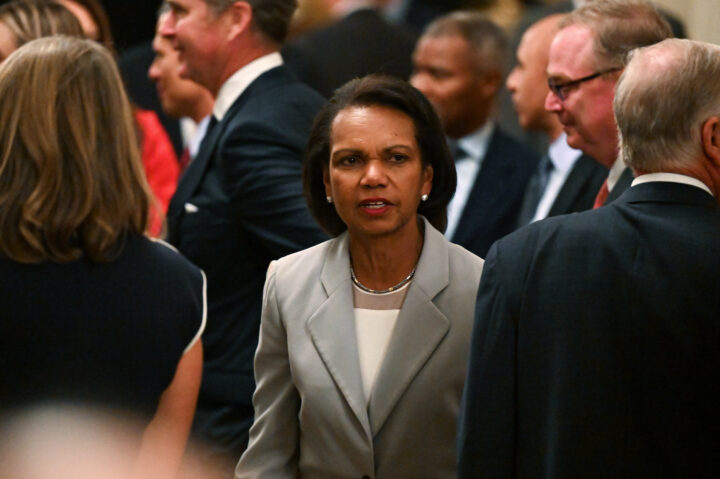
Former U.S. Secretary of State Condoleezza Rice attends the swearing-in ceremony for Chairman of the Federal Reserve Kevin Warsh in the East Room of the White House on May 22, 2026 in Washington, DC.
ASPEN, Colo. — Former Secretary of State Condoleezza Rice on Tuesday opposed any nuclear deal with Iran, arguing at the Aspen Security Forum that the U.S. should continue pressure on Iran’s economy and “see what happens.”
Meanwhile, former Secretary of Defense Mark Esper speaking alongside Rice on a panel, suggested that the U.S. had potentially overestimated its capabilities in the war, agreeing that continued economic pressure and a renewed blockade would be the best strategies going forward.
The two, speaking at the Aspen Security Forum, also offered strong criticisms of U.S. allies for not joining with and at times attempting to obstruct the U.S. campaign against Iran.
“I would not buy a nuclear agreement [with Iran] under any circumstances. I’d let them sit there and stew in their lousy economy, where most of their A-level nuclear scientists have been killed, where I believe there are deep splits in the Iranian government … and let’s just see what happens,” Rice said. “I wouldn’t give them a penny back, and let’s just see what happens to that economy over time.”
Rice said that she believes the U.S. did do significant damage to Iran’s nuclear program and that she’s “quite confident” that the country is not in a position to produce a nuclear weapon in the near future.
Mark Esper, who served during President Donald Trump’s first term, said that the U.S. war on Iran was a “a good thing to do to show the seriousness of of how we felt about this and our willingness to commit force to do that” but added, “we can discuss whether our reach exceeded our grasp, and some of the language used about unconditional surrender, et cetera, pushed them into a corner”
He said that a success in the war would require a return to the status quo in the Strait of Hormuz and a deal on Iran’s nuclear program superior to the 2015 Joint Comprehensive Plan of Action.
Esper argued that there would be no way to bring such a result solely through airstrikes, and that the primary path forward should be renewed economic pressure on Iran, including a renewed blockade targeting Iran’s ports and land and air routes. He said the U.S. should continue to respond to Iranian attacks with strikes on its missile and drone capabilities.
Esper said that strategy will take time, patience, discipline and the support of allies and come at the cost of higher gas prices. He said the end goal should not be to collapse the Iranian regime but to bring Iran back to the negotiating table.
“That approach, barring — I’m open to any better one — gives you the highest return with the lowest risk to where we don’t want to go,” Esper said.
Former Secretary of Commerce Penny Pritzker, who also spoke on the panel, emphasized that economic pressure is a useful tool, which can be effective but takes time, will and coordination, without which there are ways to evade sanctions.
“I’m hopeful that with all this pressure, that something rational can come of this, because we’re not in a good place right now, obviously,” Pritzker said.
Rice and Esper both expressed frustration with U.S. allies’ refusal to cooperate with the U.S. operations and, particularly, European allies’ decisions to block the U.S. from using their bases in their countries in the course of those operations — a move Esper called “really stupid.”
Rice said it was “really not a very smart thing” for allies to dismiss the conflict as not “our war.”
She said would have “preferred” if the U.S. had worked more closely with its allies before the operation, but acknowledged that actually getting them onboard would have been questionable, pointing to her own experience trying to bring allies onboard with the Iraq invasion during the Bush administration.
Sometimes, she said, “the United States has to do something really hard, like really deal with a bad guy who’s been a bad guy for a long time,” she said, emphasizing that the sophistication and range of Iran’s missile program was increasing and it was preparing to make a major agreement with Russia on missiles. “When the time comes, if it’s your ally and your friend, even if you’re not going to join, you don’t try to harm the effort,” she said.
“When I hear, ‘Well, it wasn’t imminent,’ I think, ‘Do you really want to wait until it’s imminent, or do you want to try to degrade it earlier?’” she continued.
Both Esper and Rice warned that, through their actions around the Iran war and comments denigrating the U.S.’ reliability as an ally, or declaring that they will handle their own defense without American assistance, allies are only playing into the hands of those who want to see those alliances collapse.
“You may speak into existence exactly what you need to avoid, because there are some people inside the American political system, on both sides of the aisle, who would be perfectly happy to withdraw from the world, and you don’t want to help empower those people,” Rice warned.
The Senate majority leader also said the deal triggers requirements for the administration to provide Congress with the opportunity to review the agreement under INARA

Kayla Bartkowski/Getty Images
Sen. Majority Leader John Thune (R-SD) calls on reporters following the weekly Senate Republican caucus policy luncheon at the U.S. Capitol on January 14, 2025 in Washington, DC. Senators spoke about the Laken Riley Act which was named after a nursing student who was murdered in February 2024 by Jose Ibarra, a migrant from Venezuela who crossed the border in September 2022, that could give state attorney generals far-reaching veto power over federal immigration policy.
With scant details provided by the Trump administration about the contours of the peace deal with Iran, Senate Majority Leader John Thune (R-SD) said on Monday afternoon that he doesn’t yet know enough about the administration’s deal with Iran to determine whether it is a good deal that will prevent Iran from acquiring a nuclear weapon.
“I don’t know enough about it to say,” Thune told reporters. “I think the issues are going to be compliance, and how you can enforce that, and what are the financial incentives that the Iranians have from our country, and what are they conditioned upon.”
The South Dakota Republican said that a positive deal would include financial incentives that are conditioned upon Iran winding down its nuclear program, the disposal of Iran’s enriched uranium and Tehran giving up its capacity to have a nuclear program in the future.
Thune also indicated that he believes the deal should be submitted to Congress for review under the Iran Nuclear Agreement Review Act.
“There are some requirements that are triggered because of the nuclear components of the deal, in terms of notification or informing Congress,” Thune said. “I know there is probably some expectation that there may be a vote at some point, whether that’s on a resolution of disapproval or something. We’ll see. I just don’t know enough about it yet. And I don’t think even the people who follow this stuff closely up here know that much.”
The administration hasn’t publicly commented on the issue of INARA yet, and has offered varying timelines for when it might release the text of the agreement. In media appearances, Vice President JD Vance has been framing specific nuclear issues as part of the next round of talks, rather than the current MOU, which could give the administration an avenue to attempt to dodge INARA review.
Thune said that “somebody” from the administration, whether that be Vance or other officials, “will need to” come to the Hill to brief members.
“For sure, our members are going to have a lot of questions about it,” Thune said.
Sen. John Barrasso (R-WY), the No. 2 Senate Republican, indicated he was similarly in the dark about the agreement.
“I haven’t seen anything from the president in terms of what’s in it. I’ve seen some press reports,” Barrasso told reporters. “I want to see what’s actually in it and I congratulate the president for his continued efforts.”
But asked whether he was concerned that the deal would be an effective surrender to Iran in providing sanctions relief, Barrasso rejected the idea out of hand.
“President Trump is never, ever going to do what you just suggested,” Barrasso said. “He’s not going to accept a deal that doesn’t eliminate nuclear weapons, isn’t enforceable, isn’t verifiable and doesn’t take Iran completely out of what they’ve been doing to try to undermine and attack us for the last 47 years.”
At the NATO summit, Trump said he doesn’t see Iran ‘getting back in the nuclear business’
NICOLAS TUCAT/AFP via Getty Images
Defense Secretary Pete Hegseth (L) and Secretary of State Marco Rubio (R) listen as US President Donald Trump addresses a press conference during a North Atlantic Treaty Organization (NATO) Heads of State and Government summit in The Hague on June 25, 2025. =
President Donald Trump announced on Wednesday that the U.S. and Iran will hold a meeting next week, but said that he doesn’t think reaching a nuclear agreement with the country is necessary in the aftermath of U.S. strikes on the Islamic Republic’s nuclear facilities.
Speaking at a press conference before leaving the NATO summit in the Netherlands, Trump said, in response to a question asking if he was interested in restarting nuclear negotiations with Iran, “I’m not.”
“The way I look at it, they fought, the war is done,” Trump continued. “And you know, I could get a statement that they’re not going to go nuclear. We’re probably going to ask for that, but they’re not going to be doing it anyway.” He said he had asked Secretary of State Marco Rubio to draw up a “little agreement for them to sign, because I think we can get them to sign it. I don’t think it’s necessary.”
Trump announced that the U.S. is “going to talk to them next week, with Iran. We may sign an agreement, I don’t know. To me, I don’t think it’s that necessary. I mean, they had a war they fought. Now they’re going back to their world. I don’t care if I have an agreement or not. The only thing we’d be asking for is what we were asking for before, about ‘we want no nuclear,’ but we destroyed the nuclear. … I said ‘Iran will not have nuclear.’ Well, we blew it up. It’s blown up to kingdom come. And so I don’t feel very strongly about it.”
The president said that he “doesn’t see [Iran] getting back involved in the nuclear business anymore” but “if it does, we’re always there. It won’t be me, it’ll be somebody else, but we’re there. We’ll have to do something about it.”
Asked if he is “giving up” on his maximum-pressure campaign against Iran after he announced that China can again buy oil from Iran, contravening congressionally approved sanctions legislation, Trump said that he wanted Tehran to use the funds to rebuild.
“No, look, they just had a war. They fought it bravely. I’m not giving up. They’re in the oil business. I mean, I could stop it if I wanted. I could sell China the oil myself. I don’t want to do that. [Iran is] going to need money to put that country back into shape. We want to see that happen.”
Speaking a day after an initial Pentagon assessment was leaked stating that the U.S. and Israel did not completely destroy Iran’s nuclear program and amid concerns that some nuclear material may have been smuggled elsewhere before the strikes, Trump said, “I think all of the nuclear stuff is down there, because it’s very hard to remove. And we did it very quickly. When they heard we were coming, it was, you know, you can’t move. It’s very hard, very dangerous, actually, to move. And they also knew we were coming. So I don’t think too many people want to be down there knowing we’re coming with the bunker-busters, as we call them. … We think it’s covered with granite, concrete and steel.”
Secretary of Defense Pete Hegseth said the report was a “low assessment,” meaning “low confidence in the data in that report. Why is there low confidence? Because all of the evidence of what was just bombed by 12 30,000-pound bombs is buried under a mountain — devastated and obliterated. So if you want to make an assessment of what happened at Fordow, you better get a big shovel and go really deep, because Iran’s nuclear program is obliterated.”
Trump read out an assessment by the Israel Atomic Energy Agency, released today, that said, “The devastating U.S. strike on Fordow destroyed the site’s critical infrastructure and rendered the enrichment facility totally inoperable. We assess that the American strikes on Iran’s nuclear facilities has set back Iran’s ability to develop nuclear weapons for many years to come. This achievement can continue indefinitely if Iran does not get access to nuclear material.”
“Which it won’t,” Trump added.
Please log in if you already have a subscription, or subscribe to access the latest updates.
 Continue with Google

 Continue with Apple