














































































Co-founders of the Hostages and Missing Families Forum in the U.S. received the James Foley Foundation’s Humanitarian Award; Qatari minister of state received the 2026 American Hostage Freedom Award
Isaac Campbell
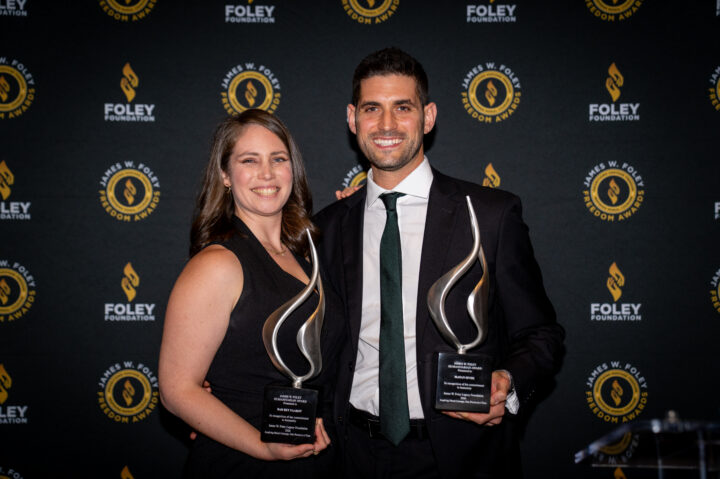
Bar Ben-Yaakov and Matan Sivek, co-founders of the Hostages and Missing Families Forum in the United States, jointly received the James Foley Foundation’s Humanitarian Award, May 5, 2026.


 Add JewishInsider on Google
Middle Eastern diplomacy is often defined by deadlock. But on Tuesday night, an unlikely cohort of awardees – the Israeli grassroots activists who advocated for the families of those taken hostage on Oct. 7, 2023, and a Qatari minister who took part in the high-stakes negotiations to secure the hostages’ return – were brought together to celebrate one thing: the work that goes into the breakthroughs that bring hostages home.
The event, held at the National Press Club in Washington, D.C., was hosted by CBS News Chief Foreign Affairs Correspondent Margaret Brennan, with awards presented by the James Foley Foundation — a nonprofit honoring the legacy of James Foley, who was killed by ISIS in 2014. The foundation advocates for families of detainees and works to end what it describes as the “scourge of wrongful detention worldwide.”
Bar Ben-Yaakov and Matan Sivek, co-founders of the Hostages and Missing Families Forum in the United States, jointly received the Humanitarian Award. The forum was established less than 24 hours after the Oct. 7, Hamas-led terrorist attacks in Israel and grew into a broad, nonpolitical network of volunteers, hostage families and professionals.
In her acceptance speech, Ben-Yaakov said that following the attacks, “it felt like there were only two options: either do something about it or go crazy.”
“We just could not accept that the story we would tell our children is one where 251 people were simply left to die in the hands of Hamas,” Ben-Yaakov said. “We needed to be able to tell them [our children] a different story. That people showed up, that they refused to look away and that in the end they helped bring them home.”
She said that despite the two having “no formal role, no background in hostage advocacy and no network in the corridors of power,” they decided to get to work.
“What began in that moment grew into a campaign, but from day one it was never ours,” Sivek said. “It belonged to the hostage families. They decided, we stayed behind the scenes – by design. We were creating the conditions for families to advocate with clarity and impact.”
Sivek said he got involved in part because of his grandfather, Jacob Sivek, who survived the Holocaust. The elder Sivek attended Tuesday’s awards ceremony.
“After Oct. 7, I thought of him and his family living through World War II, left to their own devices. Who was advocating for them?” Sivek said as his grandfather stood up to applause from the room of attendees. “I knew – and we knew – that we were not going to be bystanders.”
However, the road was long and often demoralizing. “During the campaign, most of the time, you feel like you’re failing,” Yaakov said. “Nothing moves. Everything depends on forces far beyond your control.”
“Throughout this turbulent road we held onto one goal,” she continued. “We had one image in front of our eyes and it was to witness the embrace – the precious moment when families are reunited and held in each other’s arms again. The renewed smiles, the tears of joy, the ability to see life in color again. That moment was the reason for everything we had done.”
Qatari Minister of State Mohammed Al-Khulaifi was also honored at the event, where he received the group’s 2026 American Hostage Freedom Award for his role in facilitating negotiations that contributed to the release of hostages in Gaza, as well as his efforts that have brought several other hostages and Americans home.
Al-Khulaifi told the audience that “every negotiation, every sleepless night and every difficult decision is for one glorious moment when the phone finally rings and the voice on the other side says we are finally coming home.”
“Every person who walks away safe is the result of a deliberate effort, solid coordination and an unshakable commitment to the value of human life,” Al-Khulaifi continued. “There are long nights filled with uncertainty, decisions made with incomplete information, and moments where you hold your breath and simply hope that preparation meets opportunity, yet knowing this opportunity is only made possible through the work of creating an environment for dialogue and understanding.”
Al-Khulaifi spoke of his role in negotiations between the U.S., Israel and Hamas to free the hostages in Gaza. He said that the stories of several individuals, including Edan Alexander, an American Israeli who was held captive in Gaza, “remind me and my team why this work matters.”
“Each case was difficult,” Al-Khulaifi said. “Each required trust, assistance and coordination across difficult circumstances, but all shared the same profound victory. The long awaited healing of broken families. Our collective efforts help us create breakthroughs every single day.”
Democratic hopeful pushes back against ‘smears’ from ‘political elites’

Credit: Marc Nozell/Flickr
Insisting that claims she has not broken through in the Democratic primary are “an illusion,” author Marianne Williamson brought her campaign to the National Press Club in Washington, D.C. on Thursday.
Speaking to a crowd of a few dozen journalists and supporters, Williamson touted her plans for a Department of Peace and her broader goal to move American politics away from “a very 20th century mindset… infiltrated by the undue influence of money.”
Williamson told the crowd that the past century “was dominated by a mindset that’s basically a product of Newtonian physics, that saw the world as a huge machine… that 20th century mindset dominates our politics today.” In contrast, the Democratic hopeful urged a 21st century mindset that was “far more integrated” and “far more holistic.”
The presidential candidate said she had been targeted in a smear campaign by “political elites” after the second presidential debate in Detroit, where she warned of “the dark psychic force of collectivized hatred” that Trump was evoking.
“I sure as hell did break through,” Williamson said of her performance, suggesting “the political hits began” as a result of her popularity. Williamson has faced scrutiny over a variety of past statements including skepticism towards mandatory vaccination. The author did not meet the polling qualifications for the last two DNC debates, although she garnered a sufficient number of small donors to participate.
Advocating for a Department of Peace, a proposal pushed in past Democratic primaries by former congressman Dennis Kucinich (D-OH), Williamson argued, ”our national security agenda is dominated — as you know — basically by a constant perpetuation of war.” In contrast, she claimed “peace-building exemplifies skill sets and expertise [that are] just as sophisticated, just as important and, in many ways, take just as much courage” as those shown by the armed forces.
In her view, the building blocks were already there for this agency inside of government: “We already have the experts,” insisted Williamson. “It is simply not what we fund. We don’t need to bring in new people but to coordinate among the agencies that exist.”Williamson also outlined her foreign policy vision and reiterated her longstanding support for reentering the nuclear deal with Iran. She harshly criticized the Iraq War, saying “it was an absolutely horrible transgression on every level” — and argued that “the genesis of ISIS comes from that” — but insisted that the United States should have intervened militarily in Rwanda in the 1990s. She also expressed her support for the U.S. invasion of Afghanistan after September 11 by noting the brutal treatment of the Taliban towards women.
Please log in if you already have a subscription, or subscribe to access the latest updates.
 Continue with Google

 Continue with Apple