














































































How largely pro-Israel Democrats in solidly-blue districts balance the pressures from the base against their longstanding principles will speak volumes about whether the U.S.-Israel relationship can maintain support within their party
Eric Lee/Bloomberg via Getty Images
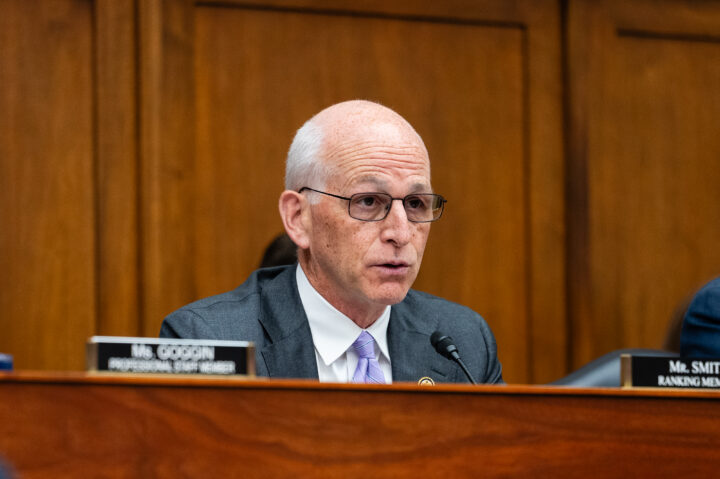
Rep. Adam Smith (D-WA), ranking member of the House Armed Services Committee, during a hearing on May 14, 2026.


 Add JewishInsider on Google
President Donald Trump’s capture of the Republican Party did not happen at once, and was memorably met with resistance from some lawmakers who would later become his allies.
Many Republicans, during the rise of Trump, cast mostly party-line votes alongside the president and rarely spoke out publicly when they disagreed. But there were notable times when prominent party leaders used their political capital to stand up for their principles on key issues, such as then-Senate Majority Leader Mitch McConnell’s (R-KY) outspoken advocacy for Ukraine funding or Sen. Susan Collins’ (R-ME) decisive vote against repealing Obamacare.
There may be a similar political calculus at play for some typically pro-Israel Democrats, who are facing immense political pressure from loud activists in their party base to turn against the Jewish state. Nearly half of the House Democratic caucus voted to cut off aid to Israel last week, a record number that included 18 lawmakers who had previously been endorsed by AIPAC and were seen as strong allies of the U.S.-Israel relationship.
AIPAC cut off fundraising to their reelection campaigns after the vote, and how these lawmakers will position themselves on Israel policy going forward is now uncertain.
Not all of the Democrats who supported the amendment have adopted an anti-Israel worldview. Some said that they still support Israel, but wanted to make a statement, via a bill that was certain to fail, that they disagree with many recent actions of the Israeli government.
It’s also possible that some of them — especially those in districts where they face a credible primary threat from the left — took the vote to attempt to placate anti-Israel activists without making any real change in policy, like the Republicans who would offer an olive branch to their right-wing base by voting contrary to their longstanding beliefs.
For instance, in April 2024, then-Sen. Marco Rubio (R-FL) and Sen. Ted Cruz (R-TX) voted against a sweeping foreign aid package for Israel and Ukraine in the face of rising isolationist sentiment in the party, despite their hawkish records. But politically speaking, it helped maintain their credibility with a MAGA base skeptical of any foreign assistance without jeopardizing the funding.
A similar dynamic appears to be taking place among the generally pro-Israel Democrats who are trying to hold onto their place in the party as anti-Israel voices are on the rise.
Rep. Adam Smith (D-WA), for instance, described his “yes” vote as an attempt to “to try to get the attention of the Netanyahu government to force them to change their actions.” He also said he still supports Israel and expressed concern “about the tactics used by those on the far left to advocate for cutting off aid to Israel,” including vandalizing his family’s home. Days later, he spent time on a far-left podcast attacking the host’s anti-Israel views and explaining to her why he’s been such a strong supporter in his career of the Jewish state.
Far from sounding like an anti-Israel convert, Smith sounded like he wanted to throw the left-wing activists a bone by voting for the symbolic anti-Israel resolution without fundamentally shifting his longstanding views on Middle East policy.
In the liberal Boston suburbs, Rep. Jake Auchincloss (D-MA) — a Jewish Democrat and strong supporter of the U.S.-Israel relationship — surprised many by voting for the amendment. But in an interview with Jewish Insider’s Marc Rod this week, he asserted that the vote was in line with his pro-Israel beliefs.
“I represent a pro-Israel, anti-Netanyahu district and this is a pro-Israel, anti-Netanyahu vote,” Auchincloss said, adding that he believes “a majority of my Jewish constituents would agree with me.”
How largely pro-Israel Democrats in solidly blue districts such as those represented by Smith and Auchincloss balance the pressures from the base against their longstanding principles will speak volumes about whether the U.S.-Israel relationship can maintain support within their party.
Graham: ‘How many times does he have to play footsie with this antisemitic view of the Jewish people and Israel until you figure out that’s what he believes?’
Amir Levy/Getty Images
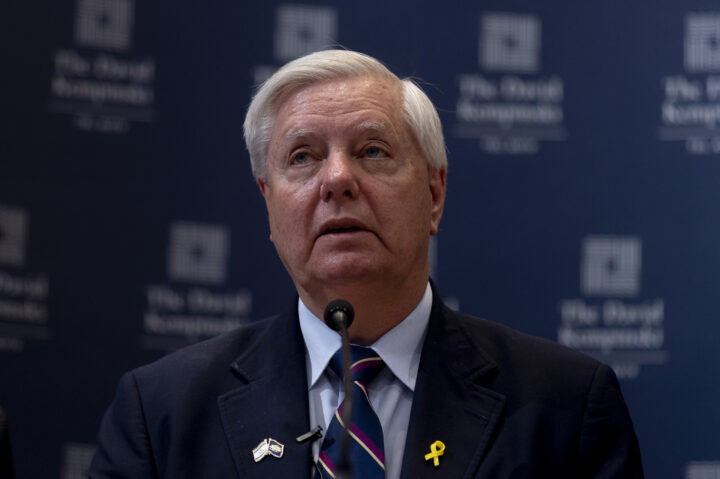
Senator Lindsey Graham (R-SC) speaks at a press conference on US-Israel relations on February 17, 2025
LAS VEGAS — Sen. Lindsey Graham (R-SC) spoke out against Tucker Carlson for giving a friendly platform to Nick Fuentes, the neo-Nazi influencer, on his podcast this week, calling it “a wake-up call” for the Republican Party as it grapples with rising antisemitism within its ranks.
“How many times does he have to play footsie with this antisemitic view of the Jewish people and Israel until you figure out that’s what he believes?” Graham said of Carlson in an interview with Jewish Insider on Friday on the sidelines of the Republican Jewish Coalition’s annual leadership summit at the Venetian Resort.
Graham said that “antisemitism has been with us, and it’ll always be with us, and the goal is to limit it, fight back and contain it.”
“I am confident that if anybody in the Republican world ran for office as a member of Congress, for the Senate or any major elected office and spouted this garbage, it would get creamed,” Graham told JI. “This is a niche market. It won’t sell to a wider audience.”
Carlson, a frequent critic of Graham, has faced backlash this week for failing to challenge Fuentes’ antisemitic views, including praising Adolf Hitler and engaging in Holocaust denialism. During the interview, Fuentes railed against “organized Jewry” while Carlson expressed his disdain for Christian Zionists including Mike Huckabee, the U.S. ambassador to Israel, saying he had been seized by a “brain virus.”
“To suggest that evangelical Christians are confused or got it wrong says more about the critic than it does evangelical Christians,” Graham countered. “The guy that’s doing the talking is a raving antisemite white nationalist, and if you want to hook your wagon to that, you’ll have a very short journey in the Republican Party.”
Graham said that Carlson and Fuentes “did us all a favor by being so brazen. It’s kind of a wake-up call.”
Even as Carlson, a close ally of Vice President JD Vance, remains influential in the GOP, Graham argued that “being anti-Israel in the modern Republican Party is a death sentence to political viability.”
“We’re not gonna put up with that crap. We’re not that kind of party,” he said.
The South Carolina senator also joined other senators in raising concerns about the president of the Heritage Foundation, Kevin Roberts, who has faced widespread criticism for defending Carlson’s interview and for soft-pedaling Fuentes views in a video he posted to social media on Thursday. “That’s the decision made, and we’ll see how well it plays in the marketplace,” Graham, who is facing a primary challenge next year from a former Heritage Foundation staffer, reiterated.
Amid the criticism Friday, Roberts posted a follow-up statement on X where he condemned Fuentes’ “vicious antisemitic ideology, his Holocaust denial, and his relentless conspiracy theories that echo the darkest chapters of history” but made no further comment about Carlson.
Sen. Ted Cruz (R-TX), who spoke at the RJC summit on Thursday night, and Mitch McConnell (R-KY) have spoken out against right-wing antisemitism after Carlson’s Fuentes interview.
Vance also drew scrutiny this week from conservative Jewish critics after he spoke at a campus Turning Point USA event and avoided forcefully confronting students who had asked him questions about Israel that used antisemitic tropes, such as suggesting Jewish control of U.S. politics and claiming that Jews oppress Christians.
Graham said he believed that the students were “espousing stereotypes about the Jewish people and the Jewish state,” which he called “pretty unnerving.”
“I think JD handled it well,” he said, but added: “I wish he would have been more direct.”
“I would have been real direct and said, ‘Let me tell you, if you think our relationship with Israel is less than beneficial, you’re ignorant. Israel’s fighting our fight,” he said. “My goal is to keep the threats over there so they don’t come here,” he added. “My goal is not to fight alone, to have other people fighting with us. And you can’t have a better partner in the fight than Israel.”
“It’s alarming that people can clear vetting after claiming U.S. interests in the Middle East are ‘minimal to nonexistent,’’ McConnell told JI

Julia Demaree Nikhinson - Pool/Getty Images
Sen. Mitch McConnell (R-KY) arrives with his wife, former U.S. Secretary of Transportation Elaine Chao arrive for the Inauguration of Donald J. Trump in the U.S. Capitol Rotunda on January 20, 2025 in Washington, DC.
Sen. Mitch McConnell (R-KY) is urging the Trump administration to “steer clear of Pentagon advisors who make their Obama and Biden predecessors look tough by comparison,” as Republicans grow increasingly concerned over recent high-ranking hires at the Department of Defense opposed to U.S. engagement in the Middle East — and the individual who hired them.
In a rebuke of the viewpoints held by at least one recent Pentagon hire and the staffing process that resulted in their appointments, McConnell, the longtime former Senate Republican leader, told Jewish Insider he finds it “alarming” that such individuals had survived the vetting process given each of their well-documented records on Middle East policy.
“President Trump has committed to restoring peace through strength and standing with Israel. But the folks staffing up his Pentagon operation don’t appear to have read the memo,” McConnell said in a statement to Jewish Insider.
“It’s alarming that people can clear vetting after claiming U.S. interests in the Middle East are ‘minimal to nonexistent,’ suggesting that America should ‘militarily retrench’ from the region, or claiming that providing Israel even defensive assistance against Iran-backed terrorists is escalatory. The administration would be wise to steer clear of Pentagon advisors who make their Obama and Biden predecessors look tough by comparison,” he continued.
McConnell, who now chairs the Senate Rules Committee and the Senate Appropriations subcommittee responsible for defense funding, was quoting prior writings from Michael DiMino, Trump’s pick for deputy assistant secretary of defense for the Middle East, and Dan Caldwell, reportedly a top advisor to Pete Hegseth, Trump’s nominee for defense secretary, who has been playing a role in the transition staffing process at the Pentagon.
DiMino, who was sworn in on Monday, said last February that the U.S. has “minimal to nonexistent” interests in the Middle East and the U.S.’ role in the region had not provided any benefits domestically or geostrategically.
Caldwell argued in a piece in Foreign Affairs in November that the U.S. “should militarily retrench from regions in which American interests are less pronounced, such as Europe and the Middle East, especially when the United States’ current responsibilities can be outsourced to relatively wealthy and capable allies.”
McConnell is the longest serving Senate leader in U.S. history, who stepped aside from his leadership role at the end of the last Congress. He vowed at the time to be outspoken in defense of his national security concerns, even if that meant diverging from the leader of his party.
Asked in an interview with JI last July what he wanted to see the next administration do to counter Iran, McConnell replied that, “I’m going to disappoint you in saying that I’m not going to tell you exactly what I would do, but what I know won’t work is what we’ve been doing.”
“Generally speaking, when you ratchet up the pressure on Iran, the behavior changes. I would certainly be in the camp of making it extremely uncomfortable to continue what they’re doing,” he said.
Please log in if you already have a subscription, or subscribe to access the latest updates.
 Continue with Google

 Continue with Apple