














































































Addressing the UNGA, Trump said, ‘Will a deal be made … or do I annihilate the Islamic Republic?’
Brendan Smialowski-Pool/Getty Images
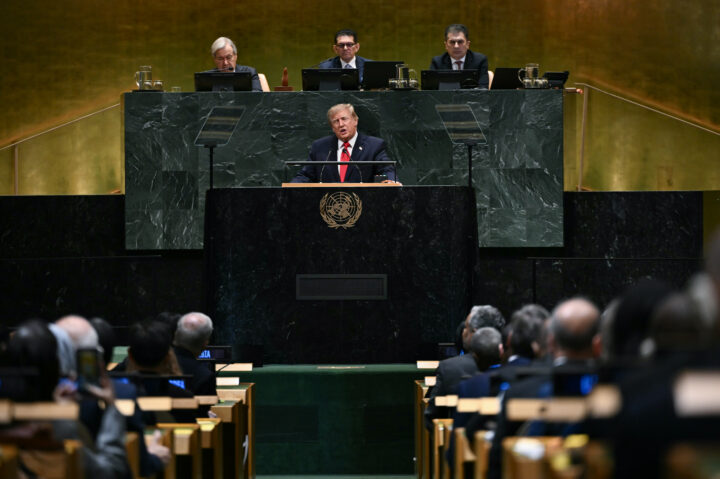
President Donald Trump speaks during the 81st United Nations General Assembly at the United Nations Headquarters on September 22, 2026 in New York City.


 Add JewishInsider on Google
President Donald Trump said on Tuesday that he faces a “big decision” between making a deal with Iran and escalating military conflict, as he predicted the sides would reach an agreement following the midterm elections.
“I have a big decision to make,” Trump told the U.N. General Assembly in New York, on the first day of the high-level week. “Will a deal be made with Iran that lets them rebuild and create a far greater country than it ever was before? … Or do I annihilate the Islamic Republic and do it quickly, never giving them a chance to kill and destroy people and countries again? Do I drive them into hell with no chance of survival and no hope of future greatness or generations?”
The president has recently made similar statements suggesting he must choose between negotiations and further confrontation, though there appear to be no serious negotiations underway and U.S. strikes have been sporadic.
"I have a big decision to make,” Trump said at the UN. “Will a deal be made with Iran that lets them rebuild and create a far greater country than it ever was before? … Or do I annihilate the Islamic Republic? … I believe we’ll make a deal right after the [midterm] election.” pic.twitter.com/LYB5f2i0Fd
— Jewish Insider (@jewishinsider) September 22, 2026
Trump said he believes an agreement with Iran will ultimately be reached after the U.S. midterm elections in November, arguing that Tehran is waiting to see how Republicans perform.
“I believe we’ll make a deal right after the [midterm] election because it doesn’t make sense for them not to,” Trump said. “They’re waiting to see how I do in the midterm election. What they don’t realize is that I’m not running.”
Even absent a deal, Trump argued that U.S. efforts in Iran have yielded success, including stopping Iran from being the “bully” of the Middle East.
“For 51 years, the fanatical Iranian regime has ruled by bloodshed and mass murder, spreading death and carnage and chaos across the entire Middle East and beyond,” Trump said. “They were the bully of the Middle East, but they are the bully no more.”
While no bilateral sit-downs between Trump and Iranian leadership were scheduled, Trump said during a meeting with Ukrainian President Volodymyr Zelensky that White House Special Envoy Steve Witkoff and Jared Kushner had a “very good meeting” with Iranian officials on Tuesday.
“It was a meeting that lasted for three hours … They had a very good meeting, very productive meeting, and they have another one scheduled in the near future,” Trump said. “We’ll see how it turns out, but, certainly, it’s to their advantage to make a deal, and if we can do that, it’s preferable.”
Prior to the meeting a U.S. official had told CNN that Trump said he would be open to arranging a meeting with Iranian officials in New York “if the conditions are right,” or delegating senior advisors traveling with him to meet with them. Axios further reported that mediating Arab countries had been trying to arrange a meeting as well.
Trump called on “all nations” to “join us in enforcing the complete economic isolation of Iran until they stop their attacks on commercial shipping, relinquish their nuclear ambitions and cease their support of terror.”
Praising international support for Washington’s stance, Trump thanked the U.N. Security Council for passing a resolution in March condemning Iranian attacks on maritime trade.
“That resolution, I’m pleased to say, received more co-sponsors from U.N. member nations than any Security Council resolution in history,” Trump said. “That’s something. Now we must be equally united in maintaining pressure.”
He added that the U.S. Navy has recently escorted more than 1 billion barrels of oil out of the Strait of Hormuz, maintaining that “more oil is flowing than at any point since the start of the war.”
He also dismissed reports suggesting the U.S. military is running dangerously low on munitions as a result of the conflict.
“We have more munitions than we could ever possibly even think of using, and we’re building them at levels that we have never done before. We are adding to our stockpiles faster than we have ever been able to do before,” he said.
Trump noted that 18 new munitions facilities are currently under construction by defense contractors, promising that the expansion will lead to the “very rapid deployment of missiles of every type and ammunition of every type,” as well as faster resupply for allies.
Turning to the Middle East more broadly, Trump touched on the situation in Gaza, where implementation of his administration’s 20-point peace plan remains stalled as Hamas refuses to disarm. The president thanked countries that joined the Board of Peace, as well as those that committed personnel to secure Gaza.
“We ended the war in Gaza, saving untold thousands of lives. We also brought home all the remaining hostages, both living and dead, every single one of them,” Trump said. “Nearly 30 countries have joined the board, which I am honored to chair, and we’re thankful to many of those member nations for contributing billions and billions of dollars to relief. I also want to thank those who have committed troops, police, and training to help stabilize Gaza, including Indonesia, Morocco, Albania, Kosovo, Kazakhstan, Egypt, Jordan and more.”
Missile strikes on Ras Laffan and the closure of the Strait of Hormuz have pushed Qatar toward an 8.6% contraction this year, the steepest downturn in the GCC
Mahmud HAMS / AFP via Getty Images
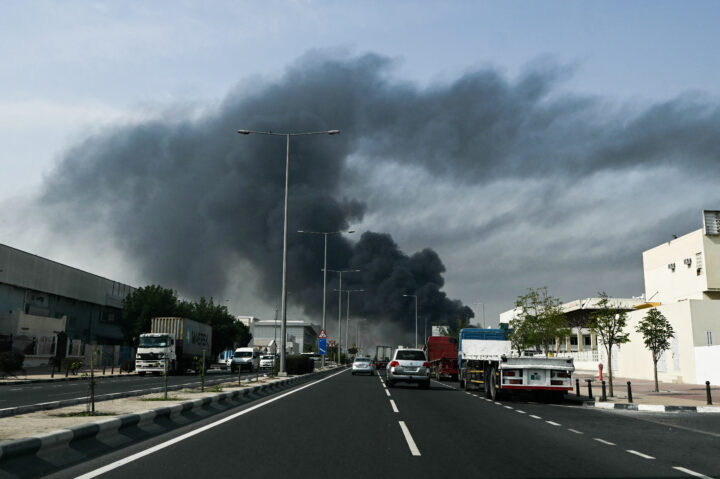
Motorists drive past a plume of smoke rising from a reported Iranian strike in the industrial district of Doha on March 1, 2026.
Six months into the military conflict between the U.S. and Iran, Qatar’s liquefied natural gas exports have plunged 96%, resulting in approximately $24 billion in lost revenue, Reuters reported on Wednesday.
Doha has been forced to halt much of its LNG production — its primary driver of export earnings — due to attacks on energy infrastructure and inability to physically move it to customers, wiping out the equivalent of roughly five months of Qatari government revenue and establishing the state as one of the chief economic casualties of the war.
Meanwhile, the Financial Times reported that Qatar’s economy is projected to contract by 8.6% this year — the steepest downturn among the Gulf Cooperation Council nations — as the Iran war and effective closure of the Strait of Hormuz continue to cripple the nation’s energy sector.
In March, Iran launched ballistic missile attacks targeting Qatar’s Ras Laffan Industrial City — Qatar’s main energy hub and the world’s largest LNG production site — causing extensive damage.
Prior to the war, Qatar served as a cornerstone of the global energy grid and supplied nearly one-fifth of the world’s daily LNG demand. However, unlike neighboring oil exporters, which have managed to navigate limited shipments through the Strait of Hormuz, Qatar’s geography offers few alternative export pipelines or bypass routes for its gas fleet.
Doha has since responded with severe fiscal austerity measures to protect its reserves. The Qatari government has slashed department budgets by up to 30% and cut funding for overseas aid by about 85%.
Turkish political leaders are circulating propaganda that Israel wants to turn its military attention to Ankara

Burak Kara/Getty Images
Turkey's President Recep Tayyip Erdogan speaks to supporters at his party’s Istanbul mayoral candidate Murat Kurum's campaign rally on March 29, 2024 in Istanbul, Turkey.
As the military conflict between the U.S., Israel and Iran continues, Turkish elites have reportedly begun circulating claims that Israel could turn its military attention toward Ankara should Iran emerge from the war depleted — a belief analysts say reflects growing mistrust and conspiratorial thinking in Turkey rather than any actual Israeli intent.
“I have started hearing from inside of Turkey suggesting that there’s a not unsizable position of governing elite circles which do believe that Israel will turn its attention next onto Turkey, militarily or some derivative thereof, after its finished with Iran,” Sinan Ciddi, director of the Turkey program at the Foundation for Defense of Democracies, said during a livestreamed webinar on Thursday.
Steven Cook, a senior fellow at the Council on Foreign Relations, called Turkey’s perception of Israel’s intentions as “ridiculous.”
“I’m surprised that even the sophisticated are deep in this idea that the Israelis are going to take on Turkey next,” said Cook. “All I’m getting from Israeli professional security and diplomatic channels is that ‘we want to find a way to de-conflict with Turkey.’ The fact that the Turkish political elite and government think that this is what the Israelis are going to do is a fundamental misreading.”
Cook suggested that Turkish officials and elites could be spreading those claims for “political purposes,” arguing that Ankara could be “whipping up anti-Zionist, antisemitic fury.”
“It is very easy for people in Turkey to make up all these conspiracy theories,” Henri Barkey, a senior adjunct fellow at the Council on Foreign Relations, said. He noted that while there is a “great deal of dislike” between Ankara and Jerusalem, there would be “positive aspects” should the two work together for the betterment of the region following the conflict with Iran.
“Turkey and Israel actually have a great deal of trade, over $5 billion a year, and it would make much more sense for Israel to work with Turkey and maybe invest in Iran together,” Barkey said.
But, he said, Jerusalem has instead become a “convenient enemy” for Ankara. “We have an Israel that clearly is much more capable than most people expected and is now willing to take on Iran, not once, but twice, so that is a very useful and convenient enemy [for Turkey].”
At the same time, experts said the two countries appear to have sharply different preferences regarding the outcome of the war with Iran.
“I think Turkey desires for the existence of a weakened Islamic Republic with the Islamic regime in charge,” Ciddi said. “But it really does not seek the emergence of a Democratic or ‘free Iran.’”
“Turkey could potentially continue to cooperate and work with a weakened Iran, because a weakened Iran would essentially be able to continue working with its proxy networks to destabilize what Turkey identifies its adversaries in the region, such as Israel, but it will also allow Turkey to grow into the region as this new hegemonic power,” he added.
Cook echoed those sentiments, calling a “greatly weakened Islamic Republic” the best outcome for Ankara. He said a diminished Iranian regime is more likely to “seek help” from Turkey.
“A weakened Iran will be much more at the beck and call of Turkey on a variety of issues,” Barkey said. “Turkey will be able to exercise much more leverage and get what it wants from Iran.”
Meanwhile, Cook noted that Israel is seeking a much different outcome.
“If something emerges from this conflict that’s called the Islamic Republic of Iran, it is a strategic defeat for Israel,” Cook said. “The Israelis have spent a lot of time and effort trying to create a pathway for the Iranian people to overthrow this regime. It’s a defeat for Israel if that doesn’t happen, and that’s good for Turkey during their current adversarial relationship.”
However, Cook cautioned that such an outcome could also backfire on Turkish ambitions for a more stable region, cautioning to “be careful what you wish for.”
“We’re right that some kind of smaller Islamic Republic that’s IRGC-dominated is the best possible outcome for Turkey, but this is still a potent and dangerous, wounded state,” Cook said. “It’s not great for the region, because if you take the Turks at their word that they want regional stability, they’re not going to get it with some rump version of the Islamic State.”
As Israel signals restraint and Iran faces mounting internal pressures, both sides are increasingly wary of miscalculating
Stringer/Getty Images
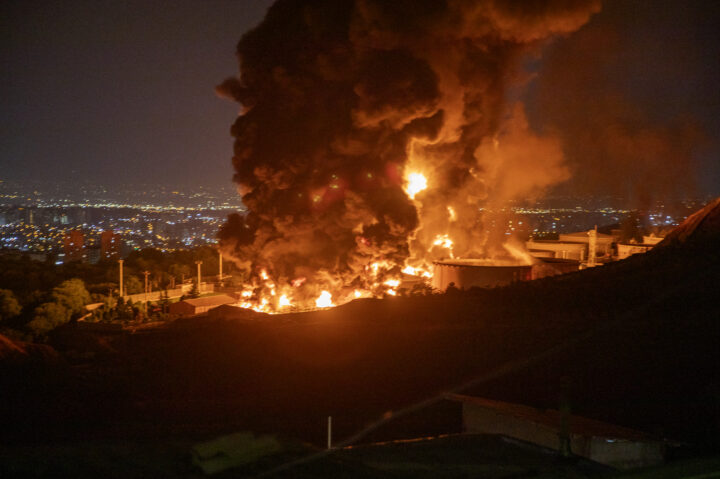
Fire and smoke rise into the sky after an Israeli attack on the Shahran oil depot on June 15, 2025 in Tehran, Iran.
At the conclusion of the 12-day war in June of last year, both Israel and Iran suspected that the ceasefire brokered by the U.S. would be a pause, not a final cessation of hostilities. That truce has lasted for more than six months, with both sides wary of entering another military conflict — one likely to be more deadly and destructive than the first.
But now, amid destabilizing world events from Venezuela to the Middle East — compounded by growing domestic pressure on the Islamic Republic amid nationwide protests — that ceasefire is even more tenuous, with officials in Tehran and Jerusalem closely watching the other’s every move, careful not to make a potentially disastrous miscalculation — even as both sides make overtures at de-escalation.
Speaking at the Knesset on Monday, Israeli Prime Minister Benjamin Netanyahu said, “President [Donald] Trump and I have expressed a firm stance — we won’t allow Iran to rebuild its ballistic missile industry or to renew the nuclear program, which we damaged severely in Operation Rising Lion.”
In response, Iran’s newly formed Defense Council warned on Tuesday that the country could act preemptively if it detects clear signs of a threat. “The long-standing enemies of this land … are pursuing a targeted approach by repeating and intensifying threatening language and interventionist statements in clear conflict with the accepted principles of international law, which is aimed at dismembering our beloved Iran and harming the country’s identity,” the council said.
Recent reports suggest that Israel, in an attempt to de-escalate tensions, has used Moscow as an intermediary, communicating through Russian President Vladimir Putin that it has no intention of launching a preemptive strike on Iranian soil. Iranian leaders, including Supreme Leader Ayatollah Ali Khamenei, are unconvinced.
In a post on X, Khamenei accused Israel of deception: “What makes the enemy first request a ceasefire during [12-day] war with the Iranian nation, then send messages saying he doesn’t want to fight us?”
“Now if he doesn’t believe the messaging and thinks that Israel is about to attack then you can understand why Israel is worried Iran is about to miscalculate and attack. Very tense days/weeks ahead of us,” Nadav Pollak, a lecturer on the Middle East at Reichman University, commented on Khamenei’s post.
Pollak told Jewish Insider that he sees the perception gaps between Israel and Iran as the “No. 1 risk for miscalculation. As we’ve seen from Khamenei’s tweet, he doesn’t believe the messages that came from Jerusalem about Israel not planning to attack. In his mind, Bibi just came back from Washington with Trump supporting action against Iran if some red lines are crossed. Bibi also continues to talk about the Iranian ballistic missile threat every week and that Israel will need to do something.”
Israeli commentator Nadav Eyal noted on Dan Senor’s “Call Me Back” podcast that “Israeli security officials are extremely worried about what’s happening vis-a-vis Iran, first and foremost because the Iranians are so tense and they are constantly fearing an Israeli attack themselves. So their first worry is miscalculation … If Iran senses that Israel might attack, it wants to preempt that. If Israel thinks that Iran is going to do that, it would want to preempt that.”
Tehran is also facing trouble at home, amid protests that have spread across the country over the last two weeks. The growing unrest, coupled with the Islamic Republic’s economic and climate woes, has put added pressure on the ayatollahs.
Aaron David Miller, a senior fellow at the Carnegie Endowment for International Peace, told JI that due to the Iranian regime’s vulnerable position amid nationwide protests over a severe economic crisis, “hardliners” within the IRGC could be weighing using a strike to “divert the public” and create national unity. However, he expressed that the decision would be a “strategic mistake,” suggesting that an Iranian strike this year is “highly unlikely.”
“It’s hard to see what the Iranians would gain,” said Miller. “A strike is simply going to wreak additional havoc on what the vast majority of the Iranian public is protesting against, which is inflation, a devaluation of the Iranian currency.”
Blaise Misztal, vice president for policy at the Jewish Institute for National Security of America, echoed those sentiments, adding that any Iranian strike now while the regime in Tehran is “on the ropes” would be “suicidal.”
“It seems unlikely that Iran would choose this moment to attack Israel,” said Misztal. “While it certainly might be looking for some way to distract its citizens from their grievances, all the evidence suggests that external aggression would have the opposite effect.”
Misztal said the Iranian regime is facing skyrocketing inflation and crumbling infrastructure “because it has chosen guns over butter and Iranians know it.”
“To once again pick up guns would only further inflame Iranians’ rightful anger,” said Misztal. “Not to mention that a direct Iranian attack against Israel would surely invite a devastating Israeli, if not also American, response.”
The lingering question is whether the fear of miscalculation will push either side toward action.
Please log in if you already have a subscription, or subscribe to access the latest updates.
 Continue with Google

 Continue with Apple