














































































Ossoff also hammered Rep. Mike Collins as a bigot in ‘cahoots with some of the most notorious white supremacists in America’ allowing antisemitic propaganda to be spread under his own roof
Tom Williams/CQ-Roll Call, Inc via Getty Images
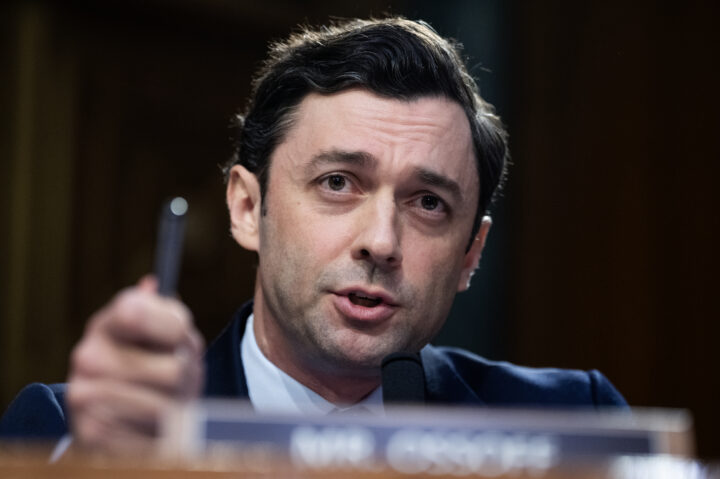
Sen. Jon Ossoff (D-GA) in the Senate Select Intelligence Committee on July 15, 2026.


 Add JewishInsider on Google
In Georgia’s first Senate debate on Thursday, Sen. Jon Ossoff (D-GA) said he would defer to the International Criminal Court on whether Israel has committed genocide in Gaza, but said that he believes Israel has violated international law.
Ossoff also repeatedly hammered his opponent, Rep. Mike Collins (R-GA), as a bigot who had hired, amplified and even welcomed into his home and family antisemitic and white supremacist figures.
Collins’ official congressional account amplified an antisemitic post from a white nationalist Twitter account, his former chief of staff was a member of a group chat with white nationalists where he discussed using congressional authority to free a Holocaust denier from prison and his son-in-law is a white nationalist influencer.
“The question of genocide is a question of whether a government has the specific intent to destroy a national ethnic group, and that is a question for the International Criminal Court,” Ossoff said at the debate. “There is no doubt in my mind that Israeli forces prosecuting the war in Gaza violated the law of armed conflict and international humanitarian law.”
Neither Israel nor the U.S. are members of the ICC.
Ossoff said that he “care[s] deeply about the security of the Israeli people,” including some members of his own family, as well as about innocent Palestinians, and said that he stands by his votes to halt arms sales to the Jewish state.
He went on to attack Collins for voting to sanction the ICC.
“His view is there should not be accountability for crimes against humanity, no matter who commits them, and that’s because the congressman is deeply disconnected from our state’s tradition of civil rights and human rights,” Ossoff said.
Sen. Jon Ossoff said during last night’s debate that whether the IDF committed genocide in Gaza "is a question for the International Criminal Court," but he has "no doubt" that Israel violated international law in the course of the war. https://t.co/SDjI8Cplgn
— Jewish Insider (@jewishinsider) October 9, 2026
Collins responded by accusing Ossoff of being a far-left extremist, highlighting his support for Michigan Democratic Senate candidate Abdul El-Sayed, and antisemitic streamer Hasan Piker’s backing — since retracted — for Ossoff. He also accused Ossoff of hating Israel and loving Iran.
Collins, for his part, faced grilling from both Ossoff and the debate moderators over his ties to various antisemitic and white nationalist figures, including his own son-in-law.
“You’ve hired half the Third Reich to staff your congressional office and you have promoted neo-Nazi content online,” Ossoff said. “Imagine running for the U.S. Senate while neo-Nazi propaganda is disseminated to an audience of millions from your home. That’s Mike Collins.”
Ossoff continued: “Mike Collins’ office intervened at the Department of Justice on behalf of a Holocaust denier, while his office was in cahoots with some of the nation’s most notorious white supremacists. Mike Collins is a bigot, and it’s disqualifying for a candidate for the U.S. Senate.”
Ossoff suggested that, had the Civil Rights Movement been happening today, Collins would have been personally involved in brutalizing protesters.
Asked by moderators about what conversations he’s had with his daughter and son-in-law about the latter’s online activity, Collins suggested that Ossoff’s attacks on him have endangered his family.
“That’s my family. That’s the craziness that John Ossoff has been spewing out there,” he said. “I actually had a crazy person get put in jail this weekend because he not only wanted to kill my son-in-law, but he wanted to kill me.”
He went on to say that he’s condemned racism, antisemitism and hate, regardless of the source, and said he’s told his son-in-law that as well, and said he’s fired staff with problematic ties when made aware of them.
“It’s wrong. We have no place in this world for that,” Collins said, going on to say that Ossoff has failed to condemn figures like El-Sayed and Piker. (Ossoff belatedly condemned Piker in August after Piker suggested that American Jews were responsible for inciting antisemitic attacks on themselves, months after Piker named him as among his favored candidates for the 2028 presidential election.)
Ossoff also attacked Collins over his support for the war in Iran and its impacts on gas and other prices domestically.
Ossoff said that the U.S. was “lied into” the war. “They told us last year that they obliterated Iran’s nuclear program. This year they told us it posed an imminent threat. So on top of the tariffs now, we have eight months of war, 18 Americans killed in action, hundreds wounded. Iran still has its uranium. Iran still has its drones and missiles,” Ossoff said.
Collins said that President Donald Trump “had every right to go in there and make sure that Iran does not get a nuclear weapon,” pointing to warnings from the International Atomic Energy Agency that Iran was approaching nuclear weapons capability.
He said that Iran, were it to obtain nuclear weapons, would attack both Israel and the United States, and that it has been attacking and killing Americans for 47 years.
Some Jewish Georgians say they feel politically homeless as they have to choose between Sen. Jon Ossoff and Rep. Mike Collins
Wikimedia Commons
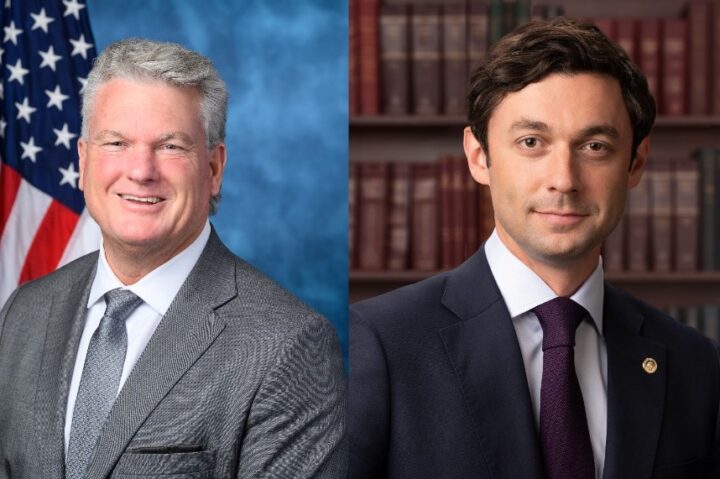
Rep. Mike Collins (R-GA) and Sen. Jon Ossoff (D-GA)
For some Jewish voters in Georgia, this year’s Senate race offers no comfortable choice. Sen. Jon Ossoff’s (D-GA) votes to block weapons shipments to Israel have alienated some longtime supporters, while Republican nominee Rep. Mike Collins’ (R-GA) history of inflammatory rhetoric and controversial staffing choices has made him a nonstarter for others.
It’s “hard for me to support either one,” Norman Radow, a major Democratic donor in Georgia and a prominent figure in Atlanta’s Jewish community, told Jewish Insider, and called the November election in the key swing state a “tough choice for a lot of Jewish people.”
“It’s hard for me to imagine that I would vote for Ossoff,” he said. “There would have to be some epiphany or something so outrageous about Collins that I have to do it.”
But at the same time, he said that Collins, a far-right Republican with a history of controversies — including boosting an antisemitic post on X and employing a chief of staff who was revealed to be a member of a group chat with white nationalists where he discussed efforts to free a Holocaust-denying far-right activist from prison — may be an equally unpalatable choice.
Cheryl Dorchinsky, the founder of the grassroots Atlanta Israel Coalition, similarly said that Ossoff’s positions on Israel have been “incredibly disappointing” — calling it a “very good example” of why she feels “politically homeless.”
Dorchinsky said she needs to look into Collins, explaining that she hadn’t been aware of the antisemitism scandals that had dogged him.
“I can’t say that I will be supporting Ossoff, and I hate that,” Dorchinsky said. “It’s just making me nauseous all around. … I really want to feel good about voting again, [to] like who I vote for.”
The race, then, offers a stark test of how defining the Israel issue will be for Jewish voters in Georgia, especially given Collins’ baggage. And they are feeling the weight of that vote in a purple state where their numbers — some 150,000 statewide — could make a difference. Ossoff defeated former Sen. David Perdue (R-GA) by about 50,000 votes out of some 4.4 million cast in 2020, helping to flip the Senate to the Democrats.
“Our vote here really, really matters,” said David Lubin, a Jewish Democrat who ran for the state Senate. But, he added, “If you’re a Democrat, you’re struggling with Ossoff’s track record on Israel.” He called the election a “very tough, very difficult” choice for him and for other Democrats.
Lubin, whose daughter was killed in a terror attack in 2023 in Israel, where she had moved two years prior and was serving as a police officer, said that Ossoff “still has time to make his case for Georgia voters and to the Jewish community.” Lubin said he’s open to voting for Collins or leaving his ballot blank in November, but he’ll give Ossoff “every opportunity” to win him over before Election Day.
But Collins’ record also raises concerns for Lubin.“That’s where people really have to sit down, they have to look at the candidate up until you go to the polls and you have to take all the information you can gather … to make the best decision.”
In order to win his vote, Lubin said that he wants to see Ossoff make a “stronger commitment” to change his votes on Israel and engage more deeply with the Jewish community in fighting antisemitism. For Collins, Lubin said he also wants to see him engage more with the Jewish community, to be “very clear on his stance with Israel with us, and his stance on how he will fight against Jewish hatred.”
Not everyone shares the concerns about Ossoff.
Cary Levow, a supporter of pro-Israel causes and candidates who has hosted fundraising events for Ossoff, told JI that the race is not “a close call,” and that Ossoff will clearly be the stronger advocate for the Jewish community.
“Jon has been very pro-Israel, even though he’s taken a vote or two that kind of got breathlessly reported as anti- or pro-Israel, which, in my opinion, gets a little too binary,” Levow said, emphasizing that Ossoff has strong ties to and family in Israel.
Collins supporters, too, say that concerns about their candidate are overblown, and argue that he’ll be the more reliable advocate for Jewish community concerns.
Peter Korman, a Jewish Republican state committee member, said he’s known both Collins and his father, former Rep. Mac Collins (R-GA), and said that allegations of antisemitism against Collins are “slander,” emphasizing Collins’ opposition to anti-Israel protests following the Oct. 7, 2023, terror attacks.
“He stood in support of Israel. He stood in support of the Jewish population here in Georgia and across the United States,” Korman said, insisting that there is “no indication” of “any antisemitism in Mike Collins’ background or his behavior, and I have personal experience with that.”
The wider currents at play in the Democratic Party nationwide are also figuring in the Ossoff-Collins race, observers note.
One Jewish donor in the state, who asked for anonymity to discuss sensitive matters, said they didn’t believe it was productive for the pro-Israel community to be strongly engaged in the Senate race, framing an Ossoff victory as essentially an inevitability even as they expressed disappointment with some of his votes.
The donor said some Jewish Democratic leaders have resigned themselves to voting for Ossoff despite their concerns, arguing that his positions are more moderate than those of the growing left flank of the party and that he continues to express support for Israel to pro-Israel donors.
The donor said that the more important focus for the Jewish community should be on defeating far-left candidates who don’t believe Israel has a right to exist.
In comments to JI about the concerns raised by Jewish community members, both candidates took shots at each other.
“Mike Collins is a notorious bigot whose blatantly antisemitic behavior and harassment is completely out of step with Georgians’ values and will be resoundingly rejected in November,” an Ossoff campaign spokesperson said in a statement.
Meanwhile, Collins’ campaign accused Ossoff of pandering to anti-Israel radicals, and emphasized Collins’ staunch support for Israel.
“Jon Ossoff would rather cater to his out-of-state, Hezbollah flag-adorned, radical anti-Israel campaign supporters than to his own constituents in Georgia,” a Collins spokesperson said in a statement. “While Jon Ossoff voted to block weapons sales to Israel and refused to condemn the dangerous anti-Israel protests that erupted across our country after October 7, Mike Collins has never bowed to the woke mob and has always put America’s and Israel’s safety first.”
Collins has seemingly taken steps to distance himself from some elements of his record that have troubled members of the Jewish community. The staffer responsible for the antisemitic X post, as well as the chief of staff who was in the group chat with white nationalists, are both no longer employed by him, according to Collins’ office.
Politico reported last week that his office had brought on a new chief of staff.
Meanwhile, a group of more than 115 leaders and members of Georgia’s Jewish community recently signed a joint statement, first shared with JI, condemning Collins’ social media activity and arguing that “Georgians deserve better.”
“Like most groups, Jews have a wide array of perspectives on issues. Yet our Jewish tradition binds us in a belief that we should all be practicing tikkun olam — working to make the world a better place,” the statement reads. “Our Jewish values also prohibit hate speech and racism — noting that all humanity is created in the image of the divine. Mike Collins’ posts run counter to our uniting principles, and we should not tolerate it, especially in a candidate for US Senate.”
Some Jewish voters in the state said they have no concerns about voting for Collins, seeing ousting Ossoff as crucial and expressing confidence that Collins’ evangelical Christian background will make him a reliable supporter of Israel and the Jewish community.
Korman, the GOP committeeman, said his concerns about Ossoff stretch back further than his votes on the arms sales to Israel, criticizing the senator for failing to speak out in favor of state-level legislation condemning the Oct. 7 attacks and codifying the International Holocaust Remembrance Alliance’s working definition of antisemitism.
He alleged that despite his Jewish identity, Ossoff has failed to speak out or be a leader for the Jewish community amid rising antisemitism nationally and within the Democratic Party.
Asked about Collins’ own vote against the Antisemitism Awareness Act in 2024, which would have codified the IHRA definition’s use by the Department of Education, Korman said that he understood that Collins’ concerns focused on free speech issues.
Others are building new relationships with Collins after the primary. Kirk Halpern, an Atlanta Jewish business leader, said he wasn’t familiar with Collins before the race but reached out to Collins’ campaign to offer his help as soon as the Republican primary ended, due to his deep opposition to Ossoff.
He said that after Ossoff’s first vote to block arms sales to Israel, he committed that “as soon as a Republican opponent is [nominated] that I will do everything I can to support that candidate. … Jon Ossoff has been wrong on every key vote.”
Halpern said that Ossoff, being Jewish and speaking out and voting against Israel, “gives cover for those that are antisemitic” and who want to see Israel destroyed.
Pressed on concerns from other community members about Collins’ history, Halpern said that he has found, living in the American South, “that the strongest support for Israel … as well as the vitality of the American Jewish community comes from the evangelical Christian community, the sincerity and love that evangelical Christians have for Israel and the Jewish people is is very deep.”
Collins, he continued, is a member of that community. “I believe that his evangelical Christian faith and his love of Israel and of the Jewish people will make sure that going forward, mistakes don’t occur,” Halpern said.
“I also believe that the absence of leadership by Jon Ossoff and with Jon Ossoff being Jewish, that is so much more problematic for our community,” Halpern added.
Halpern is set to host a meet-and-greet for Collins with members of the Jewish community later this month and said he hears similar “tremendous, informed disappointment in Jon Ossoff” from Jewish friends on both sides of the aisle.
For some Jewish voters, Derek Dooley, the moderate Republican primary candidate backed by Gov. Brian Kemp, was their favored candidate, but Collins handily won a primary runoff last month. Radow, the Democratic donor, said that Dooley would have been a more compelling Republican option for him as well.
Emanuel Fialkow, an early backer of Dooley’s campaign, said he’s now fully behind Collins.
“He’s our only chance to get rid of Ossoff, who we feel is untrustworthy and ineffective,” Fialkow said. “It should not be that difficult to support our only ally in the Middle East, and to symbolically weaken them with a vote against funding for arms sales is ridiculous. It’s almost un-American.”
Fialkow said he believes that Collins has, “whether it be for political reasons or his own religious convictions, demonstrated unwavering support for our strongest ally [Israel].”
He said he also has no concerns about Collins’ record on antisemitism, and said Collins has been “unwavering in his support in every conversation” that he’s heard about with Atlanta’s Jewish community.
One Jewish leader in the state said that Kemp, who has strong connections to the Jewish community, could have made a stronger play for the Jewish vote had he run for the seat. The leader said Collins — given both the concerns about his record and his comparative lack of relationships with the community — will have a tougher time picking up those votes. Whether Kemp decides to push his network to support Collins could also be a factor.
Ossoff, despite his votes on Israel, maintains a loyal and dedicated base among Georgia’s Jewish community — particularly in the face of a candidate with Collins’ record. His supporters argue that the backlash to his votes on Israel has been overblown.
Mike Greenwald, a member of Atlanta’s Jewish community who organized the statement of local leaders and community members, said he was “fairly horrified” at Collins’ nomination and that it was easy to find other Jewish Georgians who agreed. “He does not seem to be a friend of our community,” Greenwald told JI.
In addition to his social media activity and former chief of staff, Greenwald also raised concerns about Collins’ attendance at a New York City Young Republicans Club event alongside a member of Germany’s far-right AfD party.
He called Ossoff “an incredible friend to Israel,” emphasizing other votes the senator has taken in support of Israel and his work on hostage issues. He said Ossoff has been a champion on antisemitism, pointing to his support for federal nonprofit security grants for the community and other engagement with the Jewish community.
“He does all of the things you would expect someone who is a champion for both Israel and the Georgia Jewish community to do, and it’s not surprising, because it’s genuine, and we’re very proud of him for that,” Greenwald said. He said many in Georgia’s Jewish community are particularly proud of Ossoff as the state’s first Jewish senator.
“The contrast, as you picture him continuing on as senator versus Mike Collins, is pretty stark and an easy call for us,” Greenwald said.
Levow, the Ossoff fundraiser, said, “There’s no real comparison here, if he’s a little uncomfortable with 2,000-pound bombs [being sold to Israel], versus someone who’s flirting with antisemitism and white nationalists,”
“[Ossoff] has a very, very deep well of Jewish support,” he continued. “I haven’t really wavered from him. I don’t find any of his votes problematic, to be honest with you. I think history will look kindly on them, and they’re going to be evidently reasonable.”
He said that he sees the Jewish community, particularly younger Jews in the community, as highly supportive of Ossoff, noting that one recent Jewish community fundraiser drew around 70 supporters and raised $70,000. He said Ossoff has made frequent appearances at community events, including a speech at the area’s largest synagogue around Hanukkah.
“I think he’s done an excellent job for the Jewish community, for the state of Georgia, for the country,” Larry Auerbach, another Ossoff supporter, told JI, while raising concerns about Collins’ affiliations.
“Even if I didn’t appreciate and support Ossoff as much as I do, Collins is just somebody I could never tolerate for those reasons,” Auerbach said.
Auerbach called objections to Ossoff’s votes against arms sales to Israel “much ado about very little,” arguing that blocking the sales in question would have done nothing to hurt Israel’s operations in Gaza. He also highlighted Ossoff’s support for nonprofit security grants.
Ultimately, a Jewish leader in the state said, Ossoff is likely to pick up a substantial majority of the Jewish vote in the state — in part because most of the community generally votes Democratic.
“There will be those who vote for Collins 100% because of his support for Israel and are willing to be less concerned about the adjacent antisemitism,” the leader said. In the end, the leader continued, “Jon will probably get 70-65% of the vote — the Jewish community might increase its voting for Collins a little bit more,” but most voters will likely fall along party lines.
As the election nears, Radow, the Democratic donor, is waiting to see how things unfold.
“We’ll see how the race plays out, we’ll see how they debate, we’ll see what they say on the issues,” Radow said. “I think the Jewish community will have to make a choice. There are die-hard Democrats who’ll vote for a Democrat à la [New York City Mayor Zohran] Mamdani, just because he has a D in front of his name. I’m not that Democrat.”
Radow, who had previously engaged with Ossoff and pressed him to change his votes on weapons sales, suggested he had essentially written off Ossoff on the issue. He said Ossoff has dodged calls and outreach in the weeks ahead of major Israel votes, and then sent out mass emails to those concerned by his positions “a week after” the votes. “I’m just not going to play that game with him,” Radow said.
But his conflicted feelings about the pivotal race remain. He said that Collins being the GOP nominee “goes a long way to ensure that Jon’s going to win.”
Radow said Collins had once told him he believed the 2020 election was rigged, which was a “non-starter” for Radow, on top of Collins “surrounding himself with people that are not of moral character and I’ve heard … he’s said some antisemitic things along the way. For all those reasons, he’s not a compelling candidate for me.”
Please log in if you already have a subscription, or subscribe to access the latest updates.
 Continue with Google

 Continue with Apple