














































































In a video message directed at disaffected moderates, Rogers said ‘the fight is far greater than just left versus right. The fight is for the very soul of our nation’
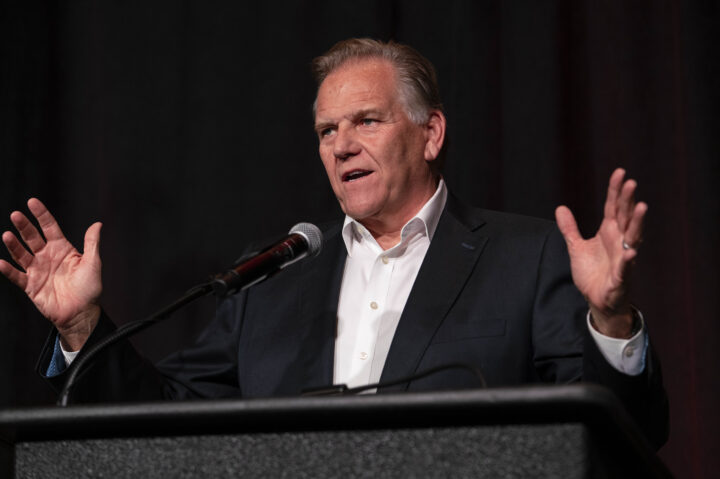
Sarah Rice/Getty Images
Michigan Senate candidate Mike Rogers speaks at his election watch party.


 Add JewishInsider on Google
Addressing Michigan Democrats in a videotaped message, Republican Senate nominee Mike Rogers said that the “vast majority of people” rejecting Democratic Senate nominee Abdul El-Sayed — whose bid he framed as a “campaign filled with anger, divisiveness, calls for violence and the views that are out of touch with your values”— have “a home with us.”
“If you’re among the majority of Democratic voters that woke up on Wednesday feeling hopeless because the person who won does not represent your values, well, just know there is still hope,” Rogers said seated next to his wife, in a 90-second video message released on Friday.
“Michigan deserves a senator who is ready to sit with you, hear from you and represent you.
The parents across Michigan who want an education system that sets up their kids for success have a home with us. Grandparents across Michigan who are heartbroken from watching their kids and grandkids leave the state, you have a home with us,” he continued.
“To young people who are looking for real solutions to our housing affordability crisis, you have a home with us. To families who don’t want higher taxes and lower paychecks, you have a home with us. The fight is far greater than just left versus right. The fight is for the very soul of our nation. Over the next 90 days, I’m going to work hard to earn your trust, to earn your support and earn your vote.”
Most Democrats quickly coalesced behind El-Sayed after he narrowly clinched victory in Michigan’s Democratic primary on Wednesday morning, while Republicans quickly attacked El-Sayed’s extremist history and ties.
Just before he was declared winner, El-Sayed doubled down on his criticism of Israel on MS NOW’s “Morning Joe,” calling the Jewish state “bloodthirsty” and saying his critiques go beyond the government of Israeli Prime Minister Benjamin Netanyahu.
After socialist candidates scored several surprise victories, party leaders are fighting with renewed vigor to rally behind Rep. Haley Stevens (D-MI) in the primary against her left-wing challenger, Abdul El-Sayed
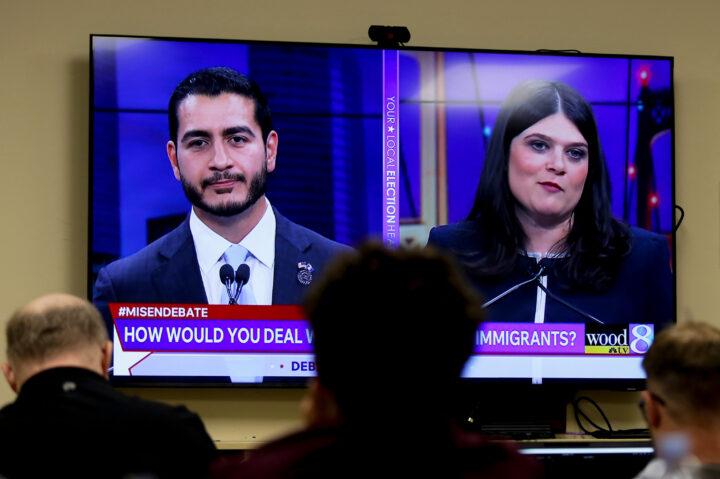
Kristen Norman/AP
Michigan U.S. Senate candidates, Abdul El-Sayed, left, and Rep. Haley Stevens, D-Mich., are displayed on a television during a debate inside the spin room at WoodTV studios on Tuesday, July 7, 2026, in Grand Rapids, Mich.
As Maine Democrats pick up the pieces of Graham Platner’s failed Senate campaign and quickly try to find a replacement for the scandal-tarred candidate on the ballot, moderate Democrats in Michigan, where a primary is fast approaching, are in a race against time to prevent another far-left Senate candidate from capturing a valuable nomination.
The final three weeks of the Michigan primary will be 2026’s most consequential test yet for the power the party establishment still holds, particularly in a pivotal swing state. After socialist candidates scored a number of surprise victories in heavily blue districts in New York City, Philadelphia and Denver, party leaders are fighting with renewed vigor to rally behind Rep. Haley Stevens (D-MI) in the primary against her left-wing challenger, Abdul El-Sayed.
Retiring Sen. Gary Peters (D-MI) endorsed Stevens on Monday, a pivot from his announcement in May that he planned to stay out of the race, joining Senate Minority Leader Chuck Schumer (D-NY), who had already backed the congresswoman. The party’s left flank — including Sens. Bernie Sanders (I-VT) and Chris Van Hollen (D-MD) — is backing El-Sayed.
“The change of heart is we just know that we have to hold Michigan,” Peters said on “Morning Joe” on Tuesday of his decision to endorse, with Stevens sitting beside him. “She’s an outstanding candidate and I certainly hope that folks get behind her around the country and understand that she’s the right person to be the next senator from the state of Michigan.”
There are fresh signs that the late push for Stevens from Democratic leaders — along with millions in ad spending from pro-Stevens outside groups — has given the congresswoman momentum in the closing stretch of the race. A new poll commissioned by the Detroit News found Stevens pulling ahead of El-Sayed by seven points, 48-41%, after she trailed in most public polls this year.
The United Democracy Project, AIPAC’s affiliated super PAC, is spending big to attack him, dropping nearly $15 million in the race so far. A new 30-second ad attacks El-Sayed as sexist, referencing criticisms he’s made against former First Lady Michelle Obama and Gov. Gretchen Whitmer. A mailer sent to Michigan voters criticized El-Sayed’s response to the attack on Temple Israel in West Bloomfield in March. El-Sayed condemned the attack but said that “hurt people hurt people,” referring to the assailant having lost his brother — a Hezbollah commander — in an Israeli airstrike in Lebanon.
“We are going to continue educating Michigan voters on El-Sayed’s track record of making disparaging and sexist comments about women,” Patrick Dorton, a UDP spokesperson, told JI on Tuesday.
Platner’s collapse in Maine has, for some Democrats, raised questions about the electability of far-left candidates in must-win Senate battlegrounds for the Democratic Party.
The centrist Democratic think tank Third Way published a memo on Tuesday underscoring that Democrats could lose other winnable races if they continue taking the advice of ideologically driven left-wing consultants who advised Platner. (Fight Agency, the political ad firm that was used by Platner and New York City Mayor Zohran Mamdani, is also consulting for El-Sayed’s campaign.)
El-Sayed has continued to play to his base, doubling down on radical rhetoric in interviews at a time when Democrats are concerned about holding onto the swing seat in November. He called Israel a “rogue state” in a recent CNN interview and said that Democrats who support Israel only do so because of money. As his rhetoric has become more extreme, and the race tightens between the two candidates, Jewish Democratic groups are planning to amp up their campaigning for Stevens ahead of the Aug. 4 primary.
“It is now a direct, high-stakes two-way race between Haley Stevens and Abdul El-Sayed,” the Michigan Democratic Jewish Caucus wrote in a recent email to members. The Jewish Caucus is hosting a canvassing event on behalf of Stevens in Farmington, a heavily Jewish suburb of Detroit, this weekend.
“With early and absentee voting already underway, to ensure Haley wins on Aug. 4, we need to leverage our deep community roots, personal relationships, and trusted voices,” Jewish Caucus Chair Decky Alexander told Jewish Insider on Tuesday.
The Jewish Democratic Council of America, a national organization, is hosting a virtual phone bank for Stevens this week. The group had previously issued a joint endorsement of Stevens and state Sen. Mallory McMorrow, who withdrew from the race earlier this month, but is now planning a five-figure digital ad buy in support of Stevens’ campaign.
“JDCA is focused on mobilizing Jewish voters across Michigan in support of Haley Stevens,” JDCA CEO Halie Soifer told JI on Tuesday. “Haley has always stood with the Jewish community, and we’re proud to support her in this critically important election. We also believe she has the best chance of beating Mike Rogers in November, and we’re committed to keeping Michigan blue.”
The Stevens campaign expects a close race but views McMorrow’s decision to drop out as a boon for Stevens. McMorrow did not endorse either candidate. A source working with the Stevens campaign, who was not authorized to speak on behalf of the congresswoman, said the campaign is particularly focused on winning over Black voters, as well as older and non-college-educated voters, many of whom remain undecided. (The Detroit News poll showed Stevens with a substantial advantage with Black voters, leading El-Sayed 67-21%.)
The Michigan Jewish community, which is centered in Stevens’ congressional district, is also a part of the campaign’s get out the vote plan.
“I think that Haley wants all Michiganders to vote, but obviously has a very special connection with the Jewish community, especially in her district in Oakland County,” said the campaign source.
El-Sayed routinely tars Stevens for receiving the backing of AIPAC. She has not said much during the primary about her ties to the group, instead highlighting her support for a two-state solution to the Israeli-Palestinian conflict, which she described as “the difference between my opponent and myself on this issue” in a debate last week. El-Sayed has said he struggles with the question of whether Israel should exist as a Jewish state.
This week, El-Sayed announced a major fundraising haul from the second quarter of the year: $4.5 million, up from $2.3 million he raised in the first quarter. A spokesperson for Stevens declined to share her latest fundraising totals, which legally must be reported by Wednesday. She took in $1.9 million in the first three months of the year.
‘I’m going to have a problem with any candidate — Democrat, Republican or independent — who shares antisemitic and hateful posts on social media,’ the Michigan senator said
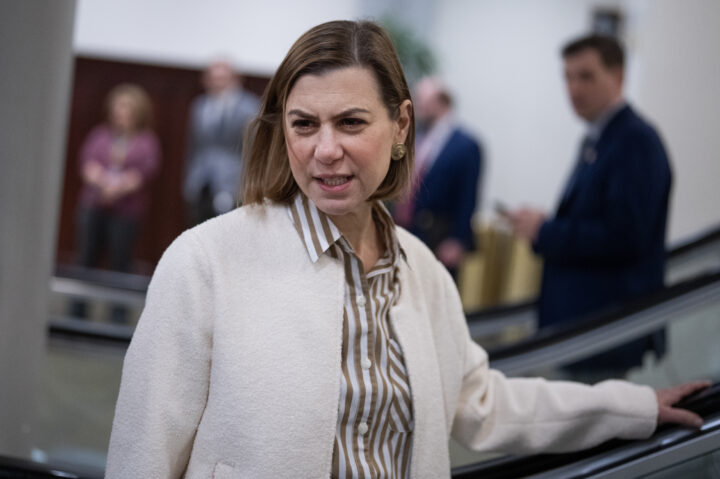
Tom Williams/CQ-Roll Call, Inc via Getty Images
Sen. Elissa Slotkin (D-MI) is seen in the U.S. Capitol on Thursday, March 26, 2026.
Sen. Elissa Slotkin (D-MI) joined other Michigan Democrats in condemning Amir Makled, a Democratic nominee for regent of the University of Michigan, over Makled’s past comments on social media expressing antisemitic sentiments and support for terrorism.
“I’m going to have a problem with any candidate — Democrat, Republican or independent — who shares antisemitic and hateful posts on social media. Especially when they refuse to disavow those comments or show remorse,” Slotkin said in a statement to Jewish Insider on Thursday, in response to a question about Makled.
Makled was nominated for the post at the Michigan Democratic Party convention last weekend, replacing Jewish and pro-Israel regent Jordan Acker, who has been repeatedly harassed and has had his home vandalized by anti-Israel campus activists.
The convention, which also featured aggressive heckling of pro-Israel speakers, has left prominent Jewish Democrats in the state feeling alienated and unmoored from their party.
Rep. Kristen McDonald Rivet (D-MI) similarly criticized Makled, and Sen. Gary Peters (D-MI) more broadly criticized the behavior of activists at the convention.
Dearborn attorney Amir Makled will proceed to the November general election, replacing Jordan Acker
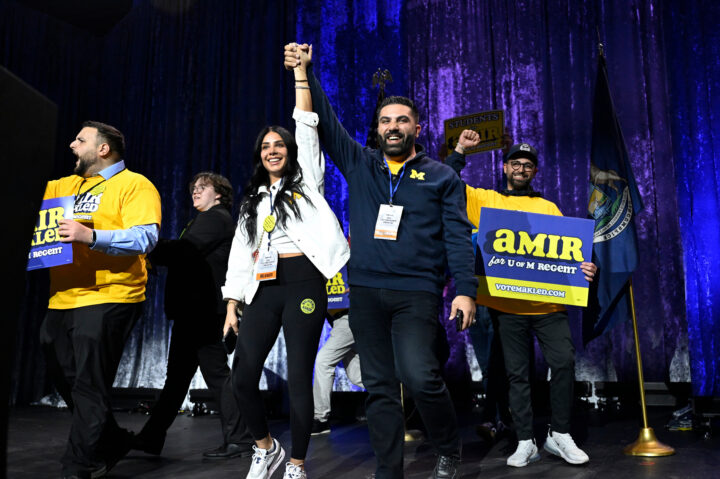
Jose Juarez/AP
Amir Makled, right center, a candidate for the University of Michigan Board of Regents, walks with his wife, Nassrine Gomah Makled, after winning the party's nomination during the Michigan Democratic Party State Endorsement Convention, Sunday, April 19, 2026, in Detroit.
Michigan Democrats on Sunday nominated insurgent candidate Amir Makled, an anti-Israel attorney, for the University of Michigan Board of Regents over incumbent Jordan Acker, a Jewish regent who had been targeted by far-left activists over his support for Israel.
Acker was actively campaigning for reelection alongside Paul Brown, both of whom were first elected in 2018. But only Acker was targeted by Makled’s backers, even though both Acker and Brown had supported disciplining anti-Israel student activists and opposing efforts to divest from Israel. Brown was also nominated by the Democratic Party on Sunday, and he and Makled will now advance to the November general election.
The positions are statewide elected offices, and regents are tasked with governing Michigan’s flagship public university. Two of the board’s eight seats are up for election this November.
Makled has argued in his campaign that the university should divest from Israel. A trial attorney based in Dearborn, Makled previously represented a University of Michigan student who was arrested during the 2024 anti-Israel encampment.
He faced criticism earlier this month after the Detroit News documented Makled’s history of sharing pro-Hezbollah and antisemitic tweets, which he has since deleted but not addressed. Those revelations prompted SEIU, the labor union, to pull their endorsement of Makled.
In 2024, Acker’s home was targeted by anti-Israel activists on multiple occasions in incidents that university leadership and Michigan politicians described as antisemitic.
Please log in if you already have a subscription, or subscribe to access the latest updates.
 Continue with Google

 Continue with Apple