


















































The bipartisan group led by Reps. Claudia Tenney and Brad Schneider had earlier this year reached out to DHS about conditions tying NSGP funding to ICE cooperation
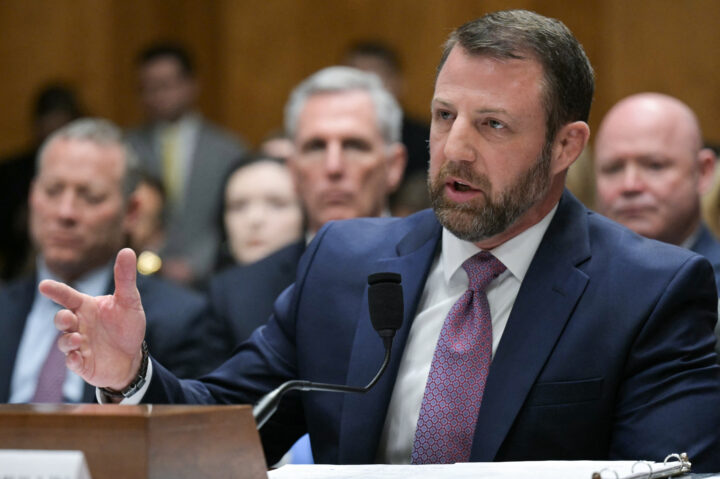
Oliver Contreras/AFP via Getty Images
DHS Secretary Markwayne Mullin testifies during a Senate Committee on Homeland Security and Governmental Affairs confirmation hearing on Capitol Hill in Washington, DC


 Add JewishInsider on Google
In a letter to Secretary of Homeland Security Markwayne Mullin, a bipartisan group of House members reiterated concerns previously communicated to his predecessor about new conditions attached by the Trump administration to funding for the Nonprofit Security Grant Program.
The lawmakers, led by Reps. Brad Schneider (D-IL) and Claudia Tenney (R-NY), said that the 2026 NSGP application “maintains these concerning new compliance requirements” as well as adds a new provision allowing the Federal Emergency Management Agency to terminate grant awards “for convenience” if it determines that the grants do not advance the “national interest.”
The conditions about which lawmakers had previously raised concerns would have tied grant funding to cooperation with Immigration and Customs Enforcement activity and eliminating diversity, equity and inclusion programs.
“This vague and expansive standard gives applicants little guidance about what is expected of them and raises concerns about mid-project terminations without warning,” the lawmakers wrote. “As NSGP requires organizations to front the costs of their security projects, the possibility of mid-award termination and, therefore, no reimbursement, may deter applicants from accepting the grant, leaving their institution vulnerable to attack.”
They noted that they had raised the issue in February with Mullin’s predecessor, then-DHS Secretary Kristi Noem, urging Noem to clarify or waive the new conditions, which they said would “divert limited funds and burden the institutions the NSGP is meant to protect.”
Noem, they continued, told them the same month that FEMA was working to develop specific guidance for NSGP including particular examples applicable to faith-based nonprofits. But, the lawmakers said, that guidance has yet to be issued.
“We have always believed that NSGP should be as streamlined and effective as possible, with minimal red tape and compliance requirements focused squarely on security,” the lawmakers said. “You rightly expressed this same belief during your confirmation hearing. That is why we urge you to revise the FY 2026 NOFO and issue new guidance that removes or waives terms and conditions unrelated to the security of grant recipients, eliminates the new overly broad termination authority and ensures that the NSGP remains accessible to all eligible faith-based and community organizations.”
The letter highlights the string of attacks on Jewish institutions and Jewish communities in recent years, emphasizing the importance of the funds.
“I’m grateful to partner with Rep. Tenney to push back against onerous new rules that make our synagogues, churches, and mosques less safe. We will continue to root out hate and discrimination in all forms, so everyone can observe their faith safely and without threat of harm,” Schneider said in a statement.
“As threats against houses of worship and community organizations continue to rise, it is important that these institutions have confidence that the program will provide the support they were awarded. Our letter encourages DHS to provide that certainty by ensuring the program remains focused on its core mission of enhancing security for vulnerable communities,” Tenney said in a statement.
The Anti-Defamation League also expressed support for the letter.
“As antisemitism and threats against faith communities remain at historic levels, NSGP is more essential than ever to help at-risk communities protect themselves from threats,” Lauren Wolman, senior director of government relations & strategy at the ADL, said in a statement. “We are grateful to Representatives Schneider and Tenney for their bipartisan leadership in championing this lifesaving program and ensuring organizations can access those resources quickly, with confidence, and without unnecessary delays.”
The 2025 grants were delayed as a result of the 76-day partial shutdown of the Department of Homeland Security this year
Oliver Contreras/AFP via Getty Images
DHS Secretary Markwayne Mullin testifies during a Senate Committee on Homeland Security and Governmental Affairs confirmation hearing on Capitol Hill in Washington, DC
Sens. Elissa Slotkin (D-MI) and James Lankford (R-OK) wrote to Secretary of Homeland Security Markwayne Mullin on Thursday urging him to take action to move forward stalled Nonprofit Security Grant Program funding, an issue both lawmakers raised with Mullin during his confirmation hearing.
“Over the past decade, the NSGP program has enabled institutions to strengthen their security and harden the exteriors of their buildings. But the program is also plagued with restrictions and delays that have limited its effectiveness. We would like to take you up on your offer [to] discuss potential improvements to the NSGP program over the long term,” the two senators wrote. “Before we meet, there are several steps that you can take immediately to assist the nonprofits that rely on this program.”
They urged Mullin to “move quickly” to finalize 2025 grants — for which the application process was delayed for months and which have still not been finalized or released — as well as to “promptly” open applications for the 2026 grant cycle, with 2026 DHS funding now finalized by Congress.
Slotkin and Lankford also encouraged Mullin to retract new conditions imposed in the 2025 cycle related to immigration enforcement and diversity, equity and inclusion programs, which they said have “have caused confusion and concern among potential applicants.” They said the grant should be focused “on security and risk rather than on these unrelated issues.”
The two senators also asked Mullin to “immediately review staffing levels” in the NSGP program office at DHS, explaining that nonprofit groups have been concerned that insufficient staffing contributed to the delays in the 2025 grant process.
Going forward, the senators said they plan to urge Mullin to improve communication with the state agencies that administer the grant program and address delays in providing reimbursements to grant recipients for security expenses.
“We appreciate your willingness to engage with us on this important program that has enabled nonprofit organizations across the country to harden themselves against terror attacks,” Slotkin and Lankford wrote. “The need for the program remains high, and we are eager to work with you to strengthen it moving forward.”
Sen. Rand Paul (R-KY), the committee’s chair, voted no, while Sen. John Fetterman (D-PA) crossed party lines to back the nomination

Drew Angerer/Getty Images
Rep. Markwayne Mullin (R-OK) speaks during a news conference with members of the House Intelligence Committee at the U.S. Capitol August 12, 2022 in Washington, DC.
The Senate Homeland Security and Governmental Affairs Committee voted 8-7 Thursday to advance Sen. Markwayne Mullin’s (R-OK) nomination to be secretary of homeland security to the full Senate, largely along party lines.
Sen. Rand Paul (R-KY), the committee chair, was the lone Republican to oppose the nomination, while Sen. John Fetterman (D-PA) voted in support. Mullin’s nomination now heads to the full Senate, where a simple majority is required for confirmation.
Prior to the vote, Sen. Gary Peters (D-MI), the committee’s ranking member, announced he would oppose the nomination, arguing that Mullin “is not up to the challenge.”
“When I heard President [Donald] Trump would be nominating Sen. Mullin, I kept an open mind,” Peters said on Thursday. “However, throughout the nomination process, he has failed to be forthright and transparent. Sen. Mullin also showed that he doesn’t have the experience or the temperament to lead this critical department.”
Some committee members had expressed frustration during his hearing on Wednesday that Mullin was not forthcoming about a trip he took as a member of Congress, which he claims was classified.
Explaining his vote as the lone Democrat in support, Fetterman said on social media: “My AYE is rooted in a strong committed, constructive working relationship with Senator Mullin for our nation’s security.” He added that he had approached the confirmation “with an open-mind.”
During Mullin’s contentious hearing on Wednesday, Paul had voiced opposition to Mullin, citing personal animosity stemming from remarks the Oklahoma senator made about a past assault on Paul.
Mullin last month called Paul a “freaking snake” and said he “understood” why Paul’s neighbor had attacked him — an assault that left Paul with serious injuries and resulted in a prison sentence for the assailant. Mullin declined to apologize during the hearing, prompting Paul to threaten to cancel the vote.
The vote also comes as DHS enters the second month of a funding lapse amid a standoff between lawmakers over funding and reforms for U.S. Immigration and Customs Enforcement.
The lapse has impacted agencies including the Transportation Security Administration, Federal Emergency Management Agency, ICE and the Coast Guard, raising security concerns amid heightened threats tied to the ongoing war with Iran.
During his confirmation hearing, Mullin said it was a “horrible time” for the department to be without full funding and acknowledged the increased threat environment.
Lawmakers also raised concerns about the Nonprofit Security Grant Program, which provides funding to help protect religious institutions.
Following last week’s violent attack at Temple Israel in suburban Detroit, Mullin was pressed on the need to streamline the program amid persistent challenges, including underfunding and delays tied in part to the DHS funding lapse.
Mullin agreed, saying “there’s a better way to do this,” adding that he would be “laser-focused” on improving the program.
Mullin said he would work to streamline the paperwork process and reimbursement timelines
Oliver Contreras/AFP via Getty Images
DHS Secretary Markwayne Mullin testifies during a Senate Committee on Homeland Security and Governmental Affairs confirmation hearing on Capitol Hill in Washington, DC
In his nomination hearing to be secretary of homeland security, Sen. Markwayne Mullin (R-OK) said he will aim to “streamline the process” for grants, including the Nonprofit Security Grant Program (NSGP) aimed at helping harden religious institutions, amid heightened antisemitism and increased threats during the ongoing war in Iran.
The NSGP has faced persistent challenges, including severe underfunding, controversial new conditions and, most recently, delays tied to the ongoing partial shutdown of the Department of Homeland Security.
When pressed by senators on the need to unlock NSGP funding in the wake of the violent attack at Temple Israel in suburban Detroit last week, Mullin agreed that the process should be streamlined and said he would aim to “cut out the redundancies” and “amount of paperwork.”
“The Jewish community is spending about a billion dollars a year privately securing their own institutions,” said Sen. Elissa Slotkin (D-MI). “No religious group should have to spend that amount of money on their own security in the United States of America. So I would just ask for your help in reforming the Nonprofit Security Grant Program so it’s agile, so you don’t have to win the grant and then still do 100 pieces of paper.”
Sen. James Lankford (R-OK) echoed those sentiments, noting that the “length of time it takes to get a response” is concerning, especially for “locations that are higher risk than others.”
“Synagogues and temples have been one of those very high risk locations that are out there,” Lankford said, referencing the attack at Temple Israel. “That location happened to be one of the locations where there’s also been this nonprofit security grant to help harden that facility.”
“We have multiple challenges here,” Lankford added. “One of them is, when the decision is made, they make a request, go through the paperwork, get approval to be one of those locations that we say we need to harden this location. Once the approval is done, it may take months to over a year just for the dollars to actually come on it because there’s more bureaucratic hoops to go through.”
In response, Mullin agreed, “there’s a better way to do this.” He added that while he may have political differences with some of the lawmakers on the committee, this issue “isn’t one” of them and that he would be “laser focused and get this resolved.”
“The amount of paperwork once you’re approved to get the funding flowing, and then the paperwork that’s followed up on is way too encompassing,” Mullin said. “Taking years to get reimbursed is not acceptable. Taking months to get reimbursed is not acceptable.”
Mullin was also pressed on the threat of terrorist attacks domestically amid the DHS funding lapse and ongoing conflict in Iran.
Sen. Josh Hawley (R-MO), cited several recent incidents that had “potential terrorist ties,” including the antisemitic attack at Temple Israel in Michigan whose perpetrator had family ties to Hezbollah; a school shooting at Old Dominion University earlier this month, which is being investigated as an act of terrorism; a mass shooting in Austin, Texas, which is being investigated as having ties to the Iran conflict; and the detonation of bombs in New York City.
“Is this a good time for the Department of Homeland Security to be shut down and unfunded?” Hawley said.
“It’s a horrible time,” Mullin replied. “It’s devastating to the morale of the men and women we have tasked to keep care, take care of all of us, all the homeland, regardless it’s a blue state or red state.”
Sen. Richard Bumenthal (D-CT) pressed Mullin over whether he would approve the deportation of Iranian dissidents who could face death or punishment upon being returned to Tehran. The Trump administration has deported Iranians back to Iran from the U.S. on several deportation flights after a deal between the two governments was reached.
“Before the war in Iran began, the Trump administration negotiated a back-channel agreement, a deal with the Islamic Republic to deport Iranian nationals, including asylum seekers and dissidents,” Blumenthal said. “I have no doubt you share my outrage about the treatment of Iranian nationals who were deported, possibly to torture and death in Iran. We should not be sending Iranian dissidents and asylum seekers back to Iran, wouldn’t you agree?”
Mullin was noncommittal, arguing that he didn’t know “the specifics” behind the incident.
“Before I can talk about hypotheticals, I would need to know the reasons behind it,” Mullin said. “But I don’t want to deport anybody that’s here legally and most definitely not individuals that have done everything possible to be a contributor to society.”
“We know that our enemies want to infiltrate us and use our rules and generosity against us, so I don’t know the specifics of their background,” Mullin added. “But I will be happy to look into it.”
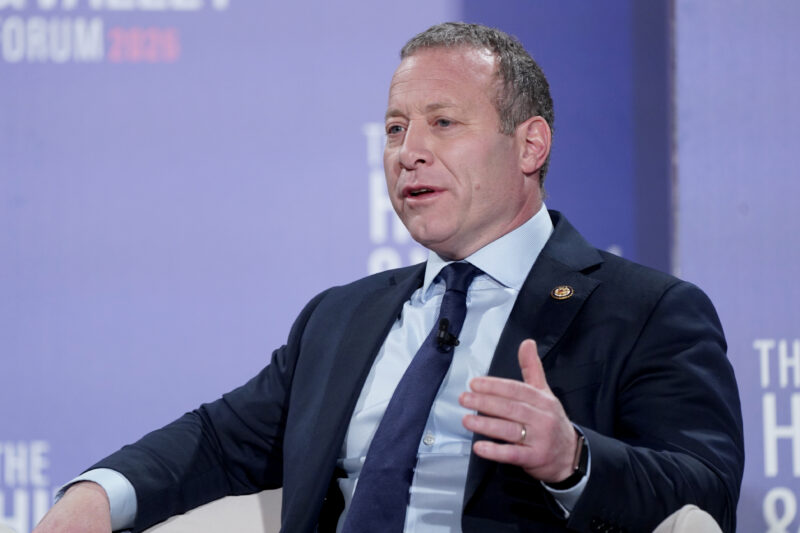
Rep. Josh Gottheimer (D-NJ), a leader in the House on antisemitism and NGSP funding who attended Mullin’s hearing, told Jewish Insider that DHS needed “new leadership,” and signaled an openness to working with Mullin on the issue.
“We don’t agree on everything, that’s for sure. But, after a decade of working out together most mornings, and finding bipartisan solutions to some of the toughest issues, Markwayne and his family have become very good friends,” Gottheimer said.
During the hearing, Mullin also noted that Gottheimer is “a friend” and that he would “run through fire for the guy.”
“When Josh asked me to join a bipartisan group called No Labels, that’s when we really started seeing that there’s a lot of common ground that we can work together on,” Mullin said. “We can set the differences aside, and we can work together. In fact, our daughters are writing a book together about bipartisanship.”
Mullin’s prospects for confirmation remain somewhat in question, given apparent opposition from Sen. Rand Paul (R-KY), who leads the committee where Mullin’s nomination vote will take place. Paul’s opposition traces to personal animosity between the two colleagues, as well as what Paul described as Mullin’s “anger issues.”
Mullin recently called Paul a “freaking snake” and said that he “understood” why Paul’s neighbor had attacked him, an assault that resulted in serious injuries and a prison sentence for Paul’s neighbor. Mullin refused to apologize at the hearing, to Paul’s outrage.
“I was shocked that you would justify and celebrate this violent assault that caused me so much pain and my family so much pain. The record will show a lack of contrition, no apology and no regrets for your support. You completely understand the violence that was perpetrated on me. You’re unrepentant,” Paul said. “I just wonder if someone who applauds violence against their political opponents is the right person to lead an agency that has struggled to accept limits to the proper use of force.”
“We can have our differences,” Mullin replied. “It’s not going to keep me from doing my job as secretary of homeland security.”
Paul threatened during the hearing to cancel the vote, scheduled for Thursday, on Mullin’s nomination. If Paul refuses to allow a vote, that would effectively block Mullin’s nomination, even if he otherwise has the necessary support to advance.
The Kentucky senator and committee Democrats also raised questions about a classified trip Mullin claims to have taken to a combat zone while he was a member of the House, the details of which Mullin refused to discuss in public during the hearing, alleging that the trip was classified. Committee members retired to a secure room to discuss the trip after the hearing.
If a vote is held, Mullin will need the support of at least one Democrat on the committee in order to advance without Paul’s support. Sen. John Fetterman (D-PA) has previously expressed his intention to support Mullin, and urged Paul and Mullin to move past their feud during the hearing.
Plus, Kristi Noem gets the boot
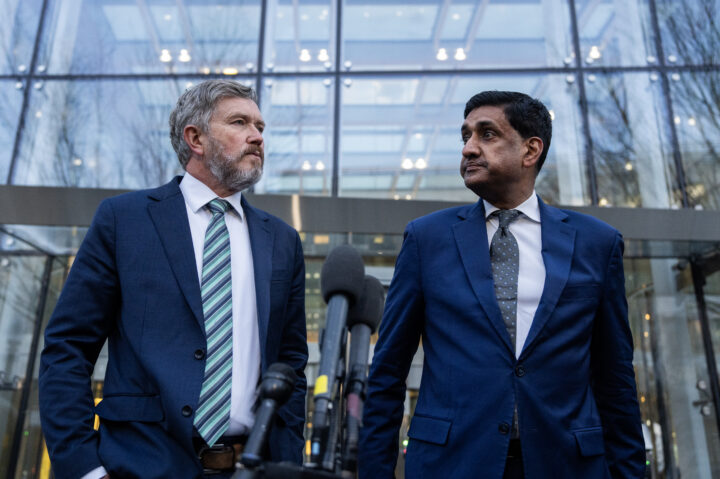
Tom Williams/CQ-Roll Call, Inc via Getty Images
Reps. Thomas Massie, (R-KY), left, and Ro Khanna, (D-CA), conduct a news conference outside a Department of Justice office in NoMa on Monday, February 9, 2026.
Good Thursday afternoon,
This P.M. edition is reserved for our premium subscribers — offering a forward-focused read on what we’re tracking now and what’s coming next.
It’s me again — Danielle Cohen-Kanik, U.S. editor at Jewish Insider and curator, along with assists from my colleagues, of the Daily Overtime. Please don’t hesitate to share your thoughts and feedback by replying to this email.
📡On Our Radar
Notable developments and interesting tidbits we’re tracking
President Donald Trump announced he’s replacing Kristi Noem as homeland security secretary with Sen. Markwayne Mullin (R-OK), after Noem had rankled the president and some Republican members of Congress with her oversight of widespread turmoil at the agency, among other issues. Mullin still needs to be confirmed by the Senate to assume the post.
Mullin, if confirmed, would take the helm of DHS amid its continued partial shutdown, and as it has repeatedly come under fire for its handling of issues related to antisemitism from lawmakers and Jewish community groups. Noem, meanwhile, will become special envoy to a new security initiative for the Western Hemisphere being launched by Trump this weekend…
House Speaker Mike Johnson (R-LA) and other GOP leadership called on Rep. Tony Gonzales (R-TX) to drop out of his reelection race, after the lawmaker admitted yesterday to having an affair with a staffer who later committed suicide. Gonzales is headed to a May runoff with his primary opponent, social media influencer Brandon Herrera; if Gonzales does step aside, Herrera, who has a history of antisemitic posts about the Holocaust, is all but guaranteed the GOP nomination in a solidly Republican district…
Trump said he “[has] to be involved in the appointment” of the next Iranian leader, in an interview with Axios, “like with Delcy [Rodriguez] in Venezuela.” He called Mojtaba Khamenei, son of the late Supreme Leader Ayatollah Ali Khamenei who has emerged as his father’s likely successor, “unacceptable.” The president’s comments seem to widen the administration’s stated war aims, which have thus far focused on eliminating Iran’s naval, air and nuclear assets.
Trump also insisted in the interview that Israeli President Isaac Herzog issue a pardon for Prime Minister Benjamin Netanyahu “today,” as he wants Netanyahu “to focus on the war and not on the f**king court case. I want the only pressure on Bibi to be the fighting against Iran”…
Some Democratic lawmakers — including Sens. Jack Reed (D-RI), Gary Peters (D-MI), Tim Kaine (D-VA) and Elissa Slotkin (D-MI) — told Politico they won’t “rule out” voting in favor of an emergency supplemental funding request to shore up the military should one come from the administration amid the campaign against Iran, despite widespread Democratic condemnation of the White House’s failure to consult Congress beforehand…
A vote on a war powers resolution to stop the military campaign in Iran failed in the House this afternoon 219-212, with two Republicans — Reps. Thomas Massie (R-KY) and Warren Davison (R-OH) — crossing the aisle in support and four Democrats — Reps. Greg Landsman (D-OH), Henry Cuellar (D-TX), Jared Golden (D-ME) and Juan Vargas (D-CA) — breaking with their party to oppose it.
Reps. Josh Gottheimer (D-NJ) and Jared Moskowitz (D-FL) both changed their positions and voted in favor of the resolution, weeks after Moskowitz told Jewish Insider — before the campaign began — that its sponsors “should just rename [the resolution] the Ayatollah Protection Act because that’s what it does.” Asked by JI about the shift in his stance today, Moskowitz answered, “I didn’t flip at all. Circumstances have changed since my first statement”…
Antisemitic podcaster Tucker Carlson’s latest extreme rhetoric took aim at the Chabad Lubavitch movement, with sweeping conspiratorial language accusing the Hasidic sect of seeking to start a “religious war” amid the U.S. and Israeli strikes on Iran, JI’s Gabby Deutch reports.
Carlson argued in an episode of his show that dropped last night that Jews see the war against Iran as an opportunity to feud with Islam and to target Christians. Carlson’s remarks prompted outrage among Chabad’s backers, who pointed out that Chabad emissaries have for decades played a crucial role in connecting American Jews to their faith and to each other…
In a conversation with ABC News, Trump said this afternoon that Tucker “has lost his way. I knew that a long time ago, and he’s not MAGA. MAGA is saving our country. … Tucker is really not smart enough to understand that”…
In a discussion with the New York Post, Trump railed against European countries which have continued to oppose the campaign against Iran, calling Spain “a loser” and the U.K. “very disappointing.” Canadian Prime Minister Mark Carney, meanwhile, said today that the Iran war is a “failure” of the international order, but would not “categorically rule out” Canada’s participation…
Iran’s indiscriminate attacks are bringing allies together worldwide: Ukrainian President Volodymyr Zelensky said he’s deploying specialists to assist the U.S. after Washington requested “specific support in protection” against Iranian Shahed drones, which Ukraine has been battling for several years as Russia has regularly deployed them, and the European Union and Gulf Cooperation Council held a joint meeting to discuss Iran’s “unjustifiable, unprovoked, and unlawful attacks”…
The New York Times profiles Lt.-Gen. Eyal Zamir, the IDF’s chief of staff, as he helps lead Israel’s efforts in the campaign against Iran…
⏩ Tomorrow’s Agenda, Today
An early look at tomorrow’s storylines and schedule to keep you a step ahead
Keep an eye out in Jewish Insider for a look at Jack Cocchiarella, the progressive Gen Z podcaster who has made a name for himself hosting high-profile Democratic candidates — including California Gov. Gavin Newsom in New Hampshire tonight — and who has recently taken a turn towards bashing Israel.
Team Israel will play its first games of the 2026 World Baseball Classic on Saturday against Venezuela and on Sunday against Nicaragua.
Also Sunday, AJ Edelman, the Israeli Olympic bobsled team pilot, will speak in conversation with Neil Goldman at Chabad of West Village in New York.
Birthright Israel’s Excelerate26 summit is also taking place in New York this weekend, with keynote speeches on Sunday from Robert Kraft, owner of the New England Patriots; Anne Neuberger, former deputy national security advisor during the Biden administration; and Sheryl Sandberg, former COO of Meta.
We’ll be back in your inbox with the Daily Overtime on Monday. Shabbat Shalom!
Stories You May Have Missed
MILITARY UPDATE

Tehran also attacked Azerbaijan for the first time, launching drones that injured two at Nakhchivan International Airport
ABOUT-FACE

The Arizona senator’s outspoken commentary has repeatedly placed blame for the military operation on Israel, leading one Jewish Democrat to pull her support
Protecting the country from terror threats sparked by the Iran war likely to be a major focus for the new homeland security secretary
Anna Moneymaker/Getty Images
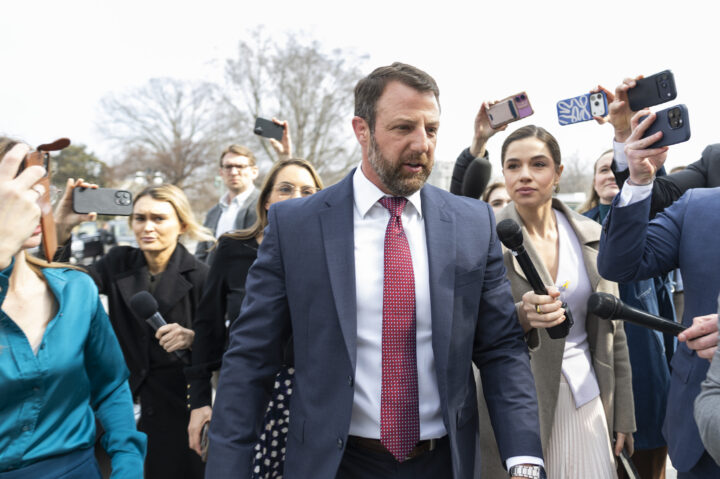
Sen. Markwayne Mullin (R-OK) speaks to reporters as he arrives at the U.S. Capitol Building on March 05, 2026 in Washington, DC.
Amid an increasing storm of controversy, President Donald Trump announced Thursday he was removing Secretary of Homeland Security Kristi Noem from her post, replacing her with Sen. Markwayne Mullin (R-OK).
Noem has come under fire for a series of issues, including her handling of immigration enforcement operations, her response to immigration agents’ shootings of two U.S. citizens, an alleged affair with a senior aide and what critics have characterized as self-promotion. Most recently, Noem claimed under oath this week that Trump had personally approved a $200 million ad campaign starring Noem herself, something that Trump has since publicly denied.
Trump said on Truth Social that the switch would take place effective March 31 — though Mullin will still need to face Senate confirmation proceedings.
Mullin could face a contentious path to confirmation. DHS remains without full funding in a partial shutdown — a result of Democratic outrage over immigration operations. Democratic lawmakers will likely grill Mullin during confirmation proceedings, and many would likely vote against him in protest of Trump’s immigration policies. But Mullin’s stature in the Senate and familiarity with his colleagues could give him an inside track to confirmation, as opposed to other potential picks.
Sen. John Fetterman (D-PA), the top Democrat on the Senate Homeland Security and Governmental Affairs Subcommittee on Border Management, Federal Workforce and Regulatory Affairs, told Jewish Insider on Thursday that he would vote to confirm Mullin. Fetterman, who was one of seven Democrats who voted to confirm Noem last January, publicly urged Trump to consider firing Noem and nominating Mullin in her place earlier Thursday.
Fetterman was the only Democrat to immediately commit to supporting Mullin’s nomination, and expressed skepticism that many of his Democratic colleagues would consider doing the same in a post on X announcing his plan to vote for Mullin.
The sometimes-combative Mullin could face some issues on his own side of the aisle as well — the Senate Homeland Security Committee, which would oversee his confirmation, is chaired by Sen. Rand Paul (R-KY), whom Mullin recently called a “freaking snake,” saying he had told Paul he understood why a neighbor attacked the Kentucky senator in 2017, breaking several of his ribs.
Oklahoma Republican Gov. Kevin Stitt similarly cheered the news of Mullin’s nomination, saying in a statement, “Markwayne Mullin has been a fighter for Oklahoma and will fight to keep our nation secure. There isn’t a better choice to lead the Department of Homeland Security..”
Stitt, who is responsible for appointing Mullin’s replacement in the Senate to serve through the next election, added that he “will be looking to appoint a strong, small government conservative voice to support President Trump and protect Oklahomans’ way of life.” Under Oklahoma law, his appointee will not be permitted to run for the seat in the next election.
With the central role of immigration in Trump’s messaging and political agenda, immigration enforcement would likely remain at the top of the priority list for any DHS director he selects. But the war in Iran has raised concerns about homeland threats linked to or inspired by the Iranian regime.
Noem told senators in a hearing this week that the administration was preparing for potential homeland attacks by Iran, including “revetting” individuals who entered the country during the Biden administration.
Mullin, in the Senate, has been hawkish on Iran and its proxies, and is a stalwart supporter of Trump, but has been less involved in discussions related to antisemitism domestically — though he indicated he would have been supportive of the Antisemitism Awareness Act.
He said after a House hearing where three college presidents refused to say that calling for the genocide of Jews would be banned under their policies, “The rise of antisemitism on college campuses was on full display yesterday as Ivy League presidents refused to say whether calling for the mass murder of Jewish people constitutes harassment on their campuses. This vile, hateful, and cowardly behavior is completely despicable.”
The 48-year-old senator took office in 2023, after serving a decade in the House.
“We look forward to working with Mr. Mullin when he takes the helm at DHS to support the security of the Jewish community and all American faith communit[ies],” Nathan Diament, the executive director of the Orthodox Union Advocacy Center, told JI.
Noem is the first Cabinet official to leave her post during the second Trump administration. Observers generally see Trump as less eager to remove top aides during his second term, an effort to counter the perception of chaos that pervaded his first term in office from frequent high-level turnover.
Under Noem, DHS has repeatedly come under fire for its handling of issues related to antisemitism from lawmakers on both sides of the aisle and Jewish community groups, though it’s not clear to what extent Noem was directly involved in those issues.
The department added new conditions to Nonprofit Security Grant Program funding which may compel religious institutions to agree to eliminate Diversity, Equity and Inclusion programs and cooperate with immigration enforcement efforts in order to qualify for funding.
NSGP funding itself has also repeatedly been delayed and waylaid, with unclear deadlines provided to grantees and the state agencies that administer the grant program. Lawmakers have said that they also have not received information usually provided to them about the program. It remains unclear whether grants from the 2025 grant cycle have been awarded yet.
Applications for 2025 grants also opened months late, and funding from supplemental grant rounds that organizations applied for in 2024 was delayed by months, well into 2025.
Noem instituted a policy at DHS that required her personal signoff on any expenditures of more than $100,000, which may have contributed to the slowdowns in NSGP funding.
Mullin, as a member of the House, voted with a majority of Republicans against the bipartisan Nonprofit Security Grant Improvement Act, which proposed increased funding for the program and a dedicated structure at DHS to oversee and manage the growing program, but does not otherwise appear to have been actively involved in discussions around the program.
Separately, DHS has repeatedly come under scrutiny over guidelines issued by the Coast Guard regarding displays of swastikas and nooses. Previous policy had described such displays as banned hate symbols, whereas a new policy first reported in November characterized them instead as “potentially divisive” and mandated a lesser investigation.
The Coast Guard assured lawmakers that the policy would be corrected, but weeks later, the Guard apparently broke that pledge and instituted the “potentially divisive” language anyway. Days later, it again walked back the policy change.
Throughout, Noem and the department denied any wrongdoing and attacked critics.
Noem, a former South Dakota governor, is now rumored to be considering a primary challenge to Sen. Mike Rounds (R-SD), a moderate Republican and pro-Israel stalwart. She is also believed to have presidential ambitions. For now, Noem will become special envoy to a new security initiative for the Western Hemisphere being launched by Trump on Saturday, the president said in his Truth Social post.
A bipartisan group of lawmakers that attended the Sunday dinner called the discussion ‘open,’ ‘moving’ and ‘constructive’
Francis Chung/POLITICO via AP Images
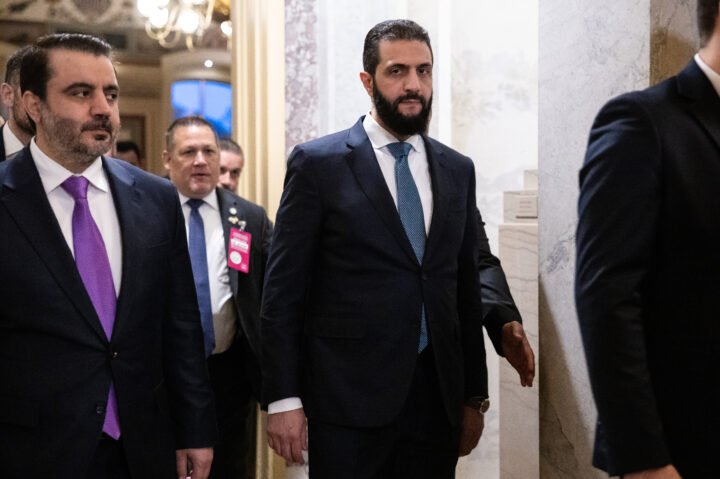
Syrian President Ahmed al-Sharaa departs a meeting in the Senate Foreign Relations Committee hearing room at the U.S. Capitol, Nov. 10, 2025.
Senators offered a positive readout from a dinner meeting with Syrian President Ahmad al-Sharaa on Sunday evening prior to al-Sharaa’s Monday summit at the White House with President Donald Trump.
Sen. Markwayne Mullin (R-OK) told Jewish Insider that al-Sharaa was “very charismatic” and “had a very open conversation” about his “checkered past” with senators. “I found it to be straightforward. I thought his answers were what we needed to hear, but I think he honestly believed it too,” Mullin said of the dinner.
“I was with him in Damascus in August. I led the first delegation there with [Rep.] Jason Smith (R-MO), [Rep.] Jimmy Panetta (D-CA) and [Sen.] Joni Ernst (R-IA). This was kind of more of the same, just building on that,” Mullin told JI. “When we talked in August, there were some issues that he brought up with sanctions towards the Assad regime that we need to work on. I’ve already been working on that, so we wanted to give him an update on it.”
The Oklahoma Republican said progress was being made on lifting the sanctions, something he attributed to the fact that the U.S. wants the al-Sharaa regime to “be successful.”
“He may not fit the mold of what you’d want as a leader in Syria. Actually, if you look at it, he’s probably what needs to be in Syria right now, because they’ve been at war for so long,” Mullin said. “As I told him, it’s trust — but verify. And so far, he’s making all the right moves. He’s trying to actually formalize relationships with Israel, that’s huge for that region. So, as he continues to move down this path, we want to continue to help him be successful.”
Sen. Elissa Slotkin (D-MI) told JI that, as a longtime Middle East and counterterrorism official, “it was quite a change to be sitting across the table from someone a decade ago I may have looked at in a very different light. But he was very impressive.”
She said that Michigan has a large Syrian-American community that supports efforts to lift sanctions and reopen Syria to the world, “so it was actually in some parts, even quite moving.” Slotkin said she also supports lifting sanctions to “do what I can to give them a shot,” and added that she wants to visit Syria.
“There were a number of people at the dinner, Democrats and Republicans, who have former service in the global war on terror,” Slotkin continued. “There was something really almost emotional about sitting across the table from someone who years ago would have been an adversary who now seems like he’s trying to really make Syria work. It was quite moving.”
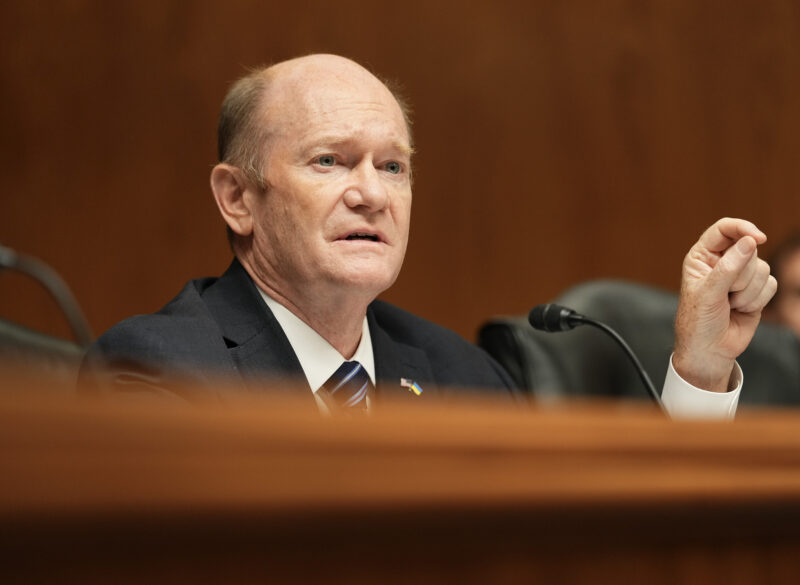
Sen. Chris Coons (D-DE) echoed his colleagues’ comments about wanting to see al-Sharaa be successful in ushering Syria into a peaceful era.
“We need Syria to succeed. We want Syria to succeed. Peace between Syria and Israel is absolutely essential. Respect and support for the Syrian Democratic Forces is essential,” Coons told JI, referring to the Kurdish-led group that has been a key U.S. ally inside Syria.
The Delaware senator said that the Sunday evening discussion “was broadly a constructive conversation. For some of the members who were present, it was their first time meeting him. For most of us, it was our second or third conversation with him.”
“Having a pathway towards repealing the state sponsor of terrorism designation and repealing or downgrading the Caesar sanctions were key asks of his, and I believe the NDAA has a Risch-Shaheen provision that repeals the Caesar sanctions,” Coons added.
Sen. Richard Blumenthal (D-CT) called the meeting “encouraging and positive.”
“I think that the relationship with Israel is still challenging,” Blumenthal told JI. “I asked him very specifically about it, but on the whole, I think it’s a new chapter for the region that could be extremely promising.”
Ernst, who also attended the dinner, described it in a statement as “frank and constructive,” praising Trump for engaging with al-Sharaa.
“Today’s visit is an important step toward building trust, fostering dialogue, and uniting Syria’s diverse ethnic and religious communities,” Ernst said. “Under President Trump’s leadership, there is a real opportunity to advance peace in the Middle East and make the vision of a more stable and prosperous world a reality.”
Other lawmakers who attended the dinner were Reps. Brian Mast (R-FL), Marlin Stutzman (R-TN), Joe Wilson (R-SC) and Abe Hamadeh (R-AZ). Mast, according to Politico, was not planning to attend the meeting but happened to be at the same hotel where the meeting was occurring and was asked to join.
He offered a more tepid readout than many of the other attendees.
Please log in if you already have a subscription, or subscribe to access the latest updates.
 Continue with Google

 Continue with Apple