














































































After socialist candidates scored several surprise victories, party leaders are fighting with renewed vigor to rally behind Rep. Haley Stevens (D-MI) in the primary against her left-wing challenger, Abdul El-Sayed
Kristen Norman/AP
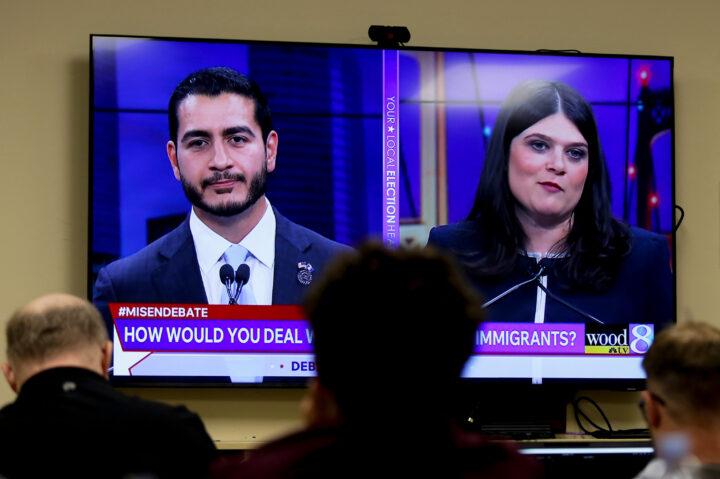
Michigan U.S. Senate candidates, Abdul El-Sayed, left, and Rep. Haley Stevens, D-Mich., are displayed on a television during a debate inside the spin room at WoodTV studios on Tuesday, July 7, 2026, in Grand Rapids, Mich.


 Add JewishInsider on Google
As Maine Democrats pick up the pieces of Graham Platner’s failed Senate campaign and quickly try to find a replacement for the scandal-tarred candidate on the ballot, moderate Democrats in Michigan, where a primary is fast approaching, are in a race against time to prevent another far-left Senate candidate from capturing a valuable nomination.
The final three weeks of the Michigan primary will be 2026’s most consequential test yet for the power the party establishment still holds, particularly in a pivotal swing state. After socialist candidates scored a number of surprise victories in heavily blue districts in New York City, Philadelphia and Denver, party leaders are fighting with renewed vigor to rally behind Rep. Haley Stevens (D-MI) in the primary against her left-wing challenger, Abdul El-Sayed.
Retiring Sen. Gary Peters (D-MI) endorsed Stevens on Monday, a pivot from his announcement in May that he planned to stay out of the race, joining Senate Minority Leader Chuck Schumer (D-NY), who had already backed the congresswoman. The party’s left flank — including Sens. Bernie Sanders (I-VT) and Chris Van Hollen (D-MD) — is backing El-Sayed.
“The change of heart is we just know that we have to hold Michigan,” Peters said on “Morning Joe” on Tuesday of his decision to endorse, with Stevens sitting beside him. “She’s an outstanding candidate and I certainly hope that folks get behind her around the country and understand that she’s the right person to be the next senator from the state of Michigan.”
There are fresh signs that the late push for Stevens from Democratic leaders — along with millions in ad spending from pro-Stevens outside groups — has given the congresswoman momentum in the closing stretch of the race. A new poll commissioned by the Detroit News found Stevens pulling ahead of El-Sayed by seven points, 48-41%, after she trailed in most public polls this year.
The United Democracy Project, AIPAC’s affiliated super PAC, is spending big to attack him, dropping nearly $15 million in the race so far. A new 30-second ad attacks El-Sayed as sexist, referencing criticisms he’s made against former First Lady Michelle Obama and Gov. Gretchen Whitmer. A mailer sent to Michigan voters criticized El-Sayed’s response to the attack on Temple Israel in West Bloomfield in March. El-Sayed condemned the attack but said that “hurt people hurt people,” referring to the assailant having lost his brother — a Hezbollah commander — in an Israeli airstrike in Lebanon.
“We are going to continue educating Michigan voters on El-Sayed’s track record of making disparaging and sexist comments about women,” Patrick Dorton, a UDP spokesperson, told JI on Tuesday.
Platner’s collapse in Maine has, for some Democrats, raised questions about the electability of far-left candidates in must-win Senate battlegrounds for the Democratic Party.
The centrist Democratic think tank Third Way published a memo on Tuesday underscoring that Democrats could lose other winnable races if they continue taking the advice of ideologically driven left-wing consultants who advised Platner. (Fight Agency, the political ad firm that was used by Platner and New York City Mayor Zohran Mamdani, is also consulting for El-Sayed’s campaign.)
El-Sayed has continued to play to his base, doubling down on radical rhetoric in interviews at a time when Democrats are concerned about holding onto the swing seat in November. He called Israel a “rogue state” in a recent CNN interview and said that Democrats who support Israel only do so because of money. As his rhetoric has become more extreme, and the race tightens between the two candidates, Jewish Democratic groups are planning to amp up their campaigning for Stevens ahead of the Aug. 4 primary.
“It is now a direct, high-stakes two-way race between Haley Stevens and Abdul El-Sayed,” the Michigan Democratic Jewish Caucus wrote in a recent email to members. The Jewish Caucus is hosting a canvassing event on behalf of Stevens in Farmington, a heavily Jewish suburb of Detroit, this weekend.
“With early and absentee voting already underway, to ensure Haley wins on Aug. 4, we need to leverage our deep community roots, personal relationships, and trusted voices,” Jewish Caucus Chair Decky Alexander told Jewish Insider on Tuesday.
The Jewish Democratic Council of America, a national organization, is hosting a virtual phone bank for Stevens this week. The group had previously issued a joint endorsement of Stevens and state Sen. Mallory McMorrow, who withdrew from the race earlier this month, but is now planning a five-figure digital ad buy in support of Stevens’ campaign.
“JDCA is focused on mobilizing Jewish voters across Michigan in support of Haley Stevens,” JDCA CEO Halie Soifer told JI on Tuesday. “Haley has always stood with the Jewish community, and we’re proud to support her in this critically important election. We also believe she has the best chance of beating Mike Rogers in November, and we’re committed to keeping Michigan blue.”
The Stevens campaign expects a close race but views McMorrow’s decision to drop out as a boon for Stevens. McMorrow did not endorse either candidate. A source working with the Stevens campaign, who was not authorized to speak on behalf of the congresswoman, said the campaign is particularly focused on winning over Black voters, as well as older and non-college-educated voters, many of whom remain undecided. (The Detroit News poll showed Stevens with a substantial advantage with Black voters, leading El-Sayed 67-21%.)
The Michigan Jewish community, which is centered in Stevens’ congressional district, is also a part of the campaign’s get out the vote plan.
“I think that Haley wants all Michiganders to vote, but obviously has a very special connection with the Jewish community, especially in her district in Oakland County,” said the campaign source.
El-Sayed routinely tars Stevens for receiving the backing of AIPAC. She has not said much during the primary about her ties to the group, instead highlighting her support for a two-state solution to the Israeli-Palestinian conflict, which she described as “the difference between my opponent and myself on this issue” in a debate last week. El-Sayed has said he struggles with the question of whether Israel should exist as a Jewish state.
This week, El-Sayed announced a major fundraising haul from the second quarter of the year: $4.5 million, up from $2.3 million he raised in the first quarter. A spokesperson for Stevens declined to share her latest fundraising totals, which legally must be reported by Wednesday. She took in $1.9 million in the first three months of the year.
Jordan Wood, a former Katie Porter staffer, says he supports the U.S.-Israel relationship but opposes 'a blank check' for the Israeli government
Campaign website
Jordan Wood
As Maine Democrats jump at the chance to replace Graham Platner on the ballot against Sen. Susan Collins (R-ME), one of the issues where candidates are staking their claim early is U.S. foreign policy — and Israel and Gaza in particular.
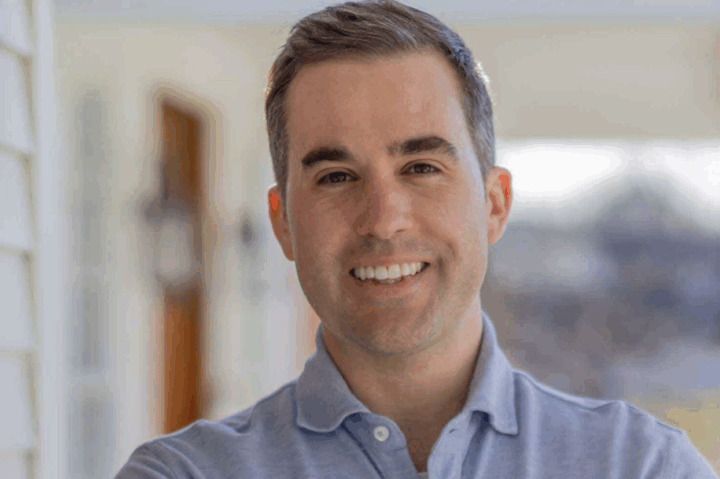
Jordan Wood, a former chief of staff to Rep. Katie Porter (D-CA), shared his views on the U.S.-Israel relationship with Jewish Insider on Thursday. He entered the race after placing third in last month’s congressional primary to replace retiring Rep. Jared Golden (D-ME).
He told JI that he considers Israel “our strongest ally in the Middle East” but that its government must be reined in.
“The United States should absolutely have a cooperative relationship with Israel, and I want that relationship to work. But a real partnership is not a blank check,” said Wood. “It comes with honesty and accountability. The United States has enormous leverage with the Israeli government, and we’ve been refusing to use it.” He pledged to “push America to actually use that leverage to stop the genocide in Gaza.”
Wood spent a decade in Washington as a political staffer, with stints as a vice president at End Citizens United and executive director at a pro-democracy nonprofit.
Shortly after announcing his campaign, he said in his first official statement that he would not accept support from AIPAC. In a post on X hours later, he said that the U.S. “can’t continue to fund Israel’s genocide in Gaza,” and that he would support the Block the Bombs Act.
Still, he told JI, he believes that “Israel is our strongest ally in the Middle East.”
“But there’s a difference between the Israeli people and the Netanyahu government, and nothing about self-defense justifies waging a war without limits,” said Wood. “Starving children and flattened hospitals don’t make Israel safer, and they don’t make America safer.” He referred to the family members of the Israelis taken hostage after Oct. 7, many of whom protested in Tel Aviv for two years, and said “they deserve leaders, in Israel and in America, with the courage to deliver the peace they’ve been asking for.”
Wood said Hamas should have no role in governing Gaza and called for the group to disarm. “The Oct. 7 terrorist attack was a horrific crime that shocked the world’s conscience,” said Wood.
Despite his pledge to eschew any support from AIPAC, he said that AIPAC supporters are still welcome in the party, even as he said AIPAC’s “agenda is not aligned with our values.”
“Jewish Democrats, and Democrats who care deeply about Israel’s security, are part of this party and always will be,” said Wood. “What’s not welcome is AIPAC’s agenda, which demands unconditional support for the Netanyahu government’s genocide in Gaza no matter the cost in innocent lives.”
In his victory speech, Platner railed against the political establishment and criticized U.S. wars in the Middle East
Sophie Park/Bloomberg via Getty Images
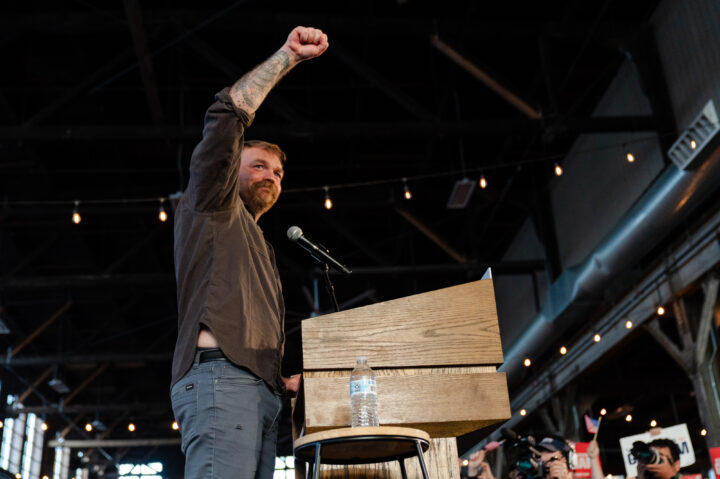
Graham Platner, Democratic Senate candidate for Maine, arrives to speak during a Fighting Oligarchy event in Portland, Maine, on May 25, 2026.
Maine Democrats rallied behind scandal-plagued oyster farmer and military veteran Graham Platner as their Senate nominee against Sen. Susan Collins (R-ME) in Tuesday’s primary, turning to a left-wing outsider running against the political and institutional establishment as its standard-bearer for the general election.
Platner — whose controversies, including his now-covered Nazi tattoo and abuse allegations, have unnerved many Democrats — will be a political test over whether his brand of progressive populism can win over swing voters in a state critical to the Democrats’ hopes of winning back the Senate.
“In trying so hard to understand me, [the media] failed to understand that this is not about me at all. This is a movement about us, about the far too many, working far too hard and struggling far too much,” Platner said in his victory speech.
Attacking “forever wars,” Platner railed against the Trump administration’s war in Iran, and slammed Collins for “closing hospitals while using our tax dollars to destroy them halfway around the world.” (The line was an apparent attack against Israel’s targeting of Hamas terror infrastructure that was often lodged in medical facilities during the war in Gaza.)
Platner won about 72% of the primary vote despite Gov. Janet Mills remaining on the ballot, a solid enough showing amid all the controversies that should mute any calls for him to drop out of the race. In a statement on Platner’s victory, Senate Minority Leader Chuck Schumer (D-NY) and Democratic Senatorial Campaign Committee Chair Kirsten Gillibrand (D-NY) reiterated their support for the nominee: “In November, Maine voters will elect Graham Platner, and we will win a Senate majority.”
Mills, for her part, did not mention Platner at all in her statement about the election results.
The most recent polls in the race, conducted as Platner’s scandals hit the news, suggest a highly competitive matchup between Collins and Platner. Maine is the only state Trump lost in the 2024 presidential election that is represented by a Republican in the Senate, but Platner’s personal baggage is complicating the party’s path to victory.
Collins, meanwhile, is one of the most politically resilient senators, winning reelection even when the political environment for her party has been less than favorable.
Platner was surrounded by mostly older women as he delivered his victory speech, a critical constituency for him to win in the general election in the state with the oldest median population, especially given the allegations of abuse towards several ex-girlfriends.
In other primary news on Tuesday, Sen. Lindsey Graham (R-SC) coasted to renomination, though he only won 58% of the GOP vote against weak competition.
In his victory speech, Graham railed against Rep. Thomas Massie (R-KY) and former Rep. Marjorie Taylor Greene (R-GA), two isolationist, anti-Israel GOP lawmakers who left or were ousted from Congress. “What did we prove tonight? That South Carolina is Trump country, not Massie country. We proved tonight that nobody gives a damn what Marjorie Taylor Greene thinks about who to vote for in South Carolina,” Graham said.
In South Carolina’s governor’s race, Lt. Gov. Pamela Evette, who was endorsed by President Donald Trump, will face state Attorney General Alan Wilson in a runoff for the nomination. Reps. Ralph Norman (R-SC) and Nancy Mace (R-SC) lagged well behind in the primary, with Mace’s fifth-place finish serving as a disappointing conclusion to her congressional career.
Please log in if you already have a subscription, or subscribe to access the latest updates.
 Continue with Google

 Continue with Apple