








































































The letter from CEO Kenneth Marcus follows a public spat in which Qatar's deputy ambassador accused the group of spreading disinformation about Qatari money in higher education
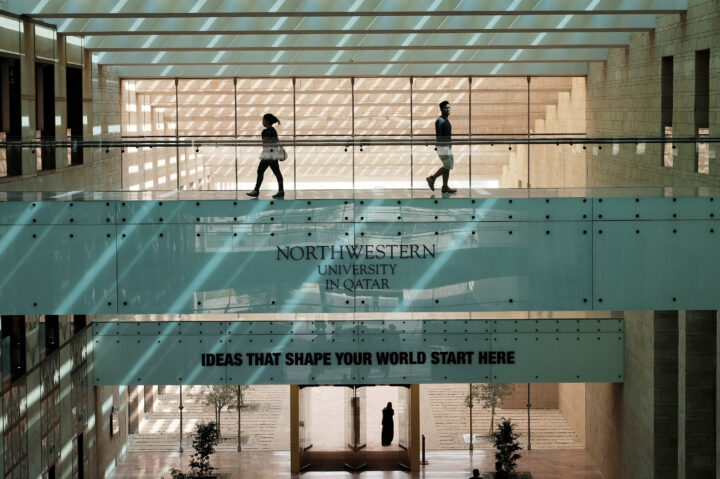
Bonnie Jo Mount/The Washington Post via Getty Images
Students cross a sky bridge in the temporary campus of Northwestern University in Qater on the Education City campus in Doha, Qatar, on November 2, 2015.


 Add JewishInsider on Google
The Louis D. Brandeis Center for Human Rights Under Law wrote to Qatari Ambassador to the U.S. Sheikh Meshal bin Hamad al-Thani on Wednesday amid a back-and-forth online, urging the Qatari Embassy to release a full public accounting of its funding to U.S. colleges and universities.
“There is a straightforward way for the Government of Qatar to demonstrate that public accounts of its activities are inaccurate or misleading: full disclosure,” Brandeis Center CEO Kenneth Marcus said in a letter to Al-Thani. “We therefore respectfully ask Qatar to provide a complete public accounting, to the people and the Congress of the United States, of the funding and other financial support that its government, the Qatar Foundation, and other Qatari governmental or government-controlled entities have provided to U.S. colleges and universities.”
Marcus urged that such a disclosure “should identify the recipients and amounts, disclose the agreements governing the funds, and explain what Qatar expected or received in return for its largesse. This should include any financial, academic, or other benefits, as well as any role in university governance, faculty or administrative appointments, academic programs, curriculum, research, public communications, or the operation of overseas campuses.”
Marcus argued that a public disclosure would “serve Qatar’s stated interest in correcting purported misinformation” and allow Congress, the administration, schools and the public to assess the relationships based on firsthand information.
“Qatar has described its support for U.S. higher education as beneficial to both countries,” Marcus said. “If that is so, complete transparency should strengthen Qatar’s position. If particular public allegations are false, the documents will demonstrate that fact.”
The Qatari embassy did not respond to a request for comment.
The letter follows a public exchange on social media between Marcus and Qatar’s deputy ambassador, Hamad Al-Muftah, who claimed that critics of Qatar are engaged in a “coordinated disinformation campaign” to manipulate data on foreign funding in U.S. higher education — the release of which has been repeatedly postponed by the Department of Education — in order to accuse the Qatar Foundation of malign activities.
“Their goal appears to be eliciting reactions from House Education Republicans and, more broadly, spreading disinformation that serves the interests of their controllers,” Al-Muftah asserted.
He posted a diagram that he claimed outlined a network including the Foundation for Defense of Democracies, Brandeis Center and Jewish Insider, as well as op-eds published in The Wall Street Journal and Chicago Tribune, which he claimed is intending to influence Republicans on the House Education Committee to investigate the Qatar Foundation.
Marcus responded in a thread on X, stating that the diagram “identifies no disinformation.”
“My colleagues have also presented evidence in the [Chicago Tribune] concerning the relationship between Qatari funding, foreign influence and anti-Semitism on U.S. campuses. You may not like their conclusions, but disagreement is not disinformation,” Marcus said, adding that Al-Muftah’s language invoked an antisemitic trope.
Al-Muftah responded that “we have zero intention to hide anything. Everyone is fully cooperating with the appropriate authorities to ensure complete transparency.” He also said that Qatar has “observed instances of data manipulation and the amplification of misleading information,” denying any connection between Qatari funding and protests on college campuses.
“Regarding the accusation of antisemitism, I am unclear about its origin and why it has been brought up,” he continued. “I simply presented the facts and observations regarding those involved.”
Al-Muftah also said that Qatar’s only intention is “to provide world-class education to individuals in the region.”
Al-Muftah told another critic that presenting the aggregate totals of Qatari funding to various universities is “misleading.”
“The overwhelming majority of this funding is for the operation of American university campuses in Qatar,” he said. “It pays for the education of students, faculty, facilities, and the day-to-day costs of running those campuses. It is not a blank check to the universities’ U.S. operations, nor is it evidence that Qatar is funding antisemitism or campus protests in America.”
A long-delayed federal report on foreign spending in education is due out on Friday, unless its release is again postponed, for what would be the fifth time.
The penalty is less severe than the original legislation endorsed by Gov. Kathy Hochul, which would have charged such obstruction as a felony, but expands the buffer zone to 50 feet
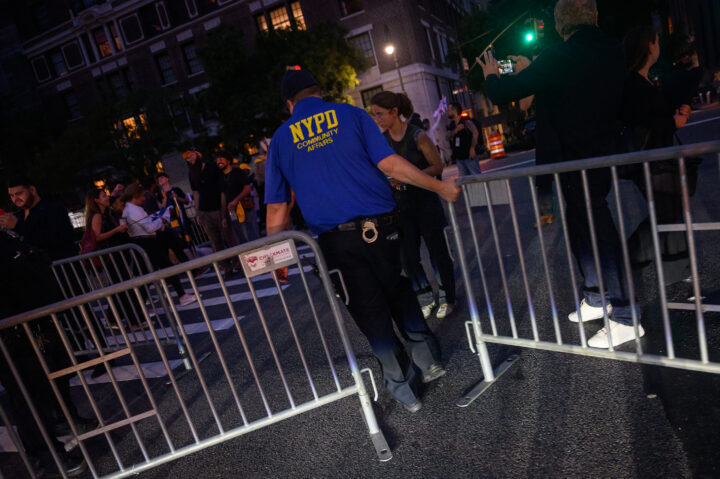
Alexi J. Rosenfeld/Getty Images
NYPD officers set up barricades separating pro-Israel and anti-Israel protesters on Sept. 25, 2025 in New York City.
The final version of the New York state “buffer zone” legislation passed by the state Legislature on Tuesday makes it a Class B misdemeanor — one of the lowest levels of criminal offense — to “knowingly” infringe on the right of access or egress to a religious institution, or to cause those entering or exiting to fear for their safety from a distance of less than 50 feet.
The language is less punitive than the legislation that Gov. Kathy Hochul initially endorsed, which would have made it a low-level felony for demonstrators to obstruct doorways and driveways at houses of worship. But the 50-foot enforcement zone in the final draft is twice as large as the one described in the earlier versions of the bill, and would apply to sidewalks as well as private parking lots and other entry points.
The measure explicitly covers community centers, as well as any other sort of facility that “a reasonable person would know that religious adherents collectively recognize as a place to regularly gather for or hold religious services, observance, prayer, assembly, education, instruction, or devotional practice” — indicating that the bill also shields religious schools.
UJA-Federation of New York, which became a leading proponent for the measure following pro-Hamas protests that targeted synagogues in Manhattan and Queens, applauded the measure ahead of its passage as part of the legislative package around the New York state budget.
The Jewish advocacy group particularly praised Hochul — as well as state Sen. Sam Sutton and Assemblymember Micah Lasher — for championing the proposal.
“We commend Governor Hochul and the state legislature for taking decisive action to protect New Yorkers by passing ‘buffer zone’ legislation, ensuring that safety and security remain a top priority across our communities,” the group said in a statement to Jewish Insider. “Governor Hochul, Senator Sutton, and Assemblyman Lasher have demonstrated strong leadership in their unwavering effort to help ensure safe access to critical community institutions and safeguard the right to worship free of harassment and intimidation.”
The state legislation is distinct from a recently passed city law compelling the NYPD to develop formal protocols for deploying security perimeters around houses of worship during protests. Both measures, as well as a separate New York City bill to establish security perimeter policy around schools — vetoed by Mayor Zohran Mamdani, but since modified and reintroduced in the New York City Council — have received criticism from civil liberties groups, who allege they could interfere with First Amendment protections.
Hochul, for her part, heralded the measure as a victory for freedom of worship. The measure goes under her pen Tuesday evening, her office told JI.
“Every New Yorker should be able to enter their house of worship and practice their religion without fear,” the governor said in a statement. “As we’re witnessing an alarming rise in hate-fueled attacks and blatant antisemitism, I’m grateful our buffer zones legislation has passed and New Yorkers will be safer because of it.”
Please log in if you already have a subscription, or subscribe to access the latest updates.
 Continue with Google

 Continue with Apple