














































































The Maine Democratic Senate candidate said, ‘It’s unfortunate that there are people here in Maine that don’t like to use that term only because they’re Jewish and what that means to them, with the Holocaust’
Joseph Prezioso/Getty Images
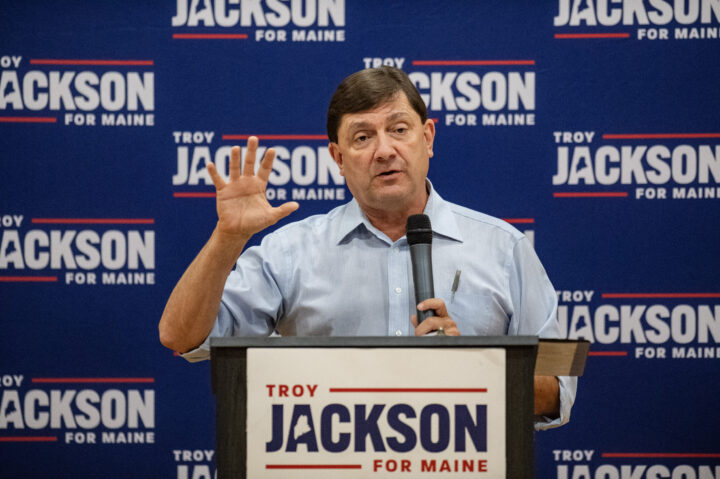
Maine Democratic Senate candidate Troy Jackson speaks at a town hall on September 13, 2026 in Biddeford, Maine.


 Add JewishInsider on Google
Maine Democratic Senate candidate Troy Jackson called it “unfortunate” that Jewish residents of Maine reject the labeling of the war in Gaza as a genocide in an interview with Portland’s NBC News affiliate released Tuesday.
“It’s unfortunate that there are people here in Maine that don’t like to use that term only because they’re Jewish and what that means to them, with the Holocaust,” Jackson said. “[Israel’s war in Gaza] fits that description and it is. It’s [an] unbelievable thing that’s happened there that people that are innocent are being murdered, and it is a genocide.”
Pressed on Hamas’ role in starting the war and killing innocent Israeli civilians, Jackson acknowledged, “You could argue the same thing for Hamas too.” He added: “There’s people that are wrong on both sides of this issue. But in the end, senseless murders, horrific murders are happening to both sides, and that has to stop.”
In a statement to Jewish Insider on Wednesday, Jackson said that he had misspoken and apologized for the comments, while maintaining his view that the war in Gaza is a genocide.
“I believe what’s happening in Gaza is genocide, and I also understand that word carries particular weight for many Jewish families given the Holocaust — the genocide of six million Jews. In trying to acknowledge that, I misspoke and made a generalization about Jewish Mainers’ views that doesn’t reflect what I meant to say,” Jackson said in the statement. “I apologize for the pain that caused.”
He continued, “Mainers hold a range of deeply considered views, and I promise I will always listen and work to approach these conversations with the care and respect they deserve. In the U.S. Senate, I’ll fight antisemitism and work for lasting peace and security for Palestinians and Israelis.”
Jackson said that the war in Gaza is the foreign policy issue he hears about the most from voters and is the most significant foreign policy challenge for the United States, beyond even the war in Iran.
During the interview, he repeatedly affirmed his view that the U.S. should not continue to send “blank checks” to the Israeli government, describing Prime Minister Benjamin Netanyahu as a “war criminal.” At one point, he said he did not want to continue sending “money” to Israel.
Jackson is facing Sen. Susan Collins (R-ME) in one of the most competitive Senate races of the cycle. A New York Times/Siena College poll released last week showed Collins narrowly ahead — one of the few battleground contests where the Republican nominee is leading.
Jackson, a former state Senate president, was the Democrats’ choice to replace Graham Platner on the ballot after the party’s original nominee withdrew from the race after facing allegations of rape and sexual abuse. Platner campaigned as a virulently anti-Israel candidate and faced controversy over a Nazi Totenkopf tattoo that he had for nearly two decades.
Yehuda Kaploun’s strategy differs from the Trump administration’s stance against censorship
Screenshot
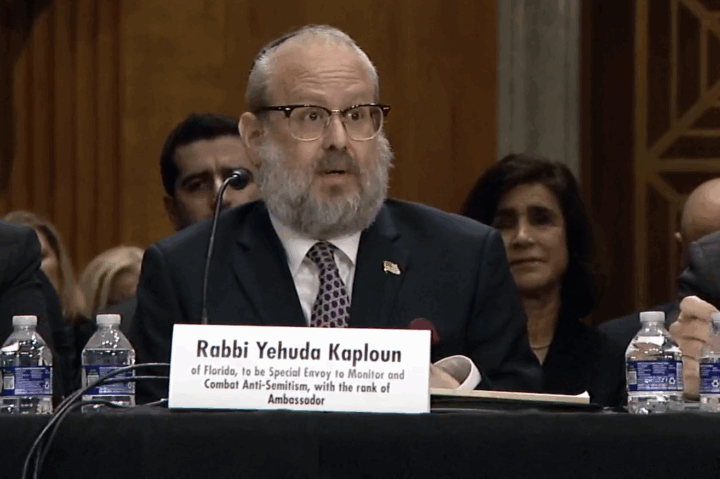
Rabbi Yehuda Kaploun, the Trump administration's nominee to be special envoy to monitor and combat antisemitism
Rabbi Yehuda Kaploun, President Donald Trump’s nominee to serve as U.S. antisemitism special envoy, warned in an interview with Jewish Insider that inaccurate, inflammatory content is being allowed to spread on social media, and pledged to work with social networks to curb the spread of antisemitic falsehoods online.
“The ideal outcome is, I want to continue America’s tradition of free speech and allowing free speech anywhere and everywhere, freedom of expression,” Kaploun said. “But I would like the platforms — because of the advent of AI and those technologies, you have the ability to recognize when something is not factually correct and it should be labeled as such. I think that’s something that we’d like to target.”
Kaploun spoke to JI on Wednesday, with his Senate confirmation vote for the State Department role expected this month before the holiday recess. His comments about working with social media platforms to label misinformation contradict the approach of the Trump administration, which has urged the major platforms not to “censor” information. Earlier this year, after Trump took office, Meta announced the end of its fact-checking program, and YouTube eased many of its content moderation policies.
“There’s many other areas of working with the companies — the algorithms and things that have been now proven, that bots are busy promoting antisemitic rhetoric on the internet, how we get to some of that and preventing some of that. These are very tall tasks. These are not things that occur overnight,” said Kaploun, a Chabad-trained rabbi and businessman from Miami. “But I truly believe there is a true willingness of many people within the administration to tackle these problems and confront them head on, globally.”
As an example of the kind of content he would seek to flag as false, Kaploun referred to a July New York Times article about the hunger that many civilians in Gaza were experiencing during Israel’s war against Hamas. The Times published a correction regarding the article several days after it was published, once it was revealed that a child who was featured prominently in the article as an example of malnutrition had preexisting health conditions.
The misrepresentation in the photo could contribute to antisemitism, according to Kaploun, who suggested that the article had been viewed hundreds of times more than the correction.
“I’m not exactly 100% sure of the actual number, but in that realm, a total disbalance and disproportionate view of people saw something that could be creating antisemitic behavior,” said Kaploun. “All those people that saw it have incorrect information.”
He declined to say whether he believes social networks should have removed posts that included that article.
“I’m not going to get into the specifics or the semantics of what that’s going to look like. We are going to work collectively and together with these companies and try and come up with productive solutions that will lower the disinformation and lower the hatred,” Kaploun said. “That’s what I’d like to work with these social media platforms to do a better job with, recognizing that and making sure that we can do a better job of getting accurate facts out.”
Discussing strategy, Kaploun laid out a vision for his tenure as special envoy to monitor and combat antisemitism, stating that his first priority would be to fight antisemitism with “pro-Semitism” — teaching about Jewish history and culture, and convincing countries and groups that are experiencing antisemitism that Jews are productive members of society and contribute a great deal to the countries in which they live.
“What I mean by pro-Semitism is to explain to countries the benefits of what it is the Jewish nation provides, and our historical perspective of what the Jewish communities have always done for communities, in terms of growth in countries,” said Kaploun. “The countries that have literally attacked the Jews and expelled the Jews don’t always have success, and there’s a reason for that. And when countries are welcoming and when Jews are in countries, usually the benefits far exceed any type of whatever detriments [there] are. There really aren’t detriments.”
“It’s not all about Israel,” Kaploun added. “It’s about the Jewish culture, the Jewish religion, the Jewish sciences.”
Still, he recognizes that separating Israel from discussions of antisemitism is not possible — like if he encounters people who insist that they have no problem with Jews, and that their only issue is with the Jewish state.
“Understand the battle that Israel has to fight here,” said Kaploun. “You’re fighting a culture that was teaching children to kill themselves, that the benefit to get to heaven is to kill a Jewish person. So we have to get to the root causes. You want to condemn Israel, ‘Oh, I love the Jews, but I hate Israel.’ Why is Israel in existence? Because there was a period of time when Jews were being slaughtered throughout Europe and the world was silent and there wasn’t a country for the Jews to go to.”
Here, too, he said it all comes down to education.
“The importance of Israel may need to be explained, but at the same time, people’s facts are incorrect,” Kaploun said. “If they’re factually accurate, then you’re able to have a conversation with someone. They will see the folly of what they’re saying.”
Kaploun has a plan, he told JI, for where to kick off his work once he is confirmed by the Senate and moves into Foggy Bottom.
“The president and the secretary [of state] are firmly behind the efforts that I am doing,” Kaploun said. “They’ve made it very, very clear that the administration is fully behind the efforts that we’re going to do to combat antisemitism.”
Please log in if you already have a subscription, or subscribe to access the latest updates.
 Continue with Google

 Continue with Apple