














































































‘Kurds are in a unique position to become the catalyst for broader change across Iran,’ Iranian Kurdish analyst tells JI
Hawre Khalid/Getty Images
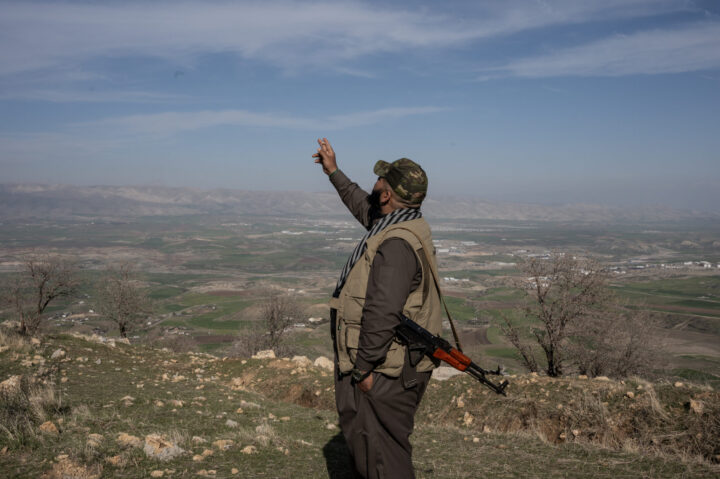
A member of the Komala of the Toilers of Kurdistan, a Kurdish Iranian dissident group, looks toward passing jets on March 6, 2026 in Sulaymaniyah, Iraq.


 Add JewishInsider on Google
President Donald Trump and Israeli Prime Minister Benjamin Netanyahu pushed back on Saturday against reports that they were working with Kurdish leaders to launch a ground invasion of Iran.
“We’re not looking for the Kurds going in,” Trump told reporters on Air Force One on Saturday night. “We’re very friendly with the Kurds, as you know, but we don’t want to make the war any more complex than it already is. … I don’t want to see the Kurds going in and getting killed.”
Trump’s remarks came in response to reporters asking the president about his phone calls with Kurdish leaders at the outset of the campaign against Iran, and a subsequent report that U.S. and Israeli officials said Kurdish Iranian factions are preparing for combat against the Iranian regime.
Many Kurdish factions have long sought an independent Kurdistan, and some of Iran’s neighbors, such as Turkey and Iraq, have historically been concerned about Kurdish separatist factions.
In an apparent reference to such concerns, Netanyahu said in a broader video statement about the war in Iran that Israel and the U.S. “do not seek to divide Iran. We seek to liberate Iran and live in peace with it.”
Netanyahu encouraged the people of Iran to once again rise up against their leaders: “At the end of the day, liberation from the yoke of tyranny, this liberation will depend on you, the brave and long-suffering Iranian people.”
In his first public statement about the war, last Saturday night, Netanyahu called for unity among Iran’s ethnic groups against the Islamic Republic: “The time has come for you to unite for a historic mission. Citizens of Iran: Persians, Kurds, Azeris, Abkhazians and Baluchis. This is your time to join forces, topple the regime and secure your future.”
Hejar Berenji, a Kurdish analyst and commentator, told Jewish Insider: “If you are serious about a free and democratic Iran, the door runs through Kurdistan.”
Berenji called on the U.S. to “protect Iraqi Kurdistan and support Iranian Kurds, because they are in a unique position to become the catalyst for broader change across Iran.”
In addition, he said, “it is time for U.S. leadership to [issue] an open call for an uprising to all Iranians.”
Berenji said that “talk about separation is mostly a distraction — something the Islamic Republic has long used, along with some like-minded voices outside Iran, to scare people away from the one force that is already organized, ready and deeply rooted inside the country.”
“This is not about dividing Iran. It is about recognizing where the real capacity, the real will and the real opportunity for democratic change already exist,” he stated.
Harold Rhode, a fellow at the Jerusalem Center for Security and Foreign Affairs and former longtime advisor on the Islamic world in the U.S. Department of Defense, told JI that Kurds “on the one hand, want an independent homeland, but on the other hand, the Kurds in Iran feel very Iranian.”
Invoking a phrase used by Iranian Kurds that loosely means that they are rooted in Iran’s land and culture, Rhode said, “That is the best solution for the Kurds and everybody. [The phrase] evokes something deep in the soul of Iranians.”
With Iran’s many ethnic minorities, “Iranian” is “a political identity and not an ethnic identity,” Rhode said.
Rhode added that one of his contacts among Iranian Kurdish leaders based in Iraq already told him before Trump’s statement that their troops would not be entering Iran.
As to whether Kurdish leadership may be disappointed by Trump’s decision, Rhodes said, “The Kurds are like the Jews. They’re constantly worried that people are going … to say all sorts of positive things and then abandon them. … That’s what really has happened.”
Witnesses at the Helsinki Commission hearing noted that Russia is taking steps to entrench its presence and expand its relationship with the Syrian government
Chip Somodevilla/Getty Images
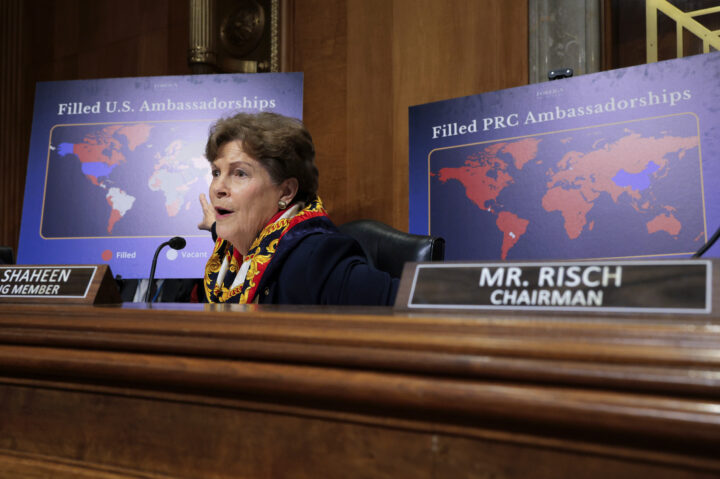
Ranking Member Sen. Jeanne Shaheen (D-NH) points to a map of filled U.S. ambassadorships as Secretary of State Marco Rubio testifies during a Senate Foreign Relations Committee hearing in the Dirksen Senate Office Building on Capitol Hill on January 28, 2026 in Washington, DC.
Lawmakers and expert witnesses pushed back at a Helsinki Commission hearing on Tuesday on efforts to reimpose sanctions on the Syrian government for its assault against the Kurds and other minorities, and pushed for the U.S. to facilitate a diplomatic arrangement between Israel and Turkey that would allow for a greater Turkish presence in Syria — in part as a counterweight to Russia.
Sens. Lindsey Graham (R-SC) and Richard Blumenthal (D-CT) introduced legislation last week to reimpose sanctions on the Syrian government, in response to Damascus’ attacks on the Kurds, which for years had been backed by the U.S. as the minority group fought the Islamic State.
Meanwhile, Israel has remained deeply skeptical of the new Syrian government and is resistant to an expanded Turkish presence in Syria, given Ankara’s open hostility toward Israel in recent years, which has included threats to invade, and ambitions for regional dominance.
Sen. Jeanne Shaheen (D-NH), the ranking member of the Senate Foreign Relations Committee and leading advocate for sanctions repeal in the Senate, criticized colleagues who were pushing to re-impose sanctions, arguing that the repeal of the sanctions has been “successful,” suggesting that their reimposition would push Syria into Russia’s hands.
“The empirical record shows that countries that we’ve sanctioned and tried to coerce, if they are strong enough, will bandwagon, will hedge against us, try to find other patrons,” Richard Outzen, a senior fellow at the Atlantic Council, said. “That’s how Russia has a back door here.”
The hearing was focused primarily on finding ways to counter the Russian presence in Syria.
Outzen asserted that sanctions would not lead to the results their advocates seek, but rather renewed violence and fragmentation.
Rep. Joe Wilson (R-SC), a champion in the House for sanctions repeal, said he hopes to see any remaining sanctions, including Syria’s designation as a state sponsor of terrorism, repealed as well.
Witnesses at the hearing noted that Russia is taking steps to entrench its presence and expand its relationship with the Syrian government, and that Syria remains heavily reliant on Russia. They largely called for increased engagement and incentives for the new Syrian government to counter Russia rather than coercive measures.
“The way to not abandon the Kurds is to not abandon Damascus. The best way to do that is to remain engaged and provide pathways to regional roles for Turkey and others, and not to give in to voices that say, we can’t trust [Syrian President Ahmed al-Sharaa],” Outzen said.
Asked about whether al-Sharaa can be trusted to protect minorities in Syria, Outzen argued that the bigger issue is whether he has the ability to control his own forces, given that many in al-Sharaa’s ranks are jihadists.
“The greatest way to protect [minorities] is to institutionalize and reform the Syrian military. That comes with a stabilized state, and frankly, probably comes with the U.S. providing oversight, whether that’s U.S. forces or contract mechanisms to insist on reforms so that the sort of people that have been responsible for atrocities fighting on that side are weeded out quickly, and, if they’re not Syrians, are sent out of the country,” Outzen said.
Michael Doran, a senior fellow at the Hudson Institute, likewise said that al-Sharaa’s “biggest problem … more than whatever he has in his heart — he has a cadre of people around him who are quite happy to go out and slaughter minorities. And they need to be kept on a short leash, and they need to be trained up,” he continued.
Doran described Turkey as the “key partner” in helping to build and professionalize the Syrian military.
Wilson expressed support for an expanded Turkish military presence in Syria as a path to removing Russian bases from Syria. He said he wants to see a deal between Turkey and Israel to facilitate that goal.
“Sadly, some in Israel prefer a weak and divided Syria and view an extended Russian presence as a buffer against Turkey. I believe this is suicidal for Israel,” Wilson said. “This will only be possible if Israel and Turkey deescalate and reach a detente in Syria.”
Wilson said that it was “startling to me” that Israel saw a Russian presence in Syria as a counterweight to Turkey.
“Our ability to expel the Russians from Syria, in the end, is going to be dependent on our ability to strike a balance between the Turks and the Israelis, and this is going to take a very sustained commitment on our part,” Doran agreed.
“I think the American leadership in pulling the Turks and the Israelis together and encouraging them, almost forcing them to talk to each other, is, I think, the starting point for solving this problem,” Doran said.
“I think the greatest fear of Israelis, more than the ideological onslaught of the Islamists against Israel and the Syrian minorities, is that Syria will become a Turkish military base — the front lines in an effort to annihilate Israel,” he continued. “I think we have a major role to play here, in getting the two sides to come to an accommodation.”
He said he wants to see Syria become a “buffer state” between Turkey and Israel, comparing it to Jordan as a buffer between Israel and Iraq.
Outzen said that outreach will be needed to the Israeli government to push back on their approach, bring together Israeli and Turkish security officials and emphasize Turkey’s role as a NATO ally and a close partner of the Trump administration — in spite of Israel’s own deep concerns about Turkey’s regional ambitions.
Graham has been a close ally of the Saudis while urging the kingdom to normalize relations with Israel
Andrew Harnik/Getty Images
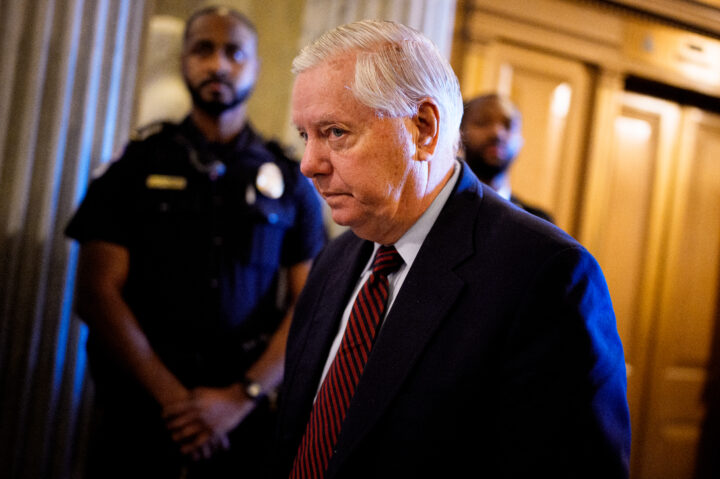
Sen. Lindsey Graham (R-SC) walks into the Senate Chamber on December 11, 2025 in Washington, DC.
Sen. Lindsey Graham (R-SC) called on Saudi Arabia to end what he described as its “attack on the United Arab Emirates” and slammed the country’s silence regarding the Syrian government’s campaign against the Kurds, demanding the kingdom use its influence to “keep the region from falling further into chaos.”
Graham made the comments in a post Tuesday morning on X, hours after announcing his plans to introduce legislation this week imposing sanctions on any government or group involved in targeting Kurdish forces in Syria. Syrian government forces have recently led a campaign against the Kurdish-led and U.S.-backed Syrian Democratic Forces, resulting in the loss of SDF control over parts of the country’s territory.
“As previously stated, I am trying to work with the administration and regional partners to prevent a bloodbath in Syria against our Kurdish allies,” Graham wrote. “It is now time for the region to change their ways and man up for decency.”
“To Saudi Arabia: I have tried to work hard to chart a new path for relations between your country, the United States and the region,” he continued. “I have tremendous respect for many of the changes that have been embraced. However, the Kingdom’s attack on the United Arab Emirates and their silence regarding the Syrian government’s constant assault on the Kurds has to change.”
Last month, Saudi forces carried out airstrikes in southern Yemen targeting what they said were weapons shipments from the United Arab Emirates to UAE-backed separatists, escalating tensions between Riyadh and Abu Dhabi and prompting the UAE to announce a withdrawal of its remaining forces from Yemen.
The South Carolina senator continued, “Please understand that I am smart enough to know that Saudi Arabia has influence on the Syrian government, and I expect them to use it to keep the region from falling further into chaos.”
Graham, who has been closely engaged with the Saudis while lobbying the kingdom to normalize relations with Israel, said earlier this month that he would be “dramatically rethinking” the “nature of” the U.S. alliance with Saudi Arabia and other Gulf states if they “intervened on behalf of Iran to avoid decisive military action” by President Donald Trump against the Iranian regime.
“All the headlines suggesting that our so-called Arab allies have intervened on behalf of Iran to avoid decisive military action by President Trump are beyond disturbing. The ayatollah’s regime has American blood on its hands. They are slaughtering people in the streets,” Graham said at the time.
“If it is accurate that the Arab response is ‘action is not necessary against Iran’ given this current outrageous slaughter of innocent people, then there will be a dramatic rethinking on my part regarding the nature of the alliances now and in the future.”
Please log in if you already have a subscription, or subscribe to access the latest updates.
 Continue with Google

 Continue with Apple