














































































‘Kurds are in a unique position to become the catalyst for broader change across Iran,’ Iranian Kurdish analyst tells JI
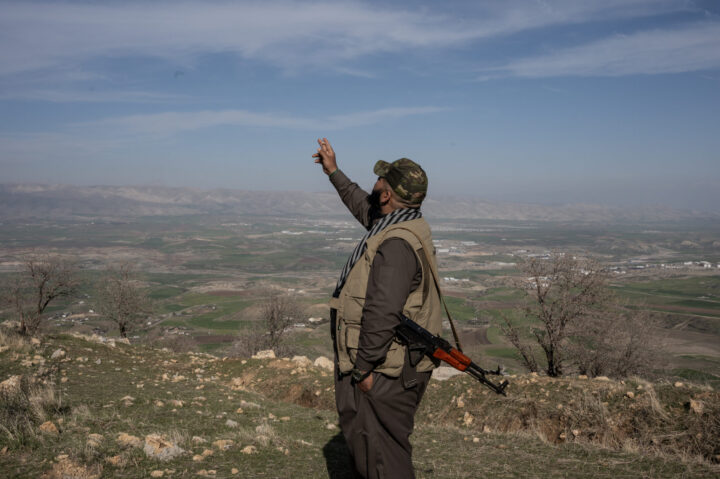
Hawre Khalid/Getty Images
A member of the Komala of the Toilers of Kurdistan, a Kurdish Iranian dissident group, looks toward passing jets on March 6, 2026 in Sulaymaniyah, Iraq.


 Add JewishInsider on Google
President Donald Trump and Israeli Prime Minister Benjamin Netanyahu pushed back on Saturday against reports that they were working with Kurdish leaders to launch a ground invasion of Iran.
“We’re not looking for the Kurds going in,” Trump told reporters on Air Force One on Saturday night. “We’re very friendly with the Kurds, as you know, but we don’t want to make the war any more complex than it already is. … I don’t want to see the Kurds going in and getting killed.”
Trump’s remarks came in response to reporters asking the president about his phone calls with Kurdish leaders at the outset of the campaign against Iran, and a subsequent report that U.S. and Israeli officials said Kurdish Iranian factions are preparing for combat against the Iranian regime.
Many Kurdish factions have long sought an independent Kurdistan, and some of Iran’s neighbors, such as Turkey and Iraq, have historically been concerned about Kurdish separatist factions.
In an apparent reference to such concerns, Netanyahu said in a broader video statement about the war in Iran that Israel and the U.S. “do not seek to divide Iran. We seek to liberate Iran and live in peace with it.”
Netanyahu encouraged the people of Iran to once again rise up against their leaders: “At the end of the day, liberation from the yoke of tyranny, this liberation will depend on you, the brave and long-suffering Iranian people.”
In his first public statement about the war, last Saturday night, Netanyahu called for unity among Iran’s ethnic groups against the Islamic Republic: “The time has come for you to unite for a historic mission. Citizens of Iran: Persians, Kurds, Azeris, Abkhazians and Baluchis. This is your time to join forces, topple the regime and secure your future.”
Hejar Berenji, a Kurdish analyst and commentator, told Jewish Insider: “If you are serious about a free and democratic Iran, the door runs through Kurdistan.”
Berenji called on the U.S. to “protect Iraqi Kurdistan and support Iranian Kurds, because they are in a unique position to become the catalyst for broader change across Iran.”
In addition, he said, “it is time for U.S. leadership to [issue] an open call for an uprising to all Iranians.”
Berenji said that “talk about separation is mostly a distraction — something the Islamic Republic has long used, along with some like-minded voices outside Iran, to scare people away from the one force that is already organized, ready and deeply rooted inside the country.”
“This is not about dividing Iran. It is about recognizing where the real capacity, the real will and the real opportunity for democratic change already exist,” he stated.
Harold Rhode, a fellow at the Jerusalem Center for Security and Foreign Affairs and former longtime advisor on the Islamic world in the U.S. Department of Defense, told JI that Kurds “on the one hand, want an independent homeland, but on the other hand, the Kurds in Iran feel very Iranian.”
Invoking a phrase used by Iranian Kurds that loosely means that they are rooted in Iran’s land and culture, Rhode said, “That is the best solution for the Kurds and everybody. [The phrase] evokes something deep in the soul of Iranians.”
With Iran’s many ethnic minorities, “Iranian” is “a political identity and not an ethnic identity,” Rhode said.
Rhode added that one of his contacts among Iranian Kurdish leaders based in Iraq already told him before Trump’s statement that their troops would not be entering Iran.
As to whether Kurdish leadership may be disappointed by Trump’s decision, Rhodes said, “The Kurds are like the Jews. They’re constantly worried that people are going … to say all sorts of positive things and then abandon them. … That’s what really has happened.”
Members of both parties indicated they had not been briefed on the alleged plans; some Republicans were broadly supportive while Democrats were skeptical
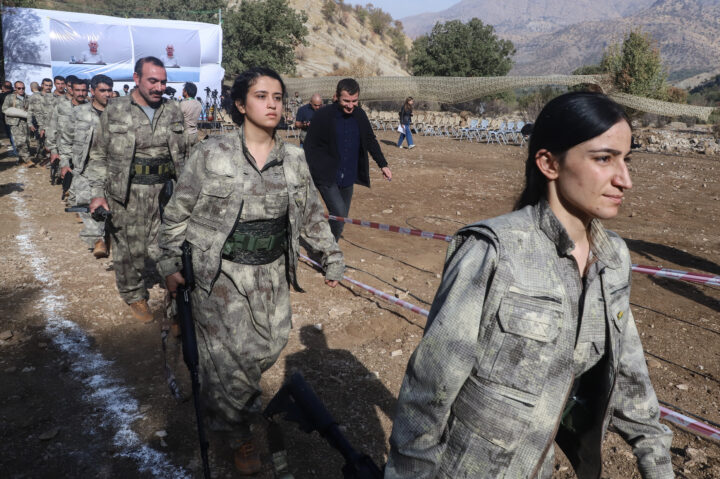
SHWAN MOHAMMED/AFP via Getty Images
Kurdistan Workers' Party (PKK) fighters attend a ceremony in the Qandil area of northern Iraq on October 26, 2025.
Lawmakers are largely keeping an arm’s length from the administration’s reported discussions with Kurdish leaders in Iraq about supporting an armed offensive against the Iranian regime, as an on-the-ground force aligned with U.S. interests in the ongoing American and Israeli air campaign.
White House Press Secretary Karoline Leavitt said Wednesday that President Donald Trump has had discussions with Kurdish leaders about the U.S. base in northern Iraq, but denied that Trump agreed to support a Kurdish offensive.
Multiple outlets reported Wednesday that Kurdish forces had begun a ground push into Iran from Iraq.a spokesperson for the government in Iraqi Kurdistan said no Iraqi Kurds had crossed the border — not directly addressing the question of Iranian Kurds, thousands of whom live in Iraq and have been at the center of the recent rumors.
Many Republican senators indicated Wednesday that they knew little about the effort. Some seemed broadly supportive, while not commenting on the specifics of the reported moves.
Sen. John Kennedy (R-LA) told Jewish Insider he couldn’t comment on the subject due to classification issues, but said generally that “the Kurds know how to fight — you don’t want to tangle with the Kurds.”
Sen. James Lankford (R-OK) said broadly that “there are a lot of people in Iran that don’t like the current government, that have been oppressed by the current government for a long time. I don’t have a comment on anything the administration may or may not be doing here, but there are a lot of people that live in Iran, that lived under the oppression of that regime that would love to be able to have a taste of freedom.”
At least some of the Iranian Kurdish forces in question have been living inside Iraq.
Several other Republican senators said they knew nothing about the alleged plan, and that it hadn’t come up in the classified briefing that senators received from the administration on Tuesday.
Democrats are generally skeptical of the reported plan.
“I am struck by the hypocrisy of pulling the rug out from under the Kurds in Syria and then asking them to fight again for Iran. Kurds deserve better,” Sen. Richard Blumenthal (D-CT) said.
Sen. Andy Kim (D-NJ) told JI on Tuesday that supporting a Kurdish insurgency would belie the administration’s recent assertions that its focus is on Iran’s ballistic missile capabilities and nuclear program.
“I’ve worked on these issues with Kurds. … The fact that this administration is having those types of conversations — I don’t know the full extent of it — but you wouldn’t be having those conversations if you weren’t thinking about maybe getting different actors on the ground,” Kim said. “It very much feels like they are fomenting potentially different groups on the ground to start to get engaged in what will essentially be what happened in Syria before, what happened in Libya before. [If] they are trying to start a civil war, this is a very good way to go about it.”
Rep. Brad Schneider (D-IL), who is generally hawkish on Iran but plans to support the war powers resolution in the House to halt the war on constitutional grounds, said, when asked about the Kurds, that he has yet to hear a clear strategy for the conflict.
“I’ve heard rumors. I don’t know any details,” Schneider said. “I have yet to see a coherent strategy articulation of what the end game is, or strategy for achieving our goals in the long run.”
The plan has also drawn skepticism outside of the Hill.
Behnam Ben Taleblu, the senior director of the Iran program at the Foundation for Defense of Democracies, warned that the Kurds would be the “main victims” of the plan, becoming primary targets for the Islamic Revolutionary Guard Corps.
He said also said that he “couldn’t think of a better gift to the Islamic Republic,” and that a Kurdish armed force wouldn’t be able to counter the Iranian regime militarily, would spook “protesting Iranians who have increasingly embraced nationalism” and would burn goodwill of Iranians toward the U.S. given the risk of sparking a civil war.
Amb. Daniel Shapiro, who served in senior roles at the State and Defense Departments under the Biden administration, also expressed caution.
“Past history of U.S. efforts to support those kinds of insurgencies have been quite spotty in terms of effectiveness,” Shapiro, now a distinguished fellow at the Atlantic Council, told JI.
He said that “you could make an argument for trying to stir up that kind of internal clash” as a supplement to the Israeli and American operations, in addition to potential strikes by European and Gulf states.
“But overall, the management of this operation has been, at the political level, very spotty, and the goals have been inconsistently described,” Shapiro continued. “It leaves me very skeptical that untested militia groups being deployed as an extra lever of pressure is going to be any more successful than it’s often been in the past. And it could even indicate there’s kind of a flailing around for additional ways of what’s not being accomplished sufficiently through the military campaign.”
A brief issued Wednesday by the Jewish Institute for National Security of America, however, offered support for engaging Kurdish partners.
“If the United States wants Operation Epic Fury to produce more than a temporary setback for Iran’s nuclear program, it needs organized partners on the ground — and it needs to arm, engage, and protect them now. The most capable candidates are Iran’s Kurdish political and armed movements,” the report’s authors, Giran Ozcan, a JINSA fellow for Kurdish Affairs, and Jonah Brody, a JINSA policy analyst, wrote.
“Three concrete U.S. actions are necessary: arm the Kurds; help defend them against Iranian airstrikes; and pair military support with political engagement.”
But they warned that the U.S. will need to overcome mistrust from the Kurds generated by U.S. acquiescence to the Syrian government offensive against the U.S.’ Kurdish allies in that country, requiring the U.S. to offer “real and credible commitments of support for Iranian Kurdish aspirations, commitments that it will honor. At the same time, Iranian Kurdish groups must be realistic about what they can achieve and what the United States can deliver.”
Washington reporter Matthew Shea contributed reporting.
Please log in if you already have a subscription, or subscribe to access the latest updates.
 Continue with Google

 Continue with Apple