














































































Reses, who has worked with Vance since 2021, has been a part of the now-vice president’s inner circle since advising him on his 2022 Senate bid
Anna Moneymaker/Getty Images
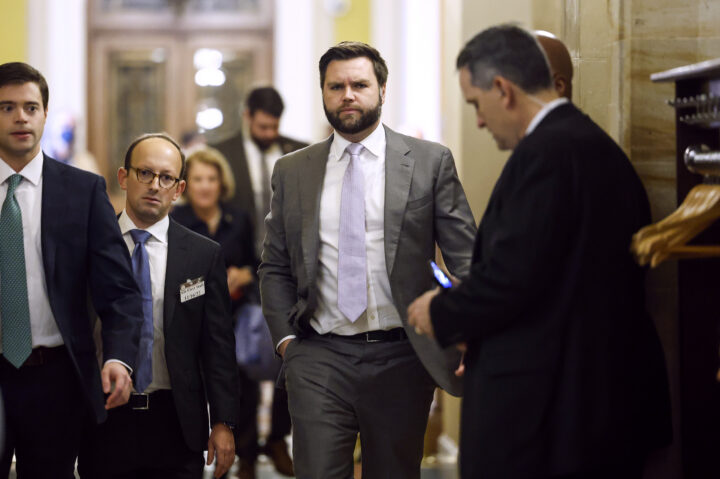
JD Vance, with advisor Jacob Reses (second from left), arrives to a meeting with Senate Republicans at the U.S. Capitol on November 16, 2022 in Washington, D.C.


 Add JewishInsider on Google
Jacob Reses, the longtime chief of staff to Vice President JD Vance, will depart the Trump administration at the end of the summer, a source familiar with the matter confirms to Jewish Insider.
Reses, 35, became a confidante to Vance in 2021, advising the vice president through the heated primary and general election contests for the Ohio Senate seat Vance briefly held before being tapped by President Donald Trump as his running mate in 2024. Vance named Reses his chief of staff immediately after winning the Senate race. Sen. Josh Hawley (R-MO), who had employed Reses as a senior advisor in his Senate office, was among those who encouraged Vance to pick Reses as his chief at the time, according to two sources familiar with the matter.
News of his departure was first reported by NBC News.
Reses has not announced what his next role will be, though he informed the vice president of his plans to leave several months ago, after learning he and his wife were expecting their first child. He married Rachel Altman, the director of outreach at the Foundation for American Innovation, a tech think tank, in January. A source in the vice president’s office suggested to JI that Reses could rejoin the team at some point down the line, but did not elaborate beyond noting that it would come as no surprise if that occurred.
“Jacob’s been by my side for my whole career in public life. I can’t imagine having been on this life-changing journey without him,” Vance said in a statement. “From day one of my time as a senator-elect, I could not have asked for a more loyal and discerning advisor and friend as my chief of staff. I’ll miss him dearly, but he won’t be far, and I plan to keep his counsel close until our paths cross again.”
Other senior Trump administration officials similarly surmised that Reses would remain close.
“Don’t let Jacob fool you – beneath his kind exterior he’s a killer. It’s been a delight to get to know him through the vice president, and our foreign adventures from Israel to Pakistan have been historic,” White House Special Envoy Steve Witkoff said in a statement. “He commands respect in every room he walks into, and I’ve been proud to have him by my side in negotiating some of the toughest deals for the president. We haven’t seen the last of him.”
White House Chief of Staff Susie Wiles said in a statement that Reses “will always be a friend and ally we can all rely upon and I hope will come back often.”
“Jacob has been an important part of our White House leadership team and has served the Vice President with absolute distinction. From diplomacy and war, to complicated matters, to the most minute logistics, there has been no task too big or too small for him to tackle,” Wiles said. “It has been a privilege to have a partner like Jacob in the vice president’s office with such humility, discretion, and loyalty. He will be missed in the halls of the West Wing, but he will always be a friend and ally we can all rely upon and I hope will come back often.”
Acting Attorney General Todd Blanche described Reses as “tough, smart, hardworking, and loyal – the perfect combination to succeed in the Trump White House.”
“I’ll always appreciate his ability to give wise and honest counsel, and you’ll never meet anyone more focused on putting the team first,” Blanche said. “I’m grateful to have had Jacob as a colleague, and while I’m going to miss working with him to advance the president’s agenda, I’m excited to see what he does next.”
Secretary of State Marco Rubio and Treasury Secretary Scott Bessent also praised Reses and said he would be missed in the administration.
“When I met Jacob over dinner shortly before the Republican convention, I had no idea we would be such close partners in the years to come,” Bessent said. “His counsel to me and to the vice president has been invaluable as we have fought to reshore critical industries and rebalance the economy from debt-driven consumption to production, saving, and investment. We will miss him enormously.”
“Jacob has served the vice president and the entire administration with distinction. He understands the moment we’re in and he spent every day fighting to deliver results for the president,” Rubio’s statement read. “His intellect, leadership, and humor will be missed.”
Reses has worked with a number of prominent figures in the MAGA political movement besides Vance and Hawley, such as Tucker Carlson, Stephen Miller, Russell Vought and Michael Needham, as well as Heritage Action, an affiliate of the conservative Heritage Foundation.
Despite the three Republican defections, the measure still failed to pass

Kevin Carter/Getty Images
U.S. Capitol Building on January 18, 2025 in Washington, DC.
Sen. Lisa Murkowski (R-AK) became the latest of a small number of Senate Republicans to break ranks and vote with the majority of Democrats in favor of an effort to force an end to the war in Iran on Wednesday.
She joined Sen. Susan Collins (R-ME), who voted for the second time for such an effort, and Sen. Rand Paul (R-KY), who has consistently voted with Democrats on the issue. Nevertheless, the effort still fell short of a majority of the Senate, or of the 60 vote threshold needed for passage, with a final vote of 49 in favor to 50 against.
Sen. John Fetterman (D-PA) remained the only Democrat to vote against the war powers effort.
Murkowski has been working with other Senate Republicans on an Authorization for Use of Military Force to set limits on the U.S. operations against Iran, but it remains unclear when she plans to introduce it or what its scope will be.
Murkowski and Collins’ votes suggest they’re unconvinced by the administration’s assertions that the military operations that began in late February have now concluded. The War Powers Act sets a 60-day deadline for military action without congressional approval.
“You’ve got a timeline that has taken us beyond the 60 days,” Murkowski told reporters. “I thought that perhaps we would get … more clarity from the administration in terms of where we are, and I haven’t received it. So I felt that it was now time to advance a discharge so that we can discuss our responsibilities as Congress under the War Powers Act.”
Collins said following the prior vote, two weeks ago, that she had voted for the resolution in order to enforce the War Powers Act.
Sen. Josh Hawley (R-MO), who previously said his position might change after the 60-day mark and has been urging the administration not to restart military operations, again voted against the war powers effort.
“I think the administration’s in compliance, the president’s [in] compliance with the war powers statute given his certification to Congress … saying that he had terminated hostilities under Operation Epic Fury,” Hawley told Jewish Insider, echoing comments he made earlier this week. “I welcome the termination of hostilities … I’m glad [Trump] has resisted some of my colleagues’ calls to return to large-scale bombing and is pursuing an end to the conflict. I think that’s good.”
Senate Majority Leader John Thune (R-SD) had urged Republicans not to break ranks on the issue while President Donald Trump is in China on a state visit this week.
“Right now, the president’s overseas,” Thune said. “He’s negotiating with the Chinese on a whole range of issues, some of which bear on national security, and I think it would be best if everybody hung together and supported the president.”
Sen. John Curtis (R-UT), who had previously expressed opposition to any military operations beyond the 60-day deadline, also voted against the resolution. He suggested to reporters that the efforts from Democrats were not “serious.”
“I’ve yet to see a serious war powers vote. Let’s admit it, all this is a poke at the president,” Curtis said.
Curtis told reporters later in the day that the situation and the path forward is not simple, and that many questions including whether the U.S. is in a ceasefire, whether hostilities have actually stopped and whether the U.S. is drawing down from operations in Iran need to be answered to shape his approach to the issue.
He said that there is not “any question in my mind” that the 60-day period has expired. He reiterated that he would not fund the war beyond 60 days without congressional authorization.
Asked by JI whether he would introduce his own war powers resolution or AUMF as an alternative to those pushed by Democrats, Curtis indicated he does not plan to do so. “Ever since 1973,” when the War Powers Act was first passed, “Congress has struggled with what the answer is.”
He said he wants to ensure the administration maintains freedom to act in an emergency scenario. He said that drawing the proper boundaries is “not easy, and there’s a reason nothing’s been done on it. It’s not a matter of will, it’s a matter of where do you draw that line? I do think it’s time to have that conversation and count me in, in a group that would try to define that.”
Asked about the potential for renewed military action, he said he would have to evaluate it and the requirements for notifying Congress based on events as they occur.
Sen. Thom Tillis (R-NC) told reporters he wants to work with the administration on an AUMF, dismissing comments by Secretary of Defense Pete Hegseth yesterday indicating that the administration feels it does not need and does not plan to seek an AUMF if it returns to combat.
The House is set to vote on a war powers resolution on Thursday, which stands a greater chance of passage. However, Rep. Warren Davidson (R-OH), who voted for the first war powers resolution that came before the House earlier this year, said he plans to vote “present” tomorrow, as he did on the second House vote.
Jewish Insider Washington reporter Matthew Shea contributed reporting.
The move, which Trump has sent mixed signals about, may cause further fractures in the GOP over support for the war

Kayla Bartkowski/Getty Images
Sen. Josh Hawley (R-MO) speaks to the press on June 2, 2025 in Washington.
As the U.S. deploys thousands of Marines to the Middle East and President Donald Trump continues to send mixed messages about whether he plans for a ground invasion of Iran, one GOP senator said he’s hoping the administration does not take that step.
“I would hope it wouldn’t come to that,” Sen. Josh Hawley (R-MO) told Jewish Insider on Friday, when asked about the possibility of a ground operation in Iran.
Hawley has previously argued that the war should wrap up quickly and said that deploying ground troops might require an affirmative congressional war authorization. His comments suggest that a ground invasion could cause further fractures among Republican lawmakers over the war.
Trump gave conflicting answers last week on whether he plans to send U.S. troops to Iran, saying at one point that he was “not afraid” to deploy troops, but saying later in the week that he did not plan to do so.
Already, a small number of other congressional Republicans are growing hesitant about the effort.
“I wish that the president would figure out a way to end the war. I think it’s becoming more challenging every day in terms of how you end it,” Sen. Lisa Murkowski (R-AK) said earlier this week.
Murkowski also said, before reports emerged of a potential $200 billion supplemental funding request for the war, that the funding level requested might “provide its own level of shock.”
And Rep. Lauren Boebert (R-CO) said she would oppose any additional funding request for the conflict.
But other Republicans are standing firmly by the administration.
Sen. Rick Scott (R-FL) said that he’s not concerned about the possibility of placing troops on the ground.
“The president is doing what he needs to do, he’s got to protect American freedom, he’s got to destroy their nuclear weapons, their ability to hit us with ballistic missiles,” Scott said. “He’s doing the right thing.”
But with Iran maintaining various capabilities and continuing its attacks, other leading GOP senators say it would be premature to end the war now
Al Drago/Getty Images
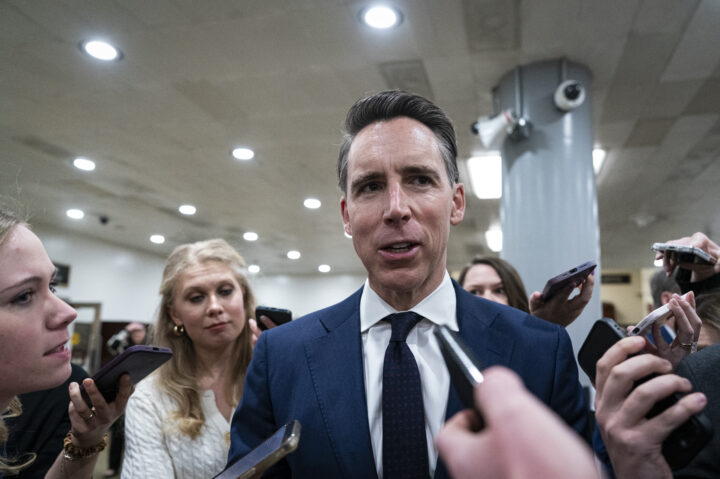
Sen. Josh Hawley (R-MO) speaks to reporters prior to the Senate Republicans weekly policy luncheon, in the US Capitol on March 25, 2025 in Washington, DC.
Both of Missouri’s Republican senators, Josh Hawley and Eric Schmitt, argued that the administration seems to have largely achieved its key objectives for the war in Iran — a posture that distinguishes him from most GOP colleagues and highlights subtle but emerging divisions among Republicans on the proper scope and duration of the war.
Pointing to comments by President Donald Trump saying that the war was substantially complete and that the U.S. had achieved its objectives, Hawley said on Fox News earlier this week, “I agree with what the president said last night. You look at all the success that we’ve had in the last 10 days. I mean, this thing is a victory. I think we should be hailing our military. We ought to be saying we’ve achieved our objectives here. … If this isn’t success, I don’t know what would be. … Now it’s time to declare victory.”
He also posited that Iran has nothing remaining with which to reconstitute its nuclear program — though the regime maintains a stockpile of enriched nuclear material which many experts argue cannot be fully secured without some form of on-the-ground presence.
Continuing a trend of making contradictory comments on the war’s timeline, Trump had said the same day that the U.S. could and would go much further in Iran, and that the U.S.’ aims could expand significantly.
Asked by Jewish Insider on Thursday about the metrics by which he was judging the success of the war, Hawley — who is one of the more prominent senators from the populist wing of the GOP — said he was referring to Trump’s own comments on the subject.
“I assume our overriding national security objective when it comes to Iran is to prevent them from getting nukes. And between our bombing last June and in the last … 12 days, I don’t know how they’re going to reconstitute their nuclear program anytime in, maybe, our lifetimes,” Hawley said.
“Our military has done an amazing job. I think it’s been an overwhelming display of force,” Hawley continued. “I know my Democrat colleagues, a bunch of them are saying, ‘This has accomplished nothing, nothing’s happened.’ It seems to me a lot has happened. And I think we should say that’s a good thing.”
Pressed on whether the war can be ended while Iran continues to fire missiles and drones at countries throughout the Middle East and is dropping mines in the Strait of Hormuz, Hawley said he would defer to Trump’s judgement on when to end the war.
“My point is just that I think the military has achieved a tremendous amount. It has ended [Iran’s] nuclear program for all intents and purposes. It has destroyed their navy. It has eliminated most of their ballistic missiles — those are good things,” he continued. “I’d be glad to take that [win].”
“Seems pretty good to me,” Hawley added.
Schmitt, who is also aligned with the populist wing of the party, likewise emphasized the progress the U.S. has made and pushed for a quick conclusion to the war.
“I know they’re way ahead of schedule. I’d look for a swift end to it,” Schmitt told JI. “I’m not interested in forever war in the Middle East, I don’t think the president is either. And I think that, again, they’ve laid out clear objectives and [are] making a lot of progress.”
Other Republicans are taking a distinctly different approach. Sen. Kevin Cramer (R-ND) told reporters on Thursday that “victory isn’t determined by declaration, it’s determined by the outcome.” He argued that the U.S. can’t and shouldn’t end the war prematurely.
“If you pull 90% of the weeds of our garden and you leave 10%, you’re going to have a weedy garden,” Cramer continued. “The last 10% are the hardest, in many cases.”
The North Dakota senator, who sits on the Senate Armed Services Committee, expressed surprise that the U.S. had not been better prepared to secure the Strait of Hormuz, calling it a potential “miscalculation” and saying that the attacks on ships in the critical waterway “could have been avoided.”
Sen. Lindsey Graham (R-SC), one of the most vocal supporters of the Iran war on Capitol Hill, said that he thinks there are “weeks more of this coming.”
“I don’t see this conflict ending today. I think the mission is to make sure they cannot regenerate, that they’re going to be beyond capable of building missiles to hit us, and they’ll never go back to the nuclear business,” Graham continued.
Also on Thursday, in a rare Senate floor speech, Sen. Mitch McConnell (R-KY), emphasized that the war against Iran cannot be decoupled from the global axis, including Russia and China, with which Iran is aligned.
Russia, McConnell emphasized, has reportedly been providing Iran with targeting intelligence. He criticized Special Envoy Steve Witkoff, who said earlier this week that he takes Russia at its word that it has not been doing that.
“I’ve warned successive presidents to take the Russian-Iranian axis, actually, more seriously,” McConnell said. He emphasized the supportive role that Ukraine has taken in helping to protect the U.S.’ allies in the Gulf, and criticized administration officials for not moving more quickly in pre-war discussions to acquire Ukrainian anti-drone technology.
He also urged lawmakers who oppose the war to nonetheless support an expected request for supplemental military funding as “an overdue opportunity to invest in urgent and strategic defense priorities.”
Sen. Josh Hawley to JI: ‘We need to be really clear, and I say that not only as a conservative, but also as a Christian. There is no place for antisemitic hatred, tropes, any of that stuff’
Kayla Bartkowski/Getty Images
Sen. Josh Hawley (R-MO) speaks to the press on June 2, 2025 in Washington.
Sen. Josh Hawley (R-MO) warned on Monday against the mainstreaming of antisemitic figures within the conservative movement in response to Tucker Carlson’s platforming of neo-Nazi influencer Nick Fuentes.
Hawley, an ally of the national conservative movement who has advocated for the Trump administration to take an aggressive approach to combating campus antisemitism, made the comments while speaking to Jewish Insider about the controversy surrounding Fuentes’ appearance on Carlson’s podcast late last week.
“I just think on the substance of what he says, I mean, it’s antisemitic. Let’s just call it for what it is, let’s not sugarcoat it,” Hawley said of Fuentes.
“That’s not who we are as Republicans, as conservatives. Listen, this is America. He can have whatever views he wants. But the question for us as conservatives is: Are those views going to define who we are? And I think we need to say, ‘No, they’re not. No. Just no, no, no,’” he continued. “We need to be really clear, and I say that not only as a conservative, but also as a Christian. There is no place for antisemitic hatred, tropes, any of that stuff. I just think we’ve gotta say that stuff.”
The Missouri senator drew a parallel between the antisemitism seen at universities across the country since Hamas’ Oct. 7, 2023, attacks on Israel and Fuentes’ views.
“Do we really want to be part of what we’ve seen happen on college campuses, for instance, in this country in the last two or three years? Conservatives have been decrying that,” Hawley said. “Are we now to believe that, oh, actually, we have no problem with that? And that all of the things they were saying about Jews and Jewish Americans, that was fine? That’s not my view. I wasn’t fine with it then, I’m not fine with it now.”
“I thought it was morally repulsive then, I think it’s morally repulsive now. I’m not going to change my opinion on that. I want to be really clear: that’s above all a moral issue,” he added.
Hawley was not the only Republican senator to voice their objections to a GOP embrace of Fuentes or the avowed antisemite’s appearance on Carlson’s program.
The fallout now involves the Heritage Foundation, the result of its president, Kevin Roberts, coming to Carlson’s defense in a video last Thursday that called out the “venomous coalition attacking” Carlson and warned that “their attempt to cancel him will fail.” Roberts has since clarified that he and Heritage do not support Fuentes’ antisemitic views, though he refused to disavow him, and is facing growing calls to walk back his comments.
Sen. James Lankford (R-OK), the co-chair of the Senate antisemitism task force, told JI that he was “a little surprised that Heritage jumped out in support of [Carlson] and Nick Fuentes to say, ‘Hey, we want them in our camp’ after the statements that were made.”
“Heritage could have just sat back and not said anything, but instead, they chose to jump out on their side,” Lankford continued. “I don’t get that.”
He, like Hawley and other Republican lawmakers, warned that the right faces a similar crisis of antisemitism as is roiling the left if conservatives do not proactively confront and shun antisemites in their midst.
“The left has seen an implosion of their party based on antisemitism rising in their party. I don’t want to see the same thing on the right,” Lankford said. “To say the least, I want to make it very, very clear we are not the party of antisemitism. We’re not the party that believes Hitler was a good guy and that Winston Churchill was the bad guy. We’re not the party that blames media issues on the Jews and all these weird tropes that are out there. That’s not who we are, that’s not what we stand for, nor what we should stand for.”
He said that he does not understand the impulse to “allow it to be a big tent and allow antisemitism in our party. If there are [antisemites] that are there, we should call it out and say that’s wrong.”
“What I’ve tried to be very clear on is [that] the ‘New Right’ is now quoting an old wrong. It’s wrong,” Lankford continued.
Sen. Rick Scott (R-FL) offered a similar message.
“The Democrat Party — we already have a party that’s for antisemitism [and] is against Israel,” Scott told JI. “The Republican Party [is going to] stand for Israel and we’re going to stand against antisemitism. I don’t think there’s any question.”
Rabbi Yaakov Menken, the executive vice president of the Coalition for Jewish Values, told JI that Roberts’ message “was the most tone-deaf comment, in both its content and its timing, that I’ve ever heard from a major Washington organization on any political side.”
Menken resigned from Heritage’s Project Esther, the group’s antisemitism initiative, last week in response to Roberts’ video message defending Carlson. Along with Menken and CJV, several other groups have also publicly disaffiliated from Heritage’s antisemitism task force, including the National Jewish Advocacy Center, the Zionist Organization of America and Young Jewish Conservatives.
Hawley himself has previously advocated for a more restrained approach to U.S. foreign engagement and aligns with the national conservative movement
Al Drago/Getty Images
Sen. Josh Hawley (R-MO) speaks to reporters prior to the Senate Republicans weekly policy luncheon, in the US Capitol on March 25, 2025 in Washington, DC.
Sen. Josh Hawley (R-MO) says he doesn’t share the concerns of some in the isolationist wing of the Republican Party that U.S. engagement in Israel’s military operation to destroy Iran’s nuclear program would lead to a global war or another prolonged conflict in the Middle East, citing his confidence in President Donald Trump’s ability to avoid either outcome.
The Missouri senator told Jewish Insider, following a conversation with Trump on Tuesday morning, that he trusted the president to navigate the situation without dragging the U.S. into a broader war, an issue that has caused growing consternation among commentator Tucker Carlson and other neo-isolationists in the GOP. Hawley has previously advocated for a more restrained approach to U.S. foreign engagement and aligns with the national conservative movement.
“I just don’t think that. I think Donald Trump is the least likely person to let that happen,” Hawley said when asked what he’d say to those who argue Trump’s actions will embroil the U.S. in a war. “I think he’s pretty careful, and I think he’s got a pretty good sense of our security interests, obviously our allies. So I feel pretty good with him in charge.”
Hawley made similar comments in a separate conversation with JI on Monday, saying at the time, “I think the president has a pretty clear assessment of what is good, what is in America’s interests. He’s been really clear on this, America’s interest and the world’s interest is to not have Iran have a nuclear weapon.”
“There’s all kinds of paths to that, and that’s what the president is saying about negotiating. Iran ought to come and do this peacefully and give up their nuclear program. You can get there that way, but at the end of the day, we’re going to get to the point where they don’t have a nuclear weapon and they don’t have a nuclear program,” Hawley explained.
“If they keep going down this path, good luck,” he added.
Hawley also praised Trump’s approach to addressing the conflict and the threat posed by a nuclear Iran while cautioning against engaging in conjecture about what the Israelis were asking of the Trump administration.
“I think the president has struck the right position, which is supportive of Israel’s right of self-defense, which is what this really is, and supporting them publicly while they defend themselves. I think that’s the right position to stick on. I know what the speculation is in the press about what Israel may want to do or not do next, but let’s see what they actually ask us for,” he told JI on Monday.
Following his Tuesday conversation with Trump, Hawley reiterated his support for the president’s response since Israel first struck Iran last week. “He’s handled this situation very deftly. I think his message has been pretty clear, which is that Iran is not going to get a nuke. So they can either surrender their nuclear program peaceably, and he’s willing to [have] the United States facilitate that, or the Israelis are going to blow their program to smithereens. Right now they’re choosing the smithereens route. Doesn’t seem very wise to me,” he said.
Speaking to reporters later Tuesday, Hawley said he wouldn’t support Sen. Tim Kaine’s (D-VA) war powers resolution blocking the U.S. from taking military action in support of Israel’s operation against the Iranian regime, citing his opposition to the legislation broadly.
“I tend to think the War Powers Act is unconstitutional, and I don’t think the president needs preclearance to do one-off military strikes. That doesn’t mean that they’re necessarily a good idea, but I don’t think he needs preclearance from Congress. I don’t know quite how that would function,” Hawley said.
In the House, Republicans are moving ahead on a series of investigations into the matter

Kevin Dietsch/Getty Images
Sen. Lindsey Graham (R-SC) talks to members of the media as he makes his way to the Senate chamber at the U.S. Capitol on April 23, 2024 in Washington, DC.
Senate Judiciary Committee Republicans penned a letter to Sen. Dick Durbin (D-IL) on Thursday to request that he hold a hearing on how the uptick in antisemitism on college campuses is violating the civil rights of Jewish students.
The letter was led by Sen. Lindsey Graham (R-SC), the top Republican on the committee, and signed by every Republican who serves on the panel, including Sens. Chuck Grassley (R-IA), John Cornyn (R-TX), Thom Tillis (R-NC), Ted Cruz (R-TX), Tom Cotton (R-AR), Josh Hawley (R-MO), John Kennedy (R-LA), and Marsha Blackburn (R-TN). They urged Durbin, who chairs the committee, to convene a hearing “on the civil rights violations of Jewish students” and “the proliferation of terrorist ideology — two issues that fall squarely within this Committee’s purview.”
“With this current state of inaction, it is incumbent upon this Committee to shed light on these civil rights violations,” the group wrote. “This Committee owes it to Jewish students, and all students who attend universities with modest hope of having a safe learning environment, to examine these civil rights violations.”
“Our committee should examine why more is not being done to protect the civil rights of innocent students across America,” they added. “We must also examine the threat to national security posed by the proliferation of radical Islamist ideology in the academy. These pressing issues demand our immediate attention.”
A spokesperson for Durbin did not immediately respond to JI’s request for comment on the letter, which came the same day as a missive from Sen. Bill Cassidy (R-LA) to Sen. Bernie Sanders (I-VT) requesting a similar hearing before the Senate Health, Education, Labor, and Pensions Committee.
Cassidy, the top Republican on the Senate HELP Committee, sent a letter to Sanders on Thursday urging him to convene a hearing in his capacity as committee chairman on the uptick in antisemitism on college campuses.
Cassidy’s letter, first obtained by Jewish Insider, marks the second time in six months that the Louisiana senator has written to Sanders requesting that he allow for a full committee hearing “on ensuring safe learning environments for Jewish students, as required by the Civil Rights Act of 1964.” Cassidy released a statement last week re-upping his call for a hearing, though he told JI that effort got no response.
“It is our duty to ensure federal officials are doing everything in their power to uphold the law and ensure students are not excluded from participation, denied the benefits of, or subject to discrimination at school based on race, color, or national origin,” Cassidy wrote to Sanders. “In the six months since my last letter requesting a hearing, the situation has only gotten worse.”
While Republicans have generally been more vocal about their concerns on the issue of antisemitism on college campuses, there have been bipartisan calls for action in the upper chamber.
Sens. Jacky Rosen (D-NV) and James Lankford (R-OK) have also asked Sanders to hold a hearing on antisemitism on college campuses in his capacity as HELP chairman. Similar to Cassidy, they have also not heard back from the Vermont senator.
Separately, Sens. Rick Scott (R-FL) and Roger Marshall (R-KS) requested a Senate Homeland Security and Governmental Affairs Committee hearing on Washington, D.C., Mayor Muriel Bowser’s response to protests at The George Washington University’s campus this week.
The duo penned a letter on Thursday to Sen. Gary Peters (D-MI), who chairs the committee, requesting he bring in Bowser and D.C. Metropolitan Police Chief Pamela Smith to testify on their respective responses to university requests to bring DCMP onto campus to clear out an anti-Israel encampment, requests Bowser denied.
On the House side, where Republicans are in the majority, House Speaker Mike Johnson (R-LA) launched a chamber-wide effort to address all elements of the campus unrest.
Rep. Virginia Foxx (R-NC), who chairs the Education and Workforce Committee, revealed that in addition to her ongoing probes, she will have the presidents of three other schools testify next month on their responses to protests and instances of antisemitism on their campuses. The presidents of the University of California, Los Angeles; the University of Michigan; and Yale University will be brought in to testify before Foxx’s committee on May 23.
Rep. Cathy McMorris Rodgers (R-WA), chair of the Energy and Commerce Committee, noted that her panel “oversees agencies that dole out massive amounts of taxpayer funded research grants… We will be increasing our oversight of institutions that have received public funding and cracking down on those who are in violation of the Civil Rights Act.”
House Judiciary Committee Chairman Jim Jordan (R-OH) said that his panel was reaching out to the State Department and Homeland Security Department to find out “how many students on a visa have engaged in the radical activity we’ve seen now day after day on college campuses.”
Please log in if you already have a subscription, or subscribe to access the latest updates.
 Continue with Google

 Continue with Apple