














































































Republican and Democratic senators paid tribute to his legacy, while wondering if anyone will be able to fill the leadership vacuum

Anna Moneymaker/Getty Images
Sen. Lindsey Graham (R-SC) in the Senate Judiciary Committee on January 30, 2025 in Washington, D.C.


 Add JewishInsider on Google
Sen. Lindsey Graham’s (R-SC) sudden death last weekend is complicating an already difficult dynamic between Senate Republicans and President Donald Trump, as legislators try to muster enough support in the caucus to pass the president’s key legislative priorities.
Graham’s committee chairmanships, vast donor network and his close relationship with Trump and Secretary of State Marco Rubio made him a critical leader in Washington whose presence helped move forward multiple bipartisan efforts, especially on foreign policy. He became one of the most geopolitically connected members of Congress, with world leaders and captains of industry on speed dial.
“It’s impossible to fill that void, number one, so I’ll just take that off the table,” Sen. Tim Scott (R-SC), the chairman of the National Republican Senatorial Committee, told Jewish Insider at a press conference at NRSC headquarters on Capitol Hill on Wednesday.
Scott, who represented South Carolina alongside Graham for 13 years, said he has spoken with Senate Majority Leader John Thune (R-SD) about the challenges Graham’s death creates for the party and detailed several areas where Senate GOP leadership is hoping some of their members will attempt to step in on the late senator’s behalf.
The first of those “three layers,” Scott said, is “the foreign policy front.” The second was Graham’s “budgetary responsibilities” as chair of the Senate Budget Committee. The third area, he said, was “bridging the gap between the two sides of the aisle.”
“Those are the three areas that I know that we’ve been consciously considering,” Scott said. “I have spoken to Leader Thune as well. I think those are three big areas that we’d love to see, probably, a couple people step into.”
On the foreign policy front, Scott noted, “There’s no doubt that when you’re looking at leaders around the world who disagree vehemently with each other, the one guy you might be willing to sit at the table with was Lindsey Graham. He just did a really good job.”
“Frankly, you go to the Middle East and without any question, I’m not sure that there was a bigger, more enthusiastic supporter of the president’s actions in Iran — I happen to be one of them as well — than Lindsey Graham,” Scott said. “[Israeli Prime Minister] Bibi [Netanyahu] calling him at lunch was kind of fun to watch. I’m a big fan of Bibi myself, and just knowing the relationship that they had when I spoke with Bibi myself years ago, I would say without question, Lindsey Graham’s name always came up. You know why? Because, frankly, he took the time to make the trip there.”
“Whether it’s the European front, the Middle East, or frankly, his enthusiasm around Venezuela, he was always in the midst when it came to solving problems around the world because he believed in peace through strength,” he continued. “It was not just a tagline. It was not just a philosophy. It was embedded in his DNA.”
Scott said Republicans will need to focus on “finding someone who has that passion” that Graham applied to his foreign policy dealings. Graham spearheaded the passage of the second Trump administration’s two reconciliation packages — the One Big Beautiful Bill last July, which made the tax cuts implemented in the first Trump administration permanent and enacted a wide range of spending cuts, and the Secure America Act in June to fund Immigration and Customs Enforcement (ICE) and Customs and Border Protection (CBP).
“We are living in polarizing times politically. Lindsey Graham was not completely aware of that. He thought you could still find common ground to get something done,” Sen. Tim Scott (R-SC) said. “He turned out to be right. Being able to have [Sen. Richard] Blumenthal (D-CT) knocking on the door for Russian sanctions is only possible because Lindsey Graham spends so much time talking to people that vehemently disagree with him on 85% or 90% of topics. Find that one, you march together.”
As to the budget reconciliation process, Scott said, Sen. Ron Johnson (R-WI) would step in as budget chair. “Big shoes to fill,” Scott added.
Scott touted his late colleague’s ability to reach across the aisle and argued that “bridging that gap is going to be really important.”
“We are living in polarizing times politically. Lindsey Graham was not completely aware of that. He thought you could still find common ground to get something done. He turned out to be right. Being able to have [Sen. Richard] Blumenthal (D-CT) knocking on the door for Russian sanctions is only possible because Lindsey Graham spends so much time talking to people that vehemently disagree with him on 85% or 90% of topics. Find that one, you march together.”
As one of the few lawmakers capable of closing the gap between Senate Republicans and the president, Graham became somewhat of a mediator.
“Lindsey left an indelible mark on the Senate, on the nation and on the hearts of his colleagues,” Sen. Ted Cruz (R-TX) told JI. “At times when senators were at each other’s throats, were angry, Lindsey could cut the tension with a self-deprecating quip that brought everything to a stop and brought people back together again.”
Leading Democrats also paid tribute to Graham’s legislative acumen. “Lindsey was part of every important policy issue and an indispensable player in every Senate ‘gang.’ He was a fierce Republican partisan one day and a key bipartisan ally the next,” Senate Minority Whip Dick Durbin (D-IL) said of Graham after his death was announced.
“I don’t know who can play this role going forward. I just don’t see it,” Sen. Chris Coons (D-DE) told JI on Sunday of Graham. “He’s just not replaceable. There’s not going to be anyone like him again.”
Graham was involved in every successful bipartisan piece of legislation that Trump has signed into law thus far in his second term. During the Biden administration, Graham was one of the 19 Republican senators who crossed party lines to support the bipartisan infrastructure bill, and his decision to come out against the bipartisan immigration reform deal organized by Sens. James Lankford (R-OK), Chris Murphy (D-CT) and former Sen. Kyrsten Sinema (I-AZ) has been described as the final death knell that sealed the legislation’s fate.
Graham was also the Republican in Trump’s orbit to whom Senate Democrats would go when trying to settle a legislative dispute or join forces on an issue of bipartisan concern.
“I don’t know who can play this role going forward. I just don’t see it,” Sen. Chris Coons (D-DE) told JI on Sunday of Graham. “He’s just not replaceable. There’s not going to be anyone like him again.”
Graham’s passing puts the longtime legislative and geopolitical priorities he fought for in jeopardy.
The South Carolina Republican spent the last five years lobbying Saudi Crown Prince Mohammed bin Salman to bring Riyadh into the Abraham Accords. Graham tried to secure an agreement on several occasions under Trump and former President Joe Biden, and said repeatedly that he was on the verge of reaching a deal that would see Saudi Arabia normalize relations with Israel in exchange for Israel recognizing a Palestinian state.
After Hamas’ Oct. 7, 2023, attacks on Israel, Graham maintained that Iran ordered the attacks to upend his Saudi-Israeli normalization efforts.
Graham was one of the most outspoken and effective Republican advocates in Congress for increasing military funding. Prior to his death, he had been lobbying the president to get behind the Russia sanctions bill he co-sponsored with Blumenthal, and expressed optimism in his final phone call with Morgan Ortagus, the former deputy presidential envoy for Middle East peace in the second Trump administration, that Trump was coming around to the idea.
Trump said on Tuesday that he was considering supporting the bill, which he has long hesitated to get behind, “in honor of Lindsey.”
“This was his thing, he wanted this more than any other thing. You know how he felt,” Trump said from the White House. “There’s a good chance that it gets done. But they’d like to add Iran. And they’d like to add Hezbollah to it. That’s what I’m hearing.”
Ortagus told JI, “There was not a fight on domestic or foreign affairs that he didn’t want to jump into. If he believed in an issue and believed that a particular policy was the right thing, he really didn’t care about the politics.”
Lawmakers also expressed concern over the administration waiving sanctions on Iranian oil: ‘Iran has ended up stronger than they started,’ Sen. Bill Cassidy said
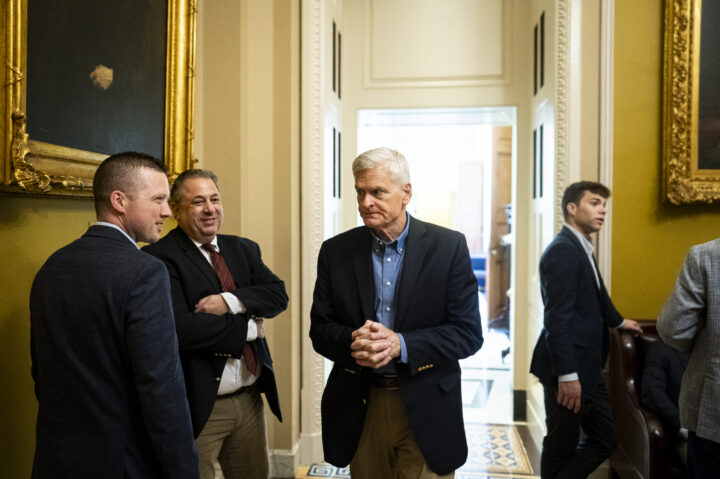
Photo by Al Drago/Getty Images)
Sen. Bill Cassidy (R-LA) departs a meeting with Senate Republicans in the U.S. Capitol on June 28, 2025 in Washington, DC.
Senate Majority Leader John Thune (R-SD) said that Israel’s right to self defense must be protected in U.S. talks with Iran, after administration officials publicly urged Israel to cease operations against Hezbollah as part of the recent memorandum of understanding — even though Israel, Hezbollah and Lebanon are not parties to that agreement.
Hezbollah has continued to attack Israel, killing Israeli soldiers last week.
“I just want to make sure that Israel is able to defend itself, and I think whatever happens as a result of these talks, that is something that needs to be maintained,” Thune said. “Hopefully the U.S.-Israeli relationship will remain such that we fully understand their need to be able to defend themselves, and right now on their northern border, they’re being attacked daily.”
Asked if he had received any word from the White House on when the administration plans to brief members of Congress, or even senior congressional leadership, on the MOU, Thune replied: “I haven’t. My assumption is because, again, all the briefers are over there [in Switzerland], but hopefully soon. We’ve asked for it, and hopefully we’ll get it.”
Senate lawmakers, including Thune, also expressed some reservations about the waiver lifting U.S. sanctions on Iranian oil sales, which was issued on Monday without any specific nuclear concessions by Iran.
Thune told reporters earlier Monday that he’d “like to see the lifting of sanctions connected to steps taken by the Iranians to shut down their nuclear program,” which he said he had not observed yet.
Sen. John Cornyn (R-TX), recently defeated in his primary election by a Trump-backed challenger, also objected to efforts to prevent Israeli operations against Hezbollah as part of the MOU.
“The whole idea that you would basically tell Israel it can’t defend itself from Hezbollah is to me a nonstarter,” Cornyn said. “The Iranians, if they were actually serious about a ceasefire and about a peace agreement, then they wouldn’t have insisted upon that in the MOU.”
The U.S. is set to host separate talks between Israel and Lebanon in Washington this week.
Asked if he thought it was a good idea to provide economic sanctions relief to Iran before a final deal is struck, the Texas senator expressed skepticism. “Not to me. This is the number one state-sponsor of terrorism. It’s just more money to fund their terror activities through their proxies and harass Israel,” he said.
Cornyn also expressed skepticism that the administration would give Congress the opportunity to review the MOU, describing it as “would be the last thing that they [the Trump administration] would do.”
“I think the president thinks he can do this on his own,” Cornyn said.
Cornyn said that “there [have] been a lot of robust discussions around” how Congress should respond if the Trump administration does not seek congressional approval on the current memorandum of understanding between the U.S. and Iran or the final deal reached through ongoing negotiations. “I don’t expect that to end,” he said of the talks on Capitol Hill.
Sen. James Lankford (R-OK) also expressed concern about the U.S. pushing for a permanent ceasefire in Lebanon as Hezbollah continues firing at Israel, which he said was placing the lives of the many Americans who live in the Jewish state at risk.
“I don’t understand how the issue with Lebanon actually affects what’s happening in the Strait of Hormuz. Those are two different issues, obviously. If Iran can’t stop attacking Israel, that’s a big issue. They continue to be able to drive weapon systems and people to go attack Israel,” Lankford told JI. “There are hundreds of thousands of Americans that also live in Israel, so it’s not just an issue of attacking Israelis, it’s also attacking Americans that live in Israel.”
Sen. Bill Cassidy (R-LA) called the sanctions relief “disappointing.”
“Iran has ended up stronger than they started. And we’ve achieved none of the objectives originally laid out,” Cassidy, who was also recently defeated by a Trump-backed challenger, said.
Sen. Ted Budd (R-NC) argued that the deal is performance-based so “they don’t get anything until they actually perform.”
Pressed on the fact that the sanctions had already been waived, Budd said, “If that helps to open the strait, that’s fine, but I am concerned what they use that money for — to support their terror proxies.”
Sen. John Kennedy (R-LA), who has argued in favor of the memorandum of understanding, said that he doesn’t want to “pick [the deal] apart” piece by piece, but instead wants to assess the net effects in 60 days. He argued that the deal was primarily a method to ensure oil flows were restored.
“I just don’t think it’s fair to take every little announcement and second guess it,” Kennedy said. “I’m very hopeful, but we’ll all know in 60 days.”
News of U.S. sanctions on Iran being lifted was also poorly received on the Democratic side of the aisle as well.
Sen. Chris Coons (D-DE) criticized the move as “such a terrible idea.”
“I don’t know if I could find a better example of unilateral disarmament. We are literally handing away what leverage we have over a regime that, if anything, is worse [than its predecessor],” Coons told JI. “Out of all the goals that Donald Trump said he had for this war: regime change, remember, ‘help is on the way’; ensuring they could never have a nuclear weapon, that’s still on hold; ending their ballistic missile program, he’s now saying, ‘Well, why shouldn’t they have ballistic missiles?’ I’m just shaking my head.”
The Senate is set to vote tomorrow on a procedural motion on an Iran war powers resolution passed by the House last month; whether the motion is approved will be largely contingent on attendance on both sides of the aisle.
Sen. Tim Kaine (D-VA), the lead sponsor of the only war powers resolution for which such a procedural motion has thus far been approved, did not tell reporters on Monday when he plans to bring up the next procedural vote to move that motion forward.
He said that “attendance generally is a factor on both sides of this.”
The Senate majority leader also said the deal triggers requirements for the administration to provide Congress with the opportunity to review the agreement under INARA

Kayla Bartkowski/Getty Images
Sen. Majority Leader John Thune (R-SD) calls on reporters following the weekly Senate Republican caucus policy luncheon at the U.S. Capitol on January 14, 2025 in Washington, DC. Senators spoke about the Laken Riley Act which was named after a nursing student who was murdered in February 2024 by Jose Ibarra, a migrant from Venezuela who crossed the border in September 2022, that could give state attorney generals far-reaching veto power over federal immigration policy.
With scant details provided by the Trump administration about the contours of the peace deal with Iran, Senate Majority Leader John Thune (R-SD) said on Monday afternoon that he doesn’t yet know enough about the administration’s deal with Iran to determine whether it is a good deal that will prevent Iran from acquiring a nuclear weapon.
“I don’t know enough about it to say,” Thune told reporters. “I think the issues are going to be compliance, and how you can enforce that, and what are the financial incentives that the Iranians have from our country, and what are they conditioned upon.”
The South Dakota Republican said that a positive deal would include financial incentives that are conditioned upon Iran winding down its nuclear program, the disposal of Iran’s enriched uranium and Tehran giving up its capacity to have a nuclear program in the future.
Thune also indicated that he believes the deal should be submitted to Congress for review under the Iran Nuclear Agreement Review Act.
“There are some requirements that are triggered because of the nuclear components of the deal, in terms of notification or informing Congress,” Thune said. “I know there is probably some expectation that there may be a vote at some point, whether that’s on a resolution of disapproval or something. We’ll see. I just don’t know enough about it yet. And I don’t think even the people who follow this stuff closely up here know that much.”
The administration hasn’t publicly commented on the issue of INARA yet, and has offered varying timelines for when it might release the text of the agreement. In media appearances, Vice President JD Vance has been framing specific nuclear issues as part of the next round of talks, rather than the current MOU, which could give the administration an avenue to attempt to dodge INARA review.
Thune said that “somebody” from the administration, whether that be Vance or other officials, “will need to” come to the Hill to brief members.
“For sure, our members are going to have a lot of questions about it,” Thune said.
Sen. John Barrasso (R-WY), the No. 2 Senate Republican, indicated he was similarly in the dark about the agreement.
“I haven’t seen anything from the president in terms of what’s in it. I’ve seen some press reports,” Barrasso told reporters. “I want to see what’s actually in it and I congratulate the president for his continued efforts.”
But asked whether he was concerned that the deal would be an effective surrender to Iran in providing sanctions relief, Barrasso rejected the idea out of hand.
“President Trump is never, ever going to do what you just suggested,” Barrasso said. “He’s not going to accept a deal that doesn’t eliminate nuclear weapons, isn’t enforceable, isn’t verifiable and doesn’t take Iran completely out of what they’ve been doing to try to undermine and attack us for the last 47 years.”
John Phelan was on Capitol Hill meeting with the leaders of the Armed Services Committee minutes before the Pentagon announced his dismissal on social media — a move that caught even Senate Majority Leader Thune off guard
Tasos Katopodis/Getty Images
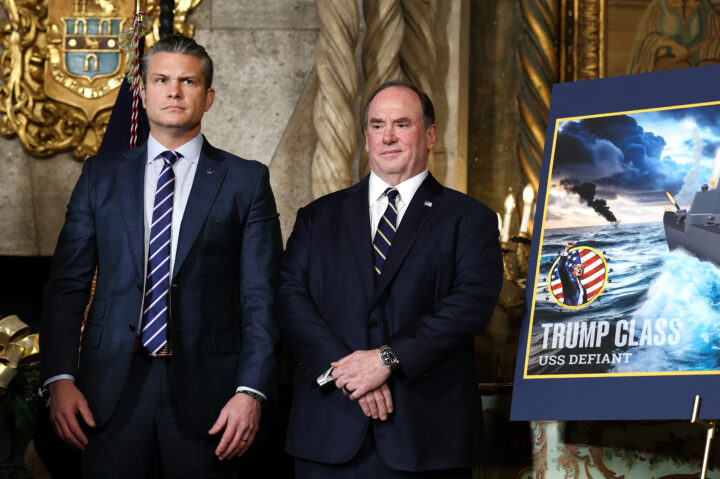
Secretary of War Pete Hegseth and Secretary of the Navy John Phelan stand together as U.S. President Donald Trump announced the creation of the “Trump-class” battleship during a statement to the media at Trump’s Mar-a-Lago estate on December 22, 2025 in Palm Beach, Florida.
Defense Secretary Pete Hegseth did not give advance notice to senior Republican senators before announcing on Wednesday that he was firing Navy Secretary John Phelan and had already tapped his replacement, causing surprise and confusion on Capitol Hill.
“I found out about it the way everybody else did,” Senate Majority Leader John Thune (R-SD) told Jewish Insider of the Pentagon’s announcement on social media of Phelan’s dismissal.
Reached for comment, the Pentagon referred JI to Pentagon spokesperson Sean Parnell’s statement on X — the first public announcement of the news.
“Secretary of the Navy John C. Phelan is departing the administration, effective immediately. On behalf of the Secretary of War and Deputy Secretary of War, we are grateful to Secretary Phelan for his service to the Department and the United States Navy,” Parnell said on X. “We wish him well in his future endeavors.”
After taking part in White House meetings earlier Wednesday, Phelan was on Capitol Hill in the afternoon for a pair of pre-scheduled meetings, the first with Sen. Roger Wicker (R-MS), the chairman of the Senate Armed Services Committee, and the second immediately after with Sen. Jack Reed (D-RI), the committee’s ranking member. Phelan’s departure was posted to the Pentagon’s social media pages minutes after Phelan walked out of Reed’s office, a source familiar with the matter told JI.
A GOP senator on the committee who spoke to Reed and Wicker after the Pentagon announced Phelan’s immediate dismissal told JI that the topic of Phelan’s future in his role did not come up in either meeting, and that none of the three men was expecting such a move.
“This was a total surprise to Senate Republican leadership, to the two leaders of the Armed Services Committee and, clearly, to the secretary of the Navy himself,” the senator said.
Senators on the committee privately expressed concern to JI over Phelan’s firing, which comes amid as the U.S. is maintaining a naval blockade of Iranian ports and has begun boarding Iranian-linked tankers around the world, with three U.S. aircraft carriers on station or en route to the Middle East.
“I mean, I’m sure there are going to be some questions asked about the reasons, etc.,” Thune told JI. “But hopefully the authorizing committee will get a briefing and be informed about some of these decisions.”
Prior to his role at the Defense Department, Phelan ran an investment firm and was a major fundraiser for President Donald Trump’s presidential campaign. Phelan and other administration officials had reportedly been clashing over how best to grow the U.S. shipbuilding industry, a longtime challenge, though Phelan has heralded his own close relationship with Trump.
Hegseth’s term has also been marked by ongoing friction with other senior officials in the department, including Army Secretary Daniel Driscoll, and the firings of multiple top officials. Hegseth fired Army chief of staff Gen. Randy George earlier in April.
Phelan is being replaced by Under Secretary of the Navy Hung Cao, a former House and Senate candidate in Virginia.
Majority Leader Thune said about a congressional vote to extend the war, ‘hopefully that question won't be a necessary one that we’ll have to answer’

Kayla Bartkowski/Getty Images
Sen. Majority Leader John Thune (R-SD) calls on reporters at the U.S. Capitol on January 14, 2025 in Washington, DC.
Senate Majority Leader John Thune (R-SD) said Tuesday that he’s hopeful that the war in Iran is close to winding down, in advance of a deadline that could require congressional action for the war to continue.
Under the War Powers Act, unilateral military action undertaken by the president without congressional authority is limited to 60 days — with a 30-day extension for draw-down purposes.
Thune emphasized that the administration’s current goal is to reopen the Strait of Hormuz, and that Senate Republicans support efforts to isolate the Iranian regime and their economy.
“We get the strait open again — and that’s sort of their last resort. The military effort here has been extraordinarily successful. This is sort of the last dying gasp of this regime, is to try and shut down the strait,” Thune said in a press conference after a GOP conference meeting. “The administration is making an effort to ensure that it’s open, that there’ll be traffic in and out there. And hopefully that will be successful and we can begin to see this thing wind down.”
Pressed on whether Republicans would be open to voting to continue the war if it extends beyond 90 days, Thune suggested that wouldn’t be necessary.
“At this point, most of us, I believe, feel pretty good about what the American military has achieved there in terms of its objectives,” Thune said. “It’s a hypothetical down the road. … I think the administration has a clear objective, a clear plan, and if they can execute on it, hopefully that question won’t be a necessary one that we’ll have to answer.”
Sen. Mike Rounds (R-SD) said that it’s “not quite time” yet for a full Senate discussion on the war, but said that he does want to see the administration more fully lay out its strategy and plan as the war continues and approaches the 60-day deadline at the end of April.
“We do expect that the administration will be laying out their plan for after the end of seven, eight, nine weeks,” Rounds said. “We have to know what the next steps are, and that’s part of our due diligence that we have to do.”
Sen. Steve Daines (R-MT) said that Republicans did not discuss the possibility of an authorization for the war during their meeting.
Other Republicans have argued that the provision of the War Powers Act that sets out the 60-day deadline, is not enforceable and that Republicans on Capitol Hill are not paying attention to it.
Sen. Lindsey Graham (R-SC) said that the U.S. should “finish the job” rather than extending a ceasefire agreement with Iran if the regime is not willing to agree to U.S. demands, including a permanent end to nuclear enrichment, surrendering all of its already enriched uranium, fully reopening the strait and abandoning its ballistic missile program and support for terrorism.
Senate Minority Leader Chuck Schumer (D-NY) said that Senate Democrats plan to bring forward another war powers resolution to stop the war on Wednesday, and will continue to force votes on similar resolutions weekly until the war ends. For now, most Republicans seem likely to continue to vote against the legislation.
Senate Republicans also indicated that they’re not likely to attempt to include supplemental funding for the Iran war in an upcoming partisan budget reconciliation package, which is focused on border security and immigration funding currently being blocked by Democrats.
Thune, who has said he wants an “anorexic-like” reconciliation package, again indicated on Tuesday at a press conference after a Senate Republican lunch meeting that the package will be tightly “focused” to fund immigration enforcement.
“I think we’re going to do a very skinny reconciliation,” Sen. Roger Wicker (R-MS), the chair of the Senate Armed Services Committee, said when asked about Republicans’ discussions on Iran during the conference meeting.
Sen. John Kennedy (R-LA) said that he has not heard anything about either the timing or the size of the supplemental request the administration plans to submit. Initial reports indicated that the Pentagon wanted to ask for $200 billion, but more recent reports have indicated that the final request will be lower.
Republicans have discussed advancing another reconciliation package before the end of the year, though some members of the conference, like Kennedy, have openly expressed skepticism that such an effort would be possible.
At this point, given the strong and widespread opposition among Democrats to the war in Iran, it’s unclear whether a funding package for the war would be able to clear the 60-vote filibuster threshold necessary for passage in the Senate.
Their letter promotes a broad approach to tackling threats to faith communities generally, rather than emphasizing legislation to combat antisemitism specifically

U.S. Senate
Sens. Jacky Rosen (D-NV) and James Lankford (R-OK)
Sens. James Lankford (R-OK) and Jacky Rosen (D-NV) urged Senate Majority Leader John Thune (R-SD) and Minority Leader Chuck Schumer (D-NY) on Tuesday to move quickly to advance a legislative package that would address rising antisemitism and religious hate generally — something Congress has repeatedly struggled and failed to do since the Oct. 7, 2023, Hamas attacks on Israel and the ensuing war in Gaza.
In a letter to the Senate leaders, Lankford and Rosen, who co-chair the chamber’s antisemitism task force, called for a bipartisan legislative package including funding increases for security assistance to religious institutions and improved training, prevention and prosecution efforts. The letter comes days after an arson attack at the largest synagogue in Mississippi, which is mentioned in the letter.
The letter does not mention high-profile bills addressing antisemitism specifically — such as the Antisemitism Awareness Act — which have previously proven difficult to pass amid growing objections on both sides of the aisle. The letter takes a broader approach, focusing on faith communities generally and the attacks that both Jewish and non-Jewish religious institutions have faced.
“As Senators committed to safeguarding Americans’ fundamental freedom to worship without fear, we write to express deep concern about the rising tide of violence, intimidation, and vandalism targeting faith-based institutions across our country,” Lankford and Rosen wrote. “As we begin the new year, threats to churches, synagogues, mosques, gurdwaras, temples, and schools have not abated. That is why we believe Congress must act swiftly to protect houses of worship, faith-based schools, and the communities they serve.”
The letter calls for legislation to increase funding for the Nonprofit Security Grant Program and to make sure funds are disbursed quickly; to clarify eligible uses for grant funding to include security contractors, physical security measures, emergency communication tools and security cameras; and to direct the administration to process NSGP applications quickly and provide free technical assistance to institutions applying for grants.
These calls follow and come in response to a year of delays and frustration with NSGP implementation by the administration. Grants for 2025 still have not been awarded or disbursed and the timeline for doing so remains unclear, with lawmakers saying they’ve been left in the dark by the administration.
Lankford and Rosen also called for the proposed legislative package to direct federal law enforcement to improve information sharing with religious community security groups, including implementing channels for the government to quickly share threat information and for religious communities to report suspicious activity, as well as to fund “scalable training” for community professionals and volunteers.
They said the Senate should pass the Pray Safe Act — the only specific pending legislation mentioned within the letter. The bipartisan and largely noncontroversial bill, which has nonetheless languished for multiple congressional sessions, would create a federal database on security best practices, training information and potential federal funding opportunities.
And they urged the Senate to provide additional resources to prosecute violence and property crimes against religious communities, to improve federal coordination with state and local law enforcement and to improve data collection and sharing on such incidents.
Emphasizing the urgency to protect impacted communities, the lawmakers said that they are “prepared to work” with the Senate leaders’ teams “immediately to translate the items above into text that can move quickly.”
They also said that they want to see the package include “near-term funding and implementation directives” in addition to any longer-term policy and programmatic changes.
“This package of priorities reflects our shared obligation — rooted in the First Amendment and our national character — to ensure that Americans can pray, learn, celebrate, and mourn in safety,” the lawmakers said. “We also recognize that the federal government cannot substitute for local leadership, nor for the resilience and vigilance of faith communities themselves. But Congress can and should ensure that federal resources are timely, accessible, and proportional to risk, and that our national security enterprise treats attacks on houses of worship with the seriousness they warrant.”
A Lankford spokesperson praised Thune’s engagement on the issue. Before taking office as the Senate majority leader, Thune pledged to take action on antisemitism, though efforts to advance the Antisemitism Awareness Act stalled last year.
“The Senate, under Sen. Thune’s leadership, has been clear about the seriousness of the violence and intimidation facing Jewish Americans and other faith communities,” the Lankford spokesperson told Jewish Insider. “Sen. Lankford appreciates Leader Thune’s engagement on combatting antisemitism and ensuring Americans can worship without fear.”
Johnson, on right-wing antisemitism: ‘Whether it’s Tucker or anybody else, I don’t think we should be giving a platform to that kind of speech’
Andrew Harnik/Getty Images
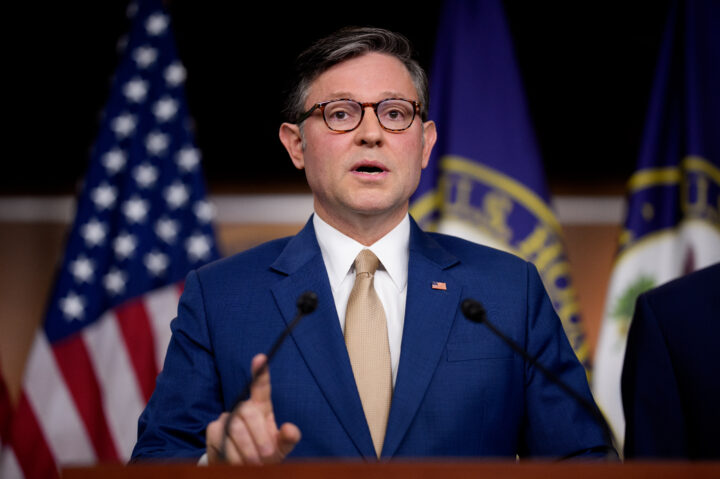
Speaker of the House Mike Johnson (R-LA) speaks during a news conference on Capitol Hill on October 20, 2025 in Washington, DC.
House Speaker Mike Johnson (R-LA) criticized Tucker Carlson’s platforming of neo-Nazi influencer Nick Fuentes, adding his voice to the growing list of Republicans who have publicly admonished the former Fox host for mainstreaming the avowed antisemite.
The House speaker made the comments on Tuesday when asked in the Capitol if Carlson should still have a place in the conservative movement given his embrace of antisemitic figures like Fuentes. Johnson criticized what he described as Fuentes’ “anti-Christian” and “antisemitic” views and said conservatives have an obligation to call out antisemitism “wherever it is.”
“Look, I heard a compilation of some of the worst things that Nick Fuentes has said. It’s absolutely outrageous,” Johnson told National Review’s Audrey Fahlberg. “Some of the things he’s said are just blatantly antisemitic, racist and anti-American. Anti-Christian, for that matter. I think we have to call out antisemitism wherever it is.”
“Whether it’s Tucker or anybody else, I don’t think we should be giving a platform to that kind of speech. He has a First Amendment right, but we shouldn’t ever amplify it. That’s my view,” Johnson added.
Asked later Tuesday if Carlson’s views and voice belong in the conservative movement, Senate Majority Leader John Thune (R-SD) did not directly reject Carlson but said that the party should have no space for antisemitism.
“Well, there are lots of voices, obviously, out there, but I don’t think there ought to be any — there just should be no room at all whatsoever for antisemitism or other forms of discrimination. That’s certainly not what our party is about,” Thune said.
“Our party is a party that welcomes all comers,” he added. “We want to stand up for and on behalf of the American people who work hard every day to make a living and just want a government that works for them, hopefully at the lowest possible cost and in a way that enables them to go about their lives and provide for them and their families.”
The endorsement announcement comes days after Ernst confirmed that she wouldn’t seek a third term in the Senate, which was followed by Hinson’s quick entry into the campaign hours later

Scott Olson/Getty Images
U.S. Rep. Ashley Hinson speaks to guests during her Ashley's BBQ Bash fundraiser on August 23, 2025 in Cedar Rapids, Iowa. The event was the fifth annual, which she holds to support Iowa Republican causes and candidates.
Senate Majority Leader John Thune (R-SD) and Sen. Tim Scott (R-SC), the chairman of the National Republican Senatorial Committee, endorsed Rep. Ashley Hinson (R-IA) on Friday in her bid to succeed retiring Sen. Joni Ernst (R-IA) next year.
The endorsement announcement comes days after Ernst confirmed that she won’t seek a third term in the Senate, which was followed by Hinson’s entry into the campaign hours later.
“We need conservative fighters in the Senate — and that’s exactly what we’ll get with Ashley Hinson,” Thune said in a statement. “Ashley has been a fierce advocate of President Trump’s America First agenda and has been instrumental in delivering big wins in the House for Iowans and the American people. I know that she’ll bring with her to the Senate that same unrelenting energy. Ashley has my full support and endorsement.”
Scott’s statement noted his time traveling across the Hawkeye State with Hinson in 2022, as the South Carolina senator was mounting his 2024 presidential bid, and expressed confidence Iowa voters would rally around her candidacy.
“Having traveled Iowa with Ashley, I know she is the fighter the Hawkeye State needs to deliver President Trump’s agenda in 2026 and beyond,” Scott said. “Iowans are all-in for Ashley Hinson, and that’s why the NRSC and I are proud to stand with my friend, a proven conservative and staunch Trump ally.”
Hinson, a former local news anchor and state representative elected to Congress in 2020, has been working to consolidate support among the GOP primary electorate to fend off competitive challengers. She was also endorsed this week by Sens. Jim Banks (R-IN), Katie Britt (R-AL) and Markwayne Mullin (R-OK), as well as House Majority Leader Steve Scalise (R-LA), House Majority Whip Tom Emmer (R-MN) and Reps. Zach Nunn (R-IA) and Elise Stefanik (R-NY). Nunn was considered a possible candidate to replace Ernst prior to endorsing Hinson.
Neither Ernst nor President Donald Trump have endorsed a candidate in the contest.
Thus far in the race, Hinson is facing Jim Carlin, a Republican former state senator who initially entered the contest to challenge Ernst from the right after delivering a 27% showing in his primary against Sen. Chuck Grassley (R-IA) in 2022, and Joshua Smith, a former libertarian and podcast host with a record as a critic of the U.S.-Israel relationship and Zionism.
Smith has also espoused virulently anti-Israel beliefs on his X account, posting in March of this year that Israel is a “fake state of anti Jesus heathens who are fine with killing children” and claiming in a post last May that Jewish people suffer from a “Jewish victim complex.”
Please log in if you already have a subscription, or subscribe to access the latest updates.
 Continue with Google

 Continue with Apple