














































































The group’s open letter calls on political leaders to confront hate within their own coalitions and reject anti-Jewish litmus tests tied to Israel
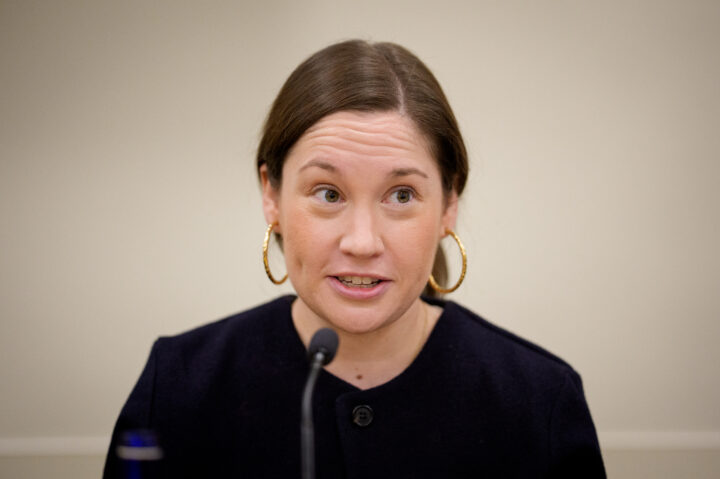
Andrew Harnik/Getty Images
Jewish Council for Public Affairs CEO Amy Spitalnick speaks at an event held by Jewish and Muslim leaders on Capitol Hill on December 16, 2025 in Washington, DC.


 Add JewishInsider on Google
The Jewish Council for Public Affairs called on Democratic and Republican candidates on Thursday to reject antisemitism and political violence, including within their own political coalitions, ahead of November’s midterm elections, warning that conspiracy theories about Jewish influence and efforts to exclude Jews from public life have become increasingly normalized.
In an open letter, the group urged candidates to condemn harassment and intimidation, reject conspiracy theories about Jewish control of government and elections and make clear that those promoting such views have no place in their political coalitions.
JCPA CEO Amy Spitalnick said antisemitism has become normalized in American politics, “with Jews too often treated as political footballs” amid increasing hate and violence. She said leaders in both parties have a responsibility to reject rhetoric and conspiracy theories that can fuel attacks against Jewish communities.
The letter emphasized that criticism of Israel, AIPAC and U.S. aid to Israel is not inherently antisemitic, but warned against holding Jewish Americans responsible for Israeli government policies or invoking conspiracy theories about Jewish money and power. It also criticized political litmus tests that exclude Jews over their connections to Israel and efforts to divide the community into “Good Jew” and “Bad Jew” camps.
While affirming the right to protest, JCPA warned that chanting “globalize the intifada” outside a synagogue or celebrating Hamas could constitute intimidation when directed at Jewish communities rather than policymakers. The letter also urged candidates to reject Nazi symbols, threats and harassment, regardless of the political cause behind them.
JCPA cited as one example Florida Republican state House nominee Marshall Rawson, whose attendance at the 2017 white supremacist rally in Charlottesville, Va., has not largely been condemned by fellow Republicans. The organization also raised concerns about antisemitic tropes and efforts to exclude Jews from political spaces on the left amid debates over Israel and pro-Israel organizations.
The letter cited the firebombing of Pennsylvania Gov. Josh Shapiro’s home and attacks at the Capital Jewish Museum, in Boulder, Colo., and at a Michigan synagogue as examples of violence targeting Jewish communities. JCPA argued that protecting Jewish Americans is inseparable from protecting other minority communities and democratic institutions, calling on political leaders to apply the same standards regardless of party.
The chair of the Jewish caucus said the 2026 convention was ‘night and day’ compared to last year's, when Jewish delegates reported being harassed on the floor

Getty Images
Notebook with a pen on a table in a classroom at a school
Major Jewish organizations expressed “reason for optimism” that the National Education Association, the nation’s largest teachers union, is taking meaningful steps to address rising antisemitism following its annual Representative Assembly, which concluded in Denver on Tuesday.
The organizations credited NEA’s Jewish Affairs Caucus (JAC) with pushing through three amendments to the NEA Constitution and a resolution on Jewish education at this year’s RA.
The Jewish Council for Public Affairs said in a statement that it “welcomed the implementation of new rules and policies that better protected the safety and First Amendment rights of Jewish and all members during the National Education Association’s annual meeting.” JCPA said it worked with the JAC to lobby the NEA for the rule changes.
The Jewish groups noted a safer and more inclusive environment for Jewish members at this year’s gathering, marking a stark contrast from last year, when delegates voted to boycott Anti-Defamation League materials in a measure Jewish groups condemned as antisemitic, among other disruptive events. The changes also come following the Equal Employment Opportunity Commission opening an investigation into NEA in June over alleged failure to address antisemitism.
“We commend the important steps the NEA took to foster a more inclusive Representative Assembly this year. Those efforts reflect the union’s stated commitment to the core values of solidarity and belonging for all,” the ADL, American Jewish Committee, Conference of Presidents of Major American Jewish Organizations, Hadassah and StandWithUs said Wednesday in a joint statement.
Ahead of the gathering, aiming to avoid the misconduct seen at the 2025 RA, the NEA adopted several new rules, including stricter conduct enforcement for delegates, electronic voting to prevent shouting on the floor, de-escalation training for staff and regular public reminders of assembly rules.
The 2026 RA — attended by some 6,000 educators — was “night and day” compared to last year’s, the chair of the JAC, Alyson Brauning, told Jewish Insider, recalling that she called security at last year’s convention when some Jewish delegates were allegedly being harassed by other attendees.
After last year’s controversies, Brauning said she spent “six months working with NEA [leadership] on delegate safety and participation protections.”
“The reality was that NEA came through. Building relationships is, to me, the absolute key to making sure we as Jewish delegates can, and did, participate fully at RAs … and I believe our relationships we were able to build with Jewish organizations and the support that they were able to give us is also extremely important,” she continued.
Out of 88 business items for the convention, Brauning viewed two as potentially concerning to Jewish educators, but said this marked an improvement over years past.
“Did they write some things that I as a Jewish person know their intent was probably antisemitic? Sure. Does the body understand that? Probably not. They didn’t outright say [anything antisemitic] which is a win because in the past they would literally say it,” she said.
One of those items mentioned war and genocide — “I’m sure that was about the genocide that they think was in [Gaza], but that’s up to the interpretation of all 6,000 delegates. That one was completely defeated on the floor,” she said.
A second business item called for NEA to add resources on its website including some from Jewish Voice for Peace. “[The majority] of the delegates had no idea who JVP is,” said Brauning. “It was referred to the executive committee because NEA has a policy that they must vet any curriculum before they can use it or recommend it as a resource. That gives us the opportunity to write to NEA and explain why it might be harmful or anti-Jewish hate.
The convention was held one month before a leadership change at JAC, a caucus established five decades ago as a social group that began taking on advocacy work following Oct. 7. Naomi Rodriguez, a Pennsylvania math teacher and first-time delegate who helped organize this year’s RA, will succeed Brauning as the caucus’ chair.
“Going into it, I was intimidated,” Rodriguez told JI of the convention. “I didn’t know how I would be received. Many issues are important to me but I came to this RA with an agenda, to protect Jewish students and teachers. I found myself speaking up about that a lot. It was the most amazing and heartwarming experience. I received so much support from my own state caucus. I felt so loved.
“Our union is simply a reflection of society. Whatever problems we’re having in society, you’re going to see in our union, too, because there are so many members and our union is a place where people exchange ideas,” she continued.
Among the most helpful new policies, Rodriguez said, was the implementation of clickers to vote. “One of the problems last year was voting was done standing up and down or holding a card in the air so everyone in your caucus could see how you vote, so sometimes you could get pushback from the people you’re working with. We could vote more confidentially with the clickers — that made a huge difference,” she said.
Although Rodriguez declined to share the specifics of the three new amendments JAC helped pass, she said the purpose of each “was to ensure that the values of our union are accurately reflected in NEA’s governing documents. The amendments included language to address discrimination and ensure equal participation access for all member communities.”
Jay Goldfischer, a teacher in Los Angeles County who has been an NEA member for 26 years, told JI that it was “overall a very positive and effective RA for Jewish teachers,” where “allies from across America stood up with the Jewish community on the floor of the RA when it counted.”
Though Goldfischer applauded the new guidelines, he noted that the improvements could have also stemmed from the majority of delegates growing “tired of the divisive and distracting issues related to Israel and things unrelated to education.”
Alongside JAC, several Jewish leaders pushed for NEA to adopt new guidelines after last year’s RA.
“Everything we’ve heard from Jewish delegates and educators has been reflective of them feeling that this was a safer and more inclusive convention and that these rules had an impact,” said JCPA CEO Amy Spitalnick, who led a presentation titled “How Educators Can Confront Antisemitism & Hate and Defend Democracy” at the convening.
“There is obviously a lot more to do,” she told JI. “We’ll continue to work with NEA on workshops, programs and trainings to address antisemitism and ensure the union and our schools are as inclusive and safe as possible. But this is definitely an important step in the right direction.”
To support JAC, the ADL and Conference of Presidents also deployed representatives to be on the ground at this year’s convention.
“I was so proud to see Naomi [Rodriguez] use her voice and play such a critical role in shaping a very different narrative at this year’s RA,” Sara Colb, ADL’s director of advocacy, told JI. “Empowering Naomi and teachers like her was ADL’s very purpose for doing this work. Watching these teachers advocate for themselves, their students and the Jewish community is truly inspiring.”
“We started working with JAC after last year to help make [the RA] better for the year ahead,” Stephanie Hausner, chief operating officer of the Conference of Presidents, who attended for the first time on behalf of the organization, told JI.
“Some of that included rules changes, multiple organizations talking to the NEA about helping the tenor of the conference. For sure there was more security [this year]. The overall vibe of the conference was much calmer than we heard from last year. Jewish delegates weren’t afraid to be present and speak, which was also an improvement. They were able to get a lot done.”
Hausner continued, “Some of the resolutions that were put forward that would have done harm to the Jewish community didn’t pass, which says a lot about the body as a whole.”
The focus this year, said Hausner, was “on education and issues of importance for teachers.”
The resolution also criticizes Paul Ingrassia, a Trump administration official who said in a group chat that he has a ‘Nazi streak’
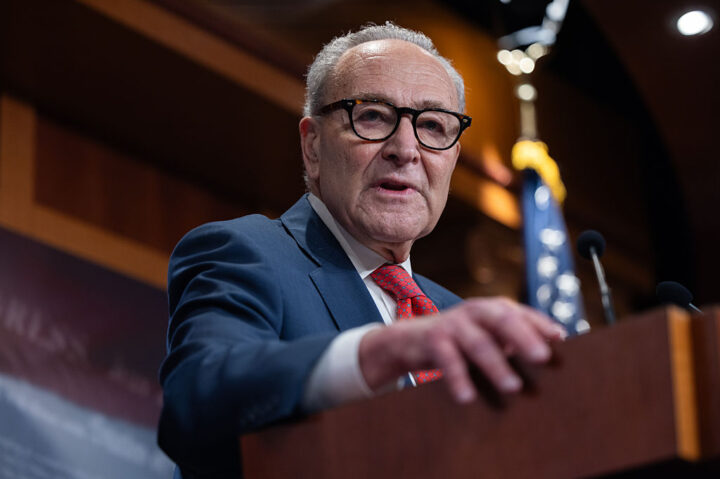
Nathan Posner/Anadolu via Getty Images
Senate Minority Leader Chuck Schumer (D-NY) speaks at a press conference following recent elections as the government shutdown continues in Washington, DC on November 5, 2025.
Senate Minority Leader Chuck Schumer (D-NY) and nearly all Senate Democrats are set to introduce a resolution on Monday condemning neo-Nazi influencer Nick Fuentes, Tucker Carlson for hosting Fuentes on his show.
The legislation also highlights that Heritage Foundation President Kevin Roberts defended Carlson and Fuentes and notes that the Trump administration nominated an official who expressed affinity for the Nazis, referring to Paul Ingrassia.
The resolution comes weeks after Carlson’s friendly sit-down with Fuentes prompted a reckoning in the conservative movement over antisemitism on the far right and its normalization in certain circles. Schumer reportedly sought Republican backing for the resolution, but no Republicans have signed on at this point.
The resolution outlines Fuentes’ long history of overt antisemitic activity, as well as the series of antisemitic comments that Fuentes repeated on Carlson’s podcast. It highlights Carlson’s failure to “push back on or reject the claims made by Fuentes” and that Carlson “at times even validat[ed] his framing.” It also notes that Carlson was a keynote speaker at the 2024 Republican National Convention.
The legislation states that the Senate “strongly rejects the views of and platforming of Nick Fuentes” and “condemns the effort by Tucker Carlson to platform and mainstream Nick Fuentes.”
The resolution also specifically highlights that Roberts posted a video defending Carlson and attacking those criticizing him — accusing Roberts of employing “antisemitic dog whistles” — as well as for refusing to take down the video even as he as apologized for portions of it.
It calls on “all elected officials, thought leaders and community leaders to reject and condemn white supremacy and antisemitism whenever and wherever they occur.”
And it highlights that President Donald Trump nominated Paul Ingrassia — who said in an unearthed group chat that he has a “Nazi streak in me from time to time” — for an administration post and has since named him to a different role in the administration after his nomination was withdrawn. The resolution does not specifically name Ingrassia.
The resolution is being sponsored by every Senate Democrat.
The legislation has been supported by a series of Democratic-affiliated and progressive-minded Jewish groups, including Democratic Majority for Israel, the Jewish Council for Public Affairs, the Jewish Democratic Council of America, Jewish Women International, the Union for Reform Judaism, Hadassah and the National Council of Jewish Women.
“The platforming of individuals who promote hateful, antisemitic, and white supremacist rhetoric is dangerous and entirely at odds with American values,” JWI CEO Meredith Jacobs said in a statement. She said that Congress “must forcefully condemn any attempt to mainstream antisemitism” and other hatred and “the fact that such condemnation is not universal underscores the very real and present danger that these ideologies are gaining ground in our society.”
JCPA CEO Amy Spitalnick said that antisemitic and white supremacist extremism “threatens every single one of our communities and the core of our democracy – yet we’ve seen political leaders continue to embrace and platform this deadly hate and those who peddle it, like Nick Fuentes” and urged all senators to support the resolution.
DMFI urged the Senate to “send a powerful message that there is no place for these hateful ideologies in our society by passing this measure.”
Halie Soifer, the CEO of JDCA, condemned Republicans for not signing onto the resolution.
“This issue should not be partisan, yet not one Republican has joined this resolution, and the President of the United States has refused to condemn Fuentes, Tucker Carlson’s platforming of Fuentes, and the hate they’ve espoused,” Soifer said in a statement. “We’re deeply concerned about Republicans placing politics above efforts like this one to combat white nationalism, antisemitism, and hate, and strongly encourage them to join this effort.”
UPDATE: This article was updated to reflect that the legislation’s findings highlight Heritage Foundation president Kevin Roberts’s defense of Carlson and Fuentes but the resolution does not specifically condemn him.
To mark the second anniversary of the Oct. 7 attacks in Israel, the Jewish Insider team asked leading thinkers and practitioners to reflect on how that day has changed the world. Here, we look at how Oct. 7 changed Jewish advocacy
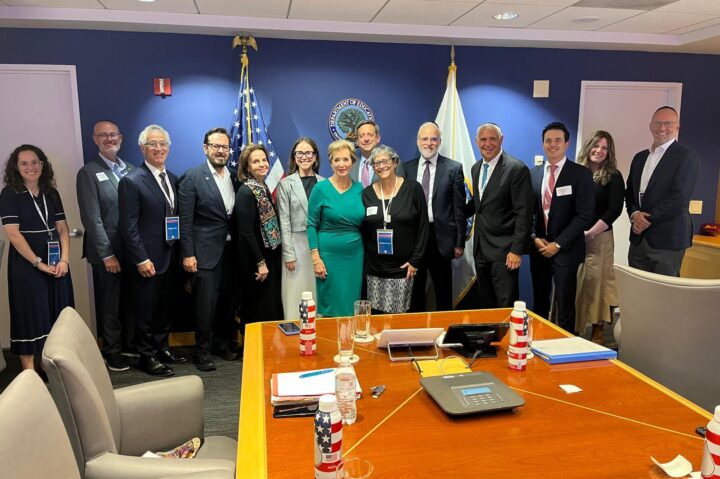
Courtesy Orthodox Union
Members of the Orthodox Union Advocacy Center met with Education Secretary Linda McMahon on Wednesday to discuss federal efforts to counter antisemitism and new legislation promoting school choice, Sept. 17th, 2025
The groups emphasized that deportations carried out under the executive order must be consistent with the First Amendment and existing laws

Selcuk Acar/Anadolu via Getty Images
Students at Columbia University have a demonstration near Gaza Solidarity Encampment on April 25, 2024 in New York City.
Several major Jewish organizations welcomed President Donald Trump’s executive order on Wednesday calling on every federal agency and department to review and report on civil and criminal actions available within their jurisdiction to fight antisemitism.
Some groups also expressed caution that deportations carried out under the executive order could conflict with the First Amendment.
Under the executive order, the Department of Justice is directed to review existing antisemitism cases and prepare to more actively bring legal action against those who commit acts of antisemitism in violation of federal civil rights laws. The Department of Education is directed to conduct a thorough review of pending Title VI complaints and investigations.
The order also “demands the removal of resident aliens who violate our laws,” according to a White House fact sheet.
The executive order expands on a 2019 executive order combating antisemitism issued during the first Trump administration, which said that federal agencies must utilize the International Holocaust Remembrance Alliance’s working definition of antisemitism when investigating Title VI civil rights violations.
Amid soaring antisemitism in the U.S. since the Oct. 7, 2023, Hamas attacks on Israel, Michael Masters, CEO of the Secure Community Network, called for “every lawful tool [to] be at the disposal of our federal law enforcement and public safety partners to be able to mitigate threats and stop violence against Jews before it happens.”
“Violent criminals who attack Jews or provide material support to designated terrorist organizations like Hamas, ISIS, or Iran and its proxies should not find safe harbor on American soil,” Masters told Jewish Insider. “Those criminals should be prosecuted in full accordance with the law; people must understand that America does not and will not stand for religious hate crimes against Jews or any religious group, nor will it —– or the people who foment it —– be tolerated.”
Nathan Diament, executive director of the Orthodox Union Advocacy Center, told JI that the group “applauds President Trump’s EO on additional steps to combat antisemitism.”
“The American Jewish community, sadly, has endured an unprecedented assault upon our religious freedoms, and it requires an unprecedented response by those charged with protecting us as citizens,” Diament said.
Jonathan Greenblatt, CEO of the Anti-Defamation League, said in a statement that “combating antisemitism requires a whole-of-government approach, and we are eager to see every federal agency and department take concrete measures to address this scourge.”
“We welcome this effort by President Trump to put the full force of the federal government against rising antisemitism in our country,” Greenblatt said, adding that since Trump returned to the White House last week, “the increased enforcement of university policies already has started to make a significant difference in the campus environment — and more should be done.”
“We hope that holding perpetrators accountable to the fullest extent of the law — including, where applicable, violations of one’s visa conditions — will have a similar effect,” Greenblatt said.
Greenblatt noted that while the ADL applauds “strong action and severe consequences for those who commit violent crimes or otherwise break the law,” he called for “any immigration-related ramifications” to be “consistent with due process and existing federal statutes and regulations.”
“They also should not be used to target individuals for their constitutionally protected speech,” Greenblatt said.
The American Jewish Committee welcomed the order. “We endorse without hesitation the instruction to identify statutes to prevent discrimination against Jews, and the call to apply existing laws to address civil rights violations relating to antisemitism in the aftermath of the October 7, 2023, Hamas terror attack against Israel,” a statement from AJC read. “With that said, it is vital that other provisions in the Executive Order which have the potential to be broadly interpreted to threaten certain ethnic and religious groups be implemented with strict adherence to existing law.”
The Nexus Task Force, which pushes for a definition of antisemitism favored by progressives as an alternative to the widely embraced IHRA definition, condemned the new executive order, arguing that it does violate free speech. “The order cynically weaponizes legitimate concerns about Jewish safety to suppress constitutionally protected speech and threatens vulnerable student populations,” Jonathan Jacoby, the group’s national director, said in a statement.
Amy Spitalnick, CEO of the Jewish Council for Public Affairs, said in a statement that the executive order left “many unanswered questions.”
These include, according to Spitalnick, “how it will actually be applied; how it intersects with and could undermine civil liberties; how the federal government will actually enforce hate crimes laws, given the freeze on civil rights cases and other disturbing steps taken over the past week; and more. Everyone in the United States has basic due process rights, and when we start applying them selectively we don’t only threaten our values – we ultimately threaten our safety too.”
Another leading Jewish group, the Jewish Federations of North America, told JI it would need time to review the executive order before commenting.
Please log in if you already have a subscription, or subscribe to access the latest updates.
 Continue with Google

 Continue with Apple