














































































The Maryland Democrat campaigned alongside Abdul El-Sayed this week, while withholding criticism of antisemitic streamer Hasan Piker
Tom Williams/CQ-Roll Call, Inc via Getty Images
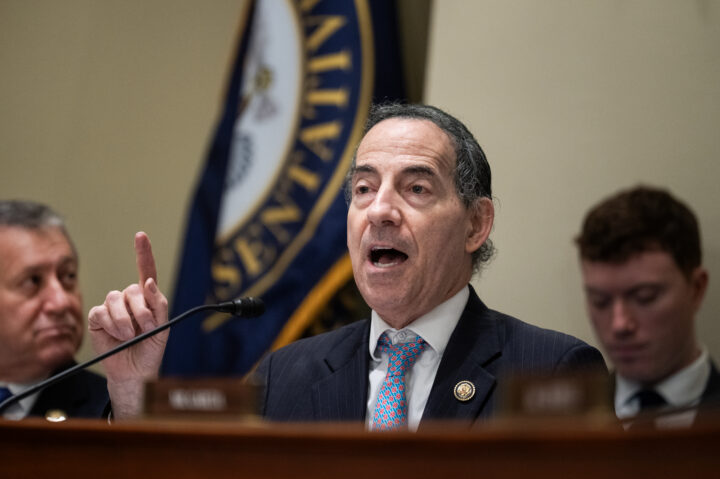
Rep. Jamie Raskin (D-MD) speaks during the House Administration Committee hearing on June 10, 2026.


 Add JewishInsider on Google
For years, Rep. Jamie Raskin (D-MD) has been viewed by his Jewish constituents as an ally in fighting antisemitism and as generally supportive of Israel, despite his deep disagreements with the Netanyahu government and current U.S. policy in the Middle East.
The congressman has maintained a good relationship with many of the Jewish constituents in his suburban Washington district with the largest share of Jewish voters in Maryland, even as he’s backed numerous measures restricting U.S. aid to Israel, which has drawn backlash from prominent Jewish community figures.
But a recent broadside against the Trump administration’s investigations into antisemitism, in which Raskin cited whistleblower reports to describe the investigations into Harvard, Brown and Columbia universities as fabricated and predetermined, is generating new tensions with some community members.
Raskin also spent Wednesday on the campaign trail boosting Michigan Senate nominee Abdul El-Sayed, whose virulent anti-Israel views and associations with an antisemitic streamer have made him persona non grata throughout much of Michigan’s Jewish community.
Rabbi Stuart Weinblatt, the CEO of the Zionist Rabbinic Coalition who leads a synagogue in Raskin’s district, said that the letter from Raskin regarding his investigation into the campus antisemitism efforts was “disappointing” in light of the extent of intimidation targeting Jewish students on campus. Weinblatt said he saw the administration’s policies as a good-faith effort to support Jewish students and disrupt those who have isolated and harassed them.
He said he’s concerned that Raskin’s letter could undermine both the federal tools to protect students as well as lead some people to believe that the problem of campus antisemitism was overstated.
“We have an administration that wants to try to do something, to help protect and defend Jewish students, to help to make them feel safer and more secure,” Weinblatt said. “It would be unfortunate and tragic to be limiting their ability to be able to do that.”
He said that, if Raskin believes — as he said he does — that campus antisemitism is a serious problem to be addressed, he should articulate how that should be done in lieu of the Trump administration-led probes.
“Congressman Raskin has a history of being committed to pursuing issues related to justice and fairness, and so I think it’s unfortunate that he — as a member of Congress who is identifiably Jewish — is taking this action, because I think many Jews are concerned about the environment on college campuses and would look to our Jewish members of Congress to help,” Weinblatt continued.
But, he acknowledged, any action should be taken in a way that is legal, appropriate and measured, and should be done in accordance with the applicable laws.
Some federal courts have also raised objections to the administration’s efforts, finding that the funding cuts targeting Harvard were unconstitutional and that the administration had overstated its case against the university.
In a lengthy statement to Jewish Insider, Raskin emphasized that antisemitism on campus is a real problem that schools must address. But he said that the government levying unjustified penalties helps no one.
“Universities have a duty, under federal law, to prevent and address harassment and discrimination on their campuses and they should be held to account if and when they fail to do so,” Raskin said. “But when the government ignores the actual facts found by its investigators and resorts instead to levying major financial penalties on our universities despite the facts and the law, everyone loses, especially the actual victims of antisemitism and racism.”
He said that the government cannot legally penalize chosen targets without or in spite of an investigation “no matter how just may be its stated cause.”
“Throughout history, Jews have often suffered as the designated scapegoats of these perverted forms of justice,” he continued.
The Washington Jewish Week called Raskin’s efforts wrongheaded, arguing in an editorial published Thursday that the congressman is “making a mistake” by focusing on re-investigating the investigations, rather than trying to address the antisemitism itself.
“Raskin instead describes the administration’s investigations as ‘fake,’ a ‘pre-baked frame-up operation’ and a ‘sham,’” the editorial continues. “Those are sweeping conclusions to announce before conducting an investigation supposedly intended to determine what happened. … The House Judiciary Committee should be strengthening [the civil rights investigatory] system, not conducting another round of political theater about who weaponized government first.”
The editorial argues that Raskin should be putting his energy toward “showing America how to address [campus antisemitism] properly.”
Raskin previously criticized the administration’s efforts to shutter parts of the Department of Education’s Office for Civil Rights, a move he said endangered efforts to fight antisemitism, among other forms of discrimination.
Raskin, citing the whistleblower testimony, said in his statement to JI that the administration had “used fabricated and disproven claims of antisemitic discrimination as a cudgel, even in cases where the targeted school’s own Jewish students, faculty, and rabbis applauded and praised the university’s positive and proactive responses to incidents of antisemitism or intolerance” and “ignored Jewish voices and the on-the-ground facts found by investigators.”
He said that in doing so, the administration, rather than his probe, undermined legitimate efforts to combat antisemitism and sent a public message that the problem of campus antisemitism is not a real one.
“If we lose public confidence in the integrity of government investigations and the government’s respect for the facts, we will lose the effectiveness of our anti-discrimination laws,” Raskin said. “This is why everyone, but especially the actual victims of antisemitism and racism, have every reason to stand by the rule of law and the central importance it places on actual facts rather than allegations and suppositions.”
Ron Halber, the CEO of the Jewish Community Relations Council of Greater Washington, took a more sympathetic view of Raskin’s efforts, even while underscoring that colleges and universities have failed to protect Jewish and pro-Israel students and that he’s glad that they are being investigated and held accountable.
But he also expressed concerns about some of the penalties the Trump administration imposed, particularly stripping funding from the schools, and said that if Raskin has evidence that the cases were pre-determined, those issues should be investigated.
“If there are cases where nothing was found and the universities were punished, first of all, it’s illegal, it’s unethical and Jews do not want antisemitism being used as a weapon to further other political goals. We want open, objective investigations,” Halber said. “If a university did not act properly and protect their Jewish students, we want them to be held accountable and punished accordingly.”
He said that if some of the investigations do prove to have been faulty, that would also cast doubt on other investigations that may have found more credible evidence. “It doesn’t help us get to the bottom of [the campus anti-Israel protests and administration responses] if the investigations themselves are flawed.”
Kenneth Marcus, the CEO of the Brandeis Center for Human Rights Under Law, which has represented Jewish students in legal action against various colleges and universities, dismissed the Raskin letter as the result of a disgruntled former Department of Justice employee, who filed a whistleblower complaint because she did not align with the administration’s efforts to combat antisemitism.
“It is no secret that the career ranks of the Justice Department contains some long-time employees who do not share the current administration’s values or priorities. The federal government has a legal obligation to enforce Title VI to protect Jewish students as vigorously as it does with other groups,” Marcus said. “After years of paying insufficient attention to anti-Semitism, it is a welcome relief that the Justice Department has finally made it a priority.”
He argued that the administration’s investigations were evidently necessary, as well as overdue.
“No one can deny the seriousness of the problem at institutions like Harvard and Columbia. The question isn’t so much why this administration has responded forcefully to the problem at these campuses but rather why wasn’t it done sooner,” Marcus continued.
On the campaign trail with El-Sayed this week, Raskin was also asked — as a widely regarded figure among liberal Jews — about his pitch to Jewish Democrats concerned about El-Sayed. He emphasized in response that Democrats’ efforts must be focused on defeating President Donald Trump and GOP candidates for Congress.
Raskin visited Ann Arbor on Wednesday to campaign for El-Sayed, also joining Rep. Debbie Dingell (D-MI). Many prominent Jewish Democrats in the state say they’re agonizing over the general election, torn between their party loyalty and their concerns about El-Sayed and his allies.
“The Democratic Party is a very big tent,” Raskin said. “It’s a very big tent because there are a lot of people in it, and they’re just like — you know, any big family Thanksgiving dinner, there can be arguments and people jostling, and there’s unruliness. But fundamentally, we all believe in democracy, in freedom, and the progress and prosperity of our people.”
He said that the election is a “referendum about the future: Will we have democracy or will we have autocracy? This is our chance to cut this reign of lawlessness and terror in half in this election.”
Raskin also praised El-Sayed’s career in public health and said that he would be critical to making health care more affordable in the Senate, but didn’t directly address the concerns that members of the Jewish community have raised about the nominee.
He also did not address a question from JI about influencer Hasan Piker — whom various other leading Democrats have condemned this week — and his ties to El-Sayed.
Many of the attendees at Temple Emanuel who listened to the congressman defend his position appeared critical of the stance he’d taken and unconvinced by his explanation, Jewish constituents said
Rep. Jake Auchincloss
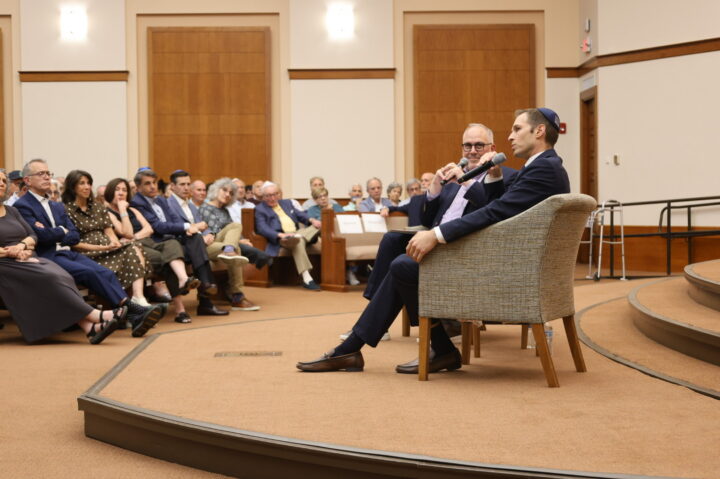
Rep. Jake Auchincloss (D-MA) appeared in conversation with Jeremy Burton, the CEO of the Jewish Community Relations Council of Greater Boston, at Temple Emanuel in Newton, Mass., July 27, 2026.
Rep. Jake Auchincloss (D-MA) appeared before a packed house of more than 700 Jewish constituents at a major Conservative synagogue in the heart of his district on Monday evening, facing a barrage of questions from attendees skeptical over his vote to cut U.S. military aid to Israel.
Auchincloss appeared in conversation with Jeremy Burton, the CEO of the Jewish Community Relations Council of Greater Boston, at Temple Emanuel in Newton, Mass., before taking around two-dozen questions from the audience, attendees said.
Those in the audience said that most of the crowd was not supportive of Auchincloss’ vote and was not persuaded by his explanation, but most of those who spoke to Jewish Insider came away expecting that he’ll maintain significant Jewish community support and were appreciative of his engagement.
Auchincloss’s explanation for his vote, attendees said, was largely consistent with those he offered in statements and in an interview with Jewish Insider last week, that he viewed the vote as a way to block further taxpayer support for the Iran war he opposes. The congressman is expected to make similar appearances at other synagogues around the district in the coming weeks.
“I really think that there was worry and skepticism about the vote, about what it says about the future of support for Israel,” Barry Shrage, the longtime former president of the Combined Jewish Philanthropies of Greater Boston, the local Jewish federation, told JI.
He said that he and others in the crowd were concerned about the impact of the amendment on Israeli security. “A majority of people in that audience were very skeptical about what he did and worried about what he did.”
One attendee who requested anonymity to speak candidly estimated that between 70 and 80% of attendees opposed the stance Auchincloss had taken on the issue.
Auchincloss declined to comment.
Lisa Coll, a former board chair of Prizmah who said she’s known and supported Auchincloss for years, said she was “shocked and surprised and slightly hurt and a little angry,” having expected Auchincloss would vote against the amendment based on his pro-Israel record and the fact that the amendment was led by Rep. Thomas Massie (R-KY), an anti-Israel Republican who has a history of making antisemitic comments.
She said that Auchincloss offered a clear and reasoned explanation for his vote, but felt that he didn’t grasp the concerns in the Jewish community or why the community was so concerned. There’s “very much a lot of surprise and hurt going around,” Coll said.
Coll said that she emerged from the event still feeling the same shock and frustration with Auchincloss’s vote. “It was not an easy evening, it was a very uncomfortable evening for everyone,” Coll said. “Everyone was squirming at some point,” and attendees were “angry and sad.”
Lisa Danetz, who works as an expert and adviser in elections and voting rights, said that she felt, and remains, “conflicted” about Auchincloss’ vote and was surprised that Auchincloss supported the amendment, given his record. But she said she understood his reasoning.
“I ended up thinking, I’m not sure how I feel about this particular vote — but since the amendment didn’t pass and wasn’t going to pass, I didn’t feel like I was going to get too worked up about it and appreciated hearing the reasoning,” Danetz said.
“I think you have to respect him, he did what he thought was right,” she continued. “I don’t know if I agree with it or not. But overall I feel aligned with his underlying values.”
Coll said that she’s concerned that, as a Jewish member viewed as a serious, policy-oriented and pro-Israel lawmaker representing a large Jewish constituency, Auchincloss’s vote has the potential to influence and provide license for other members less engaged on the issue to take anti-Israel positions.
She said that Auchincloss did not share those concerns when she asked him a question on the subject. “I don’t think he is anti-Israel,” Coll said. “I don’t know if he is aware of what I perceive as the consequences of this vote.”
She said she also didn’t think Auchincloss fully understood the community’s concerns about how his vote and comments might perpetuate narratives framing the Iran war as “America fighting Netanyahu’s war” that have fueled antisemitism and antisemitic violence.
Shrage said that Auchincloss repeatedly emphasized that his vote was intended as a repudiation of the Iran war and of President Donald Trump and Israeli Prime Minister Benjamin Netanyahu — both unpopular figures in the district’s Jewish community.
“A bunch of people got up and said, ‘This actually threatens the people of Israel,’” Shrage said. He recounted that one woman said, “‘I have Israeli and American citizenship. I have family in Israel. Your vote endangered them.’ And of course she added … ‘I’ve demonstrated against both Netanyahu and Trump, I have no sympathy for them whatsoever.’”
According to Coll, another attendee, an Israeli-American woman, said that Auchincloss’s vote was punishing the people of Israel for the actions of Netanyahu, and questioned whether he would support other countries punishing Americans the same way over frustration with Trump. Coll said Auchincloss did not offer a clear answer to the question.
A small number of attendees offered thanks and support for Auchincloss’ position in their comments, according to attendees.
Michael Gardener, a prominent area attorney, said he came into the event without having made up his mind on the vote and wanting to know more, while noting that it was out of step with Auchincloss’s prior votes on Israel issues.
Coming out of the event, “I understood his position and I must say I agree with it,” Gardener said. He said that Auchincloss had made clear that he did not seek an arms embargo in Israel and wanted to allow it to continue buying American weapons, but felt that providing U.S. taxpayer money that would facilitate the Iran war was not appropriate at this juncture, “which I agree with.”
Gardener said that views in the room weren’t uniform, but acknowledged that a majority of attendees likely did not agree with Auchincloss “and at the end of the evening probably still didn’t,” but felt that everyone understood Auchincloss’ reasoning and respected him for coming to explain it.
Another attendee, who also requested anonymity to speak candidly, cast a mixed picture of the audience, emphasizing that views in the room were diverse and said that the “audience appreciated him coming out and sitting in the hot seat to answer all of their questions” and “that he gave a lot of thought to all the implications” of the vote.
But, the attendee added, every mainstream Jewish organization in the Boston area had had serious conversations with Auchincloss about the vote expressing a “unanimity of disappointment” with him about it and exploring what his approach to Israel will entail going forward.
Shrage said he’s skeptical of Auchincloss’ claims, repeated throughout the event, that the vote wasn’t motivated by politics, or concerns about shifting Democratic party trends on Israel. Auchincloss similarly denied to JI that the vote was motivated by political considerations.
But, in spite of the concerns he saw in the audience, Shrage said he doesn’t expect any major defections in Auchincloss’ Jewish support base or efforts to oust him from office, predicting that most will “hold their nose and vote for him.” Most of the Democratic party opposition to Auchincloss in the district has come from his left.
“I don’t think anybody’s going to be joining a move to to defeat him in any way, shape or form,” Shrage said. “As a congressman, he still has broad support, but there was a lot of fear, worry and anxiety in this audience about what that vote meant.”
Coll said she wants to maintain her relationship with Auchincloss, and said she believes he’s a “principled and good person” who “in his heart … is very pro-Israel [and] does understand the importance” of the U.S.-Israel relationship and preserving Israel’s security and qualitative military edge.
She predicted that some members of the community will rethink their past support for Auchincloss, but others will likely wait to assess future votes on Israel.
“I’m hoping that we can count on [Auchincloss] to continue his support for Israel in his other votes like he has in the past and I would encourage the congressman to reach out to his constituents more before votes like this to read the room,” Coll said.
Danetz also said that Auchincloss was clear in his remarks that he didn’t take this or any vote based on politics. Asked whether she believes that, she said, “I think he thinks that, I don’t know if that’s humanly possible. He came across as very authentic and honest and wanting to have dialogue and conversation and explain his thinking.”
“I trust in his honest conviction of Israel’s right to exist and in the need for defense and also in concern related to the current government of Israel, a concern I share,” she continued.
Attendees generally said they appreciated Auchincloss coming to address the community and explain his position, and praised Burton’s questioning and the leadership of and comments by the congregation’s rabbi.
“I really respected [Auchincloss] for coming to speak to people. … I thought it showed how important it is to him to engage with his constituents in the district and in understanding that people were upset about his vote and a desire to explain his thinking,” Danetz said. “It seemed to me that whether people agreed with him or not, it would be hard to walk out of there not at least understanding where he was coming from, or where he thought he was coming from.”
She said Auchincloss was clearly knowledgeable about the issue and explained his stance clearly, and that he’d been “emphatic” in his continued support for Israel’s existence and security.
Gardener said that the synagogue was as full as it traditionally is for high holiday services, highlighting the passion that the community has for the subject, which he said can only be a good thing for Israel and the Jewish population.
He said he thinks everyone in the room shares the same passion for Israel and support for its security as a Jewish and Democratic state and “I think the congressman feels the exact same way.”
But, he continued, “I think there are different viewpoints about how you get to that spot.”
The pro-Israel congressman raised early campaign cash, defined his opponent aggressively and prioritized strong constituent services

Blue/Bloomberg via Getty Images
Representative Ritchie Torres, during an interview in New York, US, on Tuesday, Jan. 28, 2025.
Rep. Ritchie Torres (D-NY) has long been a target of the far left in New York City, largely because of his outspoken support for Israel and his Jewish constituents.
But Torres emerged with a commanding victory over a far-left challenger in Tuesday’s Democratic primaries, even as pro-Israel Reps. Dan Goldman (D-NY) and Adriano Espaillat (D-NY) were defeated by democratic socialist-aligned challengers. Brooklyn Borough President Antonio Reynoso, a progressive backed by party leaders, was also defeated by a challenger aligned with the Democratic Socialists of America.
Observers attribute Torres’ landslide win against former New York Assemblymember Michael Blake to a variety of factors, including the different demographics of his district — which includes the heavily Jewish neighborhood of Riverdale, as well as some of the poorest neighborhoods in the city— as compared to the other three districts, his strength as a member of Congress and as a campaigner and Blake’s own weaknesses as a candidate.
Torres is popular in the district, has prioritized constituent services, has been a longtime presence in the district — as a city councilman from 2014 to 2020 before his time in the House — and maintains a strong reputation locally, Torres campaign spokesperson Benny Stanislawski said.
That’s in spite of the online vitriol that’s frequently directed the congressman’s way by the far left.
House Minority Leader Hakeem Jeffries (D-NY), in an MS NOW interview on Wednesday, pointed largely to the demographics of the districts — wealthier voters taking more of an interest in Middle East policy issues — as the reason for the differential results.
“What’s interesting is that, in some of those districts, which tended to be higher-income districts … there was an outsized focus on issues connected to the Middle East, the Middle East,” Jeffries said. “In other districts, for instance, in the South Bronx, Ritchie Torres was running against somebody who was heavily critical of Ritchie Torres’s position on Israel, and he won by fifty points.”
Strategists largely offered a similar assessment.
Torres is a strong fit for his district, as an Afro-Latino man who grew up in housing projects in the district, Hank Sheinkopf, a longtime New York Democratic strategist, said.
The voting population in Torres’ district, overall, is less friendly to the far left than the other districts where left-wing candidates surged, and Torres retained strong support among both the Jewish community and older minority voters.
Blake didn’t benefit from the same institutional DSA backing that others received. Blake himself is not a DSA member and is “not particularly DSA-adjacent, although he’s tried to position himself there since the mayoral primary,” Jake Dilemani, another New York Democratic strategist, said.
“[The DSA] supports candidates who they think have the best shot at winning based on who the candidate is, but also who or what the district is,” Dilemani said. “They pick carefully where they engage, and I think a combination of, potentially, they couldn’t find a legitimate candidate for them to run, coupled with the district is not as favorable to a DSA candidate as some of the others, they wanted to use their resources wisely.”
Strategists said Blake is also known as being a politically unreliable striver — he pivoted during his recent mayoral campaign and congressional bid against Torres from being a supporter of Israel and ally of AIPAC to staunchly anti-Israel, for instance — who has run for a slew of different offices.
“I don’t know that anyone particularly took his candidacy all that seriously. He’s run for nearly every single office there is, with the exception of maybe king of England,” Dilemani quipped.
Blake also faced a barrage of attacks and scrutiny from the outset of his congressional campaign, something that was not the case for other candidates like Darializa Avila Chevalier, who defeated Espaillat.
“Torres is a better pol[itician] and a smarter campaigner. He just is,” Sheinkopf said. “The other guys … didn’t define their opponents. Torres knew that anything was possible. He has a smarter way of looking at New York City Mayor Zohran Mamdani, and he did what was appropriate to protect himself.”
Sheinkopf also speculated that Mamdani didn’t want to take a chance on Blake when he had other, easier targets that were more fertile ground for his brand of politics. DSA-style politics have typically thrived among younger populations newer to the area, a smaller contingent in Torres’ district.
Sheinkopf noted that Torres also significantly outraised Blake — he stockpiled millions in campaign cash even before Blake emerged as his leading rival.
And, strategists said, Torres’ outspokenness on behalf of Israel has been somewhat less prominent over the past year, even as the congressman’s views and positions have remained largely the same. Torres offered some criticism of Israel last year, similar to that expressed by some other pro-Israel Democrats.
“It’s smart on his part,” Sheinkopf said. “He understands that survival is important. Has he betrayed the pro-Israel community and the Jewish community as others have? The answer is no. Is he being smart about it? The answer is yes, and we should respect him for that.”
Strategists said Torres can’t count on his strong victory on Tuesday deterring future efforts to challenge him.
Dilemani emphasized that “two years is an eternity in politics,” and that it would be foolhardy to try to predict what might happen in the next race.
“The DSA people have no sense of what fits and what doesn’t fit … they will do it again because they can,” Sheinkopf said.
Former Rep. Jim Moran and his team have held dozens of meetings with members of Congress since the Oct. 7 Hamas terror attacks in 2023, mainly to talk about the Qatari role in the Middle East peace process

YASUYOSHI CHIBA/AFP via Getty Images
Former Rep. Jim Moran (D-VA) arrives to address a rally attended by supporters of Sudan's ruling Transitional Military Council (TMC) in the village of Abraq, about 60 kilometers northwest of Khartoum, on June 23, 2019.
During Jim Moran’s 24 years in Congress, the Virginia Democrat had a habit of putting his foot in his mouth, particularly when it came to his Jewish constituents.
In 2003, he blamed the Jewish community for President George W. Bush’s decision to invade Iraq, prompting several local rabbis to call for his resignation. Four years later he blamed AIPAC for the war. The blowback was so strong that when then-Sen. Barack Obama accepted Moran’s endorsement of his presidential campaign in 2008, he stated plainly that he disagreed with Moran’s views of the Jewish community.
Moran retired from Congress in 2015, but the 80-year-old still walks the halls of Capitol Hill. Now, he’s there as a lobbyist — primarily as a registered foreign agent lobbying on behalf of the government of Qatar.
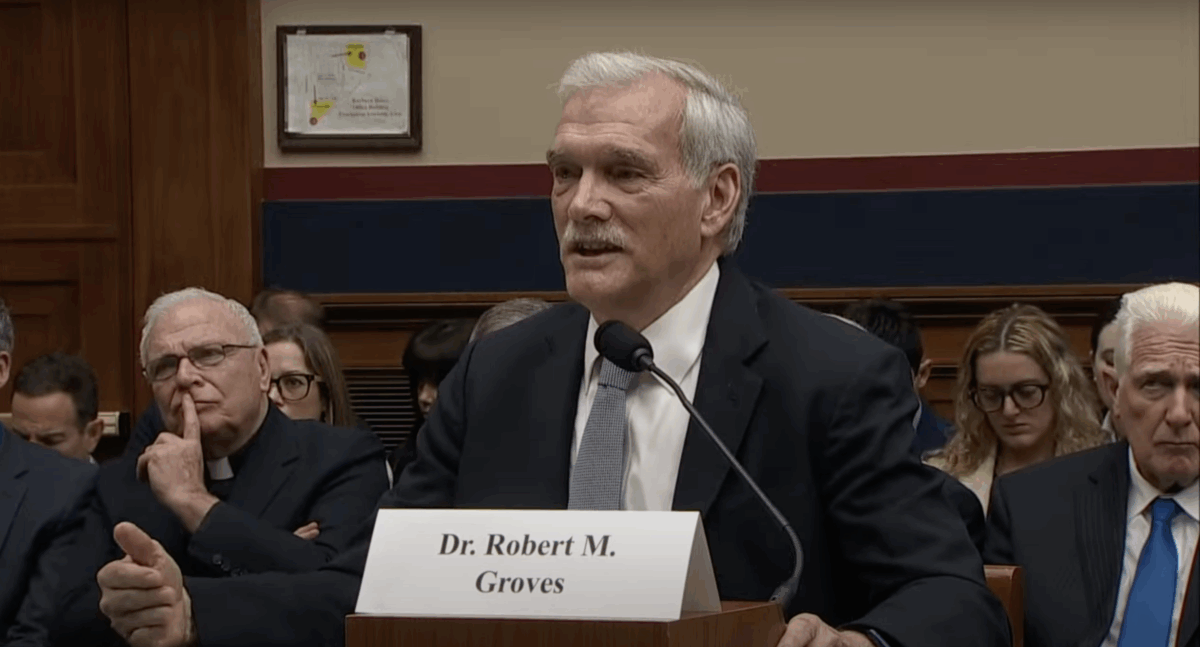
He is a regular in the offices of high-ranking members of Congress and senators. And last month, during a House Education Committee hearing about antisemitism in higher education, Moran was conspicuously seated directly behind Robert M. Groves, the president of Georgetown University, which has a campus in Doha and has received more than $1 billion from the Gulf monarchy.
“Jim is one of these guys that people seem to like on both sides of the aisle. He’s been able to keep in contact with a lot of members when needed,” Tom Davis, a former Republican congressman from Virginia who Moran hired to help represent Qatar, told Jewish Insider.
A Georgetown source said Moran was not working with the university or sitting in one of Georgetown’s three allotted seats at the hearing. Still, there’s no doubt he is a highly influential foreign policy voice in Washington on behalf of a country with which America has a complicated relationship.
Qatar is a major non-NATO ally of the U.S., an official designation conferred by President Joe Biden, and is home to the largest U.S. military base in the Middle East. But it also has financial and diplomatic ties with Hamas and other terror groups. Qatar’s leaders say that is necessary so the country can maintain its role as a trusted mediator, while its critics say Qatar’s close relationship with Hamas makes it unlikely to put real pressure on the terror group to make a deal with Israel or to release the hostages. Some on Capitol Hill and in the pro-Israel community have expressed concerns that Qatar’s massive investment in American universities has fueled anti-Israel activism and antisemitism on campuses.
With a Boston accent leftover from his childhood, Moran has a penchant for talking tough — and acting tough, too. In the 1990s, at the start of his time in Congress, he occasionally threatened to brawl with fellow lawmakers, and once shoved another member of Congress off the House floor.
Moran was an early and consistent critic of Israel, long before the wave of anti-Israel sentiment that has exploded on the far left over the past two years. He has kept up ties with Jewish leaders in Northern Virginia, but those relationships grew strained as Moran repeatedly criticized pro-Israel advocates and Jewish activists.
“Jim is an extraordinarily compassionate man. He has trouble with suffering. His judgment about what constitutes suffering and who’s causing it is not always accurate, and so that has gotten him in a considerable amount of trouble over the course of his long political career,” said Rabbi Jack Moline, who served for 27 years as the rabbi at Agudas Achim Congregation in Alexandria. Moline met regularly with Moran until the rabbi called for Moran’s resignation in 2003, after Moran blamed Jews for the Iraq war, a comment the former congressman later said he “deeply regret[s].”
“His relationship with the Jewish community fell apart,” Moline told JI. “It didn’t surprise anybody when, after he finally did retire from Congress, he was offered and accepted work lobbying for Qatar.” He first registered as a lobbyist for Qatar in 2017. His firm, Moran Global Strategies, has been paid more than $2 million by Qatar in the last two years, according to data compiled by OpenSecrets. A spokesperson for the Qatari Embassy did not respond to a request for comment, nor did Moran Global Strategies.
Though Moran expressed contrition for his antisemitic remarks during the lead-up to the Iraq war, his rhetoric toward the Jewish community has only grown more inflammatory in the decade since he left Congress. In recent years, he has appeared on several virtual panel discussions held by the Arab Organization for Human Rights in the U.K., a London-based NGO led by Mohammad Jamil Hersh, a former Hamas activist who has been sanctioned by Israel and was deported by the country more than three decades ago. In those conversations, he regularly blasted the influence of American Jews and the “pro-Israel lobby.”
During a February 2023 AOHR event, Moran tried to explain Washington’s support for “apartheid” in Gaza by pointing the finger at American Jews and suggesting that they are unduly involved in the American political system.
“It’s about domestic politics and it always has been. The majority of people who contribute to the Democratic Party in America have Jewish surnames. Now think about that,” said Moran. He described them as people “whose principal reason for contributing to the political system in America has been the sine qua non of support for Israel, and unqualified support for Israel.”
In this and several other interviews, Moran recognized that his language was rather impolitic.
“I don’t want to sound antisemitic, and Palestinians are a Semitic people,” Moran said. “I’m just saying that let’s deal with the political reality in the United States that’s driving and reinforcing the injustice that’s occurring within Palestine.”
Moran and his team have held dozens of meetings with members of Congress since the Oct. 7 Hamas terror attacks in 2023 that spurred the ongoing war in Gaza, mainly to talk about “Qatar’s role in the Middle East peace process,” according to documents he filed with the Justice Department as required by the Foreign Agents Registration Act. At the same time, he has continued to question Jewish involvement in the American political system — including just days after Oct. 7, in a call hosted by the Muslim Public Affairs Council.
“The reality is that campaign contributions have corrupted the United States Congress. One of the motivating factors is, ‘How do I please my political supporters, particularly my financial supporters?’ The reality is that the Jewish community, and frankly to their credit, is deeply engaged in the American political process,” Moran said in the MPAC call. “That’s one of the motivating factors that causes the Congress to look the other way where the Middle East is concerned.”
Although he expressed skepticism about the supposed influence of American Jews in electoral politics, he encouraged Muslim, Palestinian and Arab Americans to increase their own influence. But his prognosis for their potential efficacy was grim. “I’m not sure they’re ever going to be able to successfully catch up,” Moran said.
Even as Moran took aim at Jews’ participation in the political process, he routinely downplayed accusations of antisemitism that have been lobbed at him directly and at the broader anti-Israel movement.
In September 2024, in another AOHR virtual briefing, Moran acknowledged that he would likely be called antisemitic for his comments accusing Israel of committing war crimes “daily” and for describing the situation in Gaza as “comparable to the Holocaust.”
“Foreign aid going into committing war crimes on a daily basis because of the politics, because of the campaign financing, because of the control of the media — it’s inexcusable. It’s an indictment of what has become of this democracy,” said Moran, without saying who, exactly, he thinks controls the media. “It’s an indictment of the fact that our foreign policy has been Israeli-centric, and let me say one other thing so that people don’t particularly accuse me of being antisemitic, although I’m sure many will: Many of those protests across the country were led by Jewish students.”
This spring, after President Donald Trump returned to office and began targeting universities, Moran was dispatched to Capitol Hill to talk to Democrats on the Senate Health, Education, Labor and Pensions Committee about Qatar’s funding of American higher education, which has come under the microscope.

It is notable that one of the people tasked with advocating for a country that is close to both America and Hamas seems to have a deeply rooted hostility to Israel and even to American Jews, particularly at a moment when Qatar’s dealings in the U.S. are facing greater scrutiny — such as when Trump said earlier this year that the U.S. would accept a Qatari gift of a luxury jet to use as Air Force One.
But Qatar has a suite of lobbyists who span the political spectrum. Moran primarily deals with Democrats. Qatar has in the past also targeted hundreds of conservative “influencers” to reach Trump’s inner circle, and employs several Republicans as lobbyists. Partisan politics is at play, too; Democratic lawmakers blasted the Air Force One move, while Republicans fell in line behind Trump.
Several prominent Trump administration officials have ties to Qatar, including Attorney General Pam Bondi, who said in her January Senate confirmation hearing that she remains “very proud” of the lobbying work she did for Qatar ahead of the 2022 World Cup. Steve Witkoff, Trump’s Middle East envoy and chief negotiator, has a history of business dealings with the country.
“If you take a look at the folks they’ve got representing them, they’ve been all over the lot on that issue. It’s certainly not a pro-Arab versus Israel issue,” said Davis, the Virginia Republican who works with Moran on the Qatar file. “There’s nothing there to indicate that their lobbyists have any kind of ideological bent on that issue.”
Correction: This story has been corrected to reflect that Moran began lobbying for Qatar in 2017, not 2023.
Please log in if you already have a subscription, or subscribe to access the latest updates.
 Continue with Google

 Continue with Apple