












































































The State Department official told lawmakers that ‘a new road toward normalization’ could be ‘built not on the same ideology, but on shared supply chains’
Pier Marco Tacca/Getty Images
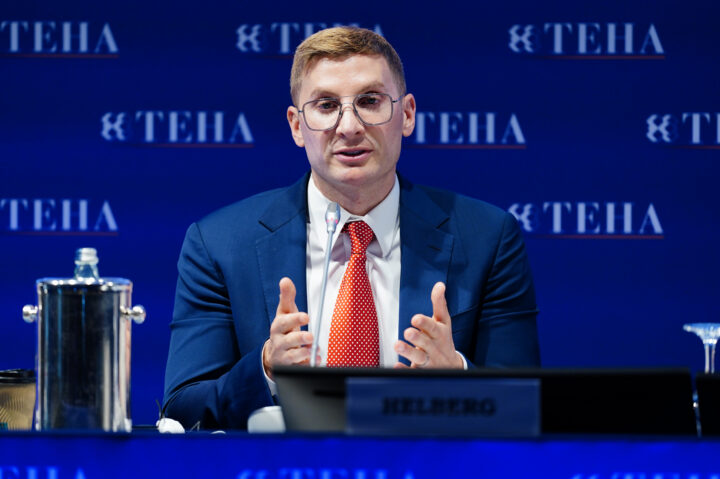
Jacob Helberg, advisor to the White House Council of Economic Advisers and U.S. Under Secretary of State designate for Economic Growth, Energy, and the Environment, attends the 51st Edition of TEHA 'Cernobbio Forum Takes Place In Italy on September 05, 2025 in Como, Italy.


 Add JewishInsider on Google
Jacob Helberg, the under secretary of state for economic growth, energy and environment, told House lawmakers on Tuesday that the administration’s Pax Silica initiative could help pave a path toward normalization between Israel and Qatar.
The initiative, which has become the State Department’s flagship effort on AI and supply chain security, currently includes 10 signatories and five non-signatory participants. Israel joined the framework in December 2025, with Qatar signing on the following month.
“Consider what this coalition has already accomplished that traditional diplomacy could not. Qatar and Israel now sit inside the same economic framework,” Helberg said during a House Foreign Affairs Committee hearing on advancing national security through diplomacy. “A new road toward normalization built not on the same ideology, but on shared supply chains.”
During his testimony, Helberg also pointed to the United Arab Emirates’ early participation in the Abraham Accords, saying the UAE joined “incredibly early at great political cost to itself,” as evidence that economic and security frameworks can reshape regional relationships.
Helberg told Jewish Insider similarly upon returning from Doha for the Pax Silica signing, “My trip to the Middle East was actually incredibly significant, because this is the first time that Israel and Qatar have been brought under the same framework and signed the same document to actually agree that shared supply chains are more important than shared ideologies.”
“When people do business together, when people focus on shared goals, you inherently create, identify and focus on things that people agree on. It’s certainly my hope that this will pave the way for peace and economic integration of the region,” he continued.
But despite Helberg’s optimism, relations between Jerusalem and Doha remain deeply strained, and formal normalization appears distant.
Israel and Qatar do not maintain diplomatic ties, and Israeli and U.S. officials and policy experts remain wary of Doha’s support of anti-Western movements such as the Muslim Brotherhood and hosting of Hamas officials.
During the war in Gaza, Doha served as a key intermediary between Israel and Hamas, helping broker temporary ceasefires and hostage-release agreements. That role was disrupted on Sept. 9, 2025, when Israeli aircraft struck Hamas figures in Doha, killing a Qatari security guard and prompting the Gulf state to scale back its mediation efforts.At the urging of the Trump administration, Israeli Prime Minister Benjamin Netanyahu later spoke with Qatari Prime Minister Sheikh Mohammed bin Abdulrahman Al Thani to express regret over the strike.
For the Trump administration’s under secretary of state for economic affairs, the Pax Silica initiative takes on additional meaning as ‘the first time that Israel and Qatar have been brought under the same framework’
Pier Marco Tacca/Getty Images
Jacob Helberg, advisor to the White House Council of Economic Advisers and U.S. Under Secretary of State designate for Economic Growth, Energy, and the Environment, attends the 51st Edition of TEHA 'Cernobbio Forum Takes Place In Italy on September 05, 2025 in Como, Italy.
That Qatar and Israel both signed onto a U.S.-led initiative to improve and strengthen AI supply chains does not mean the two nations — both of whom foster a deep reserve of hostility for each other, particularly in a Middle East transformed by the Oct. 7 attacks and two years of war in Gaza — are on the pathway toward closer ties, let alone diplomatic normalization.
But for Jacob Helberg, the under secretary of state for economic affairs who has taken a wonky but driven approach to economic diplomacy, it still counts for something. Helberg recently returned from a trip to Israel, Saudi Arabia, the United Arab Emirates and Qatar. He presided over a series of signing ceremonies for Pax Silica, an effort by the Trump State Department to bring American partners together to develop AI supply chains that rely less intensively on China.
“My trip to the Middle East was actually incredibly significant, because this is the first time that Israel and Qatar have been brought under the same framework and signed the same document to actually agree that shared supply chains are more important than shared ideologies,” Helberg told Jewish Insider in an interview last week.
Helberg is enmeshed in the specifics of AI architecture, mineral refining, semiconductor production and technology manufacturing. There is also a bigger pitch, particularly when it comes to the Middle East: that economic cooperation — driven by companies working across national borders to grow their bottom line — can also be a boon for diplomacy.
“Our goal has been the expansion of the Abraham Accords, and the president’s been very, very clear and vocal about that,” said Helberg, a China hawk who is leading the Pax Silica initiative. “When people do business together, when people focus on shared goals, you inherently create, identify and focus on things that people agree on. It’s certainly my hope that this will pave the way for peace and economic integration of the region.”
Helberg’s nomination to a senior role at the State Department marks the culmination of a political evolution that took him from being a major donor to former President Joe Biden in 2020 to giving more than $1 million to President Donald Trump’s 2024 campaign. He told JI in 2024 that his shifting political identity was owed in part to what he viewed as the Democratic Party’s shift to the left, including on Israel. Helberg grew up in Paris, the grandson of Holocaust survivors on his father’s side and Tunisian Jews who left the country for France on his mother’s side.
Helberg’s husband, Keith Rabois, is a venture capitalist who hosted a fundraiser featuring Vice President JD Vance in Florida last week.
On Helberg’s recent trip to the Middle East, he said he witnessed collaboration between Israel and the UAE that endured over the course of the war.
“There is nascent collaboration between the UAE and Israel on the tech side,” he said. “That has actually been a really interesting observation that I’ve seen in the Middle East … how pragmatic and apolitical people can be on the business side of the ledger, and very comfortable compartmentalizing politics.”
While Israel has in some ways become more isolated on the diplomatic stage since its response to the Oct. 7 attacks, Helberg said the war in Gaza revealed the strength of Israel’s tech ecosystem. The country’s defense capabilities have only contributed to that image, he noted.
“Israel, obviously, is a country that has always punched way above its weight technologically. They are respected in all corners of the world for having an incredibly innovative technology ecosystem,” said Helberg, who previously worked at Palantir and Google. “Since Oct. 7 and the unfolding of the war, the world has really witnessed just how incredible Israel’s capabilities are, both for military technologies as well as for cybersecurity.”
Please log in if you already have a subscription, or subscribe to access the latest updates.
 Continue with Google

 Continue with Apple