














































































Trust in Trump dropped 15 points among Jewish Israelis in the last month, though a majority still see tensions between Washington and Jerusalem as temporary
Jack GUEZ / AFP via Getty Images
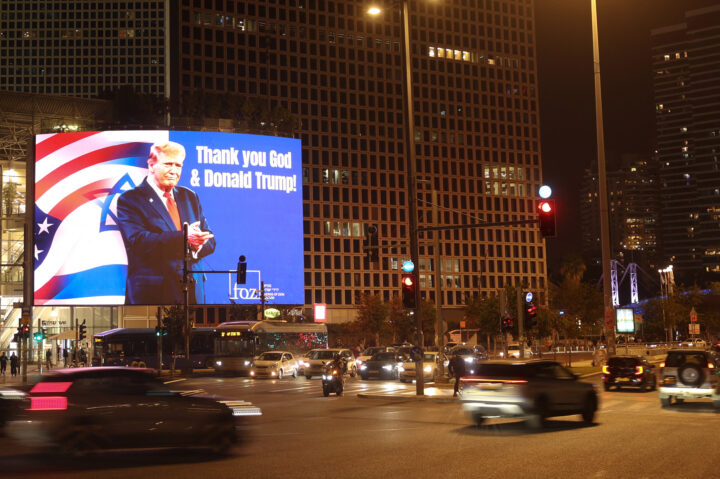
A billboard depicting an image of President Donald Trump with a message thanking him, is displayed on the side of a building in the Israeli coastal city of Tel Aviv on March 12, 2026.


 Add JewishInsider on Google
The number of Israelis who believe President Donald Trump views Israel’s security as a central consideration has continued to fall to record lows after Washington signed a memorandum of understanding with Iran, according to a new survey from the Israel Democracy Institute.
The June 2026 Israeli Voice Index, conducted between June 28 and July 1, found that 28% of respondents — including 26% of Jewish Israelis and 36% of Arab Israelis — believe Israel’s security is a key consideration for Trump.
Among Jewish Israelis, the figure dropped 15 percentage points from a month ago, when 41% of respondents said they felt Israeli security was a key consideration for Trump as his administration engaged in negotiations with Tehran. At the time, those findings marked the lowest levels of Israeli trust in Trump since the research center began tracking the metric when he was elected to a second term in November 2024.
Despite declining confidence in Trump, a majority of Israelis continue to view current tensions between Washington and Jerusalem as temporary rather than indicative of a meaningful deterioration in bilateral ties. Among Jewish Israelis, 54% said current disagreements represent a temporary crisis that will not harm the relationship, while 34% said they mark a longer-term shift for the worse.
Respondents were more divided when asked whether Israel’s strategic security situation was better or worse than it was before the Iran war. Thirty-six percent said Israel’s security situation is now worse, an increase of eight percentage points from April. Meanwhile, 38% said it is better, down six percentage points over the same period.
The survey also found strong support for maintaining an Israeli security zone in southern Lebanon, even if doing so conflicts with U.S. interests. Overall, 72% of respondents backed a permanent security zone in the area. Support was especially high among Jewish Israelis, at 80%, while a majority of Arab Israelis (58%) opposed maintaining a permanent Israeli presence in southern Lebanon.
Beyond military and diplomatic issues, the poll found that rising antisemitism and attacks targeting Israelis abroad were influencing travel decisions. Fifty-six percent of respondents said the threat environment has affected their travel plans, with 41% saying it has impacted where they choose to travel and 15% saying they plan to avoid traveling abroad altogether because of security concerns.
The Israeli Voice Index poll also found overwhelming support among Jewish Israelis for Israeli government involvement in protecting Jewish communities abroad
Getty Images
Tel Aviv and the coast from the airplane
A significant majority of Jewish Israelis feel that it is safer for them to live in Israel than abroad, according to a new survey by the Israeli Voice Index, reflecting heightened concerns about antisemitism overseas.
While 76% of Jewish Israelis feel that their home country is the safest place for them, only 32% of Arabs feel the same, with 35% of Arab respondents answering that both are equally safe and 29% seeing life abroad as safer.
Researchers at the Israel Democracy Institute, which released the findings of the survey on Tuesday, said the gap in perceptions is likely linked to high levels of violent crime in Arab communities and what they described as an inadequate state response.
The survey also found overwhelming support among Jewish Israelis for Israeli government involvement in protecting Jewish communities abroad. Ninety percent said Israel should pressure foreign governments to ensure the security of Jewish communities, 80% supported sending Israeli emissaries abroad, 62% favored direct involvement in security arrangements for Jewish events and 50% backed financial support for Diaspora communities. Support for such measures was significantly lower among Arab Israelis.
The survey was conducted by the Viterbi Center for Public Opinion and Policy Research at the end of last month, about two weeks after 15 people were killed in a terror attack targeting a Hanukkah celebration in Sydney, Australia.
The survey included 752 men and women with a ±3.57% margin of error.
Please log in if you already have a subscription, or subscribe to access the latest updates.
 Continue with Google

 Continue with Apple