














































































Avigdor Liberman's red lines and Gadi Eisenkot's ambitions could tear apart Israel's opposition

Lihi Lapid
Yair Lapid, Gadi Eisenkot, Yair Golan, Naftali Bennett and Avigdor Liberman, September 2026.


 Add JewishInsider on Google
One of the key features of this Israeli election cycle is that the math, as the meme goes, ain’t mathing.
In the average of last week’s polls, the bloc led by Prime Minister Benjamin Netanyahu wins 54 Knesset seats and the Gadi Eisenkot-led bloc receives 50. Even with the Reservists and Economic Party, who got an average of three seats in last week’s polls and have not aligned with either Netanyahu or Eisenkot, neither bloc would reach the needed 61-seat majority to establish a stable coalition.
Then there are the Joint List and Ra’am, two mostly Arab parties, with the latter being more moderate and willing to work within the system. They average a total of 13 seats, enough to bring either side to a majority. The Joint List has said they will help a coalition that can topple Netanyahu. Eisenkot has said he won’t have non-Zionist parties in his coalition, but has been less clear on whether he would rely on their votes in the Knesset to get him across the finish line to form a government.
The problem is that Eisenkot isn’t bringing in 50 Knesset seats on his own. There are three other parties in his bloc, and one emphasized repeatedly last week that relying on the Arab parties is a red line.
Yisrael Beitenu leader and former Defense Minister Avigdor Liberman laid out conditions that seem to doom the anti-Netanyahu bloc to remain in the opposition: No Arabs, no Haredim, no Bibi. He doubled down on those terms, writing on Thursday that he would not support a minority government.
Yisrael Beitenu was arguably the spoiler in the 2019 election, refusing to sit in Netanyahu’s Cabinet as long as Haredi parties were there, though Liberman had been in several such coalitions in the past. As a result of the paralysis, Israel ended up having four elections in three years.
This time Liberman has been arguing, despite all of the polls saying otherwise, that his conditions do not make it impossible for his side to reach a majority. He posited that the anti-Netanyahu bloc can win an outright majority in the Oct. 27 election.
“Stop talking about another round. Stop planning a loss. Start planning victory. With all due respect and appreciation for all the polls, victory depends first of all on turnout. If we reach 76% and up, we will win big,” he argued.
Liberman’s statements are not about basic arithmetic; they expose deep fissures within the opposition bloc. Just under a month ago, the leaders of the anti-Netanyahu parties met in former Prime Minister Yair Lapid’s basement and agreed to campaign on similar messages and not attack one another. Now, opposition insiders told Jewish Insider, Liberman is not the only one concerned that Eisenkot is going back on that agreement.
While Liberman is the only one lashing out publicly, the other parties in the bloc, B’Yachad and the Democrats, are worried that Eisenkot has moved from the strategy of working together as a bloc to trying to be the largest faction in the Knesset, with sources accusing him of targeting their voter bases to grow his Yashar party, even if it pushes them below the 3.25% threshold.
In another post from the weekend, Liberman posited that Eisenkot is “not interested in being the largest party in the bloc of those who serve [in the IDF], but to be bigger than Likud and negotiate from a position of power to be in a government with Netanyahu.”
According to Liberman, Eisenkot is “leaving the possibility of a minority government on the table to pressure Netanyahu so [Eisenkot] can be first in a rotation.”
Another scenario that opposition parties fear Eisenkot is pursuing is to form a minority coalition, meaning a coalition of under 61 seats but with the support of the Arab parties, pass a law to make it illegal for someone under indictment — i.e. Netanyahu — to be prime minister, and then call an election. The theory there is that Eisenkot would absorb many of the other opposition parties’ votes by running from the lofty position of prime minister and win, though it did not work for Lapid in 2022.
The largest party strategy only works, opposition sources noted to JI, if there are satellite parties to recommend that party’s leader to the president. If you push the parties below the electoral threshold or alienate their leaders enough, the leader of the largest party could end up as the leader of the opposition, as Tzipi Livni did in 2009, ushering in the second Netanyahu era.
With the blocs led by Netanyahu and Eisenkot neck-and-neck in the polls, whether Amcha Yisrael and the Reservists and Economy party clear the 3.25% threshold could decide who forms the next government
Lahav Harkov
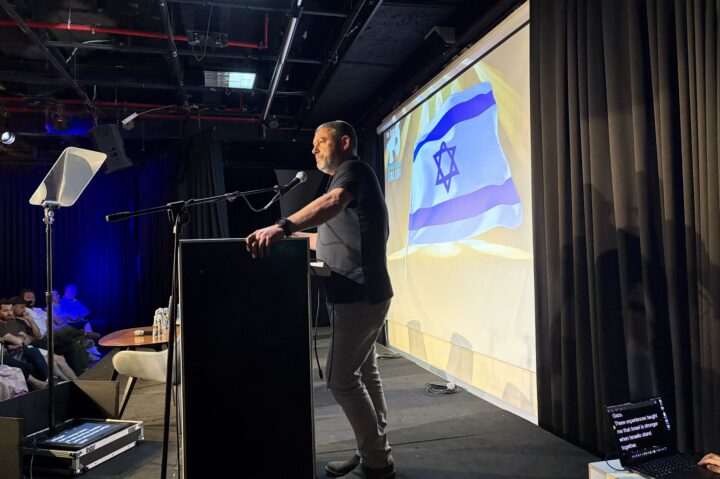
Amcha Yisrael leader Ofer Winter speaks at the Tel Aviv International Salon, Oct. 6, 2026
With the electoral blocs led by Prime Minister Benjamin Netanyahu and former IDF Chief of Staff Gadi Eisenkot running neck-and-neck in the polls only two weeks before the Israeli election, a few very small parties hovering around the electoral threshold could end up tipping the scales in favor of the prime minister or his main rival. If one or more of those small parties pass the threshold and enter the Knesset, they could end up being kingmakers.
While 10 to 12 parties have generally been represented in the Knesset in recent years, there are 38 parties running in this month’s election. Only those that receive at least 3.25% of the vote will get into the Knesset, where seats will be divided proportionally between the parties that pass that threshold.
In the last election in 2022, a party needed 154,855 votes to enter the Knesset. That year, a decisive element in the Netanyahu bloc’s victory was that two opposition parties — the left-wing Meretz party and the Arab nationalist Balad party — did not pass the threshold, though each came very close.
This year, two parties that have cleared the threshold in some polls are Amcha Yisrael, led by hawkish former Brig. Gen. Ofer Winter, and the Reservists and Economy party, a merger of small parties led by right-leaning former Communications Minister Yoaz Hendel, economist Yaron Zelekha and former Knesset member and author Einat Wilf.
While the polling average for the past week does not show either party passing the threshold, some individual polls, including Kan and The Times of Israel, put one or both parties over the 3.25% mark — though neither has ever passed the threshold in surveys conducted for pro-Netanyahu Channel 14.
Political strategist Ashley Perry, who advised Yisrael Beitenu leader Avigdor Liberman for years, told Jewish Insider that “the very possibility of forming a coalition could hinge on a few thousand votes and whether either, neither or both parties cross the threshold. Each scenario increases the chances of one or the other side’s ascendancy and possible path towards a coalition.”
Both Netanyahu and Eisenkot, head of the opposition party Yashar, which is leading the opposition in the polls, seem to have decided to try to crush the small parties.
Hendel’s eclectic list has insisted on remaining a free agent that could recommend either candidate for prime minister after the election. Winter, however, has said he will recommend that Netanyahu remain in office — but that would not preclude him from joining a coalition led by Eisenkot.
It’s that possible scenario, of Winter joining with the opposition, that is reportedly keeping Netanyahu up at night. Anonymously placed ads in the weekend papers said, “Ofer [Winter], it’s over. If you’re endangering the country, don’t run!” Perry said Netanyahu knows that Winter and Liberman have a close relationship since Winter served as Liberman’s military secretary in the Defense Ministry.
“Netanyahu is extremely concerned that Winter could be a Trojan horse and take [Likud] or [Religious Zionist Party] votes and use those seats to help the current opposition form a government,” Perry explained. (That being said, it all may be spin, since Israeli journalist Guy Lerer wrote that he has seen leaked texts, which he cannot legally publish, that indicate that Likud and Amcha Yisrael have been coordinating messaging.)
Meanwhile, Eisenkot, who for much of the campaign took a hands-off approach toward the small parties, thinking they were peeling votes away from the Netanyahu bloc, has changed his mind, according to Haaretz.
One of Likud and Yashar’s lines of attack is to say that Hendel and Winter’s parties are “wasting votes.” A similar line has been directed at former Defense Minister Benny Gantz, who is running even though his party has not crossed the threshold in any recently published polls; Gantz has faced pressure from opponents of Netanyahu who warn that by not dropping out, he could have some culpability should the prime minister stay in office. Another party that has polled at 1%-2%, likely drawing mostly from the Netanyahu bloc’s voters, is Hatzibur HaHaredi, the moderate Haredi party.
“A list that fails to cross the threshold is ‘wasted’ in the sense that it produces no parliamentary representation,” Perry said, when its voters could have helped another party that does enter the Knesset gain more seats. “However, the breadth of choice is also a strength of Israeli democracy, and no established party owns anyone’s vote.”
Perry pointed out that some may have thought that after the Oct. 7, 2023, Hamas-led attacks, Israelis may have looked for new names and faces in the Knesset, but familiar options are polling well while the new parties are struggling.
“Israelis tend to be most conservative in their voting during times of heightened security when they tend to prefer experience over promise,” he argued.
With neither the Netanyahu-led government or the Eisenkot-led opposition winning enough support for a solid majority, a governing stalemate is looking more likely — in a repeat of the 2019-2020 elections
(Oded Balilty/AP)
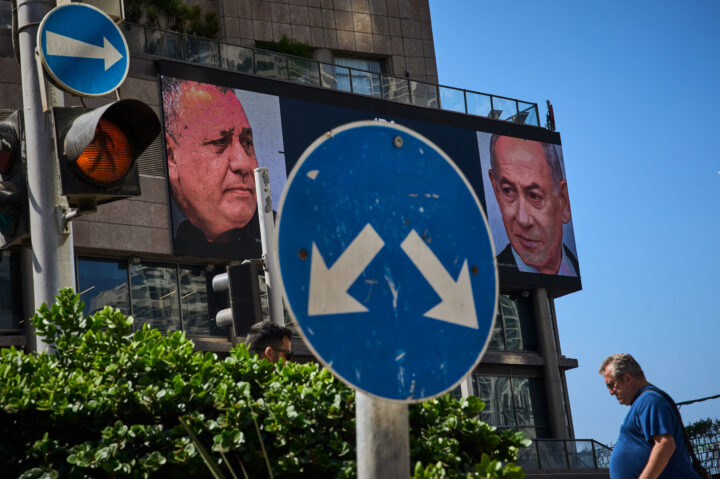
A man walks past a television channel advertisement featuring Israeli Prime Minister Benjamin Netanyahu, right, and his main rival, opposition candidate Gadi Eisenkot, ahead of Israel's general election, in Ramat Gan, Israel, Wednesday, Sept. 23, 2026.
Welcome to 2019, electorally speaking, that is.
With the High Holy Days season now in the rear-view mirror, Israelis across the country have received postcards in the mail in recent days listing their polling place address, one of the tangible signs that election season is in the homestretch. Yet the Oct. 27, 2026, vote is taking on an unmistakable back-to-the-future feel.
Then, Prime Minister Benjamin Netanyahu was bloodied but unbowed, set to be indicted on bribery and public corruption charges, with a coalition that fell apart over a court order to resolve the issue of Haredi draft exemptions. Now, Netanyahu remains bloodied but unbowed, with a large swath of the public calling for him to take responsibility for security failings surrounding Oct. 7, 2023, and the Haredi draft issue still looms large.
Then, the leading contender to take the premiership from Netanyahu was an ex-IDF chief of staff, Benny Gantz. Now, it’s Gadi Eisenkot, who held the post from 2015 to 2019. Then, Naftali Bennett formed a new party, the New Right; now, the former prime minister is back with yet another new party. And even the libertarian iconoclast Moshe Feiglin is back in play – though he’s less focused on legalizing weed this time.
With 22 days until the election, Israelis could be forgiven if they are having flashbacks. Then, in 2019 and with the country split, Netanyahu couldn’t muster the 61 seats to form a ruling coalition. Now, the pro- and anti-Netanyahu blocs are virtually tied in most polls, and a repeat of 2019 could be inevitable, analysts say.
Netanyahu and Eisenkot are each focused on breaking the stalemate so they can form the next coalition. The way things currently stand for Netanyahu to reach a 61-seat majority, he will have to reach across the aisle, where most of the parties have vowed not to join a coalition he leads. For Eisenkot to win, he and his allied parties will have to break campaign promises not to sit with the Haredi parties, who seek to perpetuate their constituents’ exemption from military service, or — as Netanyahu’s Likud campaign has emphasized — rely on Islamist party Ra’am, which has sent mixed messages about its views on Hamas.
As was the case seven years ago, there is widespread talk among the parties of boycotting Netanyahu, Arab parties or Haredi parties. That year was the first time a new election was called without a government being formed, and it happened after the second election that year, as well. The cycle was only broken by the COVID-19 pandemic pushing Gantz into an alliance with Netanyahu — a pattern that repeated itself after Oct. 7, which has led to Gantz’s nosedive in the polls. Two more elections were held over the following two years.
But unlike in 2019, this election is being held in the post-Oct. 7 world. Hamas and Hezbollah are shells of their former selves, but the IDF is still being deployed on four fronts with tens of thousands of reservists on duty. The Abraham Accords are holding strong, but more broadly, Israel’s international relations are at a nadir. The Iranian nuclear threat has been somewhat rolled back, but the situation in the Islamic Republic remains unstable and dangerous. And then there’s the prospect of airplane hijackings making a comeback. Government paralysis is an even more dangerous possibility in 2027 than it was in 2019.
Some Israelis may have hoped that the ongoing security crises would convince the political class to put aside the games they played at the end of the last decade, but despite all the developments of recent years, they’re back at square one with many of the same pieces on the board.
Please log in if you already have a subscription, or subscribe to access the latest updates.
 Continue with Google

 Continue with Apple
