












































































‘We think Tehran, they think Taiwan,’ Maj. Gen. (res.) Amir Baram said of diverging U.S.-Israeli foreign policy at the Herzliya Conference at Reichman University

Israeli Ministry of Defense/LinkedIn
Maj. Gen. (res.) Amir Baram, director general of Israel’s Ministry of Defense, speaks at the Herzliya Conference at Reichman University on July 1, 2026.


 Add JewishInsider on Google
The director general of Israel’s Ministry of Defense, Maj. Gen. (res.) Amir Baram, urged Israelis on Wednesday to understand Washington’s perspective as the U.S. and Israel negotiate the next memorandum of understanding, cautioning against judging American policy through a purely “provincial lens.”
“What some in Israel perceive as weakness or folly, an apparent disregard for every warning sign on the ground, is viewed in Washington as cold, calculated and clear-eyed risk management in an era of shifting global attention,” he said at the annual Herzliya Conference at Reichman University.
The divergence between the two allies, he concluded, is not a misunderstanding of the fundamental threat, but rather a byproduct of different national security priorities.
“For us, Iran is an existential threat; for the United States, it is a chronic regional challenge, while China and the Indo-Pacific theater remain the core concern,” Baram said. “We think Tehran, they think Taiwan.”
“At the same time, based on my deep familiarity with the range of views within the American system, if there is one thing Americans hate more than this war that has dragged on for them, it is losing a campaign they have already won,” he added of the conflict with Iran.
Ultimately, Baram asserted that as Washington increasingly operates under an “America First” framework, the historic bilateral relationship must pivot toward concrete, mutually beneficial strategic dividends.
“Our partnership cannot rest on shared values alone. It must also rest on hard interests: a strong, independent, and proactive Israel that stabilizes the Middle East is the very asset that allows the United States to redirect resources toward Asia,” Baram stated. “This is the foundation of the next memorandum of understanding on security cooperation now being formulated. The agreement will need to generate security, economic, and strategic benefits for both countries for years to come.”
The director general also noted that he understands the differing strategic realities in Washington, including a growing American desire to avoid prolonged Middle East entanglements while prioritizing competing global theaters.
“From the Pentagon’s perspective, with American munitions stretched between supporting current wars and preparing for a potential confrontation in the Taiwan Strait, a prolonged war in the Middle East runs counter to America’s global posture,” Baram observed.
Baram emphasized that the war with Iran has fundamentally transformed Jerusalem’s strategic military calculus, warning that an escalating Iranian threat necessitates a sweeping, expanded regional security alliance.
“The war has sharpened, for every actor in the region, the price of Iran’s military buildup,” Baram said. “It has created a shared interest in forging a broader alliance, from India through the UAE to Greece and Cyprus. Israel’s strengths in technology, proven operational experience, and defense innovation, combined with the Gulf’s financial power, could enable a new security-economic front.”
Baram said that building these alternative multilateral partnerships is “not a substitute” for Israel’s bedrock security relationship with the United States. Rather, he argued, the strategy allows Israel to “broaden its room to maneuver and its standing on the international stage, and allow us to diversify our strategic footing.”
The move marks the latest deterioration in the relationship between Jerusalem and Paris
Nathan Laine/Bloomberg via Getty Images
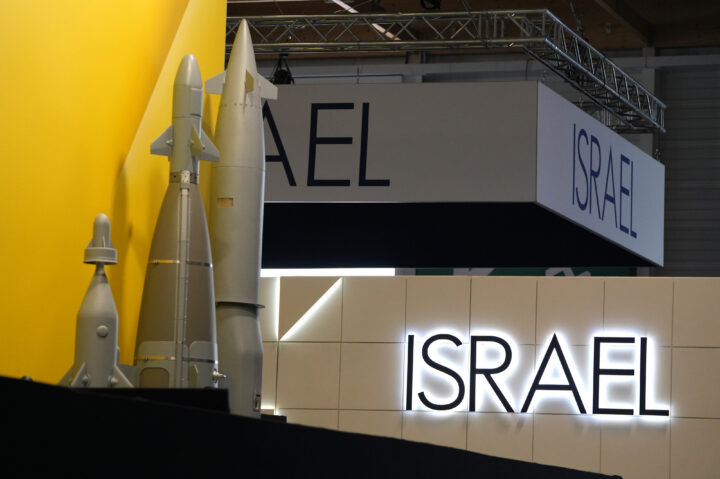
A display of air-to-surface munitions at the Elbit Systems Ltd. zone inside the Israel aerospace pavilion at the Paris Air Show in Paris, France, on Monday, June 16, 2025.
Israel is ending all defense procurement from France, the Israeli Defense Ministry said, citing Paris’ hostile posture toward Jerusalem and a desire to increase domestic production and purchases from allies.
“Israel will reduce all defense procurement from France to zero, replacing it with domestic Israeli procurement or purchases from allied countries,” Israel’s Ministry of Defense told Politico on Tuesday.
Maj. Gen. Air Baram, the director general of the ministry, said on Israel’s Channel 12 that the move is part of a larger effort to decrease military dependence on and partnerships with nations that have strained diplomatic relations with Israel.
The ministry also canceled meetings with France’s minister of the armed forces, instead insisting that “there will be no new professional engagement with the French military.”
The move is the latest rift in the bilateral relationship that has sharply deteriorated following the Oct. 7, 2023, terrorist attacks. During the Israel-Hamas war, France took a critical stance toward Jerusalem’s military conduct in the Gaza Strip and worked to pressure Israel to halt operations.
In September of last year, French President Emmanuel Macron became one of the first major U.S. allies to recognize Palestinian statehood. In that same month, Macron had said that Israel’s operations in Gaza were “making so many civilian casualties and victims that [Jerusalem is] completely destroying the credibility and image of Israel not only in the region but in public opinion everywhere.”
President Donald Trump has also expressed frustration with France for its actions amid the war in Iran, including prohibiting planes with military supplies destined for Israel from flying over its territory. He wrote on Truth Social that Paris has been “VERY UNHELPFUL” and that “The U.S.A. will REMEMBER!!!” — a post that surprised French officials.
Paris has also moved to limit Israeli participation in defense forums, barring dozens of Israeli companies from the Eurosatory 2024 exhibition, restricting their presence at the 2025 Paris Air Show and suspending export licenses.
Experts told Jewish Insider that the latest announcement is likely political posturing and will not have any practical impact on Israel given that defense ties between the two countries have already been on the decline.
“Israeli procurement from France was apparently quite limited and since the Israeli Ministry of Defense initiated the cut-off, they made the calculation that they could replace the items they obtain from France,” said Michael Eisenstadt, a fellow at The Washington Institute for Near East Policy. “I suspect there will be no practical consequence for Israeli manufacturers.”
A parliamentary report published in late 2025 found that France approved more than 200 dual-use export licenses to Israel in 2024 totaling €76.5 million — a roughly 60% drop from the previous year.
Eisenstadt noted that the latest action from Israel will not impact “collaboration between private companies or entities.” Existing agreements are expected to be upheld, and private firms can continue pursuing deals.
“Israel has lost patience with French criticism and unreliability,” Edmund Fitton-Brown, a former British diplomat and senior fellow at the Foundation for Defense of Democracies, told JI. “The fact is that Israel has historic reasons not to trust France, and now no longer needs France.”
Fitton-Brown said that moving forward Israel may increasingly “rely on the U.S. to represent its
interests in international affairs.” He similarly said that it will likely not have much impact on Israel.
“Israel is increasingly all-in with the U.S. as a defense partner, which makes diversifying defense supply an irrelevance,” Fitton-Brown said. “France has been the most disappointing of Israel’s European friends, adopting neutral or even hostile positions on a range of issues: recognition of a Palestinian state, a failure to back Israel fully against Hezbollah in Lebanon, ambivalence and obstruction regarding the U.S.-Israeli campaign against Iran.”
Please log in if you already have a subscription, or subscribe to access the latest updates.
 Continue with Google

 Continue with Apple