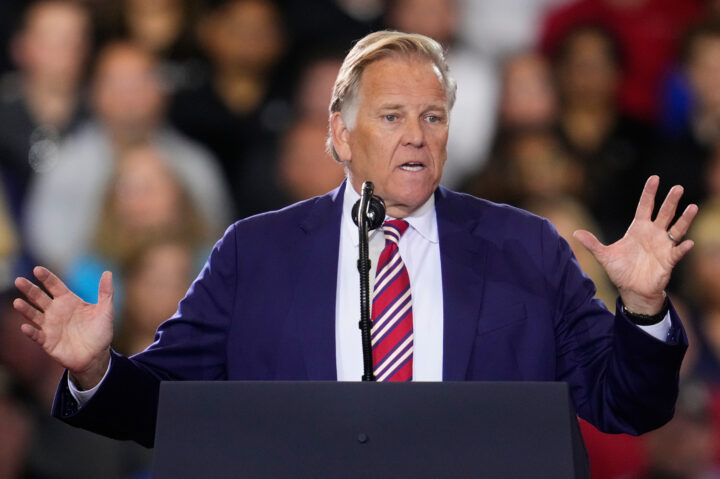
Paul Sancya/AP
Republican Senate candidate Mike Rogers speaks before President Donald Trump at an event at the General Motors Proving Ground Monday, July 27, 2026, in Milford, Mich.


 Add JewishInsider on Google
The debate over AIPAC’s involvement in the high-stakes Michigan Senate race is drawing renewed attention after an Axios report outlined a request from allies of former Rep. Mike Rogers (R-MI) for the pro-Israel group’s super PAC to lay low for the general election. The Rogers campaign advisors suggested instead that the group transfer money for the race to a separate pro-Rogers entity so as not to make its outside spending a major issue in the contest.
The episode has touched a lot of raw nerves in both the pro-Israel world and the Republican political landscape. Rogers, a longtime supporter of the U.S.-Israel relationship, is highlighting his relationships with Michigan’s Jewish community, and has made attacking Democratic nominee Abdul El-Sayed’s anti-Israel virulence and his relationship with antisemitic figures like Hasan Piker a central element of his campaign message.
AIPAC’s super PAC, United Democracy Project, spent about $32 million in the Democratic primary to try to defeat El-Sayed, and there’s little doubt its money — in the absence of any moderate group willing to spend similar resources to stop a far-left candidate like El-Sayed from winning — made the race more competitive than it otherwise would have been. But it also gave El-Sayed a talking point in attacking outside money in the race that diluted the impact of the aggressive advertising campaign, especially at a time when support for Israel itself is diminishing within the Democratic Party.
Both the Rogers campaign and AIPAC see El-Sayed as uniquely vulnerable, with polls showing the race statistically tied despite the overall favorable environment for Democrats in the swing state. But beyond focusing on winning the race, both sides have slightly different tactical imperatives: AIPAC, after coming close to defeating El-Sayed in the primary, wants credit for helping finish the job in the general election. Rogers, meanwhile, is trying to turn the tables on El-Sayed, using his endless primary campaign attacks on Israel as a way to underscore he’s more obsessed about the Middle East than the issues critical to Michigan voters.
On one hand, support for Israel is decidedly higher among the general electorate than it was among primary voters — and likely is a winning issue for Rogers, especially given El-Sayed’s radicalism on the subject. But populist concerns about foreign aid and engagement abroad still resonate across party lines, with 44% of Michigan voters in a recent Fox News survey saying they favor continued military aid to Israel, while 55% oppose such aid.
The Rogers campaign believes that making the race about Middle East policy would be shortsighted, especially given that El-Sayed’s record and background makes him vulnerable to the charge that he’s the candidate more consumed with international affairs than improving the lives of Michiganders.
Furthermore, unlike in the Democratic primary, there will be no shortage of money available for the Rogers campaign and its allies in the general election. Rogers has been a solid fundraiser, and the deep pockets of both the Senate Leadership Fund GOP super PAC and a separate pro-Rogers super PAC should offer more than enough resources to run a full-fledged campaign. Rogers’ campaign would prefer donations get directed — and spent — under the Republican Party umbrella.
There’s a reason AIPAC’s super PAC hardly ever spends in general elections — most competitive races are already saturated with cash, so its involvement (or that of any outside nonpartisan super PAC) wouldn’t make much of a difference anyway.
AIPAC’s concerns are understandable as well, and I have heard them echoed by several senior GOP strategists involved with the race. El-Sayed’s ties to extremists and inability to forthrightly condemn antisemitism in his home state is a major reason why he’s vulnerable in the first place. Diluting or downplaying that argument takes one of the campaign’s strongest angles off the table.
It’s one thing to debate about whether advertisements would be best aired under the GOP banner or the UDP banner. It’s another issue to be concerned that the Rogers’ campaign, in its desire to universalize the race, isn’t taking full advantage of winning over the many Democratic-friendly Jewish voters who view El-Sayed’s record as intolerable. Asking AIPAC’s chair to stand down its ad campaign, as reported in the Axios story, might have been a tactical dispute, but it risks coming across as downplaying the importance of the pro-Israel and Jewish communities in the state.
Ultimately, the goals of the two sides are the same: winning the race. If the differences between the Rogers’ campaign and AIPAC are tactical, that’s understandable in a lengthy campaign. But if it’s a dispute about who gets credit for taking down El-Sayed, the argument seems a bit frivolous when the stakes in the race are so high.
The Democratic congresswoman said AIPAC supporters are ‘good Americans who care about democracy and freedom’
Finn Gomez/Getty Images
Rep. Haley Stevens (D-MI) speaks to the press after casting her ballot at Baldwin Public Library on Aug. 4, 2026 in Birmingham, Michigan.
Rep. Haley Stevens (D-MI) dismissed the notion on Wednesday that campaign spending in her favor by AIPAC’s super PAC backfired in her failed bid for U.S. Senate, and defended the pro-Israel group as Jewish Americans participating in the democratic process.
Stevens, who lost the Michigan Democratic Senate primary to Abdul El-Sayed last week, has faced scrutiny from progressive Democrats over her support for Israel and the role of AIPAC in supporting her campaign. Following her primary loss, Stevens endorsed El-Sayed, who is now facing former Rep. Mike Rogers (R-MI) in the November general election.
Asked by CNN’s Pamela Brown whether AIPAC’s involvement ultimately hurt her campaign, Stevens remained firm.
“No, I don’t,” Stevens said. “I mean, I think that there [were] a lot of people talking about it, and they didn’t love it because maybe they don’t understand what the group is. AIPAC is a group of six million Jewish Americans, a lot of Jewish moms whose kiddos spend time in Israel.”
“They’re scared, just like a lot of people are scared, for a variety of different reasons here in America,” she continued. “They’re really good Americans who just care about democracy and freedom.”
Stevens said she remains “proud of the campaign I have run,” as well as the “friendships and relationships” she maintains within AIPAC, asserting that the pro-Israel lobbying group, “just like some of the other large groups, is going to continue to exist.”
“Obviously, I don’t work for the organization, so in terms of how they pitch themselves and sell themselves, that — I will leave that to them,” Stevens said, noting that “a lot of people are deeply frustrated that [Israeli Prime Minister Benjamin] Netanyahu has failed to give us peace.”
The congresswoman emphasized, however, that AIPAC was not the only outside entity involved in the primary, noting that “a bunch of Democratic money got involved, too” and that “Abdul also had super PACs and outside monies and all that going on.”
Addressing whether Jewish voters might still harbor concerns over El-Sayed, despite her decision to rally behind him, Stevens acknowledged that “there’s going to be a private and personal decision made by Michigan’s Jewish community.”
“I deeply respect and cherish the relationship that I have with Michigan’s Jewish population. I am a Zionist Democrat. I’m saying that live on CNN. I’m standing by the Jewish community,” Stevens said.
However, Stevens emphasized that Michiganders ultimately “don’t want to see this seat go to a Republican.”
“He’s [El-Sayed] going to do a ton more for healthcare than Mike Rogers ever will. He will stand up for women’s health as well,” Stevens. “And he has rejected socialism, which I appreciate.”
After 104 members of the House voted last week in favor of an amendment to eliminate military aid to Israel, pro-Israel activists who have spent years building ties with lawmakers are now wondering how to approach those relationships
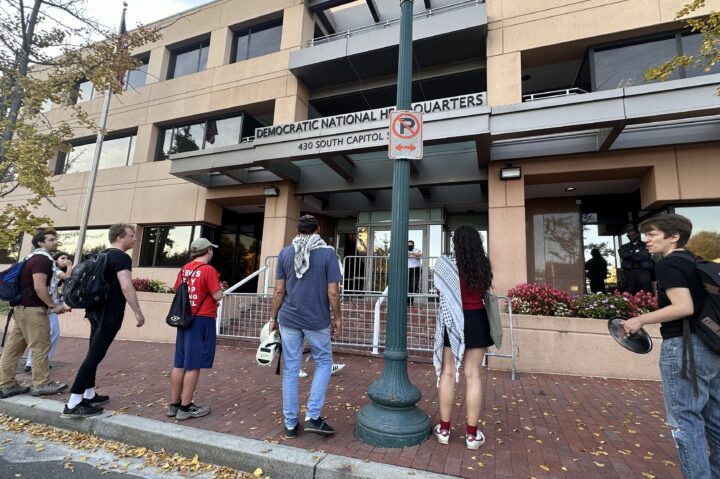
(Yasin Ozturk/Anadolu via Getty Images)
A group of demonstrators hold a noise protest outside the Democratic National Committee Headquarters in Washington D.C., United States on October 31, 2024.
Before AIPAC began spending tens of millions of dollars per election cycle on campaigns, back when it was purely an advocacy organization that touted its relationships with many of the 535 members of Congress, the pro-Israel group used to describe its approach to Capitol Hill with a cheeky, upbeat motto: “You have friends, and you have potential friends.”
But when former Bay Area AIPAC leader Naomi Lauter used to invoke the slogan, she added a third category: “Friends who have a little less potential than others.” Lauter died in 2017, but the saying still resonates with her son, Sam, who is a major Democratic donor and pro-Israel activist in his own right — and who is now wondering whether that third category might be growing even larger.
After 104 members of the House voted last week in favor of an amendment to eliminate all $3.3 billion in annual military aid to Israel, pro-Israel activists across the country who have spent years building ties with lawmakers are now wondering how to approach those relationships following a vote that some see as a betrayal. Even many longtime Israel supporters — including Reps. Jack Auchincloss (D-MA), Glenn Ivey (D-MD), Laura Friedman (D-CA), Nancy Pelosi (D-CA) and Pat Ryan (D-NY) — voted for the amendment, which did not pass. Pro-Israel activists who spent years building trust and gaining access to these lawmakers are now grappling with whether whether those relationships are still worth their continued investment.
To borrow from AIPAC’s old slogan: Are the lawmakers who voted for the amendment still considered friends — or potential friends — of the U.S.-Israel relationship? Or was their vote against the annual aid package to Israel, and against a bill that was opposed by a wide swath of nonpartisan and Democratic Jewish groups, a crossing-the-Rubicon moment that cannot be undone?
Friends and backers of the members of Congress who voted for the amendment are struggling to answer those questions. Several who spoke to Jewish Insider said that a single vote on a measure that was sure to fail should not spell the end of years of friendship. But even as they acknowledged the seismic reverberations of the vote, many also spoke of the need to tread carefully at a politically uncertain moment.
“Our issues are too important to not hold onto the ability to have a conversation with the person, because the votes are not going to end. It’s not going to all of a sudden stop,” Sam Lauter said. He talked to several members of Congress in the days before the vote, including Pelosi, urging them to vote no.
“It’s not a good trend line, but also this idea that we’ve lost the Democrats — let’s not create self-fulfilling prophecies here. There’s an opportunity for us to turn some of this around,” Tyler Gregory, CEO of the Bay Area Jewish Community Relations Council, said. “I am optimistic that several of them could be flipped if the vote had actual consequences, and I think that’s the job ahead of us.”
“Now, if someone said to me, ‘You know what, I voted yes, and my reasoning was because actually I don’t think we should be allies with Israel anymore, and I have no interest in the friendship with the community or the country, I’m done.’ Well, OK, that friendship’s done,” said Lauter.
This vote was destined to fail, but Tyler Gregory, CEO of the Bay Area Jewish Community Relations Council, called it “a dress rehearsal.” It will not be the last time U.S. aid to Israel comes up for a vote, and Gregory said he will need to lean on those lawmaker relationships in the future when the vote is more consequential.
“It’s not a good trend line, but also this idea that we’ve lost the Democrats — let’s not create self-fulfilling prophecies here. There’s an opportunity for us to turn some of this around,” Gregory said. “I am optimistic that several of them could be flipped if the vote had actual consequences, and I think that’s the job ahead of us.”
Halie Soifer, who served as an advisor to then-Sen. Kamala Harris (D-CA), now leads the Jewish Democratic Council of America, which urged members to vote against the amendment — as did Democratic Majority for Israel and the more liberal J Street. She called the vote “an inflection point,” but said the group is not considering removing its endorsements of lawmakers who supported the amendment.
“We’ve maintained a very consistent, principled position with regard to aid for Israel, and it’s not us that shifted,” Soifer said. “There is clearly a fast-moving shift within the Democratic Party itself, and we’re considering what that means.”
When asked whether she had ever seen so many candidates shift their positions on an issue within a single two-year election cycle, Soifer answered directly: “Absolutely not.”
AIPAC responded to the vote by no longer allowing donations, through its political action committee, to the 18 lawmakers it endorsed who voted for the measure.
“AIPAC members across the country watched this vote closely and are making sure their representatives in Congress who stood on principle hear that they’re appreciated,” AIPAC spokesperson Deryn Sousa told JI.
“The reality is these are our representatives. There is a relationship that we have with most of them, and they continue to be our representatives today, tomorrow, next week,” said Jeremy Burton, the CEO of the Greater Boston Jewish Community Relations Council. “The ones who say, ‘No, I’m still committed to Israel’s security and the Jewish community,’ things like that — and I’m not going to quote any one of them — but the ones who are saying that in these private conversations, it’s incumbent upon them now to show what that means.”
Many activists who have relationships with lawmakers are taking the long view, arguing that cutting ties now will not help in future battles. For a lot of them, Israel is not the only issue about which they are concerned.
Jeremy Burton, the CEO of the Greater Boston Jewish Community Relations Council, said he knows that some Jewish Bostonians have told Massachusetts’ congressional representatives, all of whom voted for the amendment, that this moment represents a “break point.” But as the leader of a nonpartisan organization, he cannot end relationships over a disagreement on one vote. He has other issues — such as nonprofit security funding and cooperation on fighting antisemitism — to consider.
“The reality is these are our representatives. There is a relationship that we have with most of them, and they continue to be our representatives today, tomorrow, next week,” said Burton. “The ones who say, ‘No, I’m still committed to Israel’s security and the Jewish community,’ things like that — and I’m not going to quote any one of them — but the ones who are saying that in these private conversations, it’s incumbent upon them now to show what that means.”
For one Jewish former Biden administration staffer, voting to cut off security aid to Israel must be the red line.
“They’re like, ‘Don’t worry about it. It’s just symbolic.’ Well, no, you’re telling us not to care about it, but clearly other people care about it, and that’s why you’re voting in that way,” said the staffer, who requested anonymity to speak about communal organizations they support. “I don’t think the Jewish community should be giving these people a pass right now, and I believe that’s actually creating an incentive for them to actually take these votes against us and against our interests, because there’s no political consequence or repercussions for them.”
House Minority Leader Hakeem Jeffries (D-NY) said on Thursday that Democrats will adopt a new approach to Israel if the party regains control of the House in November. “The current status quo is unsustainable,” said Jeffries, who voted no on the amendment.
“On one hand, I am really disappointed to see some true friends of mine and Israel vote for the [amendment] or vote ‘present,’” said Jennifer Laszlo Mizrahi, a Jewish philanthropist and disability rights advocate in Maryland. “On the other hand, as an American and as a Jew, I am horrified by how Netanyahu and his administration treat Palestinians in the West Bank, give Haredim the ability to be draft-dodgers and don’t show empathy when legitimate security operations accidentally kill an innocent child.”
Many of the 103 Democrats who voted “yes” released statements saying that they still support America’s relationship with Israel, but that they viewed the amendment as a symbolic way to tell Israeli Prime Minister Benjamin Netanyahu that they disagreed with his handling of the wars in Gaza and Iran.
In doing so, they tapped into a difficult reality for many of the Jewish activists who wanted to see the measure defeated. Many of those activists also wish Netanyahu would do more to take the concerns of Democrats and liberal Jews into account, even as they think Washington should continue supporting Jerusalem’s security needs.
“On one hand, I am really disappointed to see some true friends of mine and Israel vote for the [amendment] or vote ‘present,’” said Jennifer Laszlo Mizrahi, a Jewish philanthropist and disability rights advocate in Maryland. “On the other hand, as an American and as a Jew, I am horrified by how Netanyahu and his administration treat Palestinians in the West Bank, give Haredim the ability to be draft-dodgers and don’t show empathy when legitimate security operations accidentally kill an innocent child.”
In Los Angeles, Democratic donor and pro-Israel activist Howard Welinsky said many of the “yes” votes were a result of political “noise” — namely, concerns about current or future primary challengers from the left. “It’s the volume of the noise, and some members of Congress have more intellectual capacity to withstand it, and others have less,” said Welinsky.
So he is holding out hope that a change in Israel’s political leadership might help rectify Israel’s plummeting support among Democrats. “I just pray that Oct. 27” — the day Israel goes to elections — “gives Israel a new prime minister, and we can turn a page,” said Welinsky.
DeLauro has long publicly affiliated more closely with J Street than AIPAC, but AIPAC has maintained its support for and endorsement of the senior Democrat
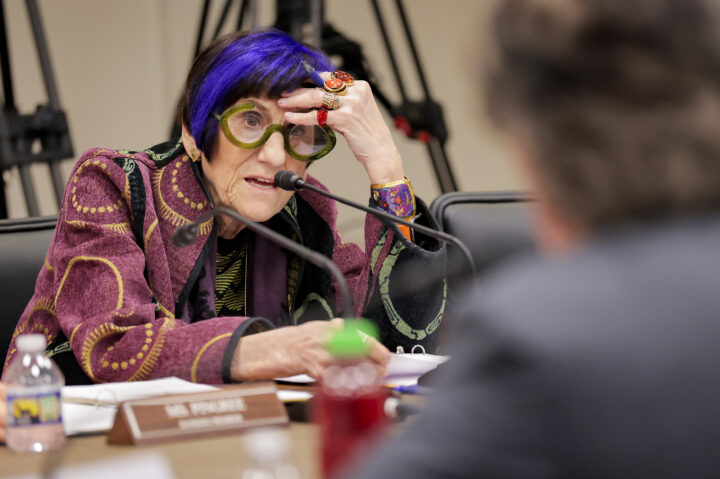
(Heather Diehl/Getty Images)
Rep. Rosa DeLauro (D-CT) questions Interior Secretary Doug Burgum during a House Appropriations Committee hearing at the Rayburn House Office Building on April 20, 2026 in Washington, DC.
Rep. Rosa DeLauro (D-CT), the ranking Democrat on the House Appropriations Committee, said she’ll no longer accept support from AIPAC, a major break with the pro-Israel group by one of the key power players in the House.
As the top Democrat on the Appropriations Committee, in line to again be the committee chair if Democrats retake the House, DeLauro has significant sway on federal funding matters, including the provision of aid to Israel.
DeLauro has long publicly affiliated more closely with J Street than AIPAC, and has staked out some positions more critical of Israel, including floating conditions on U.S. aid. But AIPAC has maintained its support for and endorsement of the senior Democrat, whose voice can be crucial to advancing its priorities.
“Congresswoman Rosa DeLauro is taking no contributions from AIPAC. She did in prior years when she believed Israel was acting like a strategic partner & was committed to a two-state solution,” DeLauro’s campaign manager Allison Dodge said in a statement posted on X. “It is abundantly clear now that the Netanyahu government has no interest in either.”
Dodge emphasized that DeLauro has “repeatedly called out the humanitarian crisis in Gaza and Israel’s annexation of the West Bank,” as well as pushed for additional aid to Gaza and an amendment in the 2027 Defense Appropriations bill that would “ensure U.S. weapons and equipment are not being used in violation of the ceasefire.”
Shapiro, to Politico: ‘When you have people who are advocating for issues that they feel strongly about and they are having their voices silenced, I think that's a problem in our system’
Peter W. Stevenson/The Washington Post via Getty Images
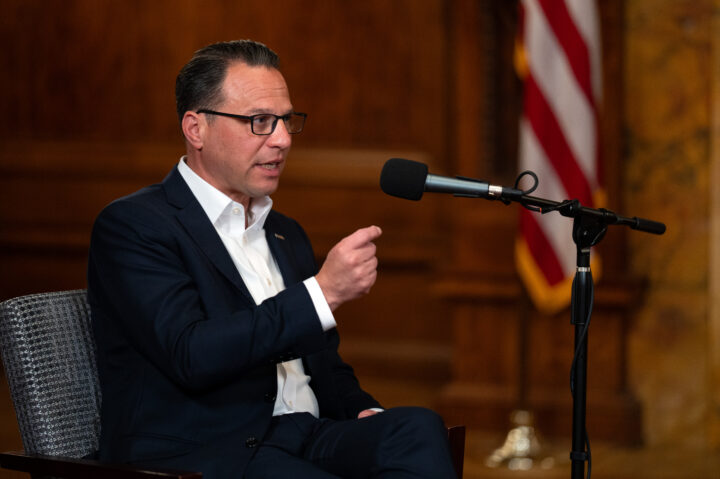
Pennsylvania Gov. Josh Shapiro sits for an interview at the Pennsylvania State Capitol on June 11, 2025.
Pennsylvania Gov. Josh Shapiro warned of the dangers of efforts within the Democratic Party to single out AIPAC, telling Politico in a new interview that painting the pro-Israel group as “toxic” could be seen as silencing Jewish voices in the American political system.
“I think it’s been used cynically by some to try and silence certain voices, to try and say that certain people participating in politics shouldn’t count, or should be viewed in a toxic way,” Shapiro said in the interview, which was released on Tuesday.
Where some Democrats have recently distanced themselves from AIPAC, Shapiro declined to do so.
“Do I agree with every political decision they’ve made, every endorsement they made? Of course not,” said Shapiro. “I think what we have seen is a weaponization of that. And I think that is a danger for our system. When you have people who are advocating for issues that they feel strongly about and they are having their voices silenced, I think that’s a problem in our system.”
Shapiro, a potential 2028 presidential contender, declined to say whether he would accept support from AIPAC, which does not get involved in state or presidential races, nor did he address AIPAC’s tactics or its involvement in any particular race.
He cautioned that efforts to vilify the group have sometimes crossed a line into targeting American Jews’ political advocacy, noting that sometimes Jewish donors who currently or have in the past supported AIPAC are tarred just for being part of the political process.
“I think it does get blurred because now what you are seeing is not ‘AIPAC money,’” said Shapiro, “but you’re getting the Jews who give to that candidate who also support AIPAC. I think it’s very dangerous in our system, if you are trying to silence certain voices based on their race, based on their faith, based on their particular ideology.”
Pennsylvania Gov. Josh Shapiro is warning about the dangers of efforts within the Democratic Party to single out AIPAC.
— Jewish Insider (@jewishinsider) May 26, 2026
“I think it’s been used cynically by some to try and silence certain voices, to try and say that certain people participating in politics shouldn’t count, or… pic.twitter.com/uighmwoMgu
Shapiro, who is one of the most prominent Jewish politicians in the U.S., described a “dramatic spike in antisemitism across this country.” He condemned the Islamophobic attack on a mosque in San Diego last week in which three people were killed while also pointing out that, overall, antisemitism is a much larger problem than other forms of hate.
“There is rising hatred and bigotry targeting people across the board, but it is also undeniable, and no one’s pain is greater or more important than others, but from a data perspective, there has been a dramatic spike in antisemitism that is unmatched elsewhere, and that’s a problem,” said Shapiro.
Asked whether he plans to run for president, Shapiro declined to answer. But he said his family had to consider whether he should run for reelection this year in Pennsylvania after an arson attack on the governor’s mansion last year on the first night of Passover.
“My family and I spent a bunch of time thinking about running for reelection. It is hard for me as a dad to know that doing this job I love, this job I find great purpose in where I get to help people, puts my kids’ lives at risk,” said Shapiro. “I’m not going to cower. I’m not going to be fearful.”
The pro-Israel Democratic group warns that nominating far-left candidates will cost the party winnable seats against GOP incumbents

Daniel Knighton/Getty Images
City of San Diego Councilmember Marni von Wilpert rides in the Port of San Diego Holiday Bowl Parade on December 28, 2022 in San Diego, California.
As Democratic Majority for Israel prepares for the midterms amid growing divisions in the party over Middle East policy, the pro-Israel group is now focusing much of its energy on three under-the-radar House races for swing seats in California and Colorado that could be key to the party’s chances of reclaiming the majority in Congress.
In those primaries, DMFI’s political arm recently endorsed a trio of relatively moderate, pro-Israel Democrats facing opponents whom, the group feels, have demonstrated anti-Israel records or questionable positions on Middle East policy — qualities that could hamper their odds of winning Republican-held districts in the November election.
“These definitely rank high on our list of priorities,” Brian Romick, DMFI’s president and the chair of its super PAC, said in an interview with Jewish Insider on Tuesday. “These are all strong places where this matters.”
DMFI’s political arm is backing Marni von Wilpert, a San Diego councilwoman seeking the nomination in California’s 48th Congressional District; Jasmeet Bains, a California assemblywoman and a physician competing in the state’s 22nd District; and Shannon Bird, a former Colorado legislator running to unseat a vulnerable freshman Republican in the state’s 8th District. The nonpartisan Cook Political Report has ranked each of the races as “toss-ups” in its election forecast.
“We think all three of these candidates are strongly pro-Israel and have great relationships and records with the community,” Romick noted, calling them “the kind of candidates we need who can win both primaries and generals” and “hold these seats over the long term.”
DMFI’s efforts underscore how the organization is choosing to highlight consequential races in which the interests of Democratic Party leaders converge with its own, a notable alignment during a moment when Israel — and outside spending from pro-Israel groups — has emerged as one of the most polarizing sources of internal conflict in reliably blue districts.
One of DMFI’s “major goals” this cycle, Romick explained, is to “both elect pro-Israel candidates and help Democrats take back the House,” citing Republicans’ narrow three-seat majority as partly motivating its calculus. “If we win these three seats, then Democrats are in the majority with pro-Israel candidates.”
“I don’t think that anyone else is in that lane, and I think that’s an important distinction for us,” he told JI.
Romick declined to share if DMFI PAC plans to invest in the three primaries, following election cycles in which the group has spent heavily to help unseat vocally anti-Israel Democrats in deep blue House districts. “Possibly,” he hinted. “But I don’t want to show my hand.”
Here’s a rundown on the state of play in those races:
San Diego showdown
In California’s 48th District, redrawn last year to give Democrats an edge, von Wilpert is running in a crowded open primary to replace Rep. Darrell Issa (R-CA), who has long been a fixture in state and national politics. Her top opponent in the June race, Ammar Campa-Najjar, twice unsuccessfully competed for the seat in 2018 and 2020 — and is familiar to voters as a perennial candidate in a district covering the San Diego area.
Campa-Najjar outraised the field in the last quarter of 2025 and has claimed endorsements from a range of House members — including his girlfriend, Rep. Sara Jacobs (D-CA).
During his race against Issa in 2020, Campa-Najjar, who is of mixed Palestinian and Mexican-American descent, stressed support for Israel as an important strategic partner, broadly aligning with mainstream Democratic sentiment regarding Middle East policy. He said in a candidate questionnaire solicited by JI at the time, for instance, he believed the U.S. should maintain foreign aid to Israel.
In a statement to JI on Tuesday, Campa-Najjar said his “Middle East foreign policy remains consistent,” arguing that the “United States must help broker a lasting peace to end the bloodshed between Israelis and Palestinians.”
“As a new member of Congress, I’ll put forward a meaningful agenda for the day after that promotes a stable, secure, and prosperous future for both Israel and Palestine,” he continued. “That future is only possible with new leadership, with Palestinians no longer under Hamas rule and the Israelis no longer burdened by Netanyahu’s failures,” he added, in a reference to the right-wing Israeli prime minister.
Still, Romick echoed other critics of Campa-Najjar in noting that the candidate had previously changed his positions on key issues as part of a conservative makeover in his last election, raising questions over his commitment to upholding support for Israel as a lawmaker.
“He’s on record as anti-Trump. He’s on record as pro-Trump,” Romick said. “You never know what you’re going to get and that’s obviously dangerous when people shift a lot on Israel.”
Andrew Lachman, the political committee chair of California Jewish Democrats, said his organization reviewed questionnaires from both candidates and concluded that von Wilpert’s record in backing Jewish community causes was more substantive. The group gave von Wilpert a rating of “strong support” and is “neutral” on Campa-Najjar.
“Campa-Najjar seems interested in building a relationship with the Jewish community, but with respect to a record of resolutions and legislation to support the Jewish community, von Wilpert had a voting record and a record of supporting the Jewish community that was much more clearly defined,” he told JI.
For her part, von Wilpert said in a statement to JI that she “strongly” supports “Israel’s right to exist as a secure, Jewish democratic state and defend itself from the real threats it faces.”
“To me, ensuring Israel’s security and building peace for all in the region, including getting the two-state solution back on track, are inseparable, and U.S. leadership is indispensable to achieving both outcomes,” she added. “Only when a nation feels safe and secure, can it take the necessary steps to make peace.”
Both von Wilpert and Campa-Najjar are endorsed by J Street, the progressive Israel advocacy group.
Last week, Jim Desmond, a Republican member of the San Diego County Board of Supervisors, also filed to run for the seat that is now being vacated by Issa.
Under the newly drawn district lines, former Vice President Kamala Harris would have narrowly defeated President Donald Trump by three points.
Bakersfield battle
In a GOP-held district hours north of San Diego that includes part of Bakersfield, Bains is facing off against a progressive rival, school board trustee Randy Villegas, to challenge Rep. David Valadao (R-CA), who took office in 2021 but is now confronting a difficult national environment for Republicans. .
Villegas has gained endorsements from some of the most prominent Israel critics in Congress, including Sen. Bernie Sanders (I-VT) as well as Reps. Pramila Jayapal (D-WA) and Ro Khanna (D-CA), along with the virulently anti-Israel AIPAC Tracker, which said in a social media post that Villegas had signed on to a January 2024 letter pressing for “an immediate ceasefire in Gaza and to end the weaponization of antisemitism claims against Israel’s critics.”
“In Congress, Randy will fight to end the flow of unconditional military aid to Israel that fuels the ongoing genocide in Gaza and ethnic cleansing in the West Bank,” AIPAC Tracker said in its January endorsement. “He is ready to champion a foreign policy that centers human rights over militarism.”
Villegas’ campaign did not respond to a request for comment about his foreign policy views concerning Israel.
Speaking with JI, Romick characterized Villegas as “the most obvious” source of concern for pro-Israel Democrats among the three primaries that DMFI is now eyeing, referring in part to his early demand for a ceasefire just a few months after the Oct. 7 Hamas attacks. “He consistently has an anti-Israel record,” Romick said.
Lachman, meanwhile, said his group had not yet weighed in on the primary. “I do know that Bains has a reputation as a fighter for progressive values, but one who can build coalitions in order to sustain them,” he told JI. “Whereas, I don’t think Villegas is known for that.”
In a statement shared with JI on Tuesday, Bains said she believes “in Israel’s right to exist, defend itself and live in peace as a secure nation.”
“As a doctor,” she pledged, “my priority will always be protecting all human life and for that we must ensure advancing lasting peace. That’s why I believe a two-state solution is a necessary path forward to ensure long-term security and the dignity of people across the region.”
Valadao, for his part, is backed by AIPAC, which calls the congressman “a steadfast supporter of the U.S.-Israel alliance throughout his six terms representing the Golden State’s Central Valley.”
Colorado clash
Meanwhile, in a Colorado House race to take on Rep. Gabe Evans (R-CO), two Democrats are vying for their party’s nomination with differing records of public commentary on Israel as well as the rise of antisemitism.
Bird, who resigned from the Colorado legislature in January to focus on her congressional bid, has long been vocal in her support for Israel and opposition to antisemitism, which she recently called a “global cancer” after the terror attack targeting the Jewish community in Bondi Beach, Australia late last year.
During the war in Gaza, she frequently highlighted the plight of hostages on social media while issuing statements standing with Israel. “Lessons learned from history make clear that the world must stand with and protect Israel,” she wrote in one X post in 2024. Bird’s campaign did not return a request for comment from JI.
By contrast, her chief rival in the June primary, Manny Rutinel, a progressive state representative, has condemned recent instances of antisemitism — but does not appear to have clarified his stances on key issues regarding Israel.
While he has garnered endorsements from some pro-Israel House members such as Reps. Adriano Espaillat (D-NY) and Rob Menendez (D-NJ), his past record of activism has raised some concerns among pro-Israel Democrats who privately worry he will assume a hostile approach to Israel if he is elected. Republicans have indicated that they are eager to run against him in the general election.
As an undergraduate at the University of Florida, for example, Rutinel attended a demonstration in 2014 that was co-organized by Students for Justice in Palestine, the extreme anti-Israel group that has recently expressed alignment with Hamas, according to a local news story covering the event at the time.
The campus demonstration was “aimed to raise awareness for police brutality in Ferguson, Mo., and military oppression in Palestine,” the article noted.
In a statement to JI, however, a spokesperson for Rutinel said he “has never affiliated with Students for Justice in Palestine.”
“While in college at the time of the Ferguson protests, he attended a demonstration to protest police brutality in the United States,” the campaign spokesperson explained. “Manny supports Israel’s right to exist and supports a two-state solution with secure borders to bring peace.”
Rutinel also “supports U.S. security assistance to Israel in line with the Obama administration’s 2016 memorandum of understanding,” the spokesperson added, when asked about his views on conditioning aid to Israel, which has become a litmus test of sorts for left-wing candidates.
Evans, an Army veteran endorsed by AIPAC, has cited his service in the Middle East as motivating his staunch support for Israel and opposition to a nuclear Iran. The first-term congressman is viewed as one of the most vulnerable House Republicans seeking reelection in a district north of Denver.
Netanyahu and Lapid are slated to address the convening via video, along with senior congressional leaders and a representative from the Trump administration, according to an AIPAC source
MANDEL NGAN/AFP via Getty Images
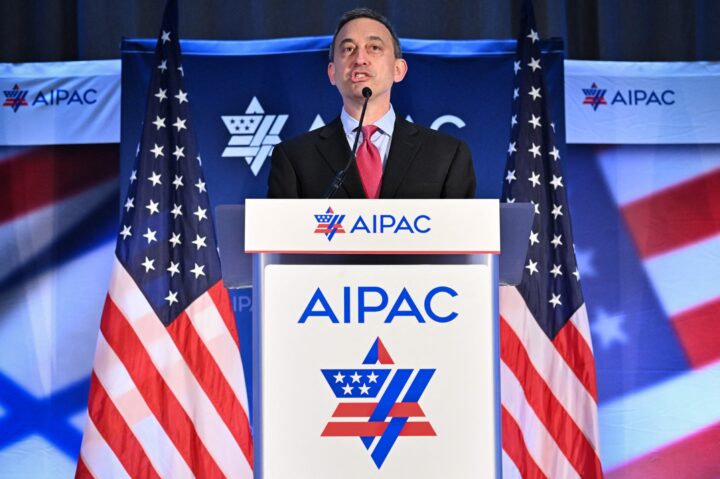
American Israel Public Affairs Committee (AIPAC) President Michael Tuchin introduces US Secretary of State Antony Blinken before his address to the AIPAC Policy Summit at a hotel in Washington, DC on June 5, 2023.
More than 1,000 of AIPAC’s top donors will gather in Washington this weekend for the pro-Israel group’s annual Congressional Summit, meeting at a moment of intense scrutiny surrounding the group’s political tactics.
Israeli Prime Minister Benjamin Netanyahu and Opposition Leader Yair Lapid are slated to address the convening via video, along with senior congressional leaders and a representative from the Trump administration, according to an AIPAC source. U.S. Ambassador to the U. N. Mike Waltz will speak at the conference, as will House Speaker Mike Johnson (R‑LA), Senate Minority Leader Chuck Schumer (D‑NY), House Minority Leader Hakeem Jeffries (D‑NY) and Sens. Tom Cotton (R‑AR) and Ted Cruz (R‑TX).
A spokesperson for Senate Majority Leader John Thune (R-SD) did not respond to a request for comment.
At the conference, AIPAC activists will work to “further accelerate the community’s political efforts this election cycle” and will meet with more than 400 members of Congress, according to the source with knowledge of AIPAC’s plans.
“Discussions will focus on the evolving threats facing Israel, the negotiations with Iran, solidarity with the Iranian people seeking freedom from a brutal regime, continued U.S. security assistance and expanding joint defense cooperation that will strengthen the security and strategic edge of both nations,” the source told Jewish Insider.
Supporters and critics alike are closely watching the group’s next moves after a very public defeat earlier this month. AIPAC spent more than $2.3 million on attack ads against former Rep. Tom Malinowski (D-NJ) in a Democratic primary in New Jersey, only for Malinowski to lose in a close race to Analilia Mejia, a far-left activist who will almost certainly take a much more hostile approach to Israel than Malinowski.
The former congressman, who was largely reliable on AIPAC’s core issues during his time in Congress but who supported conditioning aid to Israel after leaving office, called on Democratic leaders in an op-ed on Thursday to “collectively … refuse [AIPAC’s] support, instead of letting it pick off candidates one by one.”
That race, to represent a wealthy suburb just across the Hudson River from New York City, is one of several in which AIPAC’s heavy spending in Democratic primaries is drawing criticism. The group’s next major test will come in Illinois’ March 17 primaries. On Thursday, retiring Rep. Jan Schakowsky (D-IL) pulled her endorsement of Cook County Commissioner Donna Miller in one Chicago-area district, claiming Miller had received support from AIPAC, though the group has not actually endorsed Miller.
Through all of this, AIPAC has largely stayed silent. A spokesperson for AIPAC’s super PAC, United Democracy Project, told JI at the time that Malinowski’s loss to Mejia was “an anticipated possibility” but declined to comment further.
AIPAC’s decision to directly enter the political fundraising space in 2022 was a sharp pivot from the group’s previous tactics, which focused on lobbying members of Congress (which the group still does). It has been very successful in its involvement in primaries to date, winning most of the primaries it has engaged in and ousting in the 2024 election two sitting lawmakers hostile to Israel. But AIPAC has also made more than a few enemies from its aggressive spending tactics while failing to stunt the creeping animus towards Israel within the Democratic Party, especially on the left.
Its tactics have also come under scrutiny since its unsuccessful engagement in the New Jersey primary. The group had traditionally been disciplined, focusing on the most vulnerable targets rather than going after every critic of Israel. Their attack against Malinowski also jeopardized their frequent alliance with the moderate wing of the Democratic Party, which viewed Malinowski as an ally.
The question facing the group heading into the midterm elections is whether growing discontent with AIPAC among the party grassroots and a growing number of rank-and-file Democrats will impact its time-tested strategy of working with both parties’ leadership. But the decision by leading congressional lawmakers to attend the conference reveals that AIPAC’s bipartisan playbook is still effective, even as it shows signs of strain.
The group behind the pro-Hamas chants in Queens has a nationwide network and links to pro-terror organizations and individuals

Selçuk Acar/Anadolu via Getty Images
Anti-Israel demonstrators gather at 'No Settlers on Stolen Land' protest against a Nefesh b'Nefesh event at the Park East Synagogue in Manhattan in November 2025.
The group behind a pro-Hamas demonstration near a Queens synagogue earlier this month and a series of other events targeting Jewish religious institutions has deep pockets — and deep roots, which criss-cross the country and link it to various extremist cells — according to publicly available tax filings.
The demonstrators who broke into chants of “Say it loud, say it clear, we support Hamas here” outside Young Israel of Kew Garden Hills — and triggered outrage over New York City Mayor Zohran Mamdani’s belated condemnation — were affiliated with an outfit known by multiple names: Palestinian Assembly for Liberation (PAL), Al-Awda (Arabic for “the return”) and Palestine Right to Return Coalition (PRRC). But official filings with state and federal authorities reveal that the groups are different monikers of a single nonprofit operation, one whose revenue has exploded in recent years: from just $44,789 in 2022 to $451,903 in 2024, the most recent period for which filings are available.
The group also orchestrated the action targeting Park East Synagogue in Manhattan in November, and the “Flood Boro Park” rally that devolved into violence last February. On the day of Hamas’ Oct. 7, 2023, attacks on Israel, the organization issued a full-throated endorsement of the assault.
“The Palestinian Assembly for Liberation and Al-Awda NY send their highest salutations to the Palestinian Resistance, the Freedom Fighters and Defenders of the indigenous Palestinian people,” a post on its Facebook page reads. “PAL and Al-Awda NY call on Palestinians globally to take their place in history, and to mobilize in all fora in support of the Liberation Operation.”
The group helped organize a Times Square protest the following day, alongside multiple far-left organizations. Much of the blowback the event received from New York officials centered on the participation of the NYC chapter of the Democratic Socialists of America, of which Mamdani is and was a member.
However, materials promoting the demonstration show that its staging received support not just from PAL/Al-Awda/PRRC but also from the People’s Forum, a Manhattan-based arm of a global network financed by Beijing-based tech mogul Neville “Roy” Singham. Singham and his wife, Jodie Evans, have poured their massive fortune into advancing disinformation supportive of the Chinese government and its allies, Russia and Iran. The People’s Forum also hosted Al-Awda’s national conference in 2022, which featured speakers from the DSA BDS Working Group.
Social media and blog posts reveal that PAL/Al-Awda/PRRC has also worked closely with Evans’ organization CODEPINK, known for its tactics of disrupting Capitol Hill hearings and political events, and for its pro-China and pro-Iran activism. PAL/Al-Awda/PRRC has also long partnered with the Party for Socialism and Liberation and its affiliate, Act Now to Stop War and End Racism Coalition, which provides staff to the Singham network. All of these groups have been involved in the Shut It Down 4 Palestine protest campaign, as well as in the 2024 encampments at Columbia University.
PAL/Al-Awda/PRRC also has ties to Samidoun, a group identified by Israel, Germany, Canada and the United States as a fundraiser and affiliate of the Popular Front for the Liberation of Palestine, which has been designated as a terror group by the U.S. for decades. PAL/Al-Awda/PRRC and Samidoun have cross-promoted and participated in each other’s events for years.
Further, a booklet for a 2023 “People’s Tribunal” on the Al-Awda website identifies Samidoun co-founder Charlotte Kates as “a member of Al-Awda, The Palestine Right to Return Coalition,” and archived versions of a now-deleted page listing PAL/Al-Awda/PRRC’s national board identified Kates as the group’s “Communications/Secretary” from 2021-2023. These pages also reveal that Nerdeen Kiswani, the founder of Within Our Lifetime and an outspoken defender of militant group violence, served as PAL/Al-Awda/PRRC’s “Youth Representative” in these same years. During that same period, Kiswani was a student at CUNY Law School, and delivered a speech at the school’s 2022 commencement in which she alleged that she had “been facing a campaign of Zionist harassment by well-funded organizations with ties to the Israeli government and military.”
The national board also includes attorney Lamis Deek, who has publicly praised Hamas, the PFLP, and Iran’s Al-Quds intelligence force — and who officially launched the “Palestinian Assembly for Liberation” with other Al-Awda organizers in 2021.
The PFLP and Hamas are not the only terror organizations with which PAL/Al-Awda/PRRC and its leaders have shown affinity. The Anti-Defamation League discovered one of the group’s self-identified founders, Abbas Hamideh, lauded Hezbollah on his Twitter account.
Tax documents show PAL/Al-Awda/PRRC at present has just two officers on its board. The organization’s chair is Amani Barakat, part of a prominent business, real estate and philanthropic dynasty based in Southern California. The late family patriarch, Adil Barakat, was a leader in the Arab American Press Guild and the United States Organization for Medical and Educational Needs, a relief organization centered on Middle Eastern affairs.
PAL/Al-Awda/PRRC’s treasurer and only other listed executive is Anas Amireh, a Miami-area realtor who has lectured at Florida International University.
Barakat, Amireh and Deek did not respond to requests for comment, and messages left in an inbox and at a phone number listed on the Al-Awda website similarly received no answer.
The source of the group’s swelling resources isn’t clear from public information. It has received sizable contributions from “dark money” funds that mask the original contributor’s identity, as well as from the WESPAC Foundation, a New York-based charity that has come under fire for underwriting organizations that call for Israel’s destruction.
Labor for Palestine and U.S. Campaign for the Academic and Cultural Boycott of Israel are also both affiliated with PAL/Al-Awda/PRRC, and operate out of its address in Coral Gables, Fla.
Please log in if you already have a subscription, or subscribe to access the latest updates.
 Continue with Google

 Continue with Apple