













































































The poll found AIPAC viewed more favorably by Jewish Republicans and independents, while Democrats gravitated more to DMFI
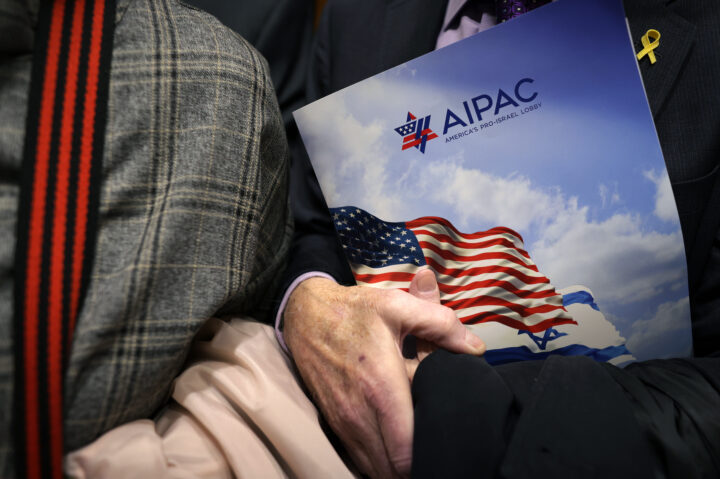
Alex Wong/Getty Images
A visitor holds an AIPAC folder in an elevator in Rayburn House Office Building on March 12, 2024 on Capitol Hill in Washington, DC.


 Add JewishInsider on Google
A recently conducted survey assessing how Jewish voters view leading Israel advocacy groups finds that public opinion is divided over the effectiveness of outside engagement in American elections.
The Mellman Group poll, commissioned by the Jewish Electorate Institute (JEI) and released last week, surveyed 800 registered Jewish voters between March 13-23. It found a narrow 39% plurality agreed that it “was more important than ever” for pro-Israel groups to play a leading role in speaking out against candidates who oppose a close U.S.-Israel alliance, while 37% of respondents feared that such advocacy risks making things worse.
The split largely was along partisan lines: While two-thirds of Jewish Republicans and 59% of Jewish independents backed strong pro-Israel political advocacy, just 28% of Democrats shared the same view. A near-majority (46%) of Democrats feared that pro-Israel electioneering could turn voters against Israel.
AIPAC’s super PAC, the United Democracy Project, has been playing a leading role in influencing contested primaries, predominantly on the Democratic side.
But while the group’s aggressive spending in last month’s Illinois Democratic primaries drew outsized attention in the national press, only 11% of Jewish respondents said they were paying a “great deal” of attention to pro-Israel groups’ activity in primaries. Over half of Jewish respondents (51%) said they were paying no attention at all or “not much” attention to pro-Israel engagement in politics.
The poll also tested the public perception of the three leading Israel advocacy groups in Washington: AIPAC, Democratic Majority For Israel and J Street. AIPAC held the highest favorability rating (39%), with 29% viewing the longtime pro-Israel group unfavorably, while 32% said they were unsure.
While Republicans and independent Jews overwhelmingly view AIPAC favorably, opinion was split among Jewish Democrats, with 29% viewing the group favorably, 37% viewing AIPAC unfavorably and 33% saying they were unsure.
DMFI boasted the highest net favorable rating among Jewish respondents, with 32% viewing the Democratic Party’s pro-Israel group favorably while just 16% viewed it unfavorably. Its numbers were strongest with Jewish Democrats and weakest with Jewish Republicans.
J Street, which came out last week against funding Israel’s Iron Dome missile-defense system, held a net unfavorable rating, according to the poll. Just 18% viewed the group favorably, while 19% viewed it unfavorably, with a 46% plurality having never heard of the progressive group.
The Anti-Defamation League said it is ‘alarmed’ by leading Saudi voices using openly antisemitic dog whistles while peddling conspiracy theories
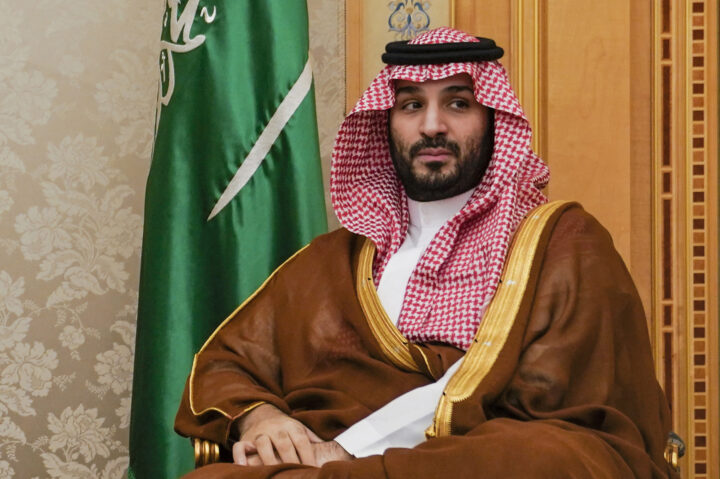
NATHAN HOWARD/POOL/AFP via Getty Images
Saudi Arabia's Crown Prince Mohammed bin Salman looks on during his meeting with the US Secretary of State in Riyadh on October 23, 2024.
Several leading Jewish and pro-Israel advocacy groups are expressing concerns about the impact of the recent rise in antisemitic and Islamist messaging out of Saudi Arabia, as the Gulf kingdom’s rhetoric is increasingly raising questions about its standing as a reliable U.S. ally in the region.
In recent weeks, Saudi Arabia has ratcheted up its anti-Israel rhetoric through state-sanctioned media and other regime mouthpieces, amid a widening rift with the United Arab Emirates and closer alignment with Islamist-oriented forces that are hostile toward Israel, such as Turkey and Qatar.
The new posturing, part of a broader pivot from what national security experts had seen as Saudi Arabia’s moderating influence in the region, has fueled surprise and frustration among Jewish American advocacy organizations that have pushed for the kingdom to normalize relations with Israel, an objective now regarded in some circles as unlikely for the foreseeable future.
Last week, the Anti-Defamation League said in a sharply worded social media statement that it was “alarmed by the increasing frequency and volume of prominent Saudi voices — analysts, journalists and preachers — using openly antisemitic dog whistles and aggressively pushing anti-Abraham Accords rhetoric, often while peddling conspiracy theories about ‘Zionist plots.’”
“This is harmful on many levels, diminishing the prospect of peaceful coexistence in the region and weakening regional initiatives promoting tolerance, understanding and prosperity,” the ADL added.
The pro-Israel lobbying group AIPAC, for its part, amplified a recent X post by Barak Ravid, a global affairs correspondent for Axios, who flagged what he called Saudi Arabia’s “information war against the UAE” and said “the Saudi press is full of articles that include anti-Israeli conspiracies, anti-Abraham Accords rhetoric and even antisemitic language.”
In a statement to Jewish Insider on Monday, Deryn Sousa, a spokesperson for AIPAC, emphasized that “America would be stronger and our interests would be better served if more nations, including Saudi Arabia, joined the Abraham Accords and worked together with our democratic ally Israel to promote regional peace, security and prosperity.”
Brian Romick, the president and CEO of Democratic Majority for Israel, echoed that sentiment, calling the Abraham Accords “a landmark diplomatic achievement” whose expansion, “especially through Saudi-Israeli normalization, should be a bipartisan pillar of U.S. policy.”
“A breakthrough between Israel and Saudi Arabia would be the most consequential step the region can take toward lasting peace, security, and prosperity, and the Trump administration should pursue it relentlessly while linking any upgrade in the relationship to measurable progress toward Saudi-Israeli normalization,” Romick said in a statement to JI. “Despite recent political frictions and unhelpful rhetoric, deep mutual interests in security, economic integration and technology make normalization an enduring strategic imperative.”
The American Jewish Committee, which has also promoted Saudi participation in the Accords, said it is “keeping a close eye on any developments” tied to the kingdom’s shift, but declined further comment.
While experts have linked Saudi Arabia’s recent animus toward Israel to such issues as the war in Gaza, Israeli recognition of Somaliland and unrest in Iran, Michael Makovsky, the president and CEO of the Jewish Institute for National Security of America, suggested that one unexplored motivating factor may be the Trump administration’s friendly relations with Islamist leaders in Turkey, Qatar and Syria.
“It sends a signal to the Saudis that you could take more Islamist positions, and it won’t hurt you with the United States,” Makovsky said in an interview with JI on Monday, arguing the administration will need to “reorient” its engagement in the region if it wants to help shape Saudi policies to align more closely with American interests.
But Makovsky said he has not seen interest among Trump officials in pursuing that path — even as the administration has long encouraged Saudi Arabia to join the Abraham Accords.
“I think the administration needs to step back and reflect on the fact that, if the Saudis are acting like this now, and they’ve been more of a moderating influence,” he said, “it should lead to a rethink of how they’re approaching all these other countries.”
Please log in if you already have a subscription, or subscribe to access the latest updates.
 Continue with Google

 Continue with Apple