










































































The U.S. ambassador to Turkey floated an overland route for regional trade centered on Iraq, sidelining the India-Middle East-Europe Economic Corridor meant to run through Israel
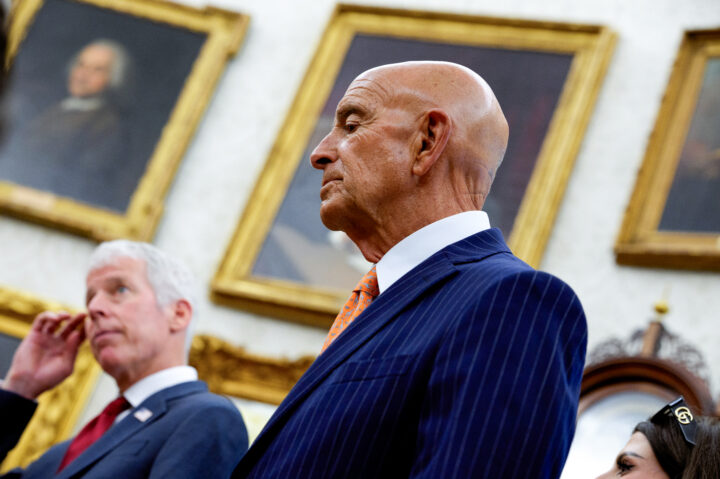
Photo by Andrew Harnik/Getty Images
U.S. Ambassador to Turkey Thomas Barrack attend a meeting with U.S. President Donald Trump and Prime Minister of Iraq Ali al-Zaidi in the Oval Office of the White House on July 14, 2026 in Washington, D.C.


 Add JewishInsider on Google
U.S. Ambassador to Turkey Tom Barrack on Friday promoted a new regional trade and security alignment in the Middle East centered around Iraq, Turkey and neighboring Arab states, appearing to sideline a similar regional project including Israel.
Speaking at the U.S.-Iraq Business Summit, Barrack told attendees that Iraqi Prime Minister Ali al-Zaidi, who visited with President Donald Trump at the White House this week, is considering a transformative agreement “that will make the Strait of Hormuz” — which has been effectively shut down due to the Iran war and continued hostilities — an “afterthought in two years” by shifting trade that usually passes through the waterway to overland routes.
“What this young leader [al-Zaidi] has in mind — aligned with Syria, Jordan, Turkey, Lebanon, Egypt — is a program that will make the Strait of Hormuz an afterthought in two years,” Barrack said. “We’re going from just-in-time delivery on boats through these minor straits to just-in-case delivery going the other way.”
The proposal appears to serve as an alternative framework to the stalled India-Middle East-Europe Economic Corridor (IMEC), which has faced roadblocks following regional turmoil and the Oct. 7, 2023, Hamas terror attacks. While the original IMEC agreement included Israel as a vital transit point connecting India to Europe via the UAE and Saudi Arabia, the newly envisioned corridor relies instead on a coalition featuring Syria, Lebanon and Jordan.
The State Department also released a statement on Friday welcoming the announcement of cooperation between Iraq and Syria on the “rehabilitation and reconstruction of the Iraq-Syria crude oil pipeline as a priority infrastructure project of bilateral and regional strategic significance.”
“We feel the chaos on one side, but actually, what’s happened is a brilliant realignment of security and strategic alliances in the region,” Barrack said in his remarks, with “Iraq being at the forefront of a new strategic security alliance.”
Barrack praised Trump for recognizing the necessity of working with localized “strong leaders” rather than enforcing Western-style regime change, which he admitted has historically failed.
“The connectivity of what can happen is mind-boggling,” he continued. “So, if we now take from Turkey, Azerbaijan, to Turkmenistan through Central Asia, the amount of gas that can be sent the other way towards Europe through commerce, we’re starting to find a way to create a different fabric.”
Lebanese-Iraqi writer and analyst Hussain Abdul-Hussain discusses Hezbollah, Lebanon’s future and the personal journey that transformed him from an anti-Israel youth into a prominent Arab advocate for normalization and peace with Israel
John Lamparski/Getty Images for Concordia Annual Summit
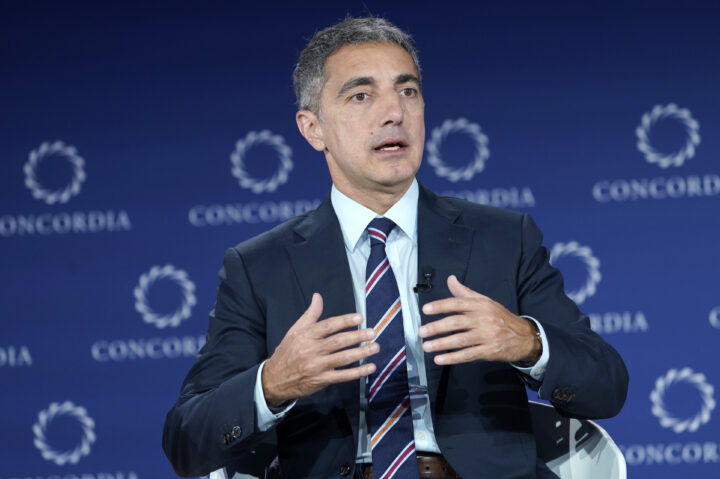
Hussain Abdul-Hussain, research fellow at the Foundation for the Defense of Democracies, speaks onstage during the 2025 Concordia Annual Summit at Sheraton New York Times Square on September 23, 2025.
Writer and researcher Hussain Abdul-Hussain has an unusual story: A Shia Muslim raised in Iraq and Lebanon and taught to hate Israel and the West, he is now a research fellow at the Foundation for Defense of Democracies living in Washington, and the author of a book called The Arab Case for Israel.
It was his years in Lebanon that gave him unique insight into the country’s political workings, which now play a major role in its tenuous ceasefire with Israel.
“Lebanon was a thriving state when the Arabs were fighting Israel state-to-state, when it was a symmetric military-to-military war,” Abdul-Hussain told Jewish Insider’s Lahav Harkov and Misgav Institute for National Security and Zionist Strategy Executive Director Asher Fredman on the “Misgav Mideast Horizons” podcast this week.
“What happened is that, after 1967, when the Arab armies were defeated, the Arabs switched from military-to-military to asymmetric war, with armed factions like Hamas, or the PLO before Hamas, or Hezbollah [against Israel],” he said. “They decided when to fight, how to fight, where to launch attacks, and these were in Jordan and Lebanon. … Jordan decided [to say] ‘We are a state and we will not allow these armed factions to run our affairs’ … They ejected them in 1970. Lebanon, unfortunately, came under enormous pressure from all kinds of Arab capitals. … Everyone forced Lebanon to accept [PLO leader Yasser] Arafat and his armed factions to operate out of Lebanon and launch attacks on Israel.”
“Since then, the Lebanese state has not been able to restore its sovereignty to pre-1969 days,” Abdul-Hussain argued. “After Israel ejected Arafat in 1982, Hezbollah inherited the mantle. … We have an issue of chronic weakness of the Lebanese state facing armed factions.”
Lebanese President Joseph Aoun is “probably the only elected Lebanese official to state on the record that Hezbollah is treasonous and wages war on behalf of Iran,” Abdul-Hussain said. In addition, there were reports as talks began last month that Aoun would be willing to meet with Israeli Prime Minister Benjamin Netanyahu.
However, Aoun said more recently that Lebanon would not be able to negotiate with Israel until its fight against Hezbollah ended.
“Hezbollah and Iran don’t want any kind of direct talks with Israel,” Abdul-Hussain pointed out.
Egypt and Saudi Arabia, he noted, have also been advising the Lebanese government not to negotiate normalization, a topic that was one of Israel’s conditions for entering the talks.
Riyadh’s motivation, according to Abdul-Hussain, is for Arab states to line up behind the Gulf state and wait for it to make peace with Israel — a move that Saudi Arabia has conditioned on the creation of a pathway to Palestinian statehood.
“This is leverage for the Saudis; it’s not in the interest of Lebanon,” Abdul-Hussain said. “These are factors that come in so the Lebanese state remains weak and unable to take on Hezbollah.”
Abdul-Hussain credited the Trump administration for “giving Lebanon more attention than any administration since the early days of Ronald Reagan. … I’m happy that someone sees Lebanon as it is, not as we imagine it to be or just dismiss it and say ‘This is too complicated for us and we’re not going to go into it.’”
That attention is “a golden opportunity … to help disarm Hezbollah and live at peace with Israel, Syria, Turkey, Iran, everybody else,” he said. “If the Lebanese don’t grasp it, I’m not sure there will be another opportunity in the coming future.”
Abdul-Hussain said that Aoun’s recent message that he will not shake hands with Netanyahu at the outset of negotiations does not diminish the major step he took toward peace talks with Israel.
“For a Lebanese president to say that we are parting ways with the Arab League and Saudi Arabia and that we are ready to shake hands with the Israeli prime minister if there is an agreement – that is huge,” he said.
As for France, which has often intervened on matters related to Lebanon, but is not involved in the talks with Israel, Abdul-Hussain said, “France has not paid a penny to Lebanon in a long time … but for some reason they keep sitting at the table deciding Lebanon’s fate. My guess is that they enjoy the spotlight.”
The French and the Saudis try to intervene in Lebanon “for their own ego,” Abdul-Hussain argued, but France is “more dangerous,” because it “tries to curry favor with Iran by taking Hezbollah’s side in Lebanon. The French would tell the Iranians, ‘Listen, we will not go against Hezbollah … [or] whatever Hezbollah policy. But keep in mind that when the time comes and there are no sanctions and you need to give contracts away, the French took your side. The French do this all the time. They did it with Saddam Hussein.”
A more recent example Abdul-Hussain cited was when the United Arab Emirates and Bahrain brought a draft resolution to the U.N. Security Council stating that the Strait of Hormuz is an international waterway and countries should be able to use military force to open it; “The French took the side of the Chinese, Russians and Iran” against it, he said.
“Why would France do that?” he said. “OK, you don’t like Trump, you don’t want to open your airspace to Trump. But if you are about international law, this is as [legitimate] as it can get. So what do the French do? They hedge against the West. … and this is what they’re doing in Lebanon.”
Abdul-Hussain said he was “thrilled” to hear Israeli Ambassador to the U.S. Yechiel Leiter say that he “would like to keep the French as far away as possible from pretty much everything, but particularly when it comes to peace negotiations.”
Abdul-Hussain’s book, The Arab Case for Israel, was published in February and features not only his arguments in favor of supporting Israel, but how he came to hold such views after receiving an anti-Israel education.
“My dad is from Iraq, from Baghdad, and my mom is from Baalbek in Lebanon,” Abdul-Hussain recounted this week. “I grew up in both countries. After second or third grade, we left Iraq permanently, during the war with Iran. … Of course, the 1980s in Lebanon is when Israel invaded [Lebanon] and when Hezbollah was being put together, and the days of the civil war.”
Abdul-Hussain recalled growing up in Iraq “shouting slogans against Khomeini and against Israel, and then … [in] Lebanon shouting pro-Khomeini slogans against Saddam Hussein, but still against Israel.”
He attended the American University in Beirut, where he was exposed to less conservative Muslim ideas of “all kinds, Marxist, socialist, anarchist, you name it” but still anti-Israel.
Abdul-Hussain became a reporter at the now-defunct Daily Star, a leading English-language newspaper in Lebanon, rising to the position of managing editor.
When Israel withdrew from southern Lebanon in 2000, Abdul-Hussain was covering the events and drove to the border.
“At the time, the border was just a flimsy barbed wire. You could see Israelis on the other side, and I stood there and I watched Israeli families in Metula and all these towns … mothers driving their children to school, men working the fields, some guy driving a tractor. This was the first time that I saw Israelis as humans … as people like us, and this made me so curious,” he recalled.
Abdul-Hussain was able to pick up Israeli radio stations from Lebanon, and began to learn Hebrew in that way, because “If you lived in Lebanon, you had no access to anything Israeli. The only access you had is anti-Israel books by Edward Said, [Norman] Finkelstein, [Noam] Chomsky. You can buy Mein Kampf anywhere.”
Listening to Israeli radio, Abdul-Hussain found that “These guys are not really obsessed with killing all the Arabs and taking all the land and establishing Greater Israel from the Nile to the Euphrates and all the conspiracy theories that I had learned.”
In 2004, he moved to Washington to work for the newly-founded Al Hurra, the U.S.-backed Arabic language news channel meant to support the spread of democracy in the Middle East, and has lived in the U.S. ever since.
“After I came to the U.S., I had unlimited access to everything Hebrew and Jewish and Israeli and I understood this is a totally different story from the one I was taught,” he said.
Abdul-Hussain makes the case that “Whatever happened in the past, whatever injustice has befallen the Arabs and the Palestinians, moving on and seeing Israel as an asset is much more in the Arab interest than trying to wind the clock back to a time when Israel didn’t exist.”
“I show the numbers, the receipts as we say here in Washington,” he added. “Look at the Abraham Accords countries and their trade and economy. Look at the cold peace with Egypt and Jordan and their trade and economy, which is much less than the Abraham Accords countries. Then, look at Lebanon and Syria, who are still at war and miserably behind the others.”
Abdul-Hussain pointed at a trend by which “The more peaceful you get with your surroundings, the better your economy thrives and blooms. This is the idea of the book.”
The Israeli-Russian Princeton researcher was kidnapped in Baghdad in 2023 by Kataib Hezbollah, an Iranian-backed terrorist group

Eric Tucker/AP Photo
In this Sept., 2018 selfie image provided by Emma Tsurkov, right, she and Elizabeth Tsurkov are shown in Santa Clara Valley, Calif.
President Donald Trump announced Tuesday that Elizabeth Tsurkov, an Israeli-Russian researcher at Princeton University, was released by an Iranian-backed terrorist group in Iraq to the U.S. Embassy in Baghdad.
Tsurkov was kidnapped in Baghdad in 2023 while working on her doctoral thesis by Kataib Hezbollah, an Iranian-backed terrorist group separate from Lebanese Hezbollah.
“I am pleased to report that Elizabeth Tsurkov, a Princeton Student, whose sister is an American Citizen, was just released by Kata’ib Hezbollah (MILITANT Hezbollah), and is now safely in the American Embassy in Iraq after being tortured for many months,” Trump said on Truth Social. “I will always fight for JUSTICE, and never give up. HAMAS, RELEASE THE HOSTAGES, NOW!”
Tsurkov’s sister Emma, who has been a vocal advocate for her freedom, thanked the Trump administration in an X post, noting that her sister had been in captivity for more than 900 days.
“We are so thankful to President Trump and his Special Envoy, Adam Boehler. If Adam had not made my sister’s return his personal mission, I do not know where we would be,” Tsurkov said. “We also want to thank Josh Harris and his team at the US Embassy in Baghdad for the support they provided to our sister and the team at the nonprofit Global Reach who advocated relentlessly for my sister’s safe return.”
Princeton University President Christopher L. Eisgruber also celebrated her release.
“The release of Princeton graduate student Elizabeth Tsurkov brings relief and joy to the University community, and we celebrate that she will be reunited with her family. We thank President Trump for securing Elizabeth’s release,” Eisgruber said. “We are also grateful to those who worked tirelessly to bring an end to her terrible ordeal, including her family, friends and advocates.”
Multiple groups of U.S. lawmakers had appealed to administration officials to work to secure Tsurkov’s release. Kataib Hezbollah, the group that kidnapped Tsurkov, holds an official role in the Iraqi government.
Tsurkov’s captors released a video in 2023 in which Tsurkov claimed to be an Israeli and American spy, which Emma Tsurkov said was clearly made under duress.
Sen. Andy Kim (D-NJ), who helped lead efforts earlier this year to advocate for Tsurkov’s release, told Jewish Insider he spoke on Tuesday evening with Emma Tsurkov while she was on a videoconference with her sister, a conversation he said was “very emotional.”
The Tsurkov family, Kim said, has been through “so much” and “I can’t even imagine what it’s been like for Elizabeth.”
“My immediate thoughts [are] just making sure she’s getting the care she needs. I’ve done a lot in the past … when I was at the State Department on hostages and the kind of care they need coming out of it,” he said. “So it’s going to be a long road ahead.”
He said that he wishes Emma “all the best with the recovery” and offered the family any help he can provide to ensure she receives the care she needs. He said he hopes to see both sisters in the United States in the future.
He added that Emma Tsurkov’s “strength as a sister, just being there, just holding that hope for Elizabeth … it’s amazing, it’s inspiring.”
Kim said he had not yet been briefed by the administration on Tsurkov’s release, including the terms by which the administration was able to secure Tsurkov’s freedom.
Sen. Jacky Rosen (D-NV), who joined a push with Kim for Tsurkov’s freedom, said in a statement, “I’m relieved to hear the news that Elizabeth Tsurkov has finally been released after being held hostage by extremists in Iraq for over two years. I’ve been proud to advocate for her release and applaud all the efforts that made this possible. My thoughts are with Elizabeth and the Tsurkov family as they reunite, and I wish them peace and healing.”
Rep. Jamie Raskin (D-MD), who led an appeal from House members for Tsurkov’s release, told JI, “I am overjoyed for Elizabeth Tsurkov’s family and loved ones on this happy occasion. I have long pushed for Elizabeth’s safe return and I’m sending her my prayers and solidarity as she returns home to recover from a 903-day-long nightmare.”
Sen. Cory Booker (D-NJ) said on X, “I am deeply grateful that Elizabeth Tsurkov has been released and will finally be reunited with her family and loved ones. Thankful for all who partnered in advocating for her release and for all who tirelessly worked to ensure her safe return.”
Democrat Maura Sullivan, a military veteran running in a swing district, is aiming to succeed Rep. Chris Pappas in the House
Maura Sullivan for Congress
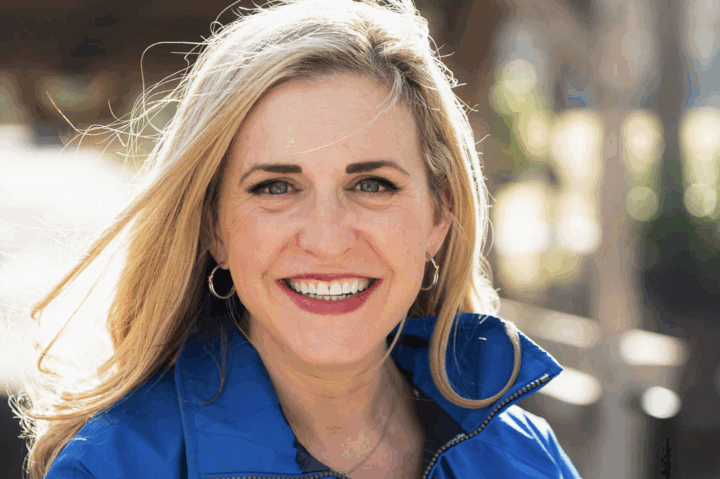
Maura Sullivan
Maura Sullivan, a Marine veteran who served in Iraq and later worked as a senior Defense Department official, is aiming to leverage that experience to win the New Hampshire congressional seat currently held by Rep. Chris Pappas (D-NH), who is running for the Senate. She’s also leaning on that background as she stakes out her positions on the conflict in the Middle East.
Speaking to Jewish Insider, Sullivan strongly criticized Israel for the humanitarian crisis in Gaza, saying it must take action to ensure more aid to the Palestinian people, but at the same time said that she would not support efforts to cut off U.S. aid to the Jewish state and affirmed her commitment to the U.S.-Israel relationship and the need to eliminate Hamas.
As a Pentagon official, Sullivan said she spent time in the Middle East on “allied reassurance tours,” visiting allies and meeting with top officials, such as Israeli Prime Minister Benjamin Netanyahu and Moshe Ya’alon, then Israel’s defense minister, to learn about Israel’s challenges and capabilities and “talking about the incredibly important relationship between the United States and Israel and strongly reaffirming the United States commitment to our ally Israel.”
“I’ll bring that perspective to the work I do in Congress and will greatly inform because I have that firsthand perspective, experience and knowledge,” Sullivan said, adding that she’d be seeking a spot on the House Armed Services Committee if elected.
“I’ve been very clear since the devastating, absolutely deplorable Oct. 7 attacks that Hamas perpetrated that Israel has the right to defend itself,” Sullivan continued. “I also want to be clear that the conditions in Gaza are inhumane, they’re deplorable and they must be improved immediately. … Hamas can be destroyed and significant aid can be let in at the same time. It’s a false choice to think that those two objectives cannot occur simultaneously.”
She said she has firsthand experience with humanitarian supply issues in a war zone, having served as a logistics and operations officer in Fallujah, Iraq, to move food and other supplies through what was at times an urban combat zone.
Doing so, she said, is “logistically complex” but also “doable” and “necessary.” She said the U.S. should apply “maximum pressure” on Netanyahu to increase aid, or provide aid directly if that fails.
Unlike growing numbers of Democrats in Congress, though, Sullivan said that she does not support efforts to cut off the U.S. supply of arms to Israel in response to the humanitarian situation in Gaza.
“I do not think that the answer in this conflict is to make Israeli civilians less secure due to the actions of their government,” Sullivan said. “In an effort to solve this conflict, the Israeli people need to have the ability to defend themselves against not only Hamas, but also other nefarious actors, [like] Hezbollah and … Iran.”
Sullivan added that she wanted to be clear that Hamas is a terrorist organization, its attack on Oct. 7, 2023, was the “catalyst behind all of this” and that it must return the hostages.
The pathway to a lasting peace, through a two-state solution, requires “eradicating Hamas,” she continued. “The Palestinians need to be able to live in a demilitarized state that they control, not Hamas, and the Israelis need to be able to live beside them in peace.”
Sullivan has visited Israel three times, including visiting extended family of her husband, who is Jewish, in Tel Aviv and Jerusalem. She described a visit to Yad Vashem, while she was a Pentagon official, as particularly “powerful and unforgettable.”
Sullivan said she saw during her time in Iraq that “leadership in Washington was totally out of touch” — on both sides of the aisle — with the actual situation on the ground, “and we were sent to a war we never should have been in without a plan to win and without the resources to succeed, in what was arguably the biggest foreign policy debacle this country has seen since the Vietnam War.”
That experience, she said, showed her firsthand the real consequences of decisions made in Washington. She expressed strong support for long-running efforts in Congress to repeal the Authorizations for Use of Military Force for Iraq and Afghanistan.
“Congress has to go on the record if we are going to declare war,” Sullivan said, asked about the U.S. military strikes on Iran. She urged the administration to prioritize the safety of U.S. troops and “resist any effort to drive the U.S. into another costly and deadly war in the Middle East.”
But, Sullivan continued, “Iran is the leading state sponsor of terrorism, relentlessly driving violence and chaos against the United States, Israel and our allies. A nuclear armed Iran would represent a direct and unacceptable threat to America’s national security, regional stability, as well as Israel’s very existence.”
Given Iran’s recent violations of the Nuclear Non-Proliferation Treaty, she said that “Israel is absolutely justified in taking action to dismantle Iran’s dangerous nuclear ambitions. No nation should be forced to stand by while its survival is threatened.”
Sullivan also served on the American Battle Monuments Commission, visiting gravesites of fallen soldiers around the world, which “greatly heightened my sense of the role of America in the world” and what the U.S. means to its allies.
The Marine veteran described the antisemitism crisis in the United States as particularly personal for her, given that her husband is Jewish and they are raising their children, ages 3 and 5, in an interfaith home.
“I understand these issues at a deep and personal level. Judaism was a first-date conversation for my husband and I,” Sullivan said. “My children are not yet old enough to talk to them about it, but it is something that we will need to address as a family.”
She said that she would be a “strong voice in Washington” against antisemitism and noted that it had recently hit close to home when a group of neo-Nazis marched on the state Capitol in Concord.
Sullivan leads the primary field in fundraising, having pulled in nearly $800,000 as of the end of the last quarter. Her leading Democratic primary challenge is Stefany Shaheen, the daughter of Sen. Jeanne Shaheen (D-NH) and a former Portsmouth city councilor, who raised $532,000 in the last quarter.
Carleigh Beriont, a Harvard professor and Hampton, N.H., selectwoman, entered the race in June, raising $162,000 that month. Multiple Republicans have filed to run for the seat, but none have reported raising any funds thus far.
Sullivan ran in the 2018 primary against Pappas, who is leaving the seat to run for the Senate. Sullivan won 30% of the vote in 2018 to Pappas’ 42%, before Pappas went on to win his first term in Congress.
The Marine veteran said that she believes that the Democratic Party and the country “needs new and different leadership,” and argued that her military background will make her more effective in holding the administration accountable.
Sullivan drew explicit comparisons between herself, and other female veterans running in swing districts, and the class of female national security leaders — including Sen. Elissa Slotkin (D-MI), Reps. Mikie Sherrill (D-NJ) and Chrissy Houlahan (D-PA) and former Rep. Abigail Spanberger (D-VA) — who helped Democrats win back the House in 2018.
She’s part of a group calling itself the Hellcats, which also includes New Jersey congressional candidate and Navy veteran Rebecca Bennett, that is trying to emulate their model.
If elected, Sullivan said she’d be the first female Marine ever elected to Congress.
She said she’s heard from voters in the 1st District, particularly veterans and small business owners who typically vote Republican, that they’re supporting her in part because of her military background.
She said her interest in public office was spurred by a family commitment to service as well — her grandfathers fought in World War II and her grandmothers were both involved in Jesuit education, as well as her own military service.
Coming back from Iraq, Sullivan felt a “very deep-seated obligation to commit my life to public service,” particularly because some of those she served with would not have that chance. “To live your life in a way that matters for something and for people way beyond yourself, something so much bigger than yourself — it was a transformational experience.”
Torres: ‘War becomes a process of mutual dehumanization which we’re seeing in real time’

Michael M. Santiago/Getty Images
Rep. Ritchie Torres (D-NY) speaks at a press conference endorsing New York City Mayoral candidate Andrew Yang on January 14, 2021 in New York City.
Rep. Ritchie Torres (D-NY) on Tuesday warned that the war in Gaza appears to be turning into a “quagmire” akin to the Iraq war, without clear objectives or any realistic end point.
The pro-Israel Democrat has grown more vocal lately about his criticisms of the Israeli government and how it has been handling the war in Gaza, as concern about the humanitarian situation in the enclave has mounted on both sides of the aisle. He has also continued to offer support for Israel and emphasize that Hamas is primarily responsible for the war in Gaza.
“I want to see Israel secure the release of hostages and end the war, because as long as the war persists, there’s a real potential — our experience with Afghanistan and Iraq tells us that wars in the Middle East can morph into quagmires that have no clear end in sight that have no clearly defined strategic objectives,” Torres said in an interview with The Bulwark.
“I feel this is a quagmire that could persist indefinitely with no clear end in sight,” he continued, a situation he said would limit the Israeli economy and expansion of the Abraham Accords. He said the Israeli government has failed to outline clear objectives for the war. “It feels like a quagmire reminiscent of the war in Iraq.”
He said that Israel has been “extraordinarily effective” in its operations against Hezbollah and Iran, “but [I] have concerns about the war in Gaza.”
Torres said that “war becomes a process of mutual dehumanization which we’re seeing in real time. There should be space in the American heart for the humanity of both Israelis and Palestinians.”
He said that Hamas is the “central cause” and “primarily responsible for the suffering that has been unleashed since Oct. 7.”
But he also said that the “humanitarian crisis in Gaza is simply and morally unacceptable and all parties including Israel and the United States must do their part to ease the hardship and hunger that has taken hold in the Gaza strip. To me, it is wrong to deny or downplay the crisis.”
He rejected arguments that he said he’d seen from Israeli officials that the crisis in Gaza is purely Hamas propaganda, and said that he can’t deny to constituents concerned about the issue that it is happening.
The correct response, he continued, is “not to downplay it, but it’s to tell our constituents that we are doing everything that we can to ease suffering among Palestinian civilians and children. That the war is not against the Palestinian people. It’s against Hamas.”
Qatar grounded all air traffic, the U.S. Embassy in Doha issued a shelter-in-place alert for Americans in the country

Win McNamee/Getty Images
President Donald Trump speaks on stage during a tour of the Al Udeid Air Base on May 15, 2025, in Doha, Qatar.
Iran launched several missiles at a U.S. base in Qatar, the Qatari Ministry of Foreign Affairs announced Monday. Majed Al Ansari, spokesperson for the ministry, affirmed that “Qatar’s air defenses successfully thwarted the attack and intercepted the Iranian missiles.”
Qatar “consider[s] this a flagrant violation of the sovereignty of the State of Qatar, its airspace, international law, and the United Nations Charter. We affirm that Qatar reserves the right to respond directly in a manner equivalent with the nature and scale of this brazen aggression, in line with international law,” Al Ansari said.
The Ain al-Assad base housing U.S. troops in Iraq was also targeted, an Iraqi security official told the Associated Press.
Three Iranian officials familiar with the plans told The New York Times that Iran gave advance notice to Qatar that attacks were coming.
Qatari authorities had previously grounded all air traffic and the U.S. Embassy in Doha had issued a warning to Americans in the country to shelter in place in anticipation of an Iranian retaliation to U.S. strikes on its nuclear program.
“As part of the State of Qatar’s commitment to the safety of its citizens, residents, and visitors, the competent authorities announce the temporary suspension of air traffic in the country’s airspace,” Qatar’s Ministry of Foreign Affairs said in a written statement. “This is part of a set of precautionary measures taken based on developments in the region.”
Al Udeid Air Base, one of the targets of Iran’s strike, serves as U.S. Central Command’s forward headquarters and hosts over 10,000 American personnel. The U.S. evacuated its aircraft from the base in the week prior to the strikes on Iran.
A Reuters report on Sunday quoted a senior U.S. official saying that Iran would likely attempt to strike U.S. assets in the region within one or two days.
According to a White House official, Chairman of the Joint Chiefs Gen. Dan Caine and Secretary of Defense Pete Hegseth were monitoring developments from the Situation Room. President Donald Trump was scheduled to receive a briefing at 1:00 p.m. ET.
Please log in if you already have a subscription, or subscribe to access the latest updates.
 Continue with Google

 Continue with Apple