




































































Most Democrats are pushing for a war powers resolution next week, amid ongoing military operations
Win McNamee/Getty Images
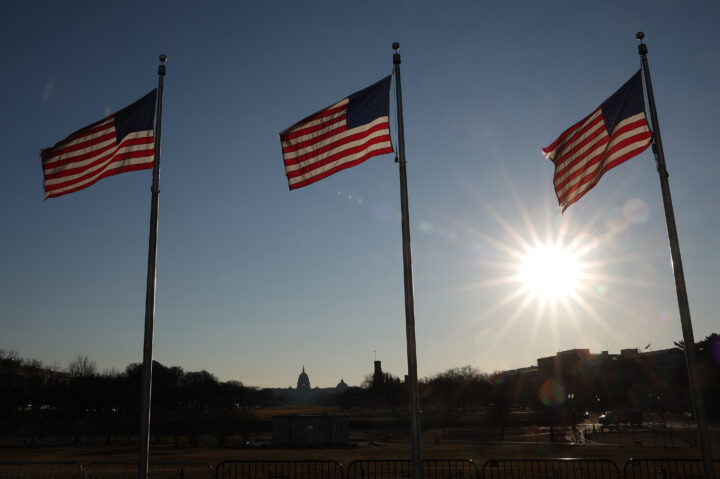
The American flag flies in front of the U.S. Capitol on February 28, 2026 in Washington, DC. U.S.


 Add JewishInsider on Google
A number of Republican lawmakers rallied behind President Donald Trump’s military strikes against Iran on Saturday, while leading Democrats expressed quick and strident opposition to the administration’s decision to attack Iran.
Democrats are also demanding Congress reconvene promptly next week to vote on war powers resolutions to block further military operations in Iran without congressional approval. The resolutions were already expected to come up for votes in the coming week.
A few Democratic lawmakers sounded more open-minded about the attack against Tehran. Sen. John Fetterman (D-PA), one of the few foreign policy hawks in his party, said the president “was absolutely” correct to attack Iran in an appearance on Fox News. “God bless the United States, our great military, and Israel,” Fetterman said.
Rep. Greg Landsman (D-OH), who told Jewish Insider earlier this week that limited strikes on Iran could be necessary and productive, echoed that stance on Saturday. He said that he would oppose the war powers resolution.
“I hope these targeted strikes on the Iranian regime’s military assets end the regime’s mayhem and bloodshed and makes way for this lasting peace in the region,” Landsman said. “Thank you to our brave service members who are leading this effort, and I pray their work will finally free the people of Iran and those in the region from more violence or war. May peace emerge from all of this.”
Rep. Josh Gottheimer (D-NJ), who had been planning to oppose the war powers resolution, praised the attack while highlighting the administration’s obligations under the War Powers Act, which limits the duration for which the president can unilaterally commit forces to armed conflict without congressional approval.
“Today, the United States, with our key democratic ally Israel, took decisive action to defend our national security, fight terror, protect our allies and stand with the Iranian people who have been massacred in the streets for demanding freedom from the murderous Iranian regime,” Gottheimer said. “I applaud the extraordinary bravery and professionalism of our servicemembers and pray for their safety as Iran and its terrorist proxies retaliate against American bases and our partners in the region.”
“Confronting the Iranian threat is essential to America’s national security and to global stability. The world is safer because of the courage and skill of our service members. I am praying for their safety and the safety of all of our allies who have been targeted by Iranian retaliation,” he continued.
Sen. Jacky Rosen (D-NV) offered more muted support for the operation, praising U.S. servicemembers while saying she “stand[s] with the Iranian people in their hope for a better future and will continue to work in a bipartisan way in Congress to provide them the support they need.” She called for an immediate and detailed briefing on the administration’s plans, and highlighted Iran’s long record of malign activity and attacks on its own citizens.
But Rosen also warned against a protracted conflict and criticized the lack of congressional authorization.
Rep. Tom Suozzi (D-NY), among the most moderate Democrats in the House and a potential swing vote on the war powers resolution, said Trump needs to seek congressional authorization for the operation, while offering support for the administration’s goals.
“I agree with the President’s objectives that Iran can never be allowed to obtain nuclear capabilities. The President must now clearly define the national security objective and articulate his plan to avoid another costly, prolonged war in the Middle East,” Suozzi said. “Iran remains the leading state sponsor of terrorism in the region and must never be allowed to obtain a nuclear weapon. Preventing that outcome is vital to our national security, the safety of our allies, and the stability of the Middle East.”
Most of the leading voices in the Democratic Party, however, are rallying against the Iran attack.
Sen. Tim Kaine (D-VA), who is leading a war powers resolution in the Senate that he planned to call up for a vote next week, said in a statement, “Every single Senator needs to go on the record about this dangerous, unnecessary, and idiotic action,” calling the strikes a “colossal mistake,” accusing the president of having “learned nothing from decades of U.S. meddling in Iran and forever wars in the Middle East” and of being “mentally incapacitated.”
Rep. Ro Khanna (D-CA), who is leading similar legislation in the House, said that “the American people are tired of regime change wars that cost us billions of dollars and risk our lives. We don’t want to be at war with a country of 90 million people in the Middle East.”
Rep. Thomas Massie (R-KY), one of the few GOP isolationists in Congress and Khanna’s cosponsor on that resolution, also said he opposes the operation.
“This is not ‘America First,’” Massie said. “When Congress reconvenes, I will work with @RepRoKhanna to force a Congressional vote on war with Iran. The Constitution requires a vote, and your Representative needs to be on record as opposing or supporting this war.”
Rep. Warren Davidson (R-OH), another isolationist-minded Republican who indicated this week that he was leaning toward voting for the war powers resolution, sent similar signals on Saturday.
“We need a government small enough to fit within the Constitution. We need a government effective enough to solve problems and serve its own people. Or, we need a new Constitution,” Davidson said.
The House is not scheduled to reconvene until Wednesday.
Rep. Jim Himes (D-CT), the top Democrat on the House Intelligence Committee, who was one of the handful of congressional leaders briefed on the administration’s plans earlier this week, said that “everything I have heard from the administration before and after these strikes on Iran confirms this is a war of choice with no strategic endgame.”
He said he expressed his concerns to Secretary of State Marco Rubio during the briefing this week.
Republicans are largely lining up behind the administration, with the exception of Massie.
Sen. Lindsey Graham (R-SC), who had urged Trump to take action, praised the administration, saying Trump had “met the moment.”
“My mind is racing with the thought that the murderous ayatollah’s regime in Iran will soon be no more. The biggest change in the Middle East in a thousand years is upon us,” Graham said. “The likelihood of normalization between Saudi Arabia and Israel getting back on track is exceedingly high – a subject I brought up last week to the key players in the region who concurred if the ayatollah goes down, historic peace advances.”
Graham met with leaders in Israel, Saudi Arabia and the United Arab Emirates this month and said on Fox News on Saturday morning that he plans to return soon. Following retaliatory strikes by Iran on U.S. military facilities in several Arab states, Saudi Arabia issued a statement condemning Iran and offering its support for measures the Arab states may take in response.
“This operation has been well-planned,” Graham continued. “It will be violent, extensive and I believe, at the end of the day, successful. Again the demise of the ayatollah’s regime with American blood on its hands is necessary and more than justified.”
He later urged Arab and other allies to “get behind President Trump and go all in to ensure the ayatollah’s Iran, which has become the largest state sponsor of terrorism in the world is no more.”
Sen. Tom Cotton (R-AR), the chairman of the Senate Intelligence Committee, who was also briefed, said, “The butcher’s bill has finally come due for the ayatollahs. May God bless and protect our troops on this vital mission of vengeance, and justice, and safety,” highlighting the regime’s long record of attacks against Americans.
House Speaker Mike Johnson (R-LA) said Iran is “facing the severe consequences of its evil actions,” and said Trump had “made every effort” at diplomacy. “For decades, Iran has defiantly maintained its nuclear program while arming and funding Hamas, Hezbollah, and other internationally recognized terrorist organizations. Iran and its proxies have menaced America and American lives, undermined our core national interests, systematically destabilized the Middle East, and threatened the security of the entire West.”
“The Gang of 8 was briefed in detail earlier this week that military action may become necessary to protect American troops and American citizens in Iran. I received updates from Secretary Rubio thereafter, and I will remain in close contact with the President and the Department of War as this operation proceeds,” Johnson continued.
Other rank-and-file Democrats, including some moderates, drew parallels with the Bush administration’s war against Iraq in their criticism.
Sen. Mark Warner (D-VA), the top Democrat on the Senate Intelligence Committee, said that the strikes raise “serious legal and constitutional concerns.”
“The American people have seen this playbook before — claims of urgency, misrepresented intelligence, and military action that pulls the United States into regime change and prolonged, costly nation-building,” Warner continued. “We owe it to our service members, and to every American family, to ensure that we are not repeating the mistakes of the past. The president owes the country clear answers: What is the objective? What is the strategy to prevent escalation? And how does this make Americans safer?”
Sen. Ruben Gallego (D-AZ), an Iraq war veteran representing a GOP-leaning state, expressed concern for U.S. forces, who Trump acknowledged could be lost in the ensuing war.
“I lost friends in Iraq to an illegal war. Young working-class kids should not pay the ultimate price for regime change and a war that hasn’t been explained or justified to the American people,” Gallego said. “We can support the democracy movement and the Iranian people without sending our troops to die.”
Rep. Brad Schneider (D-IL), a co-chair of the House Jewish caucus and a key pro-Israel leader, criticized the administration’s move and said he would support the war powers resolution. “The President of the United States is not allowed to take our nation to war without authorization from Congress.”
“This is a moment of peril and opportunity,” Schneider said. “Congress must step up to meet the moment, fulfill its constitutional duties, and ensure American action — with our allies in the region and around the world — leads to a more stable and peaceful Middle East, not another generational entanglement ending in failure.”
Former Rep. Elaine Luria (D-VA), among the House’s most vocal Democratic Iran hawks while she was in office and who is now running to reclaim her former seat, also said Congress should “immediately return to Washington” to vote on Kaine’s war powers resolution.
Rep. Jake Auchincloss (D-MA) said that Trump has “no credibility on either the strategy or law guiding foreign policy” — pointing to the president’s delayed promise to Iranian protesters earlier this year that help would be coming — and said he plans to support the war powers resolution.
“I am ready to work across the aisle to craft congressionally directed strategy on Iran, especially for securing American air supremacy in the region and supporting the Iranian people’s right to self determination,” Auchincloss said. “But first congressional Republicans must call the question on this fundamental issue of war powers by voting against a reckless commander-in-chief and for the Constitution.”
U.S.-Iran negotiations scheduled are ‘likely a diplomatic box-checking exercise and smokescreen,’ FDD’s Andrea Stricker said, while JINSA’s Jonathan Ruhe said U.S. military action is ‘unlikely for the moment’
Chip Somodevilla/Getty Images
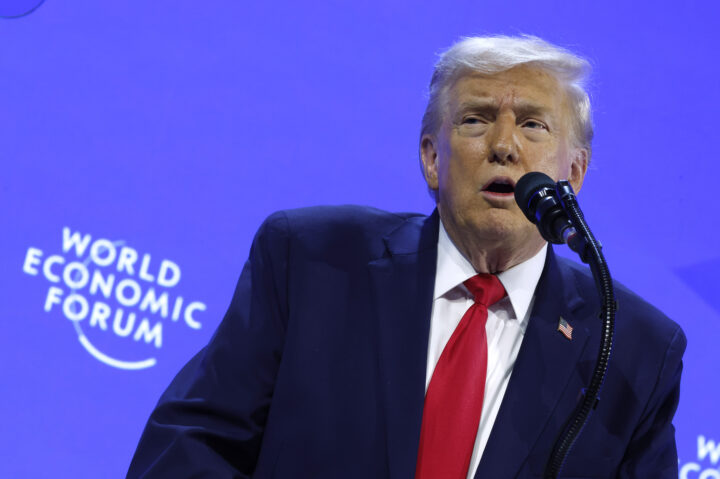
U.S. President Donald Trump gives a speech at the World Economic Forum (WEF) on January 21, 2026 in Davos, Switzerland.
Despite the Trump administration’s willingness to diplomatically engage with Iranian officials, leading Middle East experts told Jewish Insider on Monday that military action against Tehran still remains a very real possibility.
“I can’t tell you what I’m going to do,” President Donald Trump told reporters on Monday evening when asked about the threshold for an Iran strike.
“We have a tremendous force going there [to the Middle East], just like we did in Venezuela,” said Trump. “I’d like to see a deal negotiated. But right now, we’re talking to [Iran] and if we could work something out, that’d be great. If we can’t, probably bad things will happen.”
White House Special Envoy Steve Witkoff and Iranian Foreign Minister Abbas Araghchi are expected to meet in Istanbul on Friday to discuss a potential new nuclear agreement, according to reports. Jared Kushner, who has played a key role in recent high-profile diplomatic negotiations, is also expected to attend, alongside the foreign ministers of Turkey, Qatar, Egypt, Oman, Saudi Arabia and Pakistan, in the first meeting between the U.S. and Iran since U.S. strikes on Iranian nuclear facilities last June.
The planned talks come as the administration continues to exert pressure on Tehran — in response to Iran’s violent crackdown on protesters last month, Trump has publicly weighed the possibility of U.S. military intervention, ordering the movement of additional military assets into the region and issuing a series of stark warnings on social media indicating that U.S. forces are “ready, willing and able to rapidly fulfill [their] mission, with speed and violence” should a deal fail to be made.
While the administration has emphasized diplomacy as its preferred path, analysts caution that negotiations do not necessarily signal that the U.S. will not strike.
“Military intervention remains likely in light of President Trump’s demonstrated willingness to use force and the U.S. military buildup in the region,” said Michael Koplow, chief policy officer at the Israel Policy Forum. “Given the gulf between the American and Iranian positions and the general hard-line position of the Iranian regime on nuclear issues, it is hard to tag a nuclear deal as a likely outcome.”
Andrea Stricker, a research fellow at the Foundation for Defense of Democracies, told JI that a strike does remain on the table. She said that a deal could be difficult to reach and the upcoming meeting in Istanbul is unlikely to yield meaningful results or concessions from Iran.
“The planned meeting is likely a diplomatic box-checking exercise and smokescreen to enable a continued U.S. military buildup before Trump authorizes strikes,” Stricker said. “The administration’s demands that Iran abandon nuclear enrichment, cap its missile program, and halt support for regional proxies and terrorism, as well as stop executing its people, are nonstarters for the regime.”
Koplow said the administration’s “mixed signals” on whether it will seek diplomacy or take military action are likely “not a ruse or a diversion,” but instead a signal that Trump “has not actually made up his mind” and is “unsure what his end goal is.”
Jason Greenblatt, who served as White House Middle East envoy in the first Trump administration, asserted that “there’s no mixed signals,” arguing that the president’s messaging has been clear.
“President Trump has made the choice clear: a real, enforceable deal that ends Iran’s nuclear and missile threats and protects the U.S., our allies, and the Iranian people — or decisive action,” said Greenblatt, who emphasized that while Trump is reluctant to engage in war, the president will not accept an agreement he views as insufficient.
“He is not a war president,” Greenblatt said, “but he will not accept a weak deal. Iran’s leadership should understand by now that President Trump means exactly what he says.”
Stricker also noted that Trump has consistently sought to avoid prolonged conflict, but argued that Iran’s internal repression and continued nuclear advances may push the president toward decisive action. On Saturday, satellite images revealed new activity at Iranian nuclear sites, a potential sign that Tehran is aiming to salvage remaining materials from the June strikes.
“President Trump favors stability and prioritizes ending violence in global affairs,” she said. “After achieving the defanging of Tehran’s nuclear program, the regime has shown it remains a threat — the ongoing massacre is too much for Trump to tolerate as the leader of the free world.” “The president will likely ensure the regime pays a price, but whether the price is regime change remains to be seen,” she added.
When detailing what potential U.S. military intervention could look like, Koplow said that it would likely be “limited” in scope.
“Any U.S. action is likely going to fall short of what the Israelis would like to see, which is a campaign that doesn’t stop until the regime has fallen,” said Koplow. “Trump seems to favor quick strikes, and he is also facing wall-to-wall opposition from Arab states regarding the prospects of a long campaign that destabilizes the region and damages prospects for trade, investment, and growth.”
However, other analysts read the shift to negotiations as a signal that intervention is increasingly unlikely. Jonathan Ruhe, a senior fellow at the Jewish Institute for National Security of America told JI that U.S. military action is “unlikely for the moment.”
“An even bigger concern now is that military action could be off the table indefinitely, in a way it wasn’t just a day or two ago, as renewed talks now seem more likely,” said Ruhe.
Ruhe also noted that a key indicator of Trump’s intentions will be “how long he keeps the ‘armada’ within striking distance,” referring to the U.S. military assets in the region. He added that negotiating with Tehran will likely result in an unfavorable outcome for the U.S.
“Negotiating with Iran is absolutely the worst possible option for the United States now, because Iran’s regime will go from being on the ropes to thinking it prevailed,” said Ruhe, noting that Tehran is unlikely to agree to an “acceptable deal,” instead using the “prospect of talks to stave off military threats.”
“[Iran] is trying to do what it always does, playing for time and seeing what concessions it can wrangle without ever giving up anything itself,” Ruhe added. “This leaves zero upside for the U.S., since Iran is too emboldened to agree to serious concessions. There’s plenty of downside, too, since U.S. credibility would be dangerously eroded in Tehran’s eyes if Trump fails to fulfill his earlier threats.”
Koplow said Jerusalem is also concerned about a potential nuclear deal and is likely to perceive Iran’s willingness to enter talks as a way of “dragging out the process indefinitely.”
“[The Israelis] are concerned that Trump will back off his threats to take action or end up signing a deal that falls short of addressing the entire basket of issues — nuclear, missiles, and proxies,” said Koplow.
Ali Shamkhani, a senior adviser to Iranian Supreme Leader Ali Khamenei, had said Tehran would strike Israel in response to any U.S. military action, in an interview with the Lebanese-based Al Mayadeen.
Stricker warned that any agreement that falls short of dismantling the regime’s power structure and fails to address key issues would be problematic not only for the U.S. and Israel, but for the Iranian public.
“Any deal with the Islamic Republic would represent a historic betrayal of the Iranian people,” Stricker said. “The only negotiation America should entertain with Tehran is the exit of top regime officials from Iran and their relinquishing of power prior to an orderly transition to democracy.”
Please log in if you already have a subscription, or subscribe to access the latest updates.
 Continue with Google

 Continue with Apple