














































































A source told JI that Republican leadership and the administration may seek to sidestep INARA review, at least for the current 60-day agreement with Iran
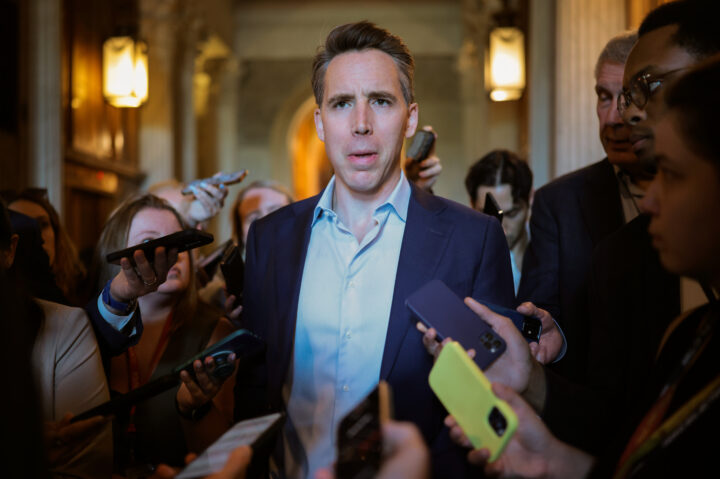
Kayla Bartkowski/Getty Images
Sen. Josh Hawley (R-MO) speaks to the press on June 2, 2025 in Washington.


 Add JewishInsider on Google
Some Republican senators said that the administration does not need to submit the recently signed 60-day memorandum of understanding with Iran to Congress for review and a potential vote under the Iran Nuclear Agreement Review Act, potentially sidestepping the first major opportunity for Congress to weigh in on the agreement.
Under INARA, the administration is required to promptly submit any deal with Iran relating to its nuclear program to Congress for review, with an opportunity for Congress to vote to reject the deal. But the administration may attempt to avoid that step, at least until a broader agreement is reached during the 60-day negotiating period — if one comes about.
A source familiar with the situation said Republican leadership is in discussions with the administration about what is included in the MOU — senior Republicans have said publicly they have not yet been informed — but they are collectively moving toward a view that the MOU is an agreement for further negotiations, not a deal on Iran’s nuclear program in itself, thereby sidestepping INARA for the time being.
The White House did not immediately respond to a request for comment.
Some senators offered a similar view on Monday evening.
Sen. Josh Hawley (R-MO) said that he’s “not aware of any precedent” for Congress to vote on an MOU.
“This is like a template for further negotiations,” Hawley said. “I don’t even know constitutionally if we have a role on that.”
Sen. Eric Schmitt (R-MO) said that he does not believe that a congressional vote on the MOU is necessary. He also went further, emphasizing that even under INARA, there is no requirement for Congress to vote on any Iran agreement.
“People may have different points of view of whether or not we should or we shouldn’t, but there’s certainly nothing required,” Schmitt said.
Pressed on why lawmakers wouldn’t want an opportunity to vote on the deal, Schmitt responded, “on whether or not a president can cease conflict in that way?”
“I don’t think it’s necessary,” he continued. “I’m just stating the law. … I will say that I do think that there are certain people in this building that want to undermine this, there’s no doubt about that. … You have the camp that wants us to lose, and then you have a camp that wants a forever war. President Trump’s not in either one of those camps.”
Sen. John Kennedy (R-LA) said that “if there’s a final” deal with Iran, he believes Congress should have the opportunity to review and vote on it, but that he does not believe that such a vote is necessary for the current MOU.
“When there’s a final agreement — if there’s a final agreement — just like the JCPOA Congress should be able to weigh in,” Kennedy said.
Sen. Tim Kaine (D-VA), who said he was involved in crafting INARA during the Obama administration, said that whether the MOU needs to be submitted is a question of what it includes.
“If the details are opening the ports, opening the straits and ceasefire, but let’s talk about the nuclear program — I don’t know that that would have to be submitted,” Kaine said. “If the details that we hear Friday include some nuclear elements, and maybe we’ll talk about some other ones down the road — well then it might have to come to us. You just have to see whether the deal that is announced Friday includes an agreement on any of the elements of [their nuclear program].”
He emphasized, however, that meeting the 60-vote threshold in the Senate to pass a joint resolution of disapproval under INARA to block a deal would be difficult given current political dynamics around the war.
Others, however, are more eager for congressional scrutiny and even Senate ratification of the deal as a treaty.
Sen. Thom Tillis (R-NC) said that he hopes the U.S. doesn’t “make the mistake Obama made [with the original nuclear deal]. We had an agreement that never really got ratified by Congress, didn’t have a lot of visibility, and I think that’s a mistake.”
Sen. James Lankford (R-OK) emphasized that any lasting agreement would need to be submitted to Congress.
“If it’s going to be long lasting, you’ve got to pass law, and that was what President Obama figured out: he could make an executive agreement, but the next president just turns it off,” Lankford said. “The president has the power to be able to negotiate foreign policy. He is the person who speaks for the country on foreign policy issues, but lasting agreements that last beyond that president have to be put in statute.”
Sen. Mike Rounds (R-SD) also said that if the deal is strong, it should be submitted to Congress for ratification as a treaty. “The JCPOA was torn apart, taken apart, because it could not meet that standard,” Rounds said.
Sen. Lindsey Graham (R-SC), asked if the Senate should vote on the MOU or only the subsequent negotiated agreement said, “It’s the law. Any nuclear deal with Iran has to be voted on. There is no way that we will not review a deal.”
The Senate majority leader also said the deal triggers requirements for the administration to provide Congress with the opportunity to review the agreement under INARA

Kayla Bartkowski/Getty Images
Sen. Majority Leader John Thune (R-SD) calls on reporters following the weekly Senate Republican caucus policy luncheon at the U.S. Capitol on January 14, 2025 in Washington, DC. Senators spoke about the Laken Riley Act which was named after a nursing student who was murdered in February 2024 by Jose Ibarra, a migrant from Venezuela who crossed the border in September 2022, that could give state attorney generals far-reaching veto power over federal immigration policy.
With scant details provided by the Trump administration about the contours of the peace deal with Iran, Senate Majority Leader John Thune (R-SD) said on Monday afternoon that he doesn’t yet know enough about the administration’s deal with Iran to determine whether it is a good deal that will prevent Iran from acquiring a nuclear weapon.
“I don’t know enough about it to say,” Thune told reporters. “I think the issues are going to be compliance, and how you can enforce that, and what are the financial incentives that the Iranians have from our country, and what are they conditioned upon.”
The South Dakota Republican said that a positive deal would include financial incentives that are conditioned upon Iran winding down its nuclear program, the disposal of Iran’s enriched uranium and Tehran giving up its capacity to have a nuclear program in the future.
Thune also indicated that he believes the deal should be submitted to Congress for review under the Iran Nuclear Agreement Review Act.
“There are some requirements that are triggered because of the nuclear components of the deal, in terms of notification or informing Congress,” Thune said. “I know there is probably some expectation that there may be a vote at some point, whether that’s on a resolution of disapproval or something. We’ll see. I just don’t know enough about it yet. And I don’t think even the people who follow this stuff closely up here know that much.”
The administration hasn’t publicly commented on the issue of INARA yet, and has offered varying timelines for when it might release the text of the agreement. In media appearances, Vice President JD Vance has been framing specific nuclear issues as part of the next round of talks, rather than the current MOU, which could give the administration an avenue to attempt to dodge INARA review.
Thune said that “somebody” from the administration, whether that be Vance or other officials, “will need to” come to the Hill to brief members.
“For sure, our members are going to have a lot of questions about it,” Thune said.
Sen. John Barrasso (R-WY), the No. 2 Senate Republican, indicated he was similarly in the dark about the agreement.
“I haven’t seen anything from the president in terms of what’s in it. I’ve seen some press reports,” Barrasso told reporters. “I want to see what’s actually in it and I congratulate the president for his continued efforts.”
But asked whether he was concerned that the deal would be an effective surrender to Iran in providing sanctions relief, Barrasso rejected the idea out of hand.
“President Trump is never, ever going to do what you just suggested,” Barrasso said. “He’s not going to accept a deal that doesn’t eliminate nuclear weapons, isn’t enforceable, isn’t verifiable and doesn’t take Iran completely out of what they’ve been doing to try to undermine and attack us for the last 47 years.”
Please log in if you already have a subscription, or subscribe to access the latest updates.
 Continue with Google

 Continue with Apple