














































































Citing the threats posed by the Houthis, Abdirahman Mohamed Abdullahi said Somaliland is 'the safest way to world trade, to maritime security, against piracy'
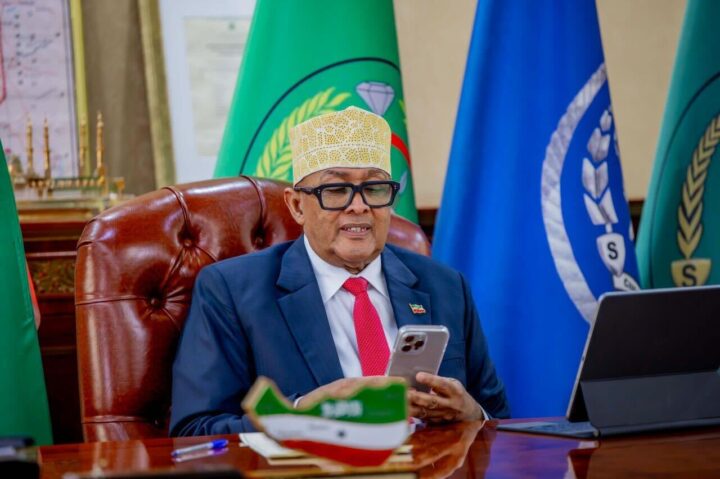
Amos Ben-Gershom/GPO
Somaliland President Abdirahman Mohamed Abdullah speaks to Israel Prime Minister Benjamin Netanyahu, Dec. 26, 2025


 Add JewishInsider on Google
Abdirahman Mohamed Abdullahi, the president of Somaliland, the pro-Western region that broke away from Somalia, discussed deepening partnerships with the U.S., including expanded U.S.-Somaliland military cooperation, during a visit last week to Washington, D.C.
Israel was the first state to recognize Somaliland’s independence last year, more than three decades after the region declared independence, though the U.S. has maintained direct and indirect relationships with the government, based in Hargeisa.
The territory in the Horn of Africa is located along the Gulf of Aden and is seen as a potential site for an American or Israeli military base in the Horn of Africa, particularly in light of the growing Houthi control over the Bab al Mandeb Strait, a key passageway through the Red Sea, in recent weeks.
Abdullahi told reporters at a media briefing on Friday that he met with representatives of the State Department, Pentagon, Treasury and Department of Energy as well as at least one representative from the National Security Council.
“We had [with] all of them fruitful conversations. Short of recognizing Somaliland, we feel that there is progress in our conversation, and we shall continue that conversation,” Abdullahi said. “In the meantime, we understand that our cooperation [in] different sectors, will increase and will expand, and we hope that some American presence will be in Somaliland in the near future.”
Somaliland is pushing for the U.S. to open a consulate in Hargeisa and expand its military presence on the ground. The two countries have an existing counterterrorism and national security cooperation program, which includes U.S. officers training Somaliland’s counterterrorism forces.
Bashir Goth, the head of Somaliland’s mission to the United States — its de-facto ambassador — told reporters that Pentagon officials said they plan to increase the size of the U.S. training force in Hargeisa. More broadly, he described the trip as the best series of meetings that a Somaliland president has had in Washington.
Abdullahi said that State Department officials said they would consider opening a consulate in Hargeisa but did not make any commitments.
Asked about his conversations with U.S. officials about potential cooperation in counter-Houthi operations, Abdullahi broadly pitched Somaliland and its port at Berbere as a haven of stability in the region and the Horn of Africa that the U.S. could utilize.
“In general, we gave an offer to the United States [of] partnership in security — whether it’s counterterrorism, maritime security, protection of of ships in the area. We have 850 kilometers of seashore [on the] Gulf of Aden,” he said. “We know that there is a problem in Hormuz, and now … in Bab al Mandeb. So Somaliland is the safest way to world trade, to maritime security, against piracy. Our waters have been free of piracy and terrorism for the last 30 years.”
Abdullahi described Berbere as an attractive site for foreign powers, including the U.S. and Israel, with what was once the longest runway in Africa and a large and efficient port. He said that military officials from both countries have visited Berbere, but said they do not currently maintain a presence there.
He expects Somaliland-Israel security cooperation to begin by the end of the year, with a focus on training Somaliland’s military and police. He said an Israeli military presence in Somaliland is a possibility in the future but not in the near term.
Abdullahi said that some U.S. companies would prefer to operate out of Berbere than Djibouti, which currently hosts the largest U.S. base in Africa. He described Berbere as “the most efficient port in the region” but acknowledged that infrastructure investment is necessary to build out railways to make the port more interconnected with the region — also likely a necessity for a U.S. military base.
China has offered assistance to build such infrastructure — as it did in Djibouti — but Abdullahi said that Beijing attached untenable conditions, including Hargeisa’s rejection of Taiwan.
Somaliland is also working to shift its electric generation away from its current diesel-powered grid toward solar and other energy sources. Somaliland had managed to bring down electricity costs significantly under Abdullahi’s leadership, but they are poised to skyrocket as a result of the Iran war. The government is currently subsidizing energy costs at $20 per barrel of oil, which Abdullahi said may be unsustainable.
At the same time that energy costs have spiked, Somaliland’s tax revenue has plummeted by nearly 50% as a result of a precipitous decline in shipping through Berbere because of the Iran war and the closure of the Strait of Hormuz. Import taxes were the government’s primary source of revenue.
Abdullahi said that Somaliland is not in direct conflict with either the Yemeni government or the Houthis, but predicted that the Houthis’ recent gains along the Red Sea will have further impacts on the trade moving through the region and through Berbere.
Abdullahi accused Somalia, Djibouti and others of working to undermine Somaliland’s stability.
During his time in Washington, Abdullahi met with several lawmakers, including Sen. Ted Cruz (R-TX), Capitol Hill’s most vocal advocate for the U.S. to recognize Somaliland, Sen. Mike Rounds (R-SD) and several House members.
Abdullahi is pushing for the U.S. to consider legislation to allow Somaliland direct access to the international financial system and to differentiate between Somaliland and Somalia in travel advisories.
He also visited multiple think tanks, including the Hudson Institute and Foundation for Defense of Democracies, met officials from the American Jewish Committee and was hosted by Israeli Ambassador to the U.S. Yechiel Leiter.
According to the AJC, the group discussed “developments in the Horn of Africa, regional security, the democratic country’s strategic importance, and Somaliland’s growing relationship with Israel” and the “significance of Israel being the first UN member state to officially recognize Somaliland as an independent and sovereign state, as well as opportunities for deeper cooperation between Somaliland and Israel.”
Leiter said in a statement, “The relationship between Israel and Somaliland has moved beyond formal recognition and official meetings, toward a relationship characterized by the warmth and friendship associated with our nations.”
“Somaliland is a rising strategic partner, and an important voice in the crucial conversations regarding maritime security in the Middle East and the Horn of Africa,” Leiter continued. “Israel is proud to be committed to this new and growing partnership, to ensure a better future for both our countries and the region.”
Abdullahi made his first state visit to Israel, where the two countries agreed to cooperate in economic, agricultural, water, health and security matters. So far, Israel is training 50 engineers in Somaliland on water projects and will begin work on water projects including a desalination plant in Berbere. Ten children suffering from heart problems have also been transported to Israel for treatment.
Abdullahi said he’s hoping to see expanded investment by Israelis and American Jews in Somaliland.
In an interview with JI, Shapiro said he ‘[hasn’t] really thought about’ whether he would appear on Hasan Piker’s stream but that he hasn’t been invited
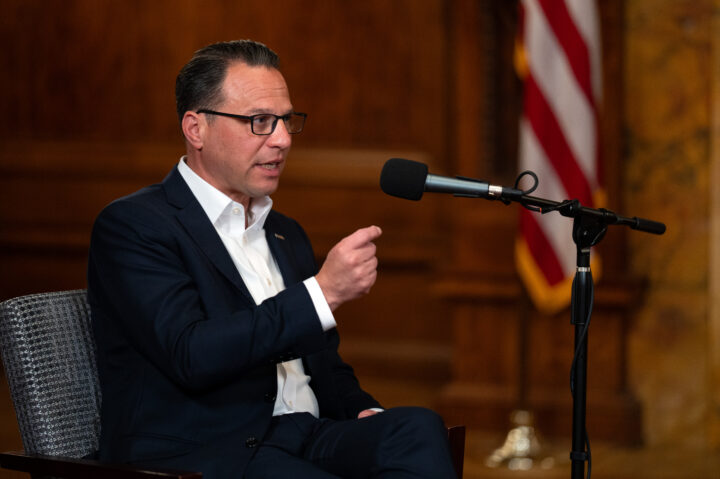
Peter W. Stevenson/The Washington Post via Getty Images
Pennsylvania Gov. Josh Shapiro sits for an interview at the Pennsylvania State Capitol on June 11, 2025.
PITTSBURGH — On the eve of the NFL Draft on Wednesday, Pittsburgh, the host city, was in full spectacle mode. Israel, 6,000 miles away, was abuzz for a very different reason: the country was celebrating Yom HaAtzmaut, marking 78 years of independence.
As he jumped between draft events, Pennsylvania Gov. Josh Shapiro shared his thoughts about both.
“I think we’re here to celebrate an iconic event in sports and sports in general. Sports has the power to bring people together, and we need more of that in our society,” Shapiro told Jewish Insider in an interview following a “unity dinner” in Pittsburgh that brought together 100 Black and Jewish students from local universities.
At the event — organized by New England Patriots owner Robert Kraft’s Blue Square Alliance Against Hate, in partnership with Hillel International, the United Negro College Fund, the NFL and the Pittsburgh Steelers — Shapiro appeared on a panel with Kraft and retired Steelers quarterback Charlie Batch. NFL Commissioner Roger Goodell stopped by to introduce the event.
“The fact that the commissioner and Robert decided to dedicate a portion of draft week to finding ways to come together to a unity dinner, I felt that it was not just something I should do, but a responsibility of mine,” said Shapiro.
Asked about Yom HaAtzmaut, Israel’s independence day, Shapiro expressed affection for Israel. He also called for America to do more to rein in its government.
“I’ve always been really clear that I have a love for Israel, even while I have real concern about the leadership of Israel,” said Shapiro.
A growing number of progressive lawmakers have in recent weeks called for an end to U.S. aid to Israel, including funding for Israel’s Iron Dome missile-defense system, a position adopted by the progressive Israel advocacy group J Street. Shapiro declined to endorse that position.
“In the case of Israel, you have a country that is constantly being attacked with missiles and other weapons that put civilians at risk, and America is invested in providing assistance like Iron Dome to protect innocent civilians from those terrorist attacks,” said Shapiro. “I think that is in America’s national security interest.”
But he did argue that the U.S. should use its position as a major financial backer of Israel to exert leverage over the country’s use of American-made weapons. Shapiro said Washington has not done a good enough job of that.
“I would say that our last two presidents, President [Joe] Biden and now President [Donald] Trump, have failed to use the leverage of an American president to force Israel’s hands to use that military aid in ways that comport with our American values, to limit the loss of innocent lives as the key factor there,” said Shapiro. “I think what we need to examine is the rubber stamp that Donald Trump has been to the Netanyahu government.”
Shapiro noted that more than 100 countries receive some form of military assistance from the U.S., a figure that includes nations who may not receive funding but who instead partner with the U.S. military for training or purchase U.S. weaponry.
“In any one of those 100 countries comes leverage for an American president to exercise to ensure that the military assistance we provide to that country is being used in accordance with our values, our American values,” said Shapiro. “What we need is an American president who’s going to use the leverage that we have when we provide that kind of assistance to Israel or any one of the other 90-plus countries.”
In recent months, as Shapiro eyes a 2028 presidential bid, he has appeared on several popular podcasts, including “Pod Save America,” “Higher Learning” from digital media company The Ringer and the “All-In Podcast.” As one of the most vocally Jewish politicians in the country, Shapiro is almost always asked about his views on Israel.
“Every day I do, of course, get asked about Israel and the Middle East, and I think it’s important to just speak truthfully about how I feel,” said Shapiro. “I think it’s important to be true to who you are, to not put your finger in the wind and just sort of follow which way it’s blowing.”
One show he has not appeared on? The Twitch stream hosted by Hasan Piker, a far-left commentator with a history of antisemitic and anti-American views who has hosted conversations with several progressive lawmakers. California Gov. Gavin Newsom, another potential 2028 contender, has said he would sit for an interview with Piker.
Piker has generated a great deal of controversy among Democrats in recent weeks after he appeared at two campaign rallies with Michigan Democratic Senate candidate Abdul El-Sayed this month. Those events prompted sharp criticism from several Michigan Democrats, including Sen. Elissa Slotkin (D-MI) and El-Sayed’s primary opponents, Rep. Haley Stevens (D-MI) and state Sen. Mallory McMorrow.
Shapiro opted not to weigh in. Asked if he would appear on Piker’s stream, he demurred.
“I haven’t been invited,” said Shapiro. “I haven’t really thought about it.”
Bashir Goth hopes Somaliland’s story of building itself ‘by the bootstraps’ will resonate in particular with the GOP
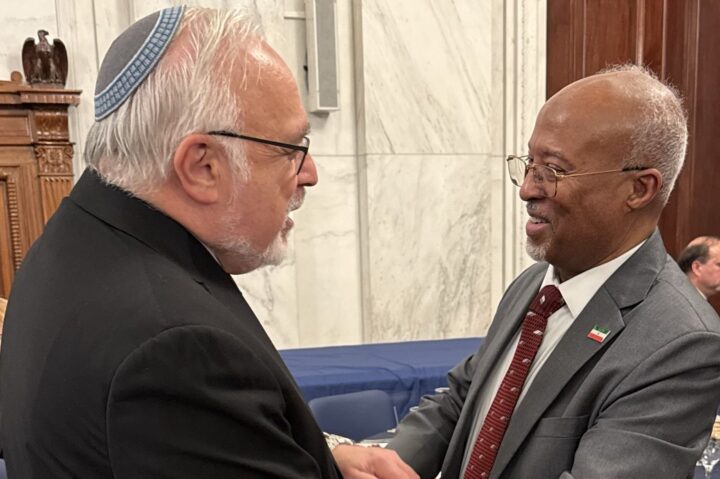
X/Rev. Johnnie Moore
Somaliland diplomat Bashir Goth with Rabbi Abraham Cooper. associate dean and director of Global Social Action for the Simon Wiesenthal Center
Bashir Goth is in the unusual position of serving as a diplomat from a place that almost no one else in the world considers a country. That changed last month, when Israel became the first state to formally recognize Somaliland as an independent nation.
That gives Goth an opening he has been seeking since he arrived in Washington in 2018: a chance to try to convince the United States to now follow Israel’s lead and recognize the independence of Somaliland, a breakaway region of Somalia that has governed itself for 35 years.
“Our friends will be more active now, more vigorous, more encouraged by the Israeli recognition,” Goth told Jewish Insider in an interview on Wednesday.
Israeli Foreign Minister Gideon Sa’ar visited Hargeisa, the capital of Somaliland, for a meeting on Tuesday with Somaliland President Abdirahman Mohamed Abdullahi. Goth is hoping to capitalize on the rare occurrence of Somaliland being in the news, in part by attempting to rally American Jews to his cause.
“We always built very strong relations and engagements with Jewish organizations in Washington, D.C., and they are more active now, more than any time before,” said Goth. “I think they will also be very, very helpful in pushing this forward.”
Major American Jewish organizations, however, have not weighed in on Israel’s decision to recognize Somaliland, except for a post on X by AIPAC that took aim at Qatar for criticizing Israel’s actions. Sen. Ted Cruz (R-TX) has urged American recognition of Somaliland, but President Donald Trump said this week that he would not do so.
Goth, ever the diplomat, did a close read of Trump’s comments and held tight to one sentence that gave him hope — Trump told The New York Post last month that he would “study” the matter.
“Regarding President Trump, I think if you look at the end, at the last sentence of his statement, with that interview, he said, ‘At the end of the day, I study everything,’” Goth said.
Washington considers Somaliland part of Somalia, a policy in keeping with the African Union and the United Nations. And while geopolitics factor into Goth’s pitch — he suggests that a Somaliland aligned with Israel, the United Arab Emirates, Ethiopia and the U.S. could be a bulwark to China, Turkey and Somalia — his message to American officials is all about politics.
“The Somaliland story always resonated with the Republican community here in Washington, D.C., and in America, because it’s a country that has built itself from ruins, from rivers, to what it is now — its democracy and infrastructure — by its own resources, ‘by its bootstraps,’ as the Americans say,” said Goth. “We will be part of contributing to the prosperity and peace that the current American government is looking for.”
News reports last year suggested that Israel had approached Somaliland officials about the prospect of relocating Palestinians from Gaza, which Somaliland has denied. Goth called it a “false statement.”
Israel has sought ties with Somaliland in part because of its strategic proximity to Yemen, which could offer Israel a better position from which to attack the Iran-aligned Houthis. Deqa Qasim, the director of the political department in Somaliland’s Foreign Ministry, told Israel’s N12 on Thursday that Jerusalem and Hargeisa were discussing setting up an Israeli military base in the African territory, contradicting a previous denial that such an agreement was on the table. Goth would not say whether Somaliland had agreed to allow Israel to do so, but he did not deny it.
“There’s nothing that says we cannot have a security pact or agreement with Israel, and I can leave it like that,” he said.
Israeli recognition of Somaliland, home to 6 million people, also allows Goth to make the case that Israeli prosperity could be a beacon for Somaliland — an example, perhaps, of making the desert bloom.
“We could be the Singapore of the Horn of Africa, if we are given the chance. And there is no better example to look at than Israel. And what you achieved in Israel. To have our recognition from Israel will open that prosperity, I think, for us, in technology [and] agriculture,” Goth said. “That would be, actually, a role model for us.”
Please log in if you already have a subscription, or subscribe to access the latest updates.
 Continue with Google

 Continue with Apple