











































































The FDD fellow, who said he was taught to hate Israel growing up in Iraq and Lebanon, spoke at a New York launch event for his book on why Arabs should reconsider their views on Israel
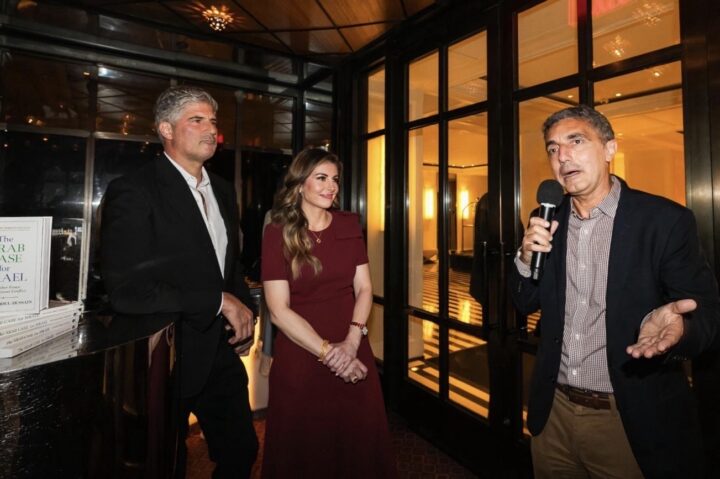
Lilya Espinosa, Soapbox Photography
Philanthropist Antoun Sehnaoui, Morgan Ortagus, former deputy U.S. special envoy to the Middle East and Hussain Abdul-Hussain at the launch of The Arab Case for Israel in Manhattan.


 Add JewishInsider on Google
At a launch event for his book, The Arab Case for Israel, on Tuesday, writer and researcher Hussain Abdul-Hussain argued that the path to peace in the Middle East begins with Arabs reexamining long-held assumptions about Israel, drawing on his own transformation from believing anti-Israel propaganda to an advocate for the Jewish state.
Speaking days after Israel and Lebanon signed a U.S.-brokered framework agreement, Abdul-Hussain said the Lebanese people can follow in his footsteps, as the country remains divided between a faction that promotes the Iranian narrative that Israel “only understands the language of war and force,” and those seeking to reclaim the country’s sovereignty.
“The Lebanese have had their share of sacrifices for big powers. This started back in the 1960s. The Lebanese will stand up for sovereignty and independence. They’ve been thrown under the bus time and time again and this makes them always wary and they try not to stick their neck out… this is what’s keeping them back,” Abdul-Hussain said.
The invitation-only event for the book, published in February, was hosted by Antoun Sehnaoui, businessman and philanthropist, and Morgan Ortagus, former deputy U.S. special envoy to the Middle East, at the Mark Hotel on Manhattan’s Upper East Side.
Abdul-Hussain, a Shia Muslim raised in Iraq and Lebanon where he said he was taught to hate Israel and the West, is now a Washington-based research fellow at the Foundation for Defense of Democracies. The Arab Case for Israel chronicles his unusual journey away from holding anti-Israel views, detailing his argument for why all Arabs should do the same.
“My story is the story of an average person who was told something and when he dug up the story it turned out to be something else,” Abdul-Hussain told some 50 attendees — a mix of Jews, Christians and Muslims — at the event. “I was taught, like every other kid was taught, that Israel must disappear. And I believed it.”
“Over the course of my life, events pushed me to try to learn about Israel.” The biggest turning point, he recalled, was in 2000 while he was working as a reporter in Lebanon. “We covered the Israeli military pulling out of the south and that day I drove my car to the border, which at the time was just a flimsy wire so I could see Israelis,” said Abdul-Hussain. “I became really curious. At the time, I could get on the FM radio of the Israeli channels. If you were in Lebanon at the time, your sources on Israel were [staunch Israel critics] Edward Said, [Noam] Chomsky and [Norman] Finkelstein.”
After learning Hebrew, Abdul-Hussain said he “discovered everything they taught us about Jews — that they were scheming to kill every Arab Lebanese kid — was not true.
“It was a long journey and I decided this journey must be told for other Lebanese, Syrians and Moroccans to understand what they are being fed is not true. I make the case that even if you think Israel has caused you injustice, moving on is much better for your future and the future of your children and grandchildren,” he said.
As Hezbollah continues to oppose the framework agreement aimed at restoring sovereignty and establishing lasting peace, Abdul-Hussain called on Americans to support the efforts of Lebanese President Joseph Aoun to resist the terror group.
“One of the main criticisms against President Aoun and his government is that he’s talking the talk and not walking the walk,” said Abdul-Hussain. “I understand that. But the guy is going all the way against Hezbollah. He’s being vilified and taking a lot of heat. The last thing he needs is for someone like me to try to push him down. Even if he’s not walking the walk, talking the talk is good enough.”
He also called on the U.S. to implement a long-term policy of protecting religious minorities in the Middle East “to make sure that non-Muslim minorities do not vanish.”
“The pattern of minority shrinking is happening all over the place, except for one place, and that’s Israel,” he said. He pointed to Lebanon where lists of registered voters show that Christians are 35% of the population, whereas 20 years ago they made up about half of the population.
“The trends are not lying. This is bad for everyone. It’s bad for diversity,” Abdul-Hussain continued.
“We in the U.S. should send the message to minorities that we are with you, that we will not let [adversaries] come after you and that Israel is something to be proud of.”
‘Does getting a deal with Israel help him become king or not?’ Ortagus posited at an event hosted by the Foundation for Defense of Democracies

John Lamparski/Getty Images for Concordia Summit
Morgan Ortagus speaks onstage during 2024 Concordia Annual Summit at Sheraton New York Times Square on September 25, 2024 in New York City.
Morgan Ortagus, the former deputy presidential envoy for Middle East peace, suggested on Thursday that normalizing relations between Saudi Arabia and Israel was not a top priority for Saudi Crown Prince Mohammed bin Salman, citing security concerns and his focus on ensuring he becomes king.
Ortagus made the comments while participating in an event at the Foundation for Defense of Democracies with Hussain Abdul-Hussain, a research fellow at FDD, discussing his book, The Arab Case for Israel: And Other Essays from a Distant Conflict, for which Ortagus wrote the forward.
Ortagus served under White House Special Envoy Steve Witkoff before joining the U.S. mission to the United Nations as a senior advisor last June. She quietly departed the Trump administration in February of this year.
Ortagus said that the Saudi crown prince’s top priority is becoming king and ensuring a peaceful transition from his father, King Salman, explaining that conversations about Riyadh normalizing relations with Israel should be viewed through that lens.
“When you look at it from the lens of MBS, everybody is a politician of some sort. What’s the most important thing that he has to do in the next few years? Actually become king,” Ortagus said. “Does getting a deal with Israel help him become king or not? Does it help that peaceful transition?”
“He got there in a very interesting manner and took out a lot of his family members in order to get where he is, but he still has that hurdle of becoming king and getting through the Shura Council and having that peaceful transition,” she continued. “I think, as for most politicians around the world, certainly here in America, that transition is more important to him than a peace deal in Israel.”
Following publication of this story, a representative for Ortagus reached out to note that her comments were not a suggestion that Saudi-Israeli normalization was unlikely and that she believes “a deal between Saudi Arabia and Israel will happen under the Trump administration.” They added that her comments “were meant to explain why it’s hard and will take time, not to question whether it happens.”
Evangelical leader Mike Evans recently claimed that the crown prince told him that he was prepared to recognize Israel but for the opposition of his father. Saudi officials have publicly rejected the idea of normalization without a path to a Palestinian state.
Abdul-Hussain noted that he had broadly been supportive of MBS’ approach to regional security and economic issues since rising to power in 2015, but criticized what he described as a pivot on the issue of normalization with Israel. He said that he did not know the reason for the shift by the Saudis, but surmised that economic factors were at play.
While Ortagus concurred that economic issues did play a role, she argued that security concerns after Hamas’ Oct. 7, 2023, attacks on Israel prompted the crown prince’s reversal.
“The threats to MBS and to the king and to the whole government in Saudi Arabia went up exponentially after Oct. 7,” Ortagus said. “It was very low before, so I think it’s also very much a security situation.”
Turning to the possibility of Israel and Lebanon normalizing ties and working together to disarm Hezbollah, Ortagus and Abdul-Hussain expressed doubt that the warnings from senior Lebanese officials of a possible civil war if Hezbollah is disarmed and the Lebanese Armed Forces’ decision to keep Gen. Rodolphe Haykal in charge of the LAF — despite Haykal being sympathetic to Hezbollah — were obstacles to reaching a deal.
“I think it comes down to the capabilities, not just the capabilities of the LAF, but the institutional will to actually do the disarmament of Hezbollah, which just fundamentally is not there,” Ortagus said.
Abdul-Hussain shared Ortagus’ skepticism about the Lebanese government’s commitment to reaching a deal.
“Knowing Lebanese politicians, I expect President [Joseph] Aoun to run for the exit. He’s thinking, ‘Well, if they’re talking to Hezbollah too, then talking to me doesn’t mean much,’” Abdul-Hussain said of the Lebanese president. “I think we in this town are not really resolved on which direction we’re going, and I want us to go in the direction of: We will not do the ceasefire the way Hezbollah wants it to be.”
Both Abdul-Hussain and Ortagus rejected the idea that Israel and Lebanon could successfully normalize relations without Hezbollah being disarmed. Ortagus also said that all parties involved in the U.S.-led peace talks between Israel and Lebanon “have to do a better job of making the argument, specifically to the Shia from the south … that you will have a better life” if the two countries normalize relations and disarm Hezbollah.
Ortagus and her partner, Antoun Sehanaoui, a Lebanese banker and producer, also hosted a book party in Georgetown for Abdul-Hussain on Thursday evening, where she praised Abdul-Husain and Sehanaoui for speaking out in favor of peace with Israel, a stance she said puts their lives, livelihoods and families in Lebanon at risk.
Abdul-Husain said his book came about through his own personal story, growing up in a Hezbollah stronghold in Lebanon and being educated that Israel was evil and aimed to conquer Lebanon. But he said that as he learned Hebrew and came to understand Israel and its true goals, his views continued to evolve, “until I reached the point I thought what they had taught us was not really correct.”
“I came up with my own ideas, and I thought that Israel is a successful story, whether we like it or not, whether we think it caused us injustice or not, it’s still a successful story,” Abdul-Hussain said. “If you are Arab or Palestinian, and you think that Israel caused you injustice, or is still causing you injustice, then moving on and forgetting about and taking this injustice is much more to your interest than trying to wind the clock back to a time when Israel did not exist and start building from there.”
He said that evidence shows that the stronger the relations an Arab state has with Israel, the more successful it is, economically and otherwise.
On Iran, at the FDD event, Ortagus argued that the U.S. is winning the war despite it still being unfinished more than 100 days since its launch, citing Iran’s heavily degraded military capabilities and what she described as the weak status of the current regime.
“Nothing about war now is easy and simple. No one’s going on a ship anymore to sign a declaration of the end of the war, it’s just not how it happens,” Ortagus said. “So you have to look at the president’s and the administration’s goals, and as much as people like to critique every single thing this president and administration does, he is the only president in 47 years of the Islamic Republic to be willing to take kinetic action in order to coerce the regime back to the negotiating table.”
“His negotiators, by the way, should be able to get a great deal because of the amount of leverage that he’s given them. The president talks about this all the time. He talks about what he’s done to destroy their nuclear facilities, their military capabilities, their Navy, their Air Force. We fly with impunity over their skies,” she continued. “To everyone sort of prognosticating that this has somehow been a failure. Look at the metrics, look at the facts, look at the capabilities, look at the regime strength today and look at their economy. … I just think it’s a matter of time before this regime falls.”
She suggested that the mass pro-democracy protests in Iran earlier this year forced President Donald Trump to expedite his plans to target the regime and what remains of its nuclear program while defending the extended length of the conflict.”
“All of these protestations by Europeans and other feckless individuals who never get in the fight are wrong,” Ortagus said. “Obviously, I think, we had a moment of opportunity after the protest earlier this year where we had to decide on action probably a little bit earlier than we had planned on, because it was the moment when we, when the president clearly told the people of Iran, the protesters that we were going to stand by them, and that help is on the way, so help had to get on the way.”
Ortagus described the president as “the leading hawk at the White House,” saying he “has fundamentally understood this issue since his very first campaign in 2016, of how destabilizing it would be for the region if Iran were to obtain a nuclear weapon. He set red lines for himself and said it will never happen on my watch, and I think he very much understands that any deal cannot be like the JCPOA [the 2015 nuclear deal] has to make sure that they can’t actually obtain a nuclear weapon. I think he’s very clear on that, and I know that his negotiators are.”
Ortagus said she believed both the president and U.S. negotiators are of the view that not reaching a deal with Iran, because the regime would not make necessary concessions, “is somewhat better than a bad deal.”
She suggested that the White House was also aware of the logistical hurdles involved in getting any agreement approved by the Senate, warning that Sens. Ted Cruz (R-TX), Tom Cotton (R-AR) and Lindsey Graham (R-SC) will not vote to approve a deal that does not address key concerns about the regime, its terror financing network and its nuclear and ballistic missile programs.
“Anybody who’s not a freshman senator was around during JCPOA, and Republican senators have been very on the record for what they would accept in any deal with Iran, certainly even during the Biden years,” Ortagus said. “Republican senators are going to get a say in whatever the final deal looks like. The beauty of our democracy is this comes down to not only what the president is willing to sign, and I happen to think that he’s one of the most hawkish people in the room on this issue, it also comes down to what the U.S. Senate and what Republicans in the Senate are going to abide by.”
This story was updated on June 12 to reflect clarifications from Ortagus’ representative about her comments on Saudi-Israel normalization.
Lebanese-Iraqi writer and analyst Hussain Abdul-Hussain discusses Hezbollah, Lebanon’s future and the personal journey that transformed him from an anti-Israel youth into a prominent Arab advocate for normalization and peace with Israel
John Lamparski/Getty Images for Concordia Annual Summit
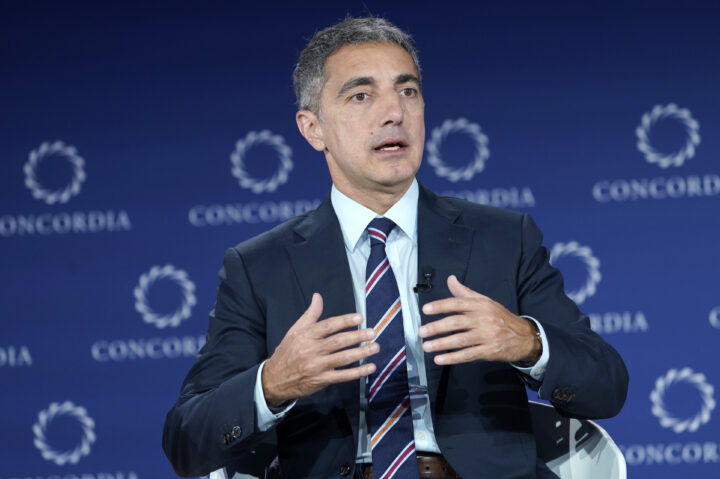
Hussain Abdul-Hussain, research fellow at the Foundation for the Defense of Democracies, speaks onstage during the 2025 Concordia Annual Summit at Sheraton New York Times Square on September 23, 2025.
Writer and researcher Hussain Abdul-Hussain has an unusual story: A Shia Muslim raised in Iraq and Lebanon and taught to hate Israel and the West, he is now a research fellow at the Foundation for Defense of Democracies living in Washington, and the author of a book called The Arab Case for Israel.
It was his years in Lebanon that gave him unique insight into the country’s political workings, which now play a major role in its tenuous ceasefire with Israel.
“Lebanon was a thriving state when the Arabs were fighting Israel state-to-state, when it was a symmetric military-to-military war,” Abdul-Hussain told Jewish Insider’s Lahav Harkov and Misgav Institute for National Security and Zionist Strategy Executive Director Asher Fredman on the “Misgav Mideast Horizons” podcast this week.
“What happened is that, after 1967, when the Arab armies were defeated, the Arabs switched from military-to-military to asymmetric war, with armed factions like Hamas, or the PLO before Hamas, or Hezbollah [against Israel],” he said. “They decided when to fight, how to fight, where to launch attacks, and these were in Jordan and Lebanon. … Jordan decided [to say] ‘We are a state and we will not allow these armed factions to run our affairs’ … They ejected them in 1970. Lebanon, unfortunately, came under enormous pressure from all kinds of Arab capitals. … Everyone forced Lebanon to accept [PLO leader Yasser] Arafat and his armed factions to operate out of Lebanon and launch attacks on Israel.”
“Since then, the Lebanese state has not been able to restore its sovereignty to pre-1969 days,” Abdul-Hussain argued. “After Israel ejected Arafat in 1982, Hezbollah inherited the mantle. … We have an issue of chronic weakness of the Lebanese state facing armed factions.”
Lebanese President Joseph Aoun is “probably the only elected Lebanese official to state on the record that Hezbollah is treasonous and wages war on behalf of Iran,” Abdul-Hussain said. In addition, there were reports as talks began last month that Aoun would be willing to meet with Israeli Prime Minister Benjamin Netanyahu.
However, Aoun said more recently that Lebanon would not be able to negotiate with Israel until its fight against Hezbollah ended.
“Hezbollah and Iran don’t want any kind of direct talks with Israel,” Abdul-Hussain pointed out.
Egypt and Saudi Arabia, he noted, have also been advising the Lebanese government not to negotiate normalization, a topic that was one of Israel’s conditions for entering the talks.
Riyadh’s motivation, according to Abdul-Hussain, is for Arab states to line up behind the Gulf state and wait for it to make peace with Israel — a move that Saudi Arabia has conditioned on the creation of a pathway to Palestinian statehood.
“This is leverage for the Saudis; it’s not in the interest of Lebanon,” Abdul-Hussain said. “These are factors that come in so the Lebanese state remains weak and unable to take on Hezbollah.”
Abdul-Hussain credited the Trump administration for “giving Lebanon more attention than any administration since the early days of Ronald Reagan. … I’m happy that someone sees Lebanon as it is, not as we imagine it to be or just dismiss it and say ‘This is too complicated for us and we’re not going to go into it.’”
That attention is “a golden opportunity … to help disarm Hezbollah and live at peace with Israel, Syria, Turkey, Iran, everybody else,” he said. “If the Lebanese don’t grasp it, I’m not sure there will be another opportunity in the coming future.”
Abdul-Hussain said that Aoun’s recent message that he will not shake hands with Netanyahu at the outset of negotiations does not diminish the major step he took toward peace talks with Israel.
“For a Lebanese president to say that we are parting ways with the Arab League and Saudi Arabia and that we are ready to shake hands with the Israeli prime minister if there is an agreement – that is huge,” he said.
As for France, which has often intervened on matters related to Lebanon, but is not involved in the talks with Israel, Abdul-Hussain said, “France has not paid a penny to Lebanon in a long time … but for some reason they keep sitting at the table deciding Lebanon’s fate. My guess is that they enjoy the spotlight.”
The French and the Saudis try to intervene in Lebanon “for their own ego,” Abdul-Hussain argued, but France is “more dangerous,” because it “tries to curry favor with Iran by taking Hezbollah’s side in Lebanon. The French would tell the Iranians, ‘Listen, we will not go against Hezbollah … [or] whatever Hezbollah policy. But keep in mind that when the time comes and there are no sanctions and you need to give contracts away, the French took your side. The French do this all the time. They did it with Saddam Hussein.”
A more recent example Abdul-Hussain cited was when the United Arab Emirates and Bahrain brought a draft resolution to the U.N. Security Council stating that the Strait of Hormuz is an international waterway and countries should be able to use military force to open it; “The French took the side of the Chinese, Russians and Iran” against it, he said.
“Why would France do that?” he said. “OK, you don’t like Trump, you don’t want to open your airspace to Trump. But if you are about international law, this is as [legitimate] as it can get. So what do the French do? They hedge against the West. … and this is what they’re doing in Lebanon.”
Abdul-Hussain said he was “thrilled” to hear Israeli Ambassador to the U.S. Yechiel Leiter say that he “would like to keep the French as far away as possible from pretty much everything, but particularly when it comes to peace negotiations.”
Abdul-Hussain’s book, The Arab Case for Israel, was published in February and features not only his arguments in favor of supporting Israel, but how he came to hold such views after receiving an anti-Israel education.
“My dad is from Iraq, from Baghdad, and my mom is from Baalbek in Lebanon,” Abdul-Hussain recounted this week. “I grew up in both countries. After second or third grade, we left Iraq permanently, during the war with Iran. … Of course, the 1980s in Lebanon is when Israel invaded [Lebanon] and when Hezbollah was being put together, and the days of the civil war.”
Abdul-Hussain recalled growing up in Iraq “shouting slogans against Khomeini and against Israel, and then … [in] Lebanon shouting pro-Khomeini slogans against Saddam Hussein, but still against Israel.”
He attended the American University in Beirut, where he was exposed to less conservative Muslim ideas of “all kinds, Marxist, socialist, anarchist, you name it” but still anti-Israel.
Abdul-Hussain became a reporter at the now-defunct Daily Star, a leading English-language newspaper in Lebanon, rising to the position of managing editor.
When Israel withdrew from southern Lebanon in 2000, Abdul-Hussain was covering the events and drove to the border.
“At the time, the border was just a flimsy barbed wire. You could see Israelis on the other side, and I stood there and I watched Israeli families in Metula and all these towns … mothers driving their children to school, men working the fields, some guy driving a tractor. This was the first time that I saw Israelis as humans … as people like us, and this made me so curious,” he recalled.
Abdul-Hussain was able to pick up Israeli radio stations from Lebanon, and began to learn Hebrew in that way, because “If you lived in Lebanon, you had no access to anything Israeli. The only access you had is anti-Israel books by Edward Said, [Norman] Finkelstein, [Noam] Chomsky. You can buy Mein Kampf anywhere.”
Listening to Israeli radio, Abdul-Hussain found that “These guys are not really obsessed with killing all the Arabs and taking all the land and establishing Greater Israel from the Nile to the Euphrates and all the conspiracy theories that I had learned.”
In 2004, he moved to Washington to work for the newly-founded Al Hurra, the U.S.-backed Arabic language news channel meant to support the spread of democracy in the Middle East, and has lived in the U.S. ever since.
“After I came to the U.S., I had unlimited access to everything Hebrew and Jewish and Israeli and I understood this is a totally different story from the one I was taught,” he said.
Abdul-Hussain makes the case that “Whatever happened in the past, whatever injustice has befallen the Arabs and the Palestinians, moving on and seeing Israel as an asset is much more in the Arab interest than trying to wind the clock back to a time when Israel didn’t exist.”
“I show the numbers, the receipts as we say here in Washington,” he added. “Look at the Abraham Accords countries and their trade and economy. Look at the cold peace with Egypt and Jordan and their trade and economy, which is much less than the Abraham Accords countries. Then, look at Lebanon and Syria, who are still at war and miserably behind the others.”
Abdul-Hussain pointed at a trend by which “The more peaceful you get with your surroundings, the better your economy thrives and blooms. This is the idea of the book.”
Please log in if you already have a subscription, or subscribe to access the latest updates.
 Continue with Google

 Continue with Apple