














































































GOP lawmakers attached language to the resolution backing Trump’s voting rights bill, which Democrats said prevented more of their caucus from joining in favor

Kevin Carter/Getty Images
U.S. Capitol building on July 12, 2026 in Washington, DC.


 Add JewishInsider on Google
The House voted 220-192 on Tuesday to adopt a Republican-led resolution condemning socialism and the Democratic Socialists of America. The vote fell largely along party lines after GOP leaders attached language to the resolution backing President Donald Trump’s priority voting rights legislation.
Introduced by Rep. Jeff Crank (R-CO), the resolution “condemns and denounces socialism in all its forms, including the Democratic Socialists of America, and opposes the implementation of socialist policies in the United States.”
However, the resolution also explicitly “calls for the enactment” of the Safeguard American Voter Eligibility (SAVE) Act — a priority for the president that would mandate proof of citizenship to register to vote in federal elections.
Seeking a clean vote denouncing the DSA without endorsing the election bill, a group of moderate Democrats — including Reps. Josh Gottheimer (D-NJ), Jared Moskowitz (D-FL), Tom Suozzi (D-NY) and Hillary Scholten (D-MI) — offered an amendment on Monday to strip out the SAVE Act language while preserving the anti-socialism provisions. However, the House Rules Committee declined to take up the amendment, forcing Democrats to vote on the combined GOP package.
Most Democrats opposed the measure due to the SAVE Act rider, though eight moderate lawmakers broke ranks to vote with Republicans in favor: Reps. Don Davis (D-NC), Henry Cuellar (D-TX), Kathy Castor (D-FL), Marie Gluesenkamp Perez (D-WA), Jared Golden (D-ME), Darren Soto (D-FL), Gabe Vasquez (D-NM) and Vicente Gonzalez (D-TX).
In addition, Reps. Chrissy Houlahan (D-PA) and Maggie Goodlander (D-NH) voted present.
Several additional Democrats had expressed that they would support a clean resolution against socialism but asserted that they could not vote for a resolution that supports the SAVE Act.
Gottheimer told Jewish Insider that the vote was a “missed opportunity,” arguing that the decision by Republicans to include the voting rights bill took away from the issue at hand.
“The missed opportunity was the fact that the right didn’t actually put up a piece of legislation that was focused on the point at hand, which is saying very clearly that people like me — and there’s other colleagues I know who think the DSA is not part of the Democratic Party, they don’t agree with a lot of their extremist views,” Gottheimer said.
The New Jersey lawmaker said that the DSA is aiming to “hijack” the Democratic Party with views that are “not in line with Democratic values.”
“I don’t like to speak for my colleagues, but I think there would have been a lot more support,” Gottheimer said of a clean resolution denouncing DSA. “Instead [Republicans] put in this poison pill, and they should focus on the issue at hand.”
Rep. Brad Schneider (D-IL) told JI that the vote was an attempt by Republicans “to try and save the SAVE Act” rather than a legitimate attempt to condemn socialism.
“I voted to condemn socialism last year. I’ll vote to condemn socialism today, tomorrow and any time,” Schneider said, noting that he also believes his colleagues would support a clean resolution condemning socialism without added language. “We support an economy that works for everybody. We’re capitalists.”
After 104 members of the House voted last week in favor of an amendment to eliminate military aid to Israel, pro-Israel activists who have spent years building ties with lawmakers are now wondering how to approach those relationships

(Yasin Ozturk/Anadolu via Getty Images)
A group of demonstrators hold a noise protest outside the Democratic National Committee Headquarters in Washington D.C., United States on October 31, 2024.
Before AIPAC began spending tens of millions of dollars per election cycle on campaigns, back when it was purely an advocacy organization that touted its relationships with many of the 535 members of Congress, the pro-Israel group used to describe its approach to Capitol Hill with a cheeky, upbeat motto: “You have friends, and you have potential friends.”
But when former Bay Area AIPAC leader Naomi Lauter used to invoke the slogan, she added a third category: “Friends who have a little less potential than others.” Lauter died in 2017, but the saying still resonates with her son, Sam, who is a major Democratic donor and pro-Israel activist in his own right — and who is now wondering whether that third category might be growing even larger.
After 104 members of the House voted last week in favor of an amendment to eliminate all $3.3 billion in annual military aid to Israel, pro-Israel activists across the country who have spent years building ties with lawmakers are now wondering how to approach those relationships following a vote that some see as a betrayal. Even many longtime Israel supporters — including Reps. Jack Auchincloss (D-MA), Glenn Ivey (D-MD), Laura Friedman (D-CA), Nancy Pelosi (D-CA) and Pat Ryan (D-NY) — voted for the amendment, which did not pass. Pro-Israel activists who spent years building trust and gaining access to these lawmakers are now grappling with whether whether those relationships are still worth their continued investment.
To borrow from AIPAC’s old slogan: Are the lawmakers who voted for the amendment still considered friends — or potential friends — of the U.S.-Israel relationship? Or was their vote against the annual aid package to Israel, and against a bill that was opposed by a wide swath of nonpartisan and Democratic Jewish groups, a crossing-the-Rubicon moment that cannot be undone?
Friends and backers of the members of Congress who voted for the amendment are struggling to answer those questions. Several who spoke to Jewish Insider said that a single vote on a measure that was sure to fail should not spell the end of years of friendship. But even as they acknowledged the seismic reverberations of the vote, many also spoke of the need to tread carefully at a politically uncertain moment.
“Our issues are too important to not hold onto the ability to have a conversation with the person, because the votes are not going to end. It’s not going to all of a sudden stop,” Sam Lauter said. He talked to several members of Congress in the days before the vote, including Pelosi, urging them to vote no.
“It’s not a good trend line, but also this idea that we’ve lost the Democrats — let’s not create self-fulfilling prophecies here. There’s an opportunity for us to turn some of this around,” Tyler Gregory, CEO of the Bay Area Jewish Community Relations Council, said. “I am optimistic that several of them could be flipped if the vote had actual consequences, and I think that’s the job ahead of us.”
“Now, if someone said to me, ‘You know what, I voted yes, and my reasoning was because actually I don’t think we should be allies with Israel anymore, and I have no interest in the friendship with the community or the country, I’m done.’ Well, OK, that friendship’s done,” said Lauter.
This vote was destined to fail, but Tyler Gregory, CEO of the Bay Area Jewish Community Relations Council, called it “a dress rehearsal.” It will not be the last time U.S. aid to Israel comes up for a vote, and Gregory said he will need to lean on those lawmaker relationships in the future when the vote is more consequential.
“It’s not a good trend line, but also this idea that we’ve lost the Democrats — let’s not create self-fulfilling prophecies here. There’s an opportunity for us to turn some of this around,” Gregory said. “I am optimistic that several of them could be flipped if the vote had actual consequences, and I think that’s the job ahead of us.”
Halie Soifer, who served as an advisor to then-Sen. Kamala Harris (D-CA), now leads the Jewish Democratic Council of America, which urged members to vote against the amendment — as did Democratic Majority for Israel and the more liberal J Street. She called the vote “an inflection point,” but said the group is not considering removing its endorsements of lawmakers who supported the amendment.
“We’ve maintained a very consistent, principled position with regard to aid for Israel, and it’s not us that shifted,” Soifer said. “There is clearly a fast-moving shift within the Democratic Party itself, and we’re considering what that means.”
When asked whether she had ever seen so many candidates shift their positions on an issue within a single two-year election cycle, Soifer answered directly: “Absolutely not.”
AIPAC responded to the vote by no longer allowing donations, through its political action committee, to the 18 lawmakers it endorsed who voted for the measure.
“AIPAC members across the country watched this vote closely and are making sure their representatives in Congress who stood on principle hear that they’re appreciated,” AIPAC spokesperson Deryn Sousa told JI.
“The reality is these are our representatives. There is a relationship that we have with most of them, and they continue to be our representatives today, tomorrow, next week,” said Jeremy Burton, the CEO of the Greater Boston Jewish Community Relations Council. “The ones who say, ‘No, I’m still committed to Israel’s security and the Jewish community,’ things like that — and I’m not going to quote any one of them — but the ones who are saying that in these private conversations, it’s incumbent upon them now to show what that means.”
Many activists who have relationships with lawmakers are taking the long view, arguing that cutting ties now will not help in future battles. For a lot of them, Israel is not the only issue about which they are concerned.
Jeremy Burton, the CEO of the Greater Boston Jewish Community Relations Council, said he knows that some Jewish Bostonians have told Massachusetts’ congressional representatives, all of whom voted for the amendment, that this moment represents a “break point.” But as the leader of a nonpartisan organization, he cannot end relationships over a disagreement on one vote. He has other issues — such as nonprofit security funding and cooperation on fighting antisemitism — to consider.
“The reality is these are our representatives. There is a relationship that we have with most of them, and they continue to be our representatives today, tomorrow, next week,” said Burton. “The ones who say, ‘No, I’m still committed to Israel’s security and the Jewish community,’ things like that — and I’m not going to quote any one of them — but the ones who are saying that in these private conversations, it’s incumbent upon them now to show what that means.”
For one Jewish former Biden administration staffer, voting to cut off security aid to Israel must be the red line.
“They’re like, ‘Don’t worry about it. It’s just symbolic.’ Well, no, you’re telling us not to care about it, but clearly other people care about it, and that’s why you’re voting in that way,” said the staffer, who requested anonymity to speak about communal organizations they support. “I don’t think the Jewish community should be giving these people a pass right now, and I believe that’s actually creating an incentive for them to actually take these votes against us and against our interests, because there’s no political consequence or repercussions for them.”
House Minority Leader Hakeem Jeffries (D-NY) said on Thursday that Democrats will adopt a new approach to Israel if the party regains control of the House in November. “The current status quo is unsustainable,” said Jeffries, who voted no on the amendment.
“On one hand, I am really disappointed to see some true friends of mine and Israel vote for the [amendment] or vote ‘present,’” said Jennifer Laszlo Mizrahi, a Jewish philanthropist and disability rights advocate in Maryland. “On the other hand, as an American and as a Jew, I am horrified by how Netanyahu and his administration treat Palestinians in the West Bank, give Haredim the ability to be draft-dodgers and don’t show empathy when legitimate security operations accidentally kill an innocent child.”
Many of the 103 Democrats who voted “yes” released statements saying that they still support America’s relationship with Israel, but that they viewed the amendment as a symbolic way to tell Israeli Prime Minister Benjamin Netanyahu that they disagreed with his handling of the wars in Gaza and Iran.
In doing so, they tapped into a difficult reality for many of the Jewish activists who wanted to see the measure defeated. Many of those activists also wish Netanyahu would do more to take the concerns of Democrats and liberal Jews into account, even as they think Washington should continue supporting Jerusalem’s security needs.
“On one hand, I am really disappointed to see some true friends of mine and Israel vote for the [amendment] or vote ‘present,’” said Jennifer Laszlo Mizrahi, a Jewish philanthropist and disability rights advocate in Maryland. “On the other hand, as an American and as a Jew, I am horrified by how Netanyahu and his administration treat Palestinians in the West Bank, give Haredim the ability to be draft-dodgers and don’t show empathy when legitimate security operations accidentally kill an innocent child.”
In Los Angeles, Democratic donor and pro-Israel activist Howard Welinsky said many of the “yes” votes were a result of political “noise” — namely, concerns about current or future primary challengers from the left. “It’s the volume of the noise, and some members of Congress have more intellectual capacity to withstand it, and others have less,” said Welinsky.
So he is holding out hope that a change in Israel’s political leadership might help rectify Israel’s plummeting support among Democrats. “I just pray that Oct. 27” — the day Israel goes to elections — “gives Israel a new prime minister, and we can turn a page,” said Welinsky.
Even as the amendment was overwhelmingly rejected, the vote underscores the anti-Israel mood within the Democratic Party is growing
Kevin Carter/Getty Images
U.S. Capitol building on July 12, 2026 in Washington, DC.
The House voted 314-104 on Wednesday to reject an amendment to the 2027 State Department appropriations bill that would have cut all $3.3 billion in annual U.S. aid to Israel. However, 103 Democrats, a near-majority of the caucus, voted in favor of the measure, with 98 others voting no and 10 voting present.
The record number of Democrats voting in favor of cutting off U.S. aid to Israel highlights the extent to which Democratic support for the Jewish state has eroded, and comes months after a vote in which 40 Senate Democrats backed blocking some weapons sales to Israel.
Rep. Thomas Massie (R-KY) introduced the amendment last month to eliminate the $3.3 billion in annual foreign military financing provided by the U.S. to Israel as laid out in the 2016 memorandum of understanding between the two countries. The Kentucky lawmaker, who was defeated in his GOP primary this year, was the only Republican member to support the amendment.
Some Democratic officials — on both sides of the issue — described Massie’s amendment as poorly drafted and overly broad, warning that it would also impact non-military aid as well as U.S. Embassy operations in Israel. Democratic leadership ultimately did not whip members for or against the vote.
House Minority Leader Hakeem Jeffries (D-NY) said in a letter on Tuesday that he planned to oppose the amendment and efforts to strip all U.S. aid to Israel, despite also noting that the relationship between the two countries requires “urgent change.”
House Democratic Caucus Chairman Rep. Pete Aguilar (D-CA) also voted no on the amendment. Aguilar told Jewish Insider last month that support for Israel’s right to exist in safety and security should continue to be a policy position of the Democratic Party, but cautioned that support for Israeli government policies would not be unconditional.
Meanwhile, House Minority Whip Rep. Katherine Clark (D-MA), in announcing she would vote yes, noted that the measure was “overly broad” and “not an attempt to have a serious and necessary debate about offensive military aid to Israel.” Despite her criticisms, she said her vote was a signal that the relationship needs to change.
Former House Speaker Nancy Pelosi (D-CA), once a reliable supporter of Israel, supported the Massie amendment, but called it an “unfortunate choice.”
“The United States must be a force for security and stability. The American people are rightly demanding an end to a perpetual cycle of war, and the Netanyahu government cannot maintain its current course,” Pelosi said. “Therefore, while this amendment is ill-conceived, I vote yes for the message that it sends.”
Rep. Alexandria Ocasio-Cortez (D-NY), a critic of Israel who is a potential Democratic candidate for president in 2028, called the vote a “very important moment.”
“A majority of Democrats voted in favor of this Massie amendment. To me what this says is that the majority of the Democratic party is most in touch with the American electorate writ large … and the Republicans are not,” Cortez said. “This has been an issue where both parties have been resistant to change.”
Ocasio-Cortez said lawmakers who voted against the amendment are “stuck in the past.”
Rep. Greg Casar (D-TX), who chairs the Congressional Progressive Caucus, said in a statement on Tuesday that he would support the amendment because the “American people are crying out for an end to U.S. tax dollars subsidizing Israel’s military.” Casar and the CPC whipped Democrats to support the amendment.
“At a time when millions are struggling to make ends meet, we are sending billions of dollars to a military that has killed tens of thousands of civilians in Gaza, the West Bank, and Lebanon,” Casar wrote. “I am aware House Democratic leadership has a different position on this amendment … I respect their leadership.”
Rep. Steny Hoyer (D-MD), the former No. 2 House Democrat and a staunch supporter of Israel, opposed the amendment and argued it would “dangerously undermine America’s national security,” limit the U.S.’ ability to counter terrorist organizations and make it harder to leverage the U.S. relationship with Israel toward peace.
“I understand the frustration many members feel with some of the policies and actions of the current Israeli government — as well as their concerns about its commitment to the peace process and a two-state solution,” Hoyer said. “However, this amendment would embolden the enemies of peace, those who seek the complete elimination of Israel, and those looking for an excuse to murder Jews. It is a vote to weaken our ability to engage in the region, and it is a vote against American security, against American interests, and against Americans’ safety.”
Rep. Brad Schneider (D-IL), who voted no, lambasted the amendment as having no legislative impact or role in helping the prospects for Middle East peace.
“This cynical Republican amendment was put forward to stoke division and divide people here in the United States, not end the conflict between Israelis and Palestinians or provide a path forward,” Schneider said. “I will seek to understand how such a flawed legislative proposal — one that would hurt Israelis and Palestinians, as well as America’s standing in the world — generated support.”
He said that supporters of Israel must work to “rebuild a bipartisan consensus” in support of Israel as well as Palestinian self-determination.
Rep. Eugene Vindman (D-VA), who ultimately voted against the amendment, said that under Israeli Prime Minister Benjamin Netanyahu, “Israel has lost its way,” suggesting that Netanyahu had undermined Israeli security and damaged the U.S.-Israel alliance.
“Yet, as a Jewish refugee who fled oppression in the Soviet Union, I have long believed that Israel is a refuge for many families like mine,” Vindman said. “These convictions made this one of the most difficult votes I’ve cast because Israel needs to change course. However, I could not support an amendment as poorly written as this one that would eliminate key funding provisions that support Palestinian security forces, humanitarian aid, and defensive systems to protect innocent civilians.”
Key Democratic committee leaders, including the ranking members of the Appropriations, Foreign Affairs and Intelligence committees, all voted against the amendment, while Rep. Adam Smith (D-WA), the ranking member on the Armed Services Committee, voted in favor.
Several pro-Israel House Democrats who are facing contentious primary challenges in which Israel has become a key issue — including Reps. Wesley Bell (D-MO), Shri Thanedar (D-MI) and Ed Case (D-HI) — voted against the amendment.
Reps. Haley Stevens (D-MI) and Angie Craig (D-MN) also voted against the amendment, while Rep. Chris Pappas (D-NH) voted present. All three are running for the Senate.
But Rep. Seth Moulton (D-MA), who is running against Sen. Ed Markey (D-MA) in Massachusetts and has tried to tack to the progressive Markey’s left, said in a statement released prior to the vote that he would support the amendment, writing, “We simply cannot continue to condone Netanyahu’s actions that are against our moral conscience and our own national security interests by perpetuating the status quo.”
Other lawmakers who have generally been reliable supporters of Israel — including Reps. Jake Auchincloss (D-MA), Glenn Ivey (D-MD), Pat Ryan (D-NY), Laura Friedman (D-CA) and Brittany Pettersen (D-CO) — voted for the amendment.
“I just voted to block sending $3.3 billion of our taxpayer dollars to Netanyahu’s government. It’s wrong on every level,” Ryan said. “I expect groups like AIPAC will not support me in my future elections and frankly, I don’t want their support. Hardline stances that refuse to stand up to a corrupt and increasingly dangerous Netanyahu regime have no place in our politics.”
Auchincloss said that his vote to cut funding to Israel was designed to send a message to both President Donald Trump and Netanyahu.
“With their disastrous war against Iran, their empowerment of settler violence in the West Bank, and their strategic incoherence against Islamist terrorism, both President Trump and Prime Minister Netanyahu have sacrificed [Congress’] trust,” Auchincloss said.
He said that the amendment is “not the ideal mechanism of action,” and raised concerns about Massie’s use of antisemitic tropes in his reelection campaign.
“I have weighed these problems against the central thrust of the amendment: there must be consequences for Trump and Netanyahu,” Auchincloss continued. “Those consequences should not impair the State of Israel’s right to defend itself against the atrocities of the terrorist regimes that threaten it. Israel and the United States have common interests, shared values, and a long history. Israel and the United States are allies.”
He also said that upcoming Israeli elections, the next memorandum of understanding with Israel and the long-term impacts of the Iran war offer “an opportunity to renew the U.S.-Israel alliance on shared principles and a bipartisan basis going into the 2027 appropriations process.”
Groups including AIPAC, J Street, the Jewish Democratic Council of America, Democratic Majority for Israel and the American Jewish Committee all opposed the amendment, though J Street said the result sent a “strong message” that Democrats agree that the party should pursue a “fundamentally different American approach to the U.S.-Israel relationship and the region.”
Over a dozen Democrats previously endorsed by AIPAC, including Auchincloss, Clark, Friedman, Pelosi, Pettersen, Ryan, Smith and Reps. Gabe Amo (D-RI), Maggie Goodlander (D-NH), Julia Brownley (D-CA), Josh Harder (D-CA), Steven Horsford (D-NV), Julie Johnson (D-TX), Bill Keating (D-MA), Seth Magaziner (D-RI), Richard Neal (D-MA) and Joe Neguse (D-CO), voted for the amendment.
The resolution aims to ban U.S. intelligence sharing and targeting assistance to Israel for its operations in Lebanon, but does not make any mention of Hezbollah

Tom Williams/CQ-Roll Call, Inc via Getty Images
Rep. Rashida Tlaib (D-MI) attends the House Financial Services Committee on Wednesday, March 29, 2023.
Rep. Rashida Tlaib (D-MI) plans to force a House vote next week on a war powers resolution blocking any U.S. involvement in or support for Israeli military operations in Lebanon, according to a memo distributed by Tlaib’s office to progressive lawmakers and obtained by Jewish Insider.
Tlaib’s resolution, co-led by Rep. Delia Ramirez (D-IL), aims to prevent any U.S. assistance to Israel in its operations in Lebanon, including intelligence sharing and targeting assistance for operations against Hezbollah. Neither the legislation nor Tlaib’s memo make mention of Hezbollah nor acknowledge its attacks on Israel or its refusal to disarm.
“The United States is assisting this destruction through the weapons, intelligence, logistics, and diplomatic cover it provides the Israeli government, and Congress has the power and duty to put an end to this illegal invasion,” a press release by Tlaib’s office read.
The legislation is backed by a host of anti-Israel groups including American Muslims for Palestine, Code Pink, the Democratic Socialists of America, Justice Democrats, Jewish Voice for Peace and the Sunrise Movement.
In the memo circulated to other progressives, Tlaib’s team accused Israel of destroying and displacing entire communities and committing war crimes, and argued that “there is no real ceasefire” between Israel and Lebanon. The two countries held their third round of ambassador-level meetings in Washington on Thursday.
The memo asserts that there are “repeated, credible, sourced reports” that President Donald Trump has personally approved or disapproved specific operations in Lebanon, and that the U.S. and Israel are coordinating on targeting.
It also states that there are “credible reports” that the U.S. is sharing targeting intelligence in Lebanon.
“It is almost certain, given the depth of this military relationship, that the U.S. has been involved in these hostilities far more than has been publicly reported thus far,” the memo reads. “The Pentagon has every incentive to avoid confirming the full scope of that involvement, and as we saw during Yemen, details only emerge under pressure. We should expect the same dynamic here.”
The memo makes the case that bringing the vote to the House floor would bring attention to the war and place pressure on the White House and on Israel to end it, though it acknowledges that the resolution is not likely to pass.
It also asserts that a war powers resolution on Cuba in the Senate forced Senate Republicans to make public statements opposing a U.S. invasion of the island, something the memo argues would not have happened without the resolution vote.
“Forced votes create forced disclosures and force people to make commitments that are harder to walk back later,” the memo reads.
Rep. Ro Khanna (D-CA) alluded to the plan to force a vote on X on Thursday, posting, “I support [Tlaib’s] War Powers Resolution to stop any US involvement in the war in Lebanon. 2,896 Lebanese have been killed, and Israel is striking even Beirut. 1.2 million have been displaced. We need a vote next week.”
Some told JI they were concerned that President Trump could use it as legal justification to continue the campaign against Iran
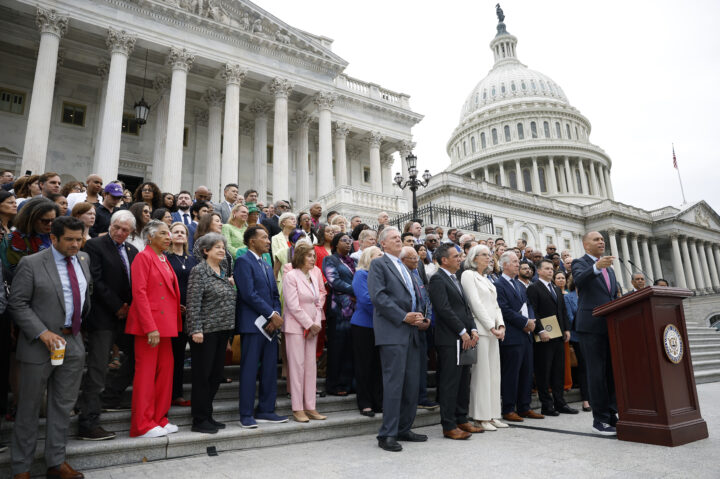
Kevin Dietsch/Getty Images
House Minority Leader Rep. Hakeem Jeffries (D-NY), joined by fellow Democrats outside of the U.S. Capitol on July 02, 2025 in Washington, DC.
In a surprise vote on Thursday afternoon that baffled some observers in Washington, 53 House Democrats voted against a resolution “reaffirming Iran remains the largest state sponsor of terrorism.” For some, their opposition traces to a desire not to give President Donald Trump rhetorical, or potentially legal, justification for continuing the Iran war, lawmakers said.
The resolution passed by a vote of 372-53, with two members voting “present.”
Most of the lawmakers voting against the resolution — like Reps. Rashida Tlaib (D-MI), Joaquin Castro (D-TX), Ilhan Omar (D-MN), Alexandria Ocasio-Cortez (D-NY) and Pramila Jayapal (D-WA) — are progressives, many of them frequent critics of Israel.
But a handful of others who ended up voting against the resolution are relative moderates who have taken more hawkish stances on Iran, such as Reps. Raja Krishnamoorthi (D-IL), Rob Menendez (D-NJ) and Steve Cohen (D-TN), who also voted against the resolution.
Many of the more moderate lawmakers who voted against the resolution are facing either competitive reelection races with challengers from their left or, in Krishnamoorthi’s case, running for higher office.
Newly elected Rep. Christian Menefee (D-TX), who had thus far not encountered any House votes on Middle East policy and faces Rep. Al Green (D-TX) in a member-on-member primary runoff, also voted no, as did Green.
Rep. Robert Garcia (D-CA), a Democratic rising star who is the top Democrat on the House Oversight Committee, told Jewish Insider he felt the legislation was meant to provide additional support for the war.
“Right now there’s an active situation that I oppose,” Garcia said. “That [resolution is] just meant to provide more pressure on that action. I think that right now, it’s a purely political stunt, and something that I won’t agree with.”
Another House Democrat, who asked to remain anonymous, explained that they were concerned about two clauses in the legislation, which they said could provide Trump with legal justifications for continuing the war.
One clause notes that “Tehran continues to harbor a network of senior al-Qaeda leaders, providing them with sanctuary space to fundraise in support of its fighters.” Given that the 2001 Authorization for Use of Military Force that approved the Afghanistan war includes language allowing the use of military power against any nations that harbored the organizations or individuals responsible for planning, carrying or aiding in the 9/11 attacks, the Democrat said that Trump could use the language “as a legal justification” for the war.
The other clause describes Iran as a “direct and persistent threat to the United States,” which the Democrat said could trigger the president’s self-defense authorities under Article II of the Constitution.
“Iran is a leading state sponsor of terrorism led by a regime that represses its own people and poses real dangers we must confront. We must ensure it never obtains a nuclear weapon. I will continue to support targeted efforts to counter the threats posed by Iran, but I voted against a separate resolution on Iran that President Trump may soon use to politically justify this war,” Krishnamoorthi said.
“Iran is obviously a state sponsor of terrorism. There’s no debate on that. The issue is that Republicans are using this to claim that Iran is harboring Al Qaeda (sound familiar?) and is a direct and persistent threat to the U.S. so they can legally justify this reckless war,” Rep. Sara Jacobs (D-CA) said on X.
Rep. Bonnie Watson Coleman (D-NJ), a progressive Israel critic who voted against the resolution, called it a “political messaging bill” designed to take attention away from the war powers resolution that failed in the House shortly after.
Rep. Adam Smith (D-WA), the ranking member of the House Armed Services Committee — who supported the resolution — said in a statement, “I agree with the principal assertion of this resolution that Iran is a bad actor. Iran’s malign and destabilizing actions in the region and treatment of its own citizens should be denounced. I have never contested this. What I do contest is that going to war is the reasonable response to this assertion. I support this resolution. I do not support the president’s war of choice with Iran.”
Four Democrats and two Republicans broke with their parties to oppose and support the resolution, respectively
Anna Moneymaker/Getty Images
U.S. Capitol on March 05, 2026 in Washington, DC.
A day after Republican senators blocked a vote to end the U.S.-Israeli operations in Iran, the House voted 219-212 to defeat a similar war powers resolution, with four Democrats breaking with their party to oppose an immediate end to the war, and two Republicans voting with other Democrats to oppose military action.
Reps. Greg Landsman (D-OH), Jared Golden (D-ME), Henry Cuellar (D-TX) and Juan Vargas (D-CA) were ultimately the only Democrats to vote against the resolution, which was led by Reps. Ro Khanna (D-CA) and Thomas Massie (R-KY). Reps. Josh Gottheimer (D-NJ) and Jared Moskowitz (D-FL), who said they would oppose the resolution before the war began, ultimately voted in favor.
On the Republican side, Massie and Rep. Warren Davidson (R-OH), both of whom have isolationist leanings, were the only members of the GOP to support the resolution.
Moskowitz had argued before the war that voting preemptively on the resolution would remove U.S. leverage in negotiations, but argued that the situation has since changed and that the U.S. is now in a full-scale war.
“I didn’t flip at all,” Moskowitz told Jewish Insider. “Circumstances have changed since my first statement two weeks ago.”
In a statement, he condemned Iran and its regime, saying he is “happy that [Ayatollah Ali Khamenei] is no longer able to reign terror on his country,” but added, “Regardless of how one feels about this war, or this President, Congress’s constitutional role in any declaration of war is a completely separate issue,” expressing concern at the erosion of congressional war powers over the past year.
“We must reestablish our Article I authority which grants Congress all legislative powers,” Moskowitz said, adding that he did not believe the resolution would prevent continued efforts to protect U.S. bases and personnel nor intelligence sharing with allies.
Gottheimer emphasized in a statement that the U.S. “simply can’t afford to get this wrong — we must win and crush” the Iranian regime’s military capabilities, emphasizing that he is not, in principle, opposed to military action against Iran and that the regime “deserves the punishment they’re receiving.
“With the defeat of the War Powers Resolution in the Senate, the vote in the House today shifted from an unacceptable call that could put our troops in harm’s way to a clear call for this Administration to articulate the goals for the mission, the end game, and their plan to avoid a protracted conflict,” Gottheimer continued — suggesting that he voted for the resolution because it was, in essence, symbolic given that it did not pass the Senate.
“Unlike some of my colleagues who are opposed to combatting the Iranian regime, the world’s leading state sponsor of terror, I’m supporting this resolution to send a clear message to the Administration: the American people deserve a coherent explanation of what precipitated this war, what success looks like, and how we will know when the mission has been achieved,” he continued, criticizing “shifting justifications and objectives” from the administration. “I’m not opposed to taking action against Iran. I believe that steps to address the persistent threats are merited and necessary to protect our broader national security interests.”
He pledged to make sure the military has sufficient resources, signaling that he may support supplemental funding for the mission if and when requested.
The beginning of combat operations, the loss of some American soldiers and the administration’s inconsistent messaging and strategy — as well as an aggressive push from Democratic leadership — likely helped Democrats close ranks on the war powers resolution.
After the vote, Rep. Greg Meeks (D-NY), the ranking member of the House Foreign Affairs Committee, said that he would call up another war powers resolution 60 days from the start of the war, the limit under which an administration can conduct military operations without congressional authorization under the War Powers Act.
“Members who voted against today’s WPR on the assumption that Trump’s war will be swift or limited will not have that excuse once we’ve entered the third month of open-ended hostilities,” Meeks said.
Like Moskowitz and Gottheimer, a handful of other Democrats who have offered a degree of support for the U.S. operations in Iran ultimately voted for the resolution. Some have pointed to concerns about constitutional process and the administration’s failure to seek congressional approval for the war, rather than opposition to the war in general.
“I will vote for the war powers resolution because I cannot support unchecked authority for the administration to engage, indefinitely, in an already deadly war with unknown size and scope, especially considering Secretary [of Defense Pete] Hegseth’s suggestion that he is willing to” use ground troops in the operation, Rep. Tom Suozzi (D-NY), a moderate House Democrat, said.
At the same time, Suozzi said that “Iran is weaker and the regime’s leadership has been decimated — those are good things. If these operations make the region more secure and America safer, those would also be good things.” He added that the war powers resolution would not prevent Congress from authorizing the use of force in Iran “if necessary and properly presented to Congress.”
Davidson, one of the two Republicans who voted for the resolution. said on the House floor on Wednesday that operations against Iran were just, and potentially necessary, but unconstitutional.
“For some this debate will be about whether we should even be fighting in Iran. For me, the debate is more fundamental: is the president of the United States, regardless of the person holding the office, empowered to do whatever he wants?” Davidson said. “That’s not what our Constitution says. … I rise in support of this war powers resolution today because the moral hazard posed by a government no longer constrained by our Constitution is a grave threat.”
Davidson argued that his Republican colleagues were ignoring the clear definition of what constitutes a war, and repudiating Trump’s campaign promises.
The House resolution, unlike the Senate version, included no specific protections to allow for continued U.S. intelligence sharing with Israel and other allies, and defensive operations to protect allies like Israel and U.S. forces.
Earlier this week, Gottheimer, Landsman, Suozzi, Cuellar, Golden and Reps. Jimmy Panetta (D-CA), Jim Costa (D-CA), Vicente Gonzalez (D-TX) and Adam Gray (D-CA) had introduced an alternative resolution that would give the administration 30 days from the start of the war to wind down operations in Iran, rather than demanding an immediate halt, while banning any ground operations.
Gottheimer said in his statement he plans to call up his resolution during the week of March 23, but he hopes that, “Between now and then, I hope either the conflict has reached its objectives or the Administration has made a strong case to Congress and the American people for why this mission must continue.”
But most ultimately voted for the Massie-Khanna resolution.
Suozzi said that the Gottheimer resolution “would prevent a reckless and potentially unsafe removal of our forces and allow us to continue to protect American troops and our allies in the region during this perilous time,” a seeming indictment of the war powers resolution he nevertheless supported.
Top lawmakers supporting the war powers resolution have largely failed to articulate what the implications of immediately ending operations would be, with some claiming, in spite of the resolution’s language, that U.S. forces would be allowed to finish their mission and wind down.
Some former Democratic officials argued that Gottheimer’s alternative effort would be a more prudent path, with U.S. forces and embassies under fire from Iran, and that any realistic and safe withdrawal would take time. One also argued that the resolution, if brought to a vote, might pick up enough Republican support to pass.
Daniel Silverberg, a former advisor to Rep. Steny Hoyer (D-MD), emphasized that a similar effort to cut off the U.S.’ Libya operations led by “one of the most ardent anti-war activists in the House,” then-Rep. Dennis Kucinich (D-OH), included a 15-day wind-down provision.
“The Massie-Khanna resolution lacks it. The notion that Democrats would not, at a minimum, support that amendment to allow for a responsible withdrawal of forces is problematic from a national security perspective and from a messaging perspective,” Silverberg said.
Jeremy Bash, a former chief of staff at the Department of Defense and Central Intelligence Agency under the Obama administration, told JI that the Khanna-Massie resolution “requires [a] very strange outcome” that would be “dangerous for our troops” and that it was not “credible” because it lacked any buffer period.
Please log in if you already have a subscription, or subscribe to access the latest updates.
 Continue with Google

 Continue with Apple