














































































The House speaker said he wants negotiations to play out before passing judgment
Andrew Harnik/Getty Images
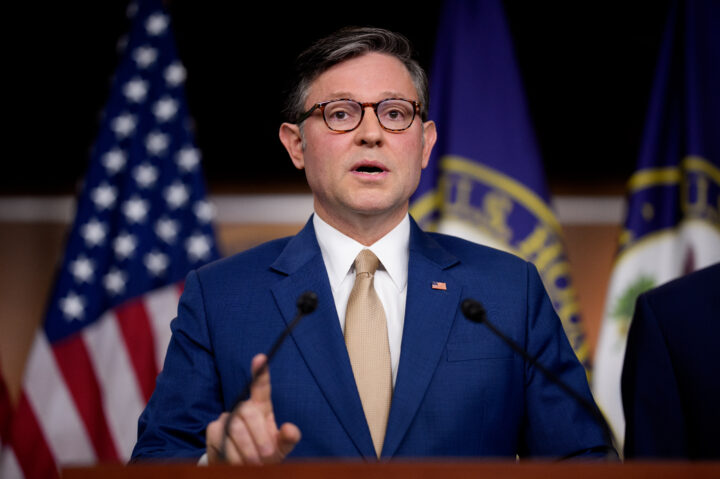
Speaker of the House Mike Johnson (R-LA) speaks during a news conference on Capitol Hill on October 20, 2025 in Washington, DC.


 Add JewishInsider on Google
Breaking with many Senate Republicans who have expressed skepticism about various elements of the Trump administration’s memorandum of understanding with Iran, House Speaker Mike Johnson defended the deal on Tuesday.
House Republicans returned to Washington on Tuesday for the first time since the deal with Iran was finalized.
“We need to keep forward with good progress, the details are still being negotiated, so I’m not going to prejudge,” Johnson said.
“There’s a lot of moving parts right now,” Johnson said, when asked whether he has concerns about the lifting of oil sanctions under the agreement, as he did for the Obama administration’s 2015 nuclear deal. “It is something the Trump administration is working around the clock on. I trust that they’re going to come to a lasting solution on that. The world desperately needs it and we do as well.”
When pressed, he said that he has “always been a supporter of strong sanctions against Iran” but added that there’s “a lot of moving parts to this” and that he’s “not going to tell the administration how to negotiate that.”
Johnson added that he is “heartened to see” gas prices decreasing and the Strait of Hormuz reopened.
While several Republican defense hawks in the Senate have criticized the administration’s deal with and concessions to Iran, others say they want to see the full effects of the agreement and the potential outcome of negotiations first.
Sen. Kevin Cramer (R-ND) said at an Orthodox Union luncheon on Tuesday that he is currently weighing in privately with Republican leadership and the White House about his views on the deal, “in the hopes that at the end of all of this, that Israel is in a better neighborhood, and I believe that … can happen.” He said he would speak out publicly if “appropriate.”
Other hawkish Republicans have pointed blame for the deal away from the president himself.
Democrats accused national Republicans of promoting the extreme candidate in a Texas swing district that both parties are contesting
Andrew Harnik/Getty Images
Speaker of the House Mike Johnson (R-LA) speaks during a news conference on Capitol Hill on October 20, 2025 in Washington, DC.
House Speaker Mike Johnson’s (R-LA) political spokesperson denied on Wednesday allegations that Johnson was involved in boosting Maureen Galindo, an antisemitic Democratic candidate in Texas’ 35th Congressional District.
The spokesperson said that Johnson had no involvement in the district’s Democratic primary, which Galindo lost on Tuesday.
The statement came after the Democratic Congressional Campaign Committee blasted Johnson in response to an article in the newsletter Popular Information that linked Lead Left PAC, the shadowy super PAC that supported Galindo, to a prominent GOP compliance consulting firm. One of the founders of that group, Caleb Crosby, has served as the treasurer for the Congressional Leadership Fund and Senate Leadership Fund, the primary super PAC arms of House and Senate leadership.
The origins of the pro-Galindo effort have been heavily shrouded in mystery, but national Republicans would have had an interest in boosting the less-electable Galindo in a swing-district race that Democrats hope to win. It’s unclear the extent to which Crosby or his firm, which advertises compliance reporting, budgetary and fiscal management and other similar services, would have been involved in any strategic decision-making for the Lead Left PAC.
“Mike Johnson’s political operation boosted a dangerous antisemite in the TX-35 Democratic primary runoff in an attempt to gain political power,” DCCC spokesperson Courtney Rice said in a statement. “This should shock the core of the Republican Party, and every single Republican needs to stand and speak out against this cynical political move.”
CLF and Crosby’s consulting firm, Crosby Ottenhoff Group, did not respond to a request for comment.
Both Secretary of State Rubio and House Speaker Mike Johnson suggested Israel’s determination to strike Iran necessitated U.S. engagement

Andrew Harnik/Getty Images
Sen. Mark Warner (D-VA) address a Senate Intelligence Committee hearing on March 25, 2025 in Washington.
House Speaker Mike Johnson (R-LA) and Senate Intelligence Committee Vice Chairman Sen. Mark Warner (D-VA) emerged from a classified briefing with Cabinet officials on Monday split over whether the U.S. faced an imminent threat from Iran that necessitated and permitted the president to take military action under U.S. statute and the Constitution.
Before entering the briefing, held by administration officials for a bipartisan group of congressional leaders, Secretary of State Marco Rubio told reporters that the U.S. launched the strikes because Israel was determined to carry out an operation against Iran, which U.S. intelligence showed would have prompted retaliation by Iran against American assets.
He also said that the U.S. goal was to degrade Iran’s ballistic missile capacities and sink its navy, not to effect regime change.
Johnson emerged from the briefing offering strong support for the administration’s actions and echoing Rubio’s explanation of the strikes.
“The most critical point is that this was a defensive measure, a defensive operation,” Johnson said. “Israel was determined to act in their own defense here, with or without American support. Why? Because Israel faced what they deemed to be an existential threat. Iran was building missiles at a radical, rapid clip, to the point where our allies in the region do not keep up.”
Johnson argued that, if the U.S. had failed to act alongside Israel and instead waited for Iran to attack its forces in retaliation, “the consequences of inaction on our part could have been devastating. … those losses would have been far greater than if we had done what we did.”
He added that, if U.S. officials had deferred action, they would instead now be facing questions from Congress about why they had not acted sooner. He said that he believes the operation “will be wound up quickly, by God’s grace.”
Warner said that the war is “a war of choice that has been acknowledged by others [that] was dictated by Israel’s goals and timelines. Israel is a great ally of America. I stand firmly with Israel, but I believe at the end of the day, when we are talking about putting American soldiers in harm’s way, when we have American casualties and expectations of more, there needs to be the proof of an imminent threat to American interests. I still don’t think that standard has been met.”
He also criticized the administration and Trump for their shifting articulation of the U.S.’ goals, and said that the administration has no clear plan for what it will do if there is an uprising by Iranian demonstrators followed by another crackdown by the remaining regime.
Warner said that, in January, when the Iranian regime was massacring protesters in the streets, “you could have actually made a case then that taking a strike towards the [Islamic Revolutionary Guard Corps] might have pushed the people forward and the regime to crumble,” but said that such an action was impossible at the time because of the operation in Venezuela and the tensions with European allies over Trump’s ambitions to take over Greenland.
“I might not have agreed with an action then, but at least there was a logic to that moment in time,” Warner said. “Now it appears that the timeline is not being driven by American imminent security concerns, but by others.”
In a brief statement to reporters, Senate Minority Leader Chuck Schumer (D-NY) said he found the administration officials’ answers “completely and totally insufficient” and said that the briefing provided more questions than answers.
Lawmakers also indicated that the administration is likely to request additional funding from Congress to replenish weapons stockpiles expended in the war.
Johnson emphasized after the briefing that administration officials had made it clear that the “objective is not regime change” and that the U.S. mission did not involve eliminating the ayatollah or other Iranian leaders, several dozen of whom have now been killed.
While none directly contradicted the Trump administration, some Senate Republicans seemed to take a different view of whether the U.S. should be pursuing a change in the Iranian regime.
Sen. John Kennedy (R-LA) emphasized that the Iranian regime’s leadership is “crazy as a bed bug” and composed of “just insane” religious fanatics who cannot be reasoned with, and that their nuclear ambitions would set off a global arms race.
“I don’t want America to be the world’s policeman,” Kennedy said. “But I don’t want these crazy people in Iran to be the world’s policeman either. And if you give them a nuclear weapon, they will be.”
Pressed on whether he would think the administration has done enough if Iran remains ruled by someone who is, as he put it, “insane” and pursuing a nuclear weapon, Kennedy said, “that would not be my preference,” but he said he could not predict what the outcome of the war will entail.
“I’m assuming that the administration is destroying all capability to develop a nuclear weapon to the extent that we haven’t destroyed it already, destroying their ability to manufacture missiles, destroying their launchers,” Kennedy continued. “The key to controlling Iran is controlling the Revolutionary Guard and the military. And I assume that they’re trying to give them a curb stomping as well.”
Sen. James Lankford (R-OK) argued that “regime change has already occurred there, one way or the other, since all the senior leadership is now gone.”
Asked whether it would be a sufficient outcome if someone else from the current Iranian government ends up leading the country at the end of the U.S. operations, Lankford said it is dependent on the posture that Iran’s next leader takes — whether they still threaten Iran’s neighbors, attack the United States, pursue a nuclear weapon and seek to eliminate Israel.
“I think that’s the litmus test,” Lankford said.
Sen. Markwayne Mullin (R-OK) said that the question of Iran’s governance is up to the Iranian people.
The duration of the war, he said, is “just a matter of how much fight they have left and how long the Iranian people are going to put up with this … they get to choose their next leadership, hopefully, and we’re eliminating a threat to the United States and our assets. After that, it’s up to the Iranian people to choose.”
Pressed on whether he would be satisfied if the regime remains in power at the end of the war, Mullin emphasized that the U.S. was no longer willing to allow Iran to present a threat, but “what they choose next will be up to the Iranian people. We’re giving that opportunity, but we’re not going to fight for their country harder than they’re willing to fight.”
Johnson argued after the briefing that it would be “frightening” and “dangerous” for Congress to approve a war powers resolution to “take [Trump’s] authority away right not to finish the job.”
Democrats — who plan to force votes on such resolutions demanding the end of U.S. operations against Iran without congressional approval — did not articulate a clear exit strategy from the conflict in the unlikely event that that resolution passes.
“Ask the drafters of the resolution,” Warner replied, when asked about the consequences of pulling U.S. troops out of ongoing operations in Iran. Warner said he intends to support the resolutions.
Asked the same question, Sen. Richard Blumenthal (D-CT) emphasized that the key question in the war powers vote is one of congressional authority and that the White House needs to explain the threat that administration officials said the U.S. faced.
He argued that Rubio’s public statements — that Iran’s ballistic missile arsenal was growing to a point of “immunity” allowing it to “hold the whole world hostage” within the next year or year and a half — illustrate that the arsenal did not pose an imminent threat to the U.S.
“The president’s been all over the place. He’s, in effect, workshopping a war. It’s like he’s a kid with a puzzle trying to fit the pieces together in a way that creates a picture,” Blumenthal continued.
Asked whether there was any form of an operation in Iran that he could support, if the administration presented a clear plan to Congress for its approval, Blumenthal emphasized that he had no regrets about the death of Supreme Leader Ayatollah Ali Khamenei and other senior Iranian leaders.
“If this war, in effect, were not a war and simply the kind of strike that we did in Venezuela, where we removed the key leader, it might be a lot more palatable,” Blumenthal said. “Here’s what really concerns me: the president is talking about regime change, and there’s no way to accomplish regime change from 30,000 feet. There is no precedent for bombing successfully achieving regime change. There have to be boots on the ground.”
Trump and Defense Secretary Pete Hegseth explicitly did not rule out a U.S. ground operation in separate comments on Monday.
Blumenthal said that such an on-the-ground operation would be unacceptable to the American people and set off a “forever war.”
“I think we are on a very perilous path without defined objectives,” Blumenthal said. “If it’s only to kill Ayatollah Khamenei, we’ve accomplished that objective. Right now, we’re way beyond it in a regional war that is spreading in both intensity and geographic scope.”
And asked whether Trump had the authority to launch the war, Blumenthal responded that Trump “doesn’t have the power to continue it, constitutionally, without approval by Congress.”
Johnson also headlining a pro-Israel event for GOP Rep. Tom Kean of New Jersey on the trip

Courtesy House Speaker Mike Johnson (R-LA)
House Speaker Mike Johnson (R-LA), center, met in June 2024 with Hasidic leaders in New Square and Monsey, N.Y., alongside local GOP Rep. Mike Lawler (R-NY), right.
House Speaker Mike Johnson (R-LA) is set to visit New Square, N.Y. on Sunday alongside Rep. Mike Lawler (R-NY), Johnson’s team confirmed to Jewish Insider. The trip will be Johnson’s third to the Hasidic village in Rockland County since becoming House speaker.
Johnson is set to meet privately with David Twersky, the grand rabbi of New Square, during his visit.
The trip comes as Lawler gears up for his third congressional race, which is one of Democrats’ top target districts in next year’s midterms. New Square has proven to be a critical voting bloc in the battleground House district. Lawler received a crucial endorsement from the community in 2024.
Both Republicans and Democrats have worked hard to court New Square in recent years — House Minority Leader Hakeem Jeffries (D-NY) and then-Senate Majority Leader Chuck Schumer (D-NY) also visited the community last October alongside Mondaire Jones, Lawler’s Democratic opponent in the 2024 election. Former President Joe Biden also reached out to Twersky in the runup to the 2022 midterms.
During his time in the New York area, Johnson is also scheduled to participate in an event for Rep. Tom Kean (R-NJ) with the pro-Israel group NORPAC in Bergen County. Kean faces a competitive re-election in a northern New Jersey swing district.
The House speaker cautioned that the party is likely bound for a major debate over foreign policy after President Trump leaves office

Kent Nishimura/Getty Images
House Speaker Mike Johnson (R-LA) does an interview with CNN at the U.S. Capitol on April 17, 2024 in Washington, D.C.
House Speaker Mike Johnson (R-LA) spoke about his efforts to hold the line against the isolationist wing of the Republican Party in a private meeting with pro-Israel leaders on Capitol Hill on Wednesday, several individuals who attended the meeting told Jewish Insider.
Johnson, who described himself to the group as a “Reagan Republican” focused on “peace through strength,” acknowledged that isolationism is rising in the Republican Party, and that the party is likely bound for a major debate on the issue after President Donald Trump leaves office.
And Johnson told the group that, in his candidate recruiting efforts, he’s working to filter out isolationists to prevent that wing of the party from growing larger in the House, four people who attended the meeting said.
“The speaker was very, very direct about the U.S. role with Israel and in the world and understands that there are voices that don’t agree in both parties, on both extremes, and urges us all to be involved in fighting back against those extremes,” Eric Fingerhut, the CEO of the Jewish Federations of North America, told JI.
One attendee said Johnson had also expressed a strong interest in finding new funding methods for humanitarian aid in Gaza, outside of the United Nations.
Johnson also discussed his recent trip to Israel and his and his wife’s lengthy dinner with Israeli Prime Minister Benjamin Netanyahu and his wife, Sara, with whom he said he has become close friends. He said that he and Netanyahu had discussed that there are no good options ahead in Gaza, one attendee told JI.
The speaker also told the group he is eager to return to Israel to address the Knesset, after he was unable to do so as scheduled in June due to the Israel-Iran war.
Johnson emphasized his commitment to working across the aisle to support Israel and the Jewish community, an individual in the room said. With a government shutdown deadline fast-approaching at the end of the month, Johnson said he’s committed to continuing to work through the regular appropriations process and negotiating with the Senate, and noted that various Jewish communal priorities would be part of that process.
One source said Johnson had also highlighted the fact that he was the highest-ranking elected official to visit a settlement in the West Bank, which the source noted puts him at odds with many in the Jewish community.
Rep. Tim Walberg (R-MI), who also addressed the meeting, provided an overview of the investigations that the House Education and Workforce Committee is conducting into antisemitism, as well as noted he’d been texting recently with Anti-Defamation League CEO Jonathan Greenblatt about the proliferation of antisemitic conspiracy theories about the killing of influencer Charlie Kirk.
Rabbi Levi Shemtov of American Friends of Lubavitch (Chabad) delivered a prayer and Reps. David Kustoff (R-TN), Randy Fine (R-FL) and Craig Goldman (R-TX) also spoke to the group.
One attendee described Johnson as clearly knowledgeable about and comfortable with the issues at play and the meeting overall as cordial and non-contentious.
“There’s just a remarkable sense of gratitude from all across the Jewish community for the leadership that Speaker Johnson has brought to the U.S.-Israel relationship,” Fingerhut said. “He was not someone who was that well-known to our community before he became speaker, but he’s comprehensively knowledgeable. It’s clearly something he feels very personally about.”
The organizations in attendance included: The Louis D. Brandeis Center for Human Rights Under Law, the Republican Jewish Coalition, Agudath Israel of America, AIPAC, the Simon Wiesenthal Center, Conference of Presidents of Major American Jewish Organizations, National Council of Jewish Women, Syngeros Holdings, CUFI Action, the Orthodox Union, the U.S.-China Economic and Security Review Commission, Standard Industries, the American Jewish Committee, Zionist Organization of America, National Debt Relief, Jewish Institute for National Security of America, the Deborah Project, Foundation for Defense of Democracies, Coalition for Jewish Values and the Endowment for Middle East Truth.
Johnson will not be addressing the Knesset on this visit to Israel, as had been planned for a postponed June trip

Western Wall Heritage Foundation
House Speaker Mike Johnson (R-LA) visits the Western Wall on August 3, 2025.
House Speaker Mike Johnson (R-LA) and a group of House Republicans are visiting Israel this week, in Johnson’s first visit to Israel since becoming speaker.
Johnson was set to visit Israel in June to address the Knesset, but postponed his visit after the war between Israel and Iran began. He will not be addressing the Knesset on this visit, a source familiar with his plans told Jewish Insider.
Johnson and those in his delegation — Reps. Michael McCaul (R-TX), Nathaniel Moran (R-TX), Claudia Tenney (R-NY) and Michael Cloud (R-TX) — have prayed at the Western Wall and met with Israeli Defense Minister Israel Katz and Foreign Minister Gideon Sa’ar.
“We’re so grateful to be in Israel, particularly on this day, recognizing the destruction of the two Temples … it is such a moving time for us to be here at the Wailing Wall. We’ve offered our prayers, we’ve put our notes into the wall,” Johnson said in brief video remarks from the Kotel, which he visited on Tisha B’Av. “We’re so moved by the hospitality of the people and the great love of Israel.”
“Our prayer is that America will always stand with the people of Israel and we pray for the preservation and the peace of Jerusalem,” Johnson continued. “That’s what scripture tells us to do, it’s a matter of faith for us, and commitment that we have.”
Katz said in a statement that he thanked the lawmakers “for their unwavering support and moral clarity in standing with Israel against its enemies, and for their vital voices in the efforts to bring all the hostages home and defeat the murderous terrorist organization Hamas.”
Sa’ar said the group discussed global antisemitism, anti-Israel efforts by countries like Ireland and the attacks on the Druze in Syria, which Sa’ar said were “same kind of barbarism perpetrated by Hamas.”
The trip was organized by the U.S.-Israel Education Association.
In comments on CNN last week, Johnson raised concerns about the humanitarian crisis in Gaza, saying that “it is quite sad and quite alarming to see” and that he’d like to see the war in Gaza end soon.
Johnson’s office did not share any further details of his itinerary while he’s visiting the Jewish state.
The House speaker said he wants to see the war in Gaza come to an end soon
Kent Nishimura/Getty Images
House Speaker Mike Johnson (R-LA) does an interview with CNN at the U.S. Capitol on April 17, 2024 in Washington, D.C.
House Speaker Mike Johnson (R-LA) expressed strong concern about the humanitarian crisis in Gaza in an appearance on CNN’s “The Lead” on Wednesday.
Johnson’s comments, made days after President Donald Trump said that there is “real starvation” happening in Gaza, indicate growing concern even among pro-Israel Republicans about the humanitarian situation in Gaza, at the same time that such concerns on the Democratic side have reached new heights.
“I do hope it comes to an end soon,” Johnson said about the war in Gaza, “and we bring an end to this suffering and misery, because it is quite sad and quite alarming to see.”
He said that “we’ve got a humanitarian crisis in Gaza — I mean the pictures tell 1,000 words and it’s heartbreaking.” Israeli Prime Minister Benjamin Netanyahu has said that there is “no starvation” happening in the enclave.
The House speaker said that he wants to see an end to the conflict and peace, adding that “President Trump is using a strong hand to try to forge that, and we’re moving in the right direction.”
He also credited Israel with opening up new channels for aid and noted that the U.S. and its partners are going to work to provide additional aid as well.
Johnson did not mention Hamas, which some supporters of Israel argue should shoulder the blame for any aid shortages and the lack of a ceasefire in Gaza.
Johnson didn’t directly address a question from host Jake Tapper about whether he’s concerned that Israel is at risk of becoming a global pariah.
‘We look forward to rescheduling the address in the near future and send our prayers to the people of Israel and the Middle East,’ the House speaker said

Tom Williams/CQ-Roll Call, Inc via Getty Images
Speaker of the House Mike Johnson (R-LA)
House Speaker Mike Johnson (R-LA) announced on Monday that he’s postponing plans to visit Israel and speak to the Knesset on Sunday in light of the ongoing conflict between Israel and Iran, which has thus far frozen all civilian air traffic in and out of Israel and prohibited public gatherings in the country.
“Due to the complex situation currently unfolding in Iran and Israel, Speaker [of the Knesset Amir] Ohana and I have made the decision to postpone the special session of the Knesset,” Johnson said in a statement. “We look forward to rescheduling the address in the near future and send our prayers to the people of Israel and the Middle East.”
The trip would have been Johnson’s first visit to the Middle East since he was elected speaker, shortly following the Oct. 7, 2023, Hamas attacks on Israel.
A separate congressional delegation is set to visit the Middle East this week and stop in Israel, although it’s not clear whether that will be feasible. Members could still attempt to transit into Israel via land crossings from Jordan or Egypt, as some did immediately following Oct. 7.
The war is likely to disrupt upcoming travel to Israel for various members — the House is currently set for a weeklong recess, and the Senate will be out of town for the latter half of the week. Members of both chambers are also in recess during the first week of July, for Independence Day.
The House speaker joined Minority Leader Hakeem Jeffries and others for a vigil honoring Yaron Lischinsky and Sarah Milgrim, killed in the Capital Jewish Museum shooting

Marc Rod
Lawmakers gather on the Capitol steps on June 10, 2025 for a vigil for Yaron Lischinsky and Sarah Milgrim, Israeli Embassy staffers who were killed in an anti-Israel attack.
House Speaker Mike Johnson (R-LA) sharply denounced the anti-Israel movement on Tuesday, describing it as making common cause with terrorists and putting “a bounty on the heads of peace-loving Jewish Americans.”
Johnson gathered on the steps of the Capitol with House Minority Leader Hakeem Jeffries (D-NY), dozens of members of Congress, Israeli Ambassador to the U.S. Yechiel Leiter, American Jewish Committee CEO Ted Deutch, hostage family members including Ronen Neutra and staff from the Israeli Embassy and AJC for a vigil honoring Yaron Lischinsky and Sarah Milgrim, the Israeli Embassy employees killed by an anti-Israel activist outside an AJC event at the Capital Jewish Museum last month.
“It’s a dangerous time to be a Jewish American,” Johnson said, noting that the House had taken extra precautions to keep the event under wraps for security reasons. Visible and covert security surrounded the gathering.
“The monster who murdered [Lischinsky and Milgrim] was not motivated by peace, [but] something very different. He went to a Jewish museum to hunt down Jewish people, and we want to be crystal clear tonight: This is targeted antisemitic terrorism,” Johnson said. “There are no shades of gray. There is no other way to describe it, as we’ve seen in the weeks since this violence is definitely not isolated.”
He said that the D.C. shooter and the individual who attacked a march for the hostages in Gaza in Boulder, Colo., were “united in their sick hatred of the Jewish people.” He highlighted that both shouted “Free Palestine” during their attacks, a slogan he noted has proliferated at protests on college campuses and in American cities.
“‘Free Palestine’ is the chant of a violent movement that has found common cause with Hamas,” Johnson said. “It’s a movement that has lost hold of the difference between right and wrong, between good and evil, between light and darkness … They proclaim that violence is righteous, that rape is justice and that murder is liberation. They have created a culture of lies that puts a bounty on the heads of peace-loving Jewish Americans.”
Jeffries described the shooting as domestic terrorism and said Lischinsky and Milgrim were “victims of the same deadly antisemitism that fueled the attacks in Boulder, the attack at Gov. Josh Shapiro’s home in Pennsylvania, at synagogues, yeshivas, businesses and communities all across America.”
“Antisemitism has been a painful reality of Jewish life throughout the world for thousands of years, but now too many of our Jewish brothers and sisters here in America fear for their safety,” Jeffries said. “In this country, antisemitism has been metastasizing like a malignant tumor, and we must all work together to eradicate this cancer.”
Referencing the week’s Torah portion, when God instructed Moses to appoint elders to help him lead the Jewish people through the desert after leaving Mount Sinai, Jeffries said that lawmakers from both parties need to step up to help the Jewish community fight antisemitism.
“We will not let you shoulder this burden alone,” Jeffries said. “That’s a moral necessity here in the United States of America.”
Leiter said that “the intifada has been globalized, and like [George] Orwell’s ‘1984,’ ‘Free, free Palestine’ means ‘Death, death Israel,’ and it is now incumbent upon all of us to confront it,” Leiter said. “Today we are challenged to act, to honor the fallen, not just with words, but with a renewed commitment to fighting the scourge of hate, fighting the demonization and delegitimization of the State of Israel.”
AJC’s Deutch said that “antisemitism is antisemitism, period. There should be no more debate about which kind of antisemitism is more dangerous, or which we need to be more afraid of.”
“It is clear every antisemitism is and has been deadly, from the extreme left to the extreme right,” Deutch said. “Both must be condemned by everyone, no excuses, because if you can only see antisemitism when it is convenient then you’re not seeing it at all.”
He described the demonization of Israel and trends of blaming it for “every injustice in the world” as the “current socially acceptable form of antisemitism,” which has “sanitized” the hatred.
“There is a straight line from the demonization of Israel, the dangerous lies that people peddle about the one Jewish state to the antisemitic violence that impacts real people,” Deutch said. “When calls to globalize the intifada and chants [of] ‘from the river to the sea’ are screamed at protests, these must be called out for what they are. They are not slogans for a social justice movement. They are incitement to violence. Everyone must call that out forcefully and with clarity.”
Deutch said he appreciates Congress’ work to improve Jewish communal security, but argued that it is not normal nor acceptable for any religious group to need armed guards and security checkpoints to gather and practice their faith.
Lischinsky and Milgrim’s supervisors at the embassy shared statements from their families, highlighting their lives, the positive impacts they had on their communities and their passion for their work at the Israeli Embassy.
Please log in if you already have a subscription, or subscribe to access the latest updates.
 Continue with Google

 Continue with Apple