



































































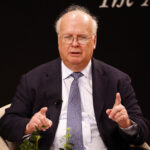










The incident is the latest in a growing number of antisemitic discrimination incidents in Ireland

Getty Images
The Herbert Park Hotel in Ballsbridge, Dublin, Ireland.


 Add JewishInsider on Google
A Dublin hotel canceled 70 rooms booked for participants in an international conference of envoys for combatting antisemitism, attendees and organizers said on Tuesday.
Maurice Cohen, the head of the Irish Jewish Representative Council, said at the opening gathering of the summit that the Herbert Park Hotel canceled the group’s reservation made in May, after finding out the nature of the event. The hotel’s manager also asked if the conference was connected to the IDF. The Herbert Park Hotel declined to comment.
The World Jewish Congress event, which was held on Tuesday and Wednesday in different locations in Dublin, convened over 35 government envoys and coordinators for combatting antisemitism, as well as leaders of Jewish organizations from 20 countries, including the J7 Task Force Against Antisemitism, which includes major organizations representing the Jewish communities in the U.S., U.K., Canada, France, Germany, Argentina and Australia. Irish Taoiseach (Prime Minister) Micheál Martin met on Tuesday with J7 representatives, including Anti-Defamation League CEO Jonathan Greenblatt, Conference of Presidents of Major American Jewish Organizations CEO William Daroff and European Commissioner Coordinator on Combating Antisemitism Katharina von Schnurbein. The European Union co-funded the conference.
In his remarks to the conference, Maurice Cohen, president of the Jewish Representative Council of Ireland, recounted that he had celebrated his mother’s birthdays at the Herbert Park Hotel for years, but that it has since “acquire[d] a very different place in my memory.”
He met with the general manager of the hotel after reserving the rooms, and she asked what the abbreviation used to describe it, SECCA, stood for. When he told her the answer — Special Envoys and Coordinators for Combating Antisemitism — and explained who would be attending, he “noticed her manner change. There was a tension that had not been there before.”
She asked, “Will the IDF be involved?” Cohen recalled.
“Nothing I had said had anything whatsoever to do with the Israeli army, yet somehow that was where the conversation had gone,” he added.
The manager then said she had to consult with the hotel’s owners, and soon after canceled the reservation.
“Contemporary antisemitism does not always arrive wearing the language of the past. It does not always announce itself with a slur, a threat or a placard. … It begins by treating Jewish identity as evidence of political allegiance. It turns Jewish people into representatives of a foreign state, Jewish gatherings into security concerns, and ordinary acts of welcome into decisions requiring special permission,” he said.
Cohen added: “That is the danger of antisemitism today: not only that it excludes Jews, but that it makes their exclusion appear reasonable.”
Former Irish Justice Minister Alan Shatter wrote on X that the incident was “a vile illustration of the issue to be addressed.”
Ireland has long been one of the EU countries most critical of Israel, and antisemitism has spiked in recent years. Israel closed its embassy in Dublin in 2024 after Ireland joined South Africa’s genocide charges against Israel at the International Court of Justice.
Irish President Catherine Connolly has said Israel is a “Jewish supremac[ist]” state, and said that Hamas should be accepted as part of a legitimate Palestinian government. As a parliamentarian, she protested the Irish Embassy to Israel commemorating Holocaust Remembrance Day.
Last month, the Irish national soccer team faced calls from fans to boycott its match against the Israeli team, and the Irish players refused to shake hands with the Israelis.
In addition, Dublin nearly removed former Israeli President Chaim Herzog’s name last year from a public park adjacent to the city’s only Jewish school. Herzog was the son of Ireland’s Chief Rabbi Yitzhak HaLevi Herzog, who later became Israel’s first chief rabbi, fought in the British Army in World War II, taking part in the liberation of Bergen-Belsen, and was the head of IDF intelligence and Israeli ambassador to the U.N. — famously tearing up its “Zionism is racism” resolution — before serving as Israel’s sixth president in 1983-1993. His son, Isaac Herzog, is Israel’s current president.
The Center for American Progress hosted leading Democratic officials and featured several panels on foreign policy. Israel was barely discussed
Screenshot
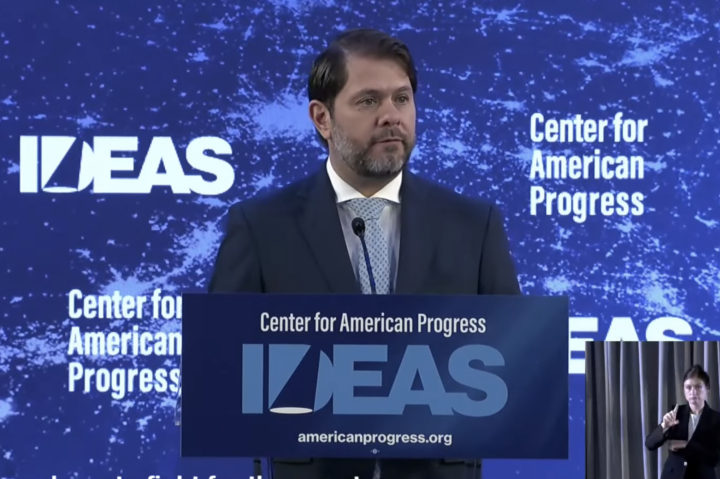
Sen. Ruben Gallego (D-AZ) speaks at the Center for American Progress’ IDEAS Conference, May 19, 2026
On Tuesday, a gilded ballroom inside a Washington hotel served as a soapbox for more than a dozen Democrats — many with national ambitions — to pitch their vision for America to a room full of liberal donors, staffers and funders.
The setting was the Center for American Progress’ IDEAS Conference, a convening put on by the Democratic think tank that pledged to bring together “the broad center-left’s leading thinkers and doers” to offer ideas on a range of policy topics.
American foreign policy was, naturally, one of those topics. In the two sessions on national security, each of which devoted significant discussion to the Middle East, one topic was notably absent: Israel.
Democratic support for Israel has shifted dramatically since the Oct. 7 attacks and the resulting war in Gaza. Over the last few months, particularly since the war in Iran began, that policy shift has quickly solidified. Forty out of 47 Senate Democrats voted last month to block some arms sales to Israel, and the progressive Israel advocacy group J Street has urged Democrats to move toward ending all U.S. aid to Israel.
Democrats’ attitude toward the U.S.-Israel relationship is in flux, and is almost certain to be a major point of contention in the 2028 primary campaign. But if CAP’s conference is any indication, many mainstream Democrats — the ones who are not pushing firebrand far-left views on Israel — would rather avoid the topic if they are not forced to discuss it.
Certainly, it made clear that they no longer see Israel as the kind of ally that will earn applause in the same way that Taiwan and Ukraine garner cheers from rank-and-file Democrats.
Sen. Ruben Gallego (D-AZ) kicked off the gathering with an address billed as “National Security Ideas for the Future.” He cited his own experiences as a member of the Marine Corps who served in Iraq, arguing that the war in Iran is misguided and harming Americans.
”I’m here today because right now our country is in danger. Will this president continue to drag America into another endless Middle East war?” Gallego said. “This is a war that wasn’t planned, wasn’t authorized and is not making us safer. [Donald] Trump got his war, and working families got stuck with the bill every day.”
Gallego made clear that his opposition to the Iran war does not mean he thinks America should step off the world stage. The U.S., he argued, should still come to the defense of Taiwan and Ukraine.
“I see on Twitter all the time, ‘Well, if you’re against the war in Iran, why do you support the war in Ukraine?’” Gallego said. “Let me be clear: The Ukrainian people are fighting for their independence, and it’s in our strategic interest to make sure that they win, that Europe wins and that we all win and defeat Russia.”
He extended the argument to Taiwan, calling for Washington to continue arms sales to the country and to help it grow its self-defense capabilities.
“We have allies that have fought with us and will continue to fight with us, but not if we abandon Taiwan, Ukraine and NATO,” said Gallego. He did not mention Israel in his speech.
Later in the day, a conversation on the future of American policy featured Sen. Andy Kim (D-NJ), former Secretary of State Tony Blinken and former U.S. Ambassador to the United Nations Linda Thomas-Greenfield. Like Gallego, they slammed Trump’s campaign against Iran as illegal.
“This is not a situation where we should normalize the idea that a president can start a war on their own, and then it’s up to Congress later to disapprove of it, right?” said Kim. “Just from the outset, this is wrong. This is an illegal, unconstitutional war.”
The only mention of Israel in their 30-minute conversation was a brief aside from Blinken, as part of a broader point he was making about Iranian missile attacks on the United Arab Emirates. All three speakers doubled down on U.S. support for Ukraine and for Taiwan, particularly in the face of Trump’s meeting with Chinese President Xi Jinping last week.
At the end of the day, CAP President Neera Tanden said she hopes attendees walk away with a sense of where the Democratic Party is going. “To win the future we have to tell people where to go, what the path is, what the path is forward,” Tanden said.
Other speakers included California Gov. Gavin Newsom, Maryland Gov. Wes Moore, Virginia Gov. Abigail Spanberger, House Minority Leader Hakeem Jeffries (D-NY), Senate Minority Leader Chuck Schumer (D-NY), Cory Booker (D-NJ) and Elizabeth Warren (D-MA).
Please log in if you already have a subscription, or subscribe to access the latest updates.
 Continue with Google

 Continue with Apple