














































































Hours later, the Senate rejected a similar measure

Kevin Carter/Getty Images
The U.S. Capitol Building is seen at sunset on May 31, 2025 in Washington, DC.


 Add JewishInsider on Google
The House passed a second Iran war powers resolution on Thursday following the resumption of hostilities between the U.S. and Iran, with a handful of Republicans who have argued that continued operations violate the War Powers Act again siding with Democrats on the measure.
But hours later, the Senate blocked a separate resolution, also along narrow margins.
Reps. Tom Barrett (R-MI), Brian Fitzpatrick (R-PA), Thomas Massie (R-KY) and Warren Davidson (R-OH) again sided with all House Democrats to pass the resolution by a 214-208 vote.
Rep. Nancy Mace (R-SC) said prior to the vote that she planned to support the war powers resolution but ultimately did not.
The Senate resolution was blocked by a 49-47 vote, with Sen. Susan Collins (R-ME) voting with most Democrats in support of the resolution and Sen. John Fetterman (D-PA) voting against it.
The House and Senate previously passed a similar resolution attempting to end the war, which Democrats have cited to describe the renewed hostilities as illegal.
The measure passed in the House on Thursday was in the form of a concurrent resolution — as was the previous resolution passed by Congress — which is not presented to the president and is generally not seen as carrying the force of law, though Democrats have been working to explore avenues to enforce it.
Also on Thursday, Rep. Greg Meeks (D-NY), the ranking member of the House Foreign Affairs Committee, introduced a resolution demanding that House Speaker Mike Johnson (R-LA) initiate civil action in federal courts to enforce the previously passed war powers resolution directing the removal of U.S. forces from the Iran war.
The president implied that the renewed strikes reset the 60-day clock for operations without congressional authorization
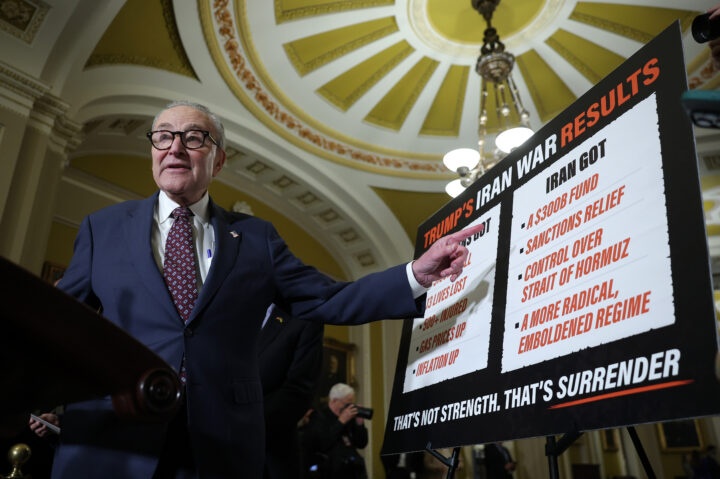
Photo by Kevin Dietsch/Getty Images
U.S. Senate Minority Leader Chuck Schumer (D-NY) speaks to reporters after the weekly Senate policy luncheons at the U.S. Capitol on June 23, 2026 in Washington.
Democrats on Monday slammed President Donald Trump’s resumption of hostilities against Iran, as well as the notion, implicit in Trump’s notification, that the operations mark a new conflict and therefore reset the 60-day window for military operations launched by the executive branch without congressional approval.
In a letter to congressional leaders on Friday notifying them that the war had resumed, Trump said that Iran repeatedly violated the memorandum of understanding by attacking commercial vessels on July 6 and 7, and that the U.S. had, as of July 7, commenced “defensive strikes against targets within Iran including missile launch sites, air defenses, military maritime assets, military support infrastructure, and command and control capabilities.”
Trump said that ground forces are not involved in the operations and are focused on protecting the U.S., but American forces “remain postured to take further action.” He added that he was notifying Congress pursuant to his obligation under the War Powers Act, the statute that lays out the 60-day timeline.
Critics of the war have argued consistently that the operations that began in February never actually concluded during the since-terminated ceasefire, despite the administration’s assertions otherwise.
“Trump’s rinse and repeat approach to the Iran war isn’t a strategy, it’s a recipe for utter disaster,” Senate Minority Leader Chuck Schumer (D-NY) said Monday. “It’s incredible what a fiasco this war is. Trump’s so-called understanding — lot of bull — with Iran fell apart faster than the ink could dry.”
Sen. Tim Kaine (D-VA), who has led war powers efforts in the Senate to end the conflict, said the U.S. has been at war, and argued that the administration is obligated to withdraw U.S. forces in response to the war powers resolution that Congress passed last month.
“The notion that [the 60-day clock] was paused before, I think, was sort of laughed out of the room. This has been an ongoing conflict, even during the midst of a ceasefire,” Kaine said. “There were still hostilities underway. So this is not a war that paused and restarted.”
He said he will continue to support war powers efforts but believes that Congress has already definitively declared the war illegal. The resolution that Congress passed came in the form of a concurrent resolution, which is not presented to the president, and its legal force is disputed.
Sen. Adam Schiff (D-CA) filed a new war powers resolution on Monday to oppose the war, which likewise argues that combat operations never ceased.
“We were promised the war would be over for months. And now in a matter of days we’ve gone from a bad U.S.-Iran deal to more strikes, another blockade, and added turmoil that will only drive prices higher,” Schiff said in a statement. “Any assertion by the Trump administration that he gets 60 more days to act without Congress has no foundation in law.”
Kaine and Sens. Andy Kim (D-NJ), Jeff Merkley (D-OR) and Chris Van Hollen (D-MD) cosponsored the resolution.
Rep. Adam Smith (D-WA), the ranking member of the House Armed Services Committee, “wholeheartedly condemn[ed]” Trump’s plans to take control of the Strait of Hormuz, arguing that it is impossible without significant escalation and would be “frankly, just wrong.”
“Iran has gained greater leverage, continues to destabilize the region, and has a younger and more hardline leadership than when this war started,” Smith said. “It is past time for [Republicans] to work with us to ensure the president finds a diplomatic solution to ending a war he never should have started and that threatens our national security and defense as well as that of our partners.”
Even some Republicans have expressed skepticism of the administration’s strategy, including over Trump’s plan to impose a toll on the Strait of Hormuz.
“I recall Secretary [of State Marco] Rubio saying that would not be proper for any country. … Am I wrong?” Sen. John Cornyn (R-TX) told reporters.
Additionally, given the recent sudden death of Sen. Lindsey Graham (R-SC) and the extended medical absence of Sen. Mitch McConnell (R-KY), Democrats may be able to more consistently pass war powers resolutions to oppose the war in Iran.
Many Democrats also say they plan to oppose a procedural vote this week to advance the 2027 National Defense Authorization Act in protest of the continued operations against Iran.
The president also said on ‘Meet the Press’ that U.S. forces could be deployed into Iran to retrieve and destroy the regime's stockpile of enriched uranium
Roberto Schmidt/Getty Images
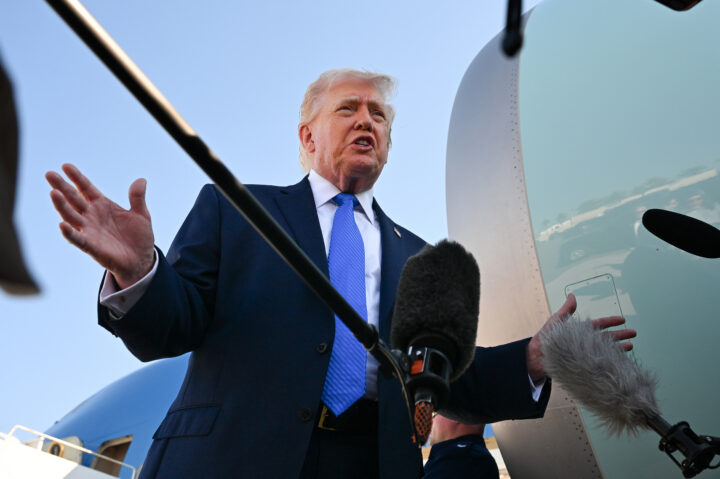
President Donald Trump speaks to reporters before boarding Air Force One at Palm Beach International Airport on March 23, 2026 in West Palm Beach, Florida.
Appearing on NBC’s “Meet the Press” on Sunday, President Donald Trump said his red line for resuming military action in Iran would be if he didn’t believe the parties could reach a deal in a timely manner, and said U.S. forces could be deployed into Iran to retrieve and destroy the regime’s stockpile of enriched uranium.
Trump continued to assert that Iran is desperate for a deal, even as negotiations appear largely deadlocked and as Esmaeil Baghaei, Iran’s Foreign Ministry spokesperson, told CNN in Tehran on Sunday that the primary obstacle to an agreement is Washington’s changing and “contradictory” positions. Meanwhile, U.S. and Iranian forces continue to exchange strikes nearly daily around the Strait of Hormuz.
Trump ruled out the prospect of unfreezing any Iranian assets or offering upfront sanctions relief to secure a breakthrough, maintaining that compliance must precede concessions.
“If they behave, if they do a good job, we start talking,” Trump said. But should Iran walk away from the table or drag out the timeline, the president emphasized he would not rule out a return to hostilities.
“My red line would be if I think I wasn’t going to make a deal, or if I wasn’t going to make a deal fast enough,” Trump said of resuming military action, noting that if Iran were to kill additional Americans — more than a dozen U.S. troops have already been killed in the current conflict — that would be “something that I would think about very seriously.”
“We’re having very good negotiations with the people that are leading the country now. It’s the third group that we’ve been dealing with. And they are different. And you could say it’s regime change actually because these are very different people. I find them to be more rational, very smart,” he added.
Trump specifically noted that he considers Supreme Leader Mojtaba Khamenei — the son of the late Supreme Leader Ayatollah Ali Khamenei — a more “rational” negotiating partner.
“I think [he is] more rational. He’s pretty badly injured. So there’s a certain bravery there,” Trump said. “A lot of people, if they were injured that badly, they wouldn’t be talking about, you know, ‘How are we doing with the United States?’ They’d have other things on their mind. So there’s a certain bravery there. But he is very seriously injured.”
The president further said U.S. forces could be sent into Iranian territory to secure the regime’s nuclear stockpiles, claiming that Washington knows exactly where the material is stored.
“The way you do it is if we make a deal now, we’re friendly, we’ll all go together. It’ll be our equipment. We’ll take it out and destroy it, whether it’s onsite or whether we take it offsite,” Trump explained. “We will be at peace. And we will go with them, or without them. But we won’t have people shooting at us, okay?”
He added: “Now, if we don’t make a deal, then we’re going to take them out militarily very harshly. And we’ll wait until we do that before we go, in which case we’ll have safety either way.”
Trump further claimed that the U.S. possesses highly specific data on Iran’s remaining military capabilities, including the locations of its drones, manufacturing plants, remaining missiles and launch sites. While the president stated that the majority of Iran’s production facilities “have been knocked out,” he acknowledged that Tehran still maintains some of its arsenal.
“I know almost the number, and we know where they are too, and we know where their drones are, and we know where their drone factories are,” Trump said. “Most of the drone factories have been knocked out, most of the launching pads have been knocked out and most of the missile manufacturing areas have been knocked out. But they still have capacity. They have some missiles, they have some drones. I would say percentage wise, maybe 21-22% of their missiles. It’s a lot of missiles, but it’s not what it was when we first attacked.”
Turning to the broader regional landscape, Trump clarified that he is “not demanding” that Lebanon be included in a peace deal with Iran, as Tehran has requested, though he expressed a desire to see “a more surgical” approach to combating Hezbollah
“I’d like to see Lebanon have a better life,” Trump said. “I’d like to see a more surgical attack on Hezbollah. I think it should be more surgical,” he added, but did not reference Israel or its recent military actions against the terror group.
Trump told Axios on Sunday that 'the clock is ticking' for Iran and the U.S. to reach an agreement to end the war
Brendan SMIALOWSKI / AFP via Getty Images
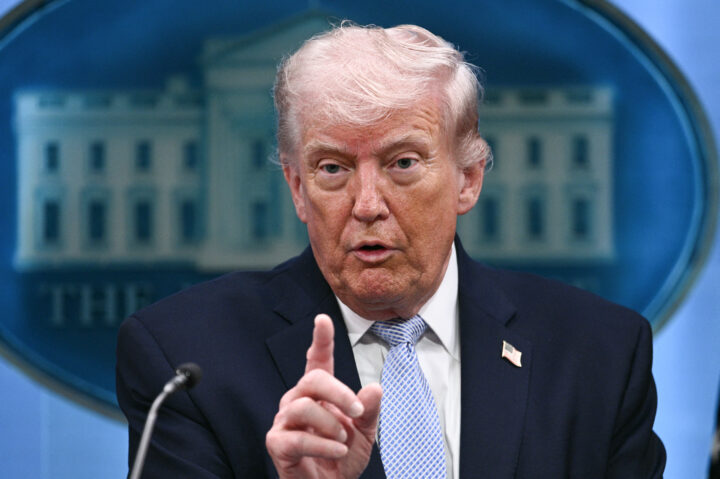
US President Donald Trump speaks about the conflict in Iran in the James S. Brady Press Briefing Room of the White House on April 6, 2026, in Washington, DC.
For the last two weeks, a resumption of hostilities with Iran seemed unlikely, with the U.S. uninterested in sparking renewed fighting against the Islamic Republic in advance of President Donald Trump’s summit with Chinese President Xi Jinping — whose country is a key trade partner of Iran.
But with the president back in Washington, the administration appears to be reopening military options — even as Iran continues to drag out tensions by offering what U.S. officials have said were unacceptable proposals to end the war. That extends to Congress, where Democrats on both sides of Capitol Hill are expected to introduce new war powers resolutions this week in an attempt to constrain the administration’s actions in the Middle East.
Trump told Axios on Sunday that “the clock is ticking” for Iran and the U.S. to reach an agreement to end the war. After rejecting Iran’s previous response to a U.S. proposal, Trump said that Tehran has to get to “where we want them to be,” or else “they are going to get hit much harder.”
A decision on whether to return to active fighting could come as soon as Tuesday, when Trump is set to hold a Situation Room meeting to discuss options. After returning from Beijing, the president met on Sunday with Vice President JD Vance, Secretary of State Marco Rubio, White House Special Envoy Steve Witkoff and CIA Director John Ratcliffe.
In Israel, preparations are being made for a possible return to war. Channel 12 quoted a senior Israeli official on Friday saying that the country is “preparing for days to weeks” of renewed fighting.
Even as the tenuous ceasefire has held, the United Arab Emirates — which during the active hostilities took the brunt of Iran’s attacks — has continued to face drone attacks. Emirati officials are investigating a fire near Abu Dhabi’s Barakah Nuclear Power Plant that broke out on Sunday after a drone entered the UAE from its western border and struck a generator near the facility.
The Islamic Republic’s ongoing strikes targeting the UAE — and its clashes with the U.S. Navy in the Gulf — play into a broader Iranian strategy to slow-walk negotiations as it continues to destabilize the region. Few doubt Iran’s capacity — even after six weeks of active fighting — to hit the U.S., the UAE, Israel or other U.S. assets in the region, but doing so would likely prompt a severe U.S. response and collapse the tenuous ceasefire, dragging Iran into a renewed conflict as it works to recoup its heavy losses from the U.S. and Israeli bombing campaigns.
It’s a strategy underscored by Iran’s seizure last week — the same day that Trump and Xi met — of a boat belonging to a Chinese security firm. While disruptive, no one aboard the vessel was killed or injured, and China is unlikely to retaliate for the incident. But analysts told The Wall Street Journal that the move was likely an effort by Tehran to send a message to Beijing. Chatham House’s Sanam Vakil told the WSJ that Iran’s apprehension of the boat “is a way to remind the Chinese who is in control of [the Strait of] Hormuz and they shouldn’t even think of providing their own security.”
Foot-dragging talks while making minimal concessions has served Iran well through multiple U.S. administrations, and allowed the Islamic Republic to retain control through rounds of active fighting while preserving its military and diplomatic leverage. Now, with Tehran appearing to bet that the outcome of the midterms could provide a more favorable environment in Washington and constrain the Trump administration’s ability to escalate, the question will be if Iran will slow-walk its way to November — or whether the clock has run out.
Monday’s Iranian missile fire came amid ramped-up rhetoric from both Tehran and Washington over the closure of the Strait of Hormuz
ANDREW CABALLERO-REYNOLDS/AFP via Getty Images
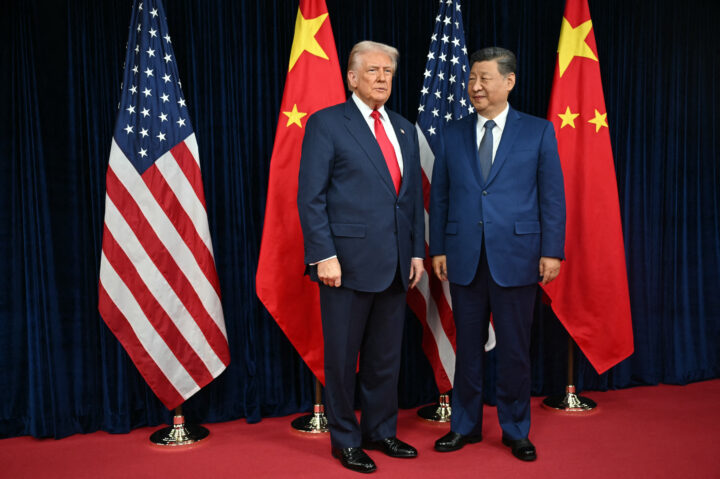
President Donald Trump (L) and Chinese President Xi Jinping arrive for talks at the Gimhae Air Base, South Korea, on October 30, 2025.
The tenuous ceasefire between the U.S. and Iran came close to collapsing overnight after the Islamic Republic fired 15 missiles and four drones at the United Arab Emirates. The question now is whether hostilities will resume in the coming days — just before next week’s major summit between President Donald Trump and Chinese President Xi Jinping, slated to take place in Beijing.
Monday’s Iranian missile fire came amid ramped-up rhetoric from both Tehran and Washington over the closure of the Strait of Hormuz, and as the U.S. launched “Project Freedom” to assist vessels attempting to transit through the waterway. One of the drones fired yesterday by Iran hit the UAE’s Fujairah Oil Industry Zone, sparking a fire that injured three Indian workers.
Iran’s attack on the UAE was widely condemned, with Saudi, Qatari, British and Indian officials denouncing the renewed strikes.
CENTCOM head Adm. Brad Cooper touted the initial success of the Project Freedom naval effort, which on its first day protected two U.S.-flagged ships traveling through the strait. It’s unclear the degree to which the endeavor will help with the resumption of normal activities in the waterway, which normally sees some 120 vessels passing through each day.
Later Monday, two U.S. naval ships came under heavy fire from Iran as they navigated through the passage. Iran claimed to have hit a warship, which CENTCOM denied. Trump told Fox News’ Trey Yingst that Iran would be “wipe[d] off the face of the earth” if it targeted ships being escorted through the strait. The Wall Street Journal reported that the president “for days has toggled between two competing impulses: severely punishing Iran for failing to abandon its nuclear work, and avoiding a significant escalation that could draw the U.S. deeper into a Middle East conflict.”
Iranian Foreign Minister Abbas Araghchi, for his part, criticized Project Freedom — which he referred to as “Project Deadlock” — claiming that Pakistan-brokered talks between Washington and Tehran “are making progress” and warning that the U.S. and the UAE “should be wary of being dragged back into quagmire by ill-wishers.”
Pakistani Prime Minister Shehbaz Sharif condemned the strikes on the UAE — albeit without mentioning Iran. “It is absolutely essential that the ceasefire be upheld and respected,” Sharif posted on X, “to allow necessary diplomatic space for dialogue leading to enduring peace and stability in the region.”
Secretary of State Marco Rubio is expected to address the situation with Iran when he speaks to reporters from the White House briefing room at 3 p.m. on Tuesday, the first press briefing since White House Press Secretary Karoline Leavitt went on maternity leave.
Later this week, Rubio is set to head to the Vatican to meet with Pope Leo XIV amid tensions between the Holy See and the Trump administration over the pontiff’s comments on the war in Iran. It’s unclear if the trip will still happen if the situation in the Gulf further devolves.
The bigger question is what will happen next week, when Trump is slated to meet with China’s Xi Jinping in Beijing — a summit already delayed once due to the war. Over the weekend, Beijing told Chinese firms to ignore U.S. sanctions on five Iran-linked oil refiners in the country.Beijing has attempted to play both sides of the conflict, encouraging Iran to pursue diplomacy while also providing the Islamic Republic with commercial support for use in the event of a resumption of hostilities. Should the summit take place, all eyes will be on Xi to see if he attempts to play Trump, as well.
Three servicemembers have been killed and five seriously injured, CENTCOM said
Stringer/Anadolu via Getty Images
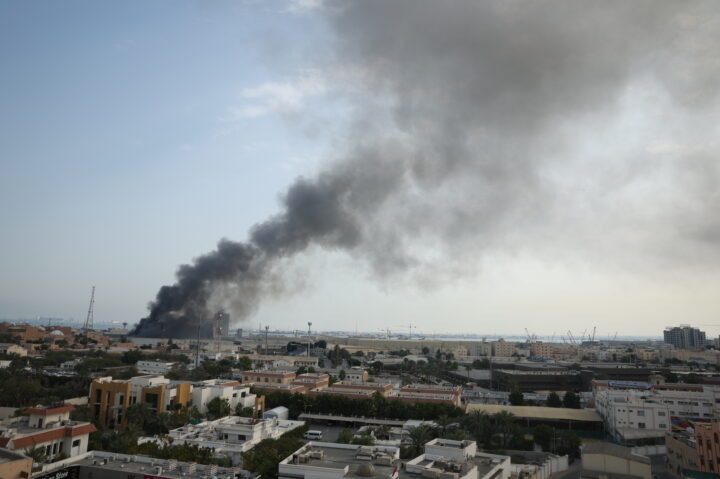
Smoke rises after Iran launched a missile attack targeting the headquarters of the U.S. Navy's Fifth Fleet in Manama, Bahrain, on February 28, 2026.
Three U.S. servicemembers have been killed since the start of hostilities with Iran on Saturday, CENTCOM announced on Sunday morning, with five more seriously wounded.
In addition, several others “sustained minor shrapnel injuries and concussions — and are in the process of being returned to duty,” the statement read, without details of where the injured troops were located or when the fatal strikes occurred.
They are the first U.S. casualties in the war, which the U.S. has named Operation Epic Fury and Israel, which is jointly conducting strikes with the Americans, has named Operation Roaring Lion. Eleven people — all civilians — have been killed in Israel.
Three people have also been killed and 58 injured in the United Arab Emirates, its defense ministry said Sunday, amid Iran’s strikes around the Gulf.
CENTCOM also announced Sunday that U.S. forces struck an Iranian warship at the beginning of the operation, which is “currently sinking to the bottom of the Gulf of Oman.”
Please log in if you already have a subscription, or subscribe to access the latest updates.
 Continue with Google

 Continue with Apple