













































































Speaking to JI about ‘I Disagree: Winning Arguments Without Losing Friends,’ the liberal Fox News co-host also shared her conflicted views on Zohran Mamdani and how Oct. 7 deepened her Jewish identity


 Add JewishInsider on Google
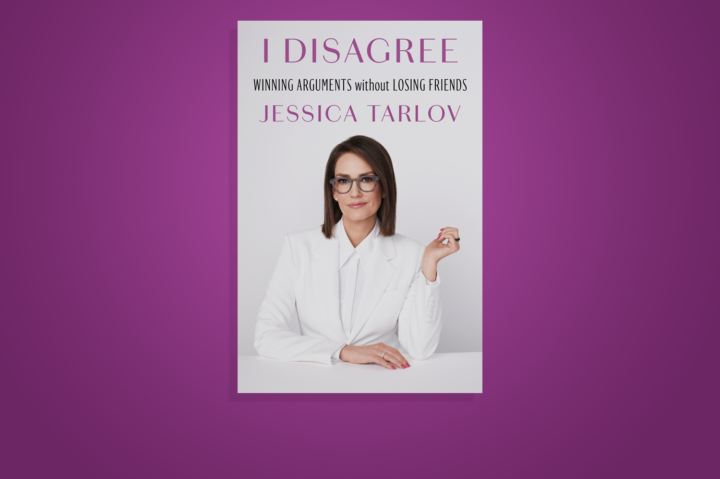
In her new book, Fox News co-host Jessica Tarlov advocates for constructive disagreement — “acknowledge without accepting,” or hearing someone out, hard as it may be, without torching the relationship or one’s own beliefs.
In an interview with Jewish Insider ahead of Tuesday’s release of I Disagree: Winning Arguments Without Losing Friends, Tarlov pointed to her closely watched sit-down last year with far-left streamer Hasan Piker as evidence that her framework holds even when strained against its limits. Piker was “incredibly nice and gracious,” she recalled, arguing that calls for him to be shut out of Democratic circles are misguided.
The exchange highlights the balancing act central to both Tarlov’s book and her on-air image as the primary liberal co-host on the Fox News talk show “The Five.” But in her conversation with JI, Tarlov, who is Jewish, noted that there is sometimes discomfort in that instinct to engage across lines — the thesis of her book. She said she finds unease in New York City Mayor Zohran Mamdani’s campaign appearance with Columbia University anti-Israel activist Mahmoud Khalil, accusations that Israel committed “genocide” and just how much attention Piker’s commentary is getting in a divided Democratic Party.
“How much the discourse is dominated by Hasan Piker and those kinds of discussions is just a general turnoff” of the Democratic Party, Tarlov told JI, “and people don’t necessarily feel like we’re getting the news because there’s so much focus on the infighting.” She pointed to Michigan’s upcoming Senate race between Democrat Abdul El-Sayed and former Rep. Mike Rogers (R-MI) as a key test of just how deep those divisions run. “It will be a really interesting test as to how divided the party actually is along the lines of this issue — and who comes around to El-Sayed, who goes through with voting for Mike Rogers, or sitting home.”
Despite her willingness to engage with Piker, Tarlov argued the wall-to-wall focus on him has become its own kind of distraction from the issues actually most important to voters.
“I do think the discourse being about him 24/7 is really ignoring what most people are concerned about in their lives,” she said. “They’re thinking ‘my gas prices are up’ and we’re like, ‘Hasan Piker.’ That’s just really missing the mark.”
Last November, when Tarlov found herself seated next to Piker on a panel at Crooked Media’s Crooked Con, she said she was “nervous” going in, given how divisive of an issue his past rhetoric — including justifying Hamas’ Oct. 7, 2023, terrorist attacks and saying America deserved 9/11 — had already become. But she found him friendly, and even took some of his feedback under consideration: “The one thing he did say to me, which did resonate, was that the only criticism of what I do is that I’m too hard on the progressive left. I spent a lot of time thinking about that and ultimately I do think that he’s right.”
“It had been much easier for me to insult AOC for instance and it was kind of low-hanging fruit and there are enough people now who aren’t even necessarily in the far-left party who want things like universal health care. The center part of the party hasn’t been talking about affordability issues in a way that is connecting like Mamdani did in the mayoral election, or that we’re not talking enough about building affordable housing. I thought that was a good note,” she added.
Asked if Democrats should more vigorously condemn Piker — who has over 3 million Twitch followers — or banish him from party circles, Tarlov rejected the premise.
“The idea of us deciding who has legitimacy or platforming when someone has a platform of that size already is really missing the point,” she said. “I show up everyday and talk to people who I disagree with, in some cases people who believe in things I am deeply against. If you don’t engage you leave open this chasm for other people to fill it. I’m not running to be on Hasan’s stream — I wasn’t invited either — but I do think this idea of we’re not going to platform him when he has a bigger platform than most of the people who are saying they have no interest in having him is a little bit embarrassing.”
“In terms of being more culturally Jewish, I do think Oct. 7 changed everything for many nonpracticing Jews in this country, where it became such a bigger part of our identity, where we’re more attuned to discussions around Judaism and Israel in general and it has made us more interested in being affiliated with the religion. It just becomes a more prominent part of your identity when something like that happens,” Tarlov said.
Tarlov’s prominent role as the only Jewish panelist on “The Five” has coincided with Fox News catching the eye of some liberal-leaning American Jews who felt that in the aftermath of the Oct. 7 attacks, much of the mainstream coverage was biased against Israel.
Tarlov said she brings up her Jewish background on air, including her family’s history of fleeing Europe ahead of the Holocaust and her own run-in with rising antisemitism as a student in London two decades ago, “because I think it is relevant and I have a pretty mainstream Jewish perspective on what’s going on in the Middle East and what [Israeli Prime Minister Benjamin] Netanyahu has done and the aftermath of Oct. 7,” she told JI. “I draw on it explicitly because I think it’s important for viewers to know there is a Jewish person who is saying this who is not just someone with an opinion and that I have real connective tissue to the religion and to Israel.”
“In terms of being more culturally Jewish, I do think Oct. 7 changed everything for many nonpracticing Jews in this country, where it became such a bigger part of our identity, where we’re more attuned to discussions around Judaism and Israel in general and it has made us more interested in being affiliated with the religion. It just becomes a more prominent part of your identity when something like that happens,” she continued.
While her cultural connection to Judaism deepened after Oct. 7, Tarlov is no stranger to antisemitism. In her book, she recounts heated politics over Israel during her time at the London School of Economics and former London Mayor Ken Livingstone’s controversial rhetoric during his 2012 campaign to reclaim the office. Tarlov told JI that the period “shaped my current political perspective” and felt like a foreshadowing of the current climate on U.S. college campuses.
“You can draw a straight line from those experiences to what happened at Columbia,” she said. “If there had been an igniting event like Oct. 7 you could easily see how it would spill over into something like that. I’m a little bit embarrassed that I didn’t understand the gravity of it in full back when it was going on. But I definitely see important comparisons — and as someone who likes to look at politics from a sociological lens — how much writing was on the wall. This was really an international movement that got so powerful in what feels like a short period of time.”
“And then working on [then-Mayor] Boris Johnson’s 2012 campaign and following Ken Livingstone, the labor candidate, and seeing him speak at town halls and mosques and how much widespread acceptance there was for antisemitism, was very jarring for me,” said Tarlov. “That stuck with me.”
Tarlov is seeing similar dynamics play out where she lives now, in Manhattan. She writes in her book that “making Jewish New Yorkers feel safe” was on her checklist for the city’s mayoral candidate, and Mamdani didn’t meet it. Eight months after he moved into Gracie Mansion, Tarlov told JI she’s “conflicted” about that view.
“I think he’s been better than a lot of people expected,” she said. “I’m close with a lot of people in the Modern Orthodox community of Riverdale and I pay a lot of attention to how they’re feeling and where they’re going for their information. If you ask them, they’d say there are [good policies like] universal childcare, not related to the Jewish community. But they feel he’s fallen short when it comes to [other issues]. I’m in the realm of neutral based upon my expectations.”
Still, she noted that “one of the difficult moments for me in his campaign was when he campaigned with Mahmoud Khalil.”
“Khalil represents somebody that infringed upon Jewish students at Columbia’s civil rights,” she said. “I was overwhelmed by the feeling that if that happened to Black students, trans students, any other protected sect that would never have been tolerated. So to see him as a campaign surrogate was very difficult for me. I understand that the Trump administration unfairly targeted [Khalil with deportation threats] and I know that’s the thrust of why he was part of the campaign, and he’s been to Gracie Mansion since then, but that was quite jolting to me.”
Asked whether she agreed with Jewish leaders who’ve blamed Mamdani’s rhetoric on Israel for fueling New York’s rise in antisemitism, Tarlov pushed back, framing the criticism as part of a broader pattern she sees playing out with Piker. “This gets back to the Hasan Piker discourse,” she said. “Everyone is going crazy about his comments and then there’s a lot of footage of other people saying similar things, and people said Hasan was antisemitic for saying that.”
She traced the surge in antisemitic rhetoric more broadly to the aftermath of the Oct. 7 attacks rather than to any one figure. “I wouldn’t put it at Mamdani’s feet like that,” she said, though she added she understood the impulse among Jewish leaders trying to reassure anxious congregants: “People are trying to manage a congregation full of people who are afraid and angry, and a lot of them are disappointed that there wasn’t a candidate that they were excited about.”
The book’s core idea is “acknowledge without accepting,” something Tarlov has proven she can do across many political subjects. But does that framework still work when the disagreement is about something like Israel’s right to exist?
Tarlov’s advice is to “find a way to slide in your perspective without making it a knockdown, drag-out fight.” She pointed to a recent appearance by Ryan Grim — the co-founder of the Hamas-sympathetic outlet Drop Site News — on “Raging Moderates,” the podcast that she co-hosts with Scott Galloway. On air, Grim referred to Israel’s “genocide” in Gaza.
“The point of my book was for people to have a longer-term perspective on these tough issues and tips and tricks that could help them do better in these fraught conversations,” Tarlov told JI.
“When he was finished talking, I said, ‘I don’t use that term, I don’t see it that way,’ and then moved on,” Tarlov recalled. “So there are ways to acknowledge without accepting, as per the book, but to make sure it doesn’t cut off all conversation.”
“I think you should always have the conversation — I believe in that,” she continued.
“Understanding other people’s point of view is really of value. I also understand how deeply personal [Israel] is for people. It’s a little different than hearing someone’s view of immigration, let’s say, where they want mass deportations. Saying there should be a one-state solution in the Palestinian direction feels different than that.”
“The point of my book was for people to have a longer-term perspective on these tough issues and tips and tricks that could help them do better in these fraught conversations,” Tarlov told JI.
“That absolutely does apply to being able to dialogue with people over something like Israel and its right to exist. On an emotional level, I think it is more complicated than your average policy issue but I still think the framework applies, and I did have it in mind as I was writing the book. It’s up there as a top five difficult issue for people to talk about and was pulling my political party — and relationships — apart.”
If elected, the prominent college football commentator would be the only Jewish Republican in the Senate
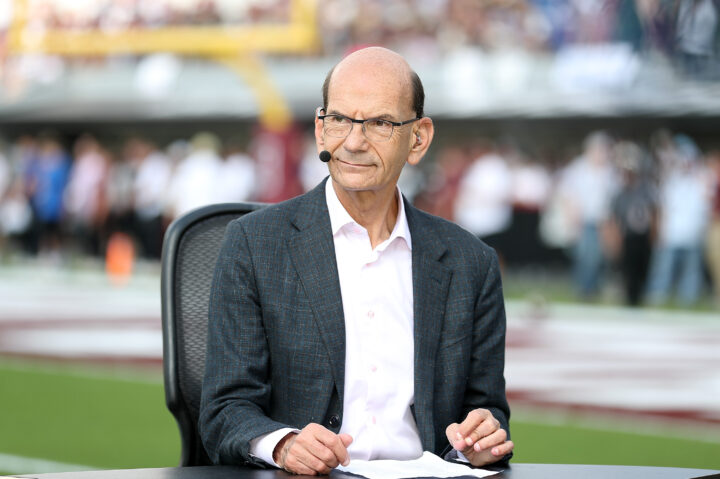
Justin Ford/Getty Images
Paul Finebaum of Sec Nation before the game against the Mississippi State Bulldogs at Davis Wade Stadium on November 08, 2025 in Starkville, Mississippi.
Paul Finebaum, the longtime ESPN host and veteran Birmingham, Ala., college football commentator, is seriously considering entering the Republican primary to replace outgoing Sen. Tommy Tuberville (R-AL), three sources familiar with the matter confirmed to Jewish Insider.
Finebaum, 70, began considering a run in late August, as it became clear that former Auburn University men’s basketball coach Bruce Pearl, whom Finebaum had encouraged over the summer to enter the race, was not going to make his own bid. Both men are Jewish and have known each other for over a decade as prominent figures in the Southeastern Conference — Pearl as a legendary college basketball coach and Finebaum as an outspoken football commentator.
Finebaum has largely avoided talking about politics during his career commentating on college football. The ESPN host, whose contract with the network ends in mid-2027, made some comments critical of President Donald Trump early in his first term, though Finebaum grew supportive of the president before he left office in 2021. During that time, Finebaum also grew tired of what he has described to those in his orbit as liberal bias at ESPN and the Walt Disney Company, the media giant that owns the network, according to a source close to Finebaum.
While confirming his interest in the seat in an appearance on the “Clay Travis & Buck Sexton Show” in late September, Finebaum said that he unsuccessfully lobbied ESPN to allow him to interview Trump on the network in 2019.
Reached for comment, Finebaum told JI, “It’s true, I’ve received a lot of calls encouraging me to run for Senate. So many of those calls have the same theme: Alabamians aren’t looking for someone running for the Senate as a job promotion. They want a senator ready to fight for their families, for conservative values and for President Trump’s agenda.”
“We all have a belief system, things that drive us and make us who we are, faith is a big part of that for me. I’m praying about the best path forward for me and my family,” his statement continued. “I’m flattered that so many people think I can serve in that role for them. Like I tell everyone who calls me or stops me at the grocery store, I’ll have something to say soon.”
A spokesperson for ESPN said they were “politely declining” JI’s request for comment.
Known as the “Mouth of the South,” Finebaum spent decades building a devoted following of college football fans as host of “The Paul Finebaum Radio Network,” a sports radio program devoted to Southeastern Conference athletics. Finebaum left Birmingham for Charlotte, N.C., in 2013, when ESPN signed him to a multiyear deal to help launch SEC Network the next year and rebrand his program as “The Paul Finebaum Show.”
The longtime sports analyst moved back to Alabama with his family earlier this year, and has since been splitting his time between his new residence and Charlotte, where the studio for his syndicated ESPN program is based.
While he has until late January to file for next May’s GOP primary, Finebaum has privately acknowledged he needs to make a decision about running imminently, with numerous other candidates already in the race. The SEC Network host has given himself a deadline of the first week in December to decide, though sources close to Finebaum say he has privately acknowledged that he is facing growing frustration from some in Alabama’s political class over the prolonged wait.
Finebaum, who grew up attending an Orthodox synagogue in Memphis, Tenn., would be the only Jewish Republican in the Senate.
As part of his Jewish upbringing, Finebaum was a member of the B’nai B’rith Youth Organization (BBYO). He said in a 2017 interview with the organization that he got involved in a Memphis-area chapter as a teen after being connected through his mother, who had been involved with BBYO for more than three decades. He eventually became a regional president at 16 years old.
Finebaum credited BBYO with teaching him “how to communicate, which is something I now do every day.” He also touted “the relationships that I formed and learning how to listen to people” as the main things he “took away from BBYO.”
Finebaum, whose family moved from New York to Memphis just before he was born, told the Athletic in a July profile that he has “explored Christianity” and once considered converting to Catholicism with his wife Linda, who was raised Methodist. He said he still practices Judaism, however, to honor his parents.
“I had a political operative tell me about a month ago: ‘Listen, I like you. I’ve followed you my entire career. I appreciate how you’ve spoken out on hypocrisy and held the people that run college football accountable. But you’re Jewish, and it will never work in Alabama,’ Finebaum said In an appearance on Travis and Sexton’s program on Monday. “I disagree strongly. I have lived in Alabama most of my adult life.”
“I believe in God and very strongly in faith, but it has been a challenge to find my way,” Finebaum said of exploring different faiths. “As I got older and opened my eyes to other things, it really helped me. … It’s a lifelong journey for me.”
“Whatever that means,” he added jokingly.
In an appearance on Travis and Sexton’s program on Monday, Finebaum said bringing Christians and Jews together would be one of his “major goals” as a Jewish senator for Alabama.
“Right now, I don’t need to tell anyone listening to the show where that issue is and how much division is out there,” Finebaum said. “I had a political operative tell me about a month ago: ‘Listen, I like you. I’ve followed you my entire career. I appreciate how you’ve spoken out on hypocrisy and held the people that run college football accountable. But you’re Jewish, and it will never work in Alabama.’ I disagree strongly. I have lived in Alabama most of my adult life.”
Finebaum argued that the claim that Alabamians wouldn’t support a Jewish candidate was a “ridiculously unfair attack” on the people of the state, who he said “have been painted in a corner.”
“That may have been true 50 or 60 years ago, but it’s not true today,” Finebaum said.
“I’m not going to run on being a Jewish Republican senator, if I chose to, from Alabama,” he continued. “But I think it would, you know, standing up there, assuming it happened, with [Alabama] Sen. [Katie] Britt, who is someone who has represented the great values of the state. I think we would make an incredible tandem. … I’m not in the field, but I think I’m the only person that could actually do that.”
If he enters the race, Finebaum would face no shortage of GOP competitors. The crowded Republican field to replace Tuberville includes Alabama Attorney General Steve Marshall, who has been the state’s chief law enforcement officer since 2017; Rep. Barry Moore (R-AL); Morgan Murphy, Tuberville’s former national security advisor; and Jared Hudson, a former Navy SEAL and pro-Trump businessman.
Moore has the support of the Club for Growth, the well-funded conservative organization that was once at odds with Trump but has pledged to “work closely” with the president in the midterms. He’s also been endorsed by Sens. Ted Budd (R-NC) and Steve Daines (R-MT), the latter of whom chaired the National Republican Senatorial Committee, the Senate GOP campaign arm, last cycle. On the House side, Reps. Jim Jordan (R-OH) and Tim Burchett (R-TN) have gotten behind his campaign.
Hudson is endorsed by Sen. Tim Sheehy (R-MT).
Trump has not endorsed in the race yet, nor has Tuberville or the NRSC. Finebaum has been making overtures to people close to the president about seeking his endorsement. He has also engaged with some of the state’s leading campaign operatives and donors, as well as the NRSC, about getting in the race.
Finebaum told those around him in recent weeks that he came away from his conversations with senior NRSC officials feeling encouraged about their interest in his candidacy, despite the fact that he’d be making such a late entry into the race. He has also cited what he described as overtures from conservative commentators, GOP lawmakers and other Trump allies urging him to run as reason to consider throwing his hat in the ring.
A NRSC spokesperson did not respond to JI’s request for comment.
“Paul is smart. He loves the country,” Sen. Tommy Tubervile (R-AL) said on Steve Bannon’s “War Room” podcast in late September. “[He’s] been a friend of mine for a long time. I tell you, he’s got 100% name ID in Alabama. He’d have a lot of big people behind him. He would be a force in the race if he decided to get into it.”
The ESPN mainstay had initially planned to travel to Washington, D.C., to meet with GOP senators and NRSC officials about a potential run after the August recess, but had to cancel the trip due to scheduling conflicts. He faced headwinds in organizing a trip this fall due to the government shutdown, and has not made it to Washington since starting to consider entering the race.
Tuberville, who opted against seeking a second term in the Senate to run for governor of Alabama, has publicly embraced the idea of Finebaum running to succeed him.
“Paul is smart. He loves the country,” Tuberville said on Steve Bannon’s “War Room” podcast in late September. “[He’s] been a friend of mine for a long time.”
“I tell you, he’s got 100% name ID in Alabama. He’d have a lot of big people behind him. He would be a force in the race if he decided to get into it,” he added of Finebaum.
Britt is not getting involved in the GOP primary and plans to hold off on weighing in until she endorses the Republican nominee in the general election, three sources familiar with her thinking told JI. The Alabama senator and her husband Wesley Britt, a former NFL tackle with the New England Patriots, are longtime friends of Pearl’s and have socialized with Finebaum for years through Alabama sports circles.
A spokesperson for Britt did not respond to JI’s request for comment.
Regardless of how Trump or the NRSC land on endorsing Finebaum’s campaign, the ESPN host is certain to face some right-wing detractors. Far-right commentator Laura Loomer has accused him of being a “Trojan horse” for his “radical” and “left-leaning views,” including his comments supporting the Black Lives Matter movement in 2020 and criticisms he made of Trump during his first term.
Loomer, a close ally of the president’s, claimed in a series of tweets last month that Finebaum’s views are “at odds with the conservative values that define the Republican Party and Alabama’s electorate,” and accused him of “using” Trump-aligned “influencers” to “dupe MAGA into thinking he’s conservative so he can run” for Tuberville’s seat.
Please log in if you already have a subscription, or subscribe to access the latest updates.
 Continue with Google

 Continue with Apple