





































































Trump cursed and yelled at the Israeli PM in a phone call with Steve Witkoff and Jared Kushner, according to book by NYT journalists Maggie Haberman and Jonathan Swan

Kevin Dietsch/Getty Images
President Donald Trump (R) speaks alongside Israeli Prime Minister Benjamin Netanyahu with a model of Air Force One on the table, during a meeting in the Oval Office of the White House on April 7, 2025 in Washington, DC.


 Add JewishInsider on Google
President Donald Trump grew so frustrated with Israeli Prime Minister Benjamin Netanyahu during last September’s negotiations over a U.S.-brokered deal to end the Israel-Hamas war in Gaza, that Trump cursed and yelled at Netanyahu in a phone call days before the agreement was announced publicly, according to a new book.
“Everybody’s sick of you, Bibi,” Trump said in a phone call with Netanyahu, Jared Kushner and White House Special Envoy Steve Witkoff, according to a book published on Tuesday by New York Times journalists Maggie Haberman and Jonathan Swan chronicling the first year of Trump’s second term. “All the Jews are sick of you. Even the two Jews on this call are sick of you.”
The conversation came during the United Nations General Assembly last September, when Trump was selling the deal that became his 20-point plan to end the Gaza war that began after the Oct. 7, 2023, Hamas attacks. In the book, titled Regime Change: Inside the Imperial Presidency of Donald Trump, Haberman and Swan recount the turbulent couple of weeks that led to the deal — starting with Kushner’s searing anger at the Israeli government after the Israel Defense Forces conducted an airstrike that targeted Hamas leadership in Doha. The September 9 attack came one day after Kushner and Witkoff met in Witkoff’s Miami home with Ron Dermer, a top advisor to Netanyahu, to discuss day-after plans for Gaza.
“Dermer lied to us,” Kushner and Witkoff told officials at the White House after the strikes in Qatar.
The Qataris, according to Haberman and Swan, initially reacted by deciding they no longer wanted to help Israel. Kushner felt the same.
“I’m f**king out. The Israelis are crazy,” Kushner reportedly told an associate at the time. Then he realized it could provide an opening to rein in Netanyahu after nearly two years of war.
In the aftermath, Kushner drafted what would become Trump’s 20-point peace plan. Days later, on the sidelines of the UNGA in New York, Kushner and Witkoff met with Sheikh Mohammed bin Abdulrahman Al Thani, Qatar’s prime minister. The Americans told Al Thani that he had two options: isolate Israel further, which would be “understandable,” or use the moment “for leverage” to get Israel to negotiate.
Al Thani took Kushner’s laptop and began typing edits directly into the draft document, according to the book.
Trump brought the deal to Arab and Muslim leaders before he showed it to Netanyahu. Witkoff and Kushner warned White House Chief of Staff Susie Wiles that Netanyahu might try to call Trump to scuttle the plan. When he did finally call the White House, Wiles patched through Kushner and Witkoff, who stayed on the phone with Trump and Netanyahu.
As soon as Trump got on the phone, he began yelling at Netanyahu — the tirade where he said everyone was sick of the prime minister.
“You can’t back out of this. I’m the best friend Israel ever had. Everybody hates you, and I’ve stood by you,” Trump said, according to the book. “This is a great deal for Israel.”
Netanyahu said he would agree to the deal. The two men announced it together at a joint press conference two days later, though the deal was not yet official. They presented a united front. Trump said Netanyahu would have his “full backing” to continue the war if Hamas did not agree to the deal.
On the evening of Oct. 8, just over a week later, the deal was finalized. Soon after, the 20 living hostages who remained in Gaza were released.
The annual confab, which kicks off today, will focus more on Europe’s shifting relations with the U.S.
THOMAS KIENZLE / AFP via Getty Images
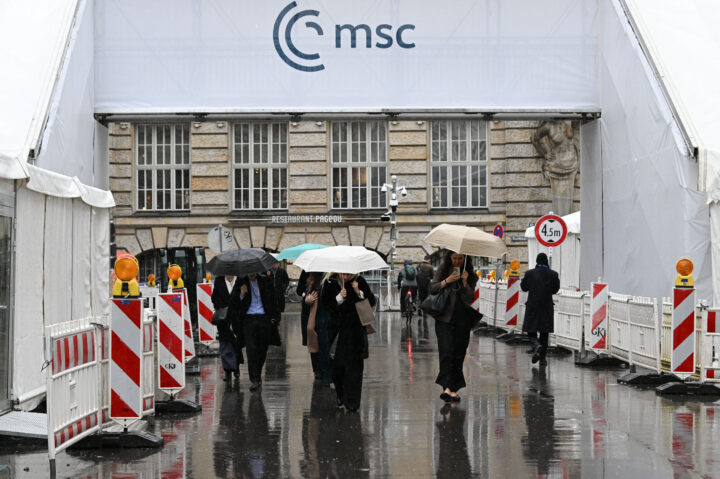
People with umbrellas walk past a pedestrian bridge with the logo of the Munich Security Conference leading to the venue of the 62nd Munich Security Conference (MSC) the hotel "Bayrischer Hof" in Munich, southern Germany on February 12, 2026.
A who’s who of the world’s major political leaders, past and present, are descending on Munich for the annual Munich Security Conference. After last year’s forum, in which Vice President JD Vance, who was leading the U.S. delegation, took an abrasive tone against Europe in his keynote address that rankled some attendees, Secretary of State Marco Rubio will lead this year’s delegation.
Unlike last year, when the Israel-Hamas war featured prominently on the agenda, this year’s MSC schedule has relatively little time dedicated to talking about the conflict, with just two sessions expected to touch on Gaza. And while last year’s attendee list included a number of Israelis, including President Isaac Herzog and Defense Minister Israel Katz, there are no current Israeli officials slated to speak. (Former Foreign Minister Tzipi Livni will join one of the panels on Gaza reconstruction.)
Also absent this year is a Qatari presence. Qatari Prime Minister and Foreign Minister Mohammed bin Abdulrahman Al-Thani, who spoke last year about de-escalating tensions in the Middle East, is not on this year’s schedule, nor are any other Qatari officials.
Sens. Lindsey Graham (R-SC) — back this year after skipping the 2025 MSC to travel to the U.S.-Mexico border — and Sheldon Whitehouse (D-RI) will lead a bipartisan congressional delegation that includes Sens. Lisa Murkowski (R-AK), Mark Warner (D-VA), Chris Coons (D-DE), Richard Blumenthal (D-CT), Steve Daines (R-MT), Jacky Rosen (D-NV), Peter Welch (D-VT), Andy Kim (D-NJ) and Elissa Slotkin (D-MI).
Rep. Alexandria Ocasio-Cortez (D-NY) is slated to speak on two panels today, one on the “rise of populism,” and another on the “future of U.S. foreign policy,” the latter in conversation with Michigan Gov. Gretchen Whitmer and Matthew Whitaker, the U.S.’ representative to NATO. Matt Duss, a former foreign policy advisor to Sen. Bernie Sanders (I-VT) who has been critical of the U.S.-Israel relationship and is now advising the New York Democrat, said that she will use her perch in Munich to give the “working-class perspective” on the intersection of domestic politics and foreign policy.
AOC isn’t the only millennial member of Congress to be addressing the MSC this year. Rep. Yassamin Ansari (D-AZ), the first Iranian American Democrat elected to Congress, will be speaking on Sunday on a panel titled “Under Reconstruction: A World Order for the Next Generation.”
The conference kicks off this afternoon with a sit-down with German Chancellor Friedrich Merz, followed by a panel discussion on “The International Order Between Reform and Destruction,” which will feature U.S. Ambassador to the U.N. Michael Waltz, the EU’s Kaja Kallas, Saudi Foreign Minister Prince Faisal bin Farhan Al Saud and Colombian Defense Minister Pedro Arnulfo Sánchez Suárez.
A town hall session focused on Gaza rebuilding efforts will take place later this afternoon. Speakers include Nickolay Mladenov, the Bulgarian diplomat serving as the head of the Gaza Board of Peace, Sen. Chris Murphy (D-CT), Livni and Palestinian Authority Foreign Affairs Minister Varsen Aghabekian. Concurrent to that panel is a session focused on maritime security, with Yemeni President Rashad al-Alimi, whose country has been used by the Iran-backed Houthis as a launching pad for attacks on ships transiting through the Gulf, set to speak.
Later in the day, CNN’s Christiane Amanpour will moderate back-to-back sessions on the future of Iran: the first with exiled Iranian Crown Prince Reza Pahlavi and British-Iranian actress and activist Nazanin Boniadi; and the second with Graham, the Carnegie Endowment for International Peace’s Karim Sadjadpour, European Parliament President Roberta Metsola and Manal Radwan, a senior advisor in Saudi Arabia’s Foreign Ministry.
Rubio will kick off Saturday’s sessions with a mainstage conversation with MSC Chairman Wolfgang Ischinger, followed by Chinese Foreign Minister Wang Yi. Also on Saturday morning, former U.K. Prime Minister Tony Blair and the International Committee for the Red Cross’ Mirjana Spoljaric Egger will speak on a panel about peace deals.
Later in the day, Elbridge Colby, the Defense Department’s under secretary of war for policy will speak in conversation with Foreign Policy’s Ravi Agrawal before joining a larger panel focused on security in the Indo-Pacific.
The Middle East will take center stage again on Saturday evening, during a session titled “Building on Momentum in the Middle East: From Promise to Progress?” that will feature another appearance by Saudi Foreign Minister Prince Faisal bin Farhan Al Saud, joined by Norwegian Foreign Minister Espen Barth Eide and Sigrid Kaag, who now sits on the executive board of the Board of Peace.
Prince Faisal will also speak alongside U.K. Foreign Minister Yvette Cooper and White House senior advisor Massad Boulos in a session Saturday focused on ending the war in Sudan.
Please log in if you already have a subscription, or subscribe to access the latest updates.
 Continue with Google

 Continue with Apple