











































































While Republicans have embraced the program that is being championed by Jewish community groups, only Colorado Gov. Jared Polis has opted in so far among Democrats

Adam Gray - Pool/Getty Images
New York Gov. Kathy Hochul arrives for a ceremony to commemorate the 25th anniversary of the September 11th terrorist attacks on September 11, 2026, in New York City.


 Add JewishInsider on Google
With the publication of regulations on Thursday for the new federal educational tax credit program, governors now have until the end of the year to decide whether to opt their states into the program.
The tax credit program, which has been championed by many Jewish community groups but opposed by teachers’ unions, has presented a choice for blue-state governors, many of whom¸ have been publicly undecided to this point on whether they’d join the program. Several said that they were waiting to see the regulations before they made a final decision.
Among the elements of the new regulations released Thursday is guidance clarifying that governors cannot make state-specific rules governing what scholarship organizations are eligible for donations under the program — such as excluding scholarship programs benefiting public or private schools.
And in states that don’t opt in, donors will be able to contribute to scholarship organizations in other states, and still receive tax credits.
Another major development clarified by the new regulations is that, even when filing jointly, spouses will each be eligible for the $1,700 tax credit, totaling $3,400 per married couple per year, a provision applauded by advocates for the program.
Republican governors have all opted into the program, but among Democrats, only Colorado Gov. Jared Polis has signed up so far, while a handful of governors have already said they will opt out.
Several other Democratic governors told Jewish Insider on Thursday that they’re still reviewing the guidance.
“Governor Hochul is committed to ensuring every student receives a quality education that best meets their needs. If properly implemented, and structured so all students can benefit, the federal scholarship tax credit can expand opportunity without diverting funding from public schools, state or local budgets,” Jonah Allon, a spokesperson for New York Gov. Kathy Hochul, said in a statement. “The Administration is carefully reviewing the proposed regulations to ensure implementation would achieve these goals.”
Hochul had previously expressed her intention to opt in, pending any “poison pills that could harm New York’s education system” in a review of the final regulations.
A spokesperson for Illinois Gov. JB Pritzker told JI that his office is also reviewing the new guidance. “As stated since the federal government announced this program, the Governor’s Office will carefully evaluate the proposed regulations and make a decision grounded in what best supports working families, students, and our public schools,” the spokesperson continued.
A spokesperson for New Jersey Gov. Mikie Sherrill said that her administration “remains committed to ensuring every child in New Jersey has access to a high-quality education and the opportunities they need to succeed.”
“As we carefully review this federal guidance, we are examining who the program would serve, which opportunities are available, and how it could best benefit public school students,” the Sherrill spokesperson said. “The bottom line is clear: put kids first and strengthen New Jersey’s public schools.”
A spokesperson for the District of Columbia’s office of the superintendent for education also said the city is reviewing the new regulations.
“As the state education agency, the vision of the Office of the State Superintendent of Education is that DC learners of all ages and backgrounds are equipped with the knowledge and skills needed to pursue and thrive on the life path of their choice. We are reviewing the temporary regulations and proposed rulemaking that came out today,” the spokesperson said.
Several others including Govs. Josh Shapiro of Pennsylvania, Maura Healey of Massachusetts, Wes Moore of Maryland and Abigail Spanberger of Virginia did not respond to requests for comment. Virginia was opted in by then-outgoing Gov. Glenn Youngkin, but Spanberger could still decide to withdraw before the Jan. 1 deadline.
Democrats are facing pressure from teachers’ unions to oppose the new tax credit program.
American Federation of Teachers President Randi Weingarten called the program a “poison pill for the 90 percent of American children who attend public schools” by diverting taxpayer funding into private hands and depriving public schools of resources.
The credits will apply exclusively to federal taxes and scholarships can be open to public school students for tutoring, special needs services, transportation and some after school activities.
“State governors should reject it — not least of all because they will have no say or oversight over how the vouchers operate,” Weingarten said. “The reality is that for every precious public dollar funneled to private schools — money that could be spent on instruction, lowering class sizes, modern buildings or new books in the library — public school parents will be hunting for pennies on the floor.”
The National Education Association said the program is “robbing students of access to great public schools across the United States” while preventing states’ “ability to protect students or ensure meaningful benefits for public schools.”
National and local Jewish groups, however, are supporting the program and have been lobbying governors to enroll in it.
Rabbi A.D. Motzen, the national director of government affairs for Agudath Israel of America, told JI that the publication of the regulations for the program will allow states that have already opted in to begin implementing the program, and should allow states whose governors have said they’ve been waiting for the regulation to make decisions.
Addressing Hochul specifically, Motzen noted that she had said she wanted to ensure that public school students would be eligible, which the regulations make clear that they are, and argued that the regulations contain no poison pills.
“The big news is that states can move forward, that wanted to move forward, and states that said [they’re] waiting have what they need now to look at and hopefully make decisions sooner rather than later,” he said.
The midterm elections could also have some bearing on the program. Though Jan. 1 is the listed deadline, Motzen explained that new governors who take office at the start of the year should have additional time to finalize lists of eligible scholarship organizations.
He also pushed back directly on the arguments made by the teachers’ unions, emphasizing that 96% of all students will be eligible for scholarships and that the program will not come from state tax budgets.
“That’s just misrepresenting what it does. It helps almost every student in the state,” he said, adding, “the idea that it would financially harm a state is ludicrous.”
“Governors across the country have been telling us they were waiting for the federal guidelines. Well, here they are, and there is no reason left to wait,” Teach Coalition CEO Sydney Altfield said in a statement. “The rules make clear, in firm writing, that public school students can benefit too, with strong standards and real oversight. This doesn’t have to be a partisan issue. For Jewish families, it matters enormously.”
Teach Coalition said it plans to continue working with Hochul’s administration as it reviews the guidelines and to continue pushing other governors to join the program as well. Altfield said that the program can give parents and Jewish schools “meaningful new resources … at a moment when Jewish education has never been more important.”
Sheila Katz, the chief Jewish life officer for the Jewish Federations of North America, said, “With the regulations now released, we urge every governor that has not yet opted in to take the steps necessary to participate. Families should not lose access to these important education scholarships simply because of where they live.”
Katz said the program “has the potential to make Jewish day school more affordable and will drastically increase access to Jewish education for generations to come” and thanked the Treasury for making the program “as accessible as possible.”
A range of national Jewish organizations have endorsed a national scholarship-granting organization to support Jewish day schools, the Opportunity Fund for Jewish Education, and a range of state-level Jewish scholarship organizations are also expected to be launched.
Youngkin, who has been an advocate for the program, wrote in a post on X, “the teachers union was wrong. This scholarship program will not take any dollars from public schools, and public school kids are eligible!”
“Governors, it’s your time now — stand with kids and parents, opt-in to the Education Freedom Tax Credit,” he continued.
All living Pa. governors decry decision not to fund security upgrades to Shapiro’s home after attack
Republican state Treasurer Stacy Garrity, Shapiro’s gubernatorial opponent, said the state would not pay for the security upgrades to Shapiro’s private residence

Kyle Mazza/Anadolu via Getty Images
Pennsylvania Governor Josh Shapiro speaks during a press conference outside of the Governor's Mansion after an arsonist sets fire to the Governor's Residence in a targeted attack in Harrisburg, Pennsylvania, United States on April 13, 2025.
All five of Pennsylvania’s living former governors, both Republicans and Democrats, released a statement on Monday calling on state officials to prioritize the safety and security of Gov. Josh Shapiro.
The bipartisan letter comes days after Pennsylvania Treasurer Stacy Garrity — Shapiro’s leading Republican opponent in this year’s gubernatorial race — said the state would not pay for security upgrades at Shapiro’s private home.
“Combatting political violence and keeping our elected officials safe should always be nonpartisan and a priority,” Democratic former Govs. Tom Wolf and Ed Rendell wrote in a statement with GOP former Govs. Tom Corbett, Mark Schweiker and Tom Ridge.
The security upgrades were already made to Shapiro’s privately-owned family home in Abington, outside of Philadelphia, following the arson attack on the state-owned governor’s mansion in Harrisburg last year. State Police said such upgrades were necessary because Shapiro and his family lived in their private home while repairs were undertaken at the governor’s mansion after the fire.
Shapiro and prosecutors have said that the attack, which occurred on the first night of Passover, was antisemitic in nature, citing the perpetrator’s targeting of Shapiro over his stance on Israel’s war against Hamas in Gaza.
The former governors did not specifically mention Garrity, though they did refer directly to the “unspeakable attack” that occurred at the governor’s residence while he and his family were asleep.
“For us, the attack on Pennsylvania’s First Family was particularly upsetting,” the governors wrote. “In the aftermath of that attack we ask the state’s current leaders and legislators to make the safety and security of the governor and his family a priority.”
Garrity told reporters last Thursday that the state’s procurement rules don’t allow public funds to be used to pay for construction work on property that is not state-owned, SpotlightPA reported.
Garrity insisted she was not motivated by politics, saying she calls “balls and strikes here at Treasury.”
A spokesperson for Shapiro said last week that Garrity’s announcement was “a completely unprecedented and shameful political action without legal basis.”
State leaders would have to opt in to a new tax credit allowing parents to get financial assistance for students

Getty Images
As governors from across the country convened in Washington over the weekend for the annual National Governors Association summit, representatives from the Jewish Federations of North America held dozens of sideline meetings with Democratic officials to lobby them on a new education tax initiative, Josh Nason, JFNA’s senior director of political affairs, told Jewish Insider.
Their goal was to educate those governors, some of whom were skeptical of the credit, and urge them to participate in the first-of-its-kind supplemental federal funding that could help pay for Jewish day school and yeshiva education.
Starting in the 2027 tax year, the federal Education Freedom Tax Credit, part of President Donald Trump’s One Big, Beautiful Bill Act, provides a dollar-for-dollar tax credit — up to $1,700 annually — for donations to approved Scholarship Granting Organizations. These SGOs offer scholarships for a variety of K-12 public and private education expenses, including private school tuition, transportation and tutoring.
If states don’t opt in, taxpayers can still donate, but residents of that state won’t have the ability to be beneficiaries.
“For Jewish day schools, it’s a huge opportunity,” Nason told JI following his meetings with both Democratic and Republican governors — the first time JFNA had a presence at NGA.
The credit differs from school-choice programs “in the sense that it’s not taking money out of public school funds,” said Nason. “It’s just a tax credit that people can put toward a school scholarship option. The advocacy that we’re doing is [to raise awareness that] any individual can make this donation and get the tax credit, but a state has to opt in in order for their [SGOs] to be eligible to receive the funds.”
While nearly all Republican governors have already opted in, their Democratic counterparts have been hesitant. Some critics have voiced concerns that the program has insufficient oversight against fraud or that it could divert public money to private schools. JFNA submitted written comments in December to the U.S. Department of the Treasury and the Internal Revenue Service regarding implementation of the tax credit.
Last month, Colorado Gov. Jared Polis became the first Democratic state leader to opt his state into the program. States have the next several months to choose to participate.
Nason said that in meetings with Democratic governors, “we heard a lot of interest in opting in.” Maryland Gov. Wes Moore, who serves as vice chair of the NGA, was among the officials JFNA met with.
“A lot of the Democratic governors are waiting to understand the implications, especially for IRS regulations,” continued Nason. “We certainly heard a lot of positive reactions to it and a lot of openness to understanding it. It was really productive and a good opportunity to educate them.”
While the Orthodox Union has been active for years in lobbying for Jewish day school affordability, JFNA has only started wading into the issue in recent months. Eric Fingerhut, JFNA’s CEO, raised the topic during the group’s inaugural “State of the Jewish Union” address last week.
Meetings with governors were just the beginning of JFNA’s advocacy for the tax credit. The group also recently started conversations in Jewish communities to raise awareness about the opportunity for prospective day school students.
“We at JFNA are leading the charge on this, but part of it is making sure there’s awareness out there,” Nason told JI. “We’ve been in touch with other partners. There’s significant interest from the denominations. We’ve had a generally positive response from everyone we’ve spoken to in the Jewish community as folks understand what can be done to make Jewish day schools more affordable. We are at the early stages of advocating for this.”
“We are doing outreach inside and outside the Jewish community,” said Nason.
While the education tax credit could help many more families send their children to Jewish schools — which cost an average of $35,000 per student annually — the program is “not really a Jewish communal issue,” he continued. “There are a lot of other religious groups in the country sending their kids to private schools, and we want to get public school parents to understand that this can benefit their schools as well.”
Jewish life in other areas could also be enhanced by the program, according to Nason, because “money coming into the system in other ways [allows for] more money in general that federations have to spend on projects.”
“This is a great opportunity for there to be funds available, and we would love to see all the states opt in,” he said. “For this program to be sustainable, it really needs to be nationwide. That’s the message we are sending.”
This story was updated on Feb. 23 to reflect that JFNA representatives met with both Democratic and Republican governors.
Fingerhut called on states to opt in to a tax credit that would provide funds for Jewish day school and yeshiva education
JFNA
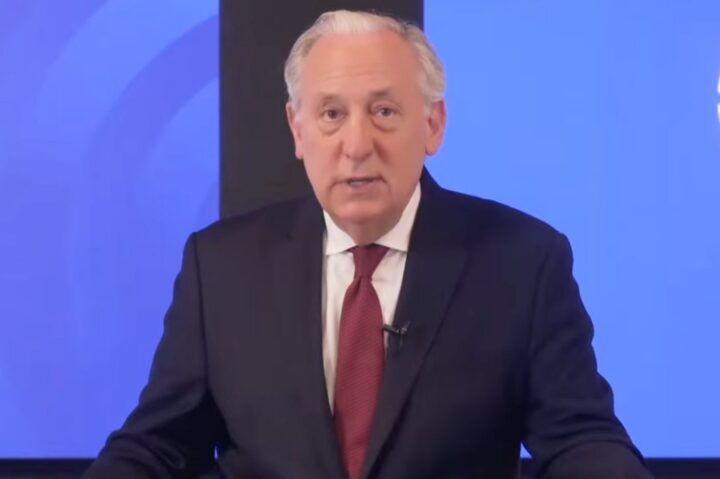
JFNA CEO Eric Fingerhut delivers the inaugural State of the Jewish Union address in Washington, Feb. 19, 2026.
As antisemitic incidents continue to roil Jewish communities nationwide, Jewish Federations of North America CEO Eric Fingerhut called on Congress to increase funding for the Nonprofit Security Grant Program to $1 billion annually and to “make the program more flexible and simpler to use.”
Fingerhut also called on governors to support an educational tax credit on Thursday during JFNA’s inaugural “State of the Jewish Union” address at the organization’s Washington headquarters.
Fingerhut urged lawmakers to provide federal support for security personnel so that schools and synagogues don’t need to cover the costs; expand the FBI’s capabilities to detect and disrupt domestic terrorism; increase support for state and local law enforcement protecting Jewish institutions; hold social media companies accountable for antisemitic hate and incitement to violence through their platforms; and prosecute hate crimes “aggressively.”
The call for increased security comes as American Jews have faced several high-profile hate crimes in the past year, including the recent arson attack at Mississippi’s largest synagogue. Less than two weeks after the attack on Congregation Beth Israel in Jackson, Congress put forward a budget of $300 million for NSGP for 2026. While that figure is a small increase from the funding provided in 2024 and 2025, it is lower than the allocations initially proposed by both the House and Senate and the amount requested by Jewish leaders.
American Jews have responded to the increase of hate and the Oct. 7 Hamas attacks in what JFNA coined as “the surge,” describing a rise in Jews engaging or seeking to engage more in communal life.
According to the organization, enrollment in Jewish schools and camps remains high. “This is why we strongly support the new federal education scholarship tax credit and urge all 50 states to opt in so the funds can reach the families and schools in every community,” Fingerhut said on Thursday.
JFNA confirmed to Jewish Insider that the group plans to hold sideline meetings with state leaders on Friday during the National Governors Association summit in Washington to encourage Democratic governors to participate in the education tax credit, which would create supplemental funding for scholarships for Jewish day school and yeshiva education.
Though the anti-Israel encampments and disruptive protests that plagued college campuses in the immediate aftermath of Oct. 7 and the ensuing Israel-Hamas war have largely died down, a larger percentage of Jewish college students report having experienced antisemitism than ever before. Fingerhut encouraged passage of the bipartisan Protecting Students on Campus Act, which would require federally funded colleges and universities to inform students of their civil rights under Title VI and provide accessible information on how to file discrimination complaints.
“The state of the Jewish union in America is strong, but it is being tested,” said Fingerhut. “We are united in our commitment to America and to Jewish life, even as we worry about the real threats of violence and the growing acceptance of antisemitic rhetoric.”
Following Fingerhut’s address, three heads of local federations shared challenges in addressing security and social needs in their communities. Rabbi Noah Farkas, president and CEO of the Jewish Federation of Greater Los Angeles; Scott Kaufman, president and CEO of the Greater Miami Jewish Federation; and Miryam Rosenzweig, president and CEO of the Milwaukee Jewish Federation echoed that — despite varying degrees of antisemitism in their communities — there is a significant “antisemitism tax,” an increased financial burden to protect Jewish institutions.
“Every dollar we’re spending [on security] we can’t spend on the ‘joy’ part of being Jewish,” said Kaufman.
Please log in if you already have a subscription, or subscribe to access the latest updates.
 Continue with Google

 Continue with Apple