













































































Former Trump special envoy Elliott Abrams: ‘Kushner’s meeting with Hamas was a terrible mistake that helps to legitimize them’

Ali Jadallah/Anadolu via Getty Images
Weapons on display as the Al-Qassam Brigades, the military wing of Hamas, hand over on Saturday two Israeli hostages in Rafah on February 22, 2025.


 Add JewishInsider on Google
A diplomatic push by Jared Kushner to revive the stalled Gaza peace plan was met with widespread skepticism from Middle East analysts, who warned that the envoy’s timeline for Hamas disarmament is unrealistic as the group continues to hide behind a smokescreen of diplomacy rather than follow through on its commitments.
Following a series of meetings in Cairo and Jerusalem this week with Hamas and Israeli officials, Kushner expressed optimism that initial progress on Hamas surrendering its weapons could begin “in as little as 30 days,” and filling in Hamas’ terror tunnels within “60 to 90 days.” Additionally, Israel and the Board of Peace established two working groups to address key issues in the plan.
However, regional experts told Jewish Insider that Hamas is unlikely to fully disarm, warning that Kushner’s timeline faces significant operational and political hurdles.
“It may feign disarming and may turn in some guns, but full disarmament means they will lose power in Gaza,” said Elliott Abrams, who served as special envoy for Iran during the first Trump administration. “What Hamas wants is what Hezbollah has had in Lebanon: someone else runs schools and collects garbage, while they remain in charge behind the scenes. In my view, Kushner’s meeting with Hamas was a terrible mistake that helps to legitimize them.”
Daniel Shapiro, former U.S. ambassador to Israel under President Barack Obama and deputy assistant secretary of defense for the Middle East under President Joe Biden, similarly questioned whether Hamas would genuinely comply with the roadmap, characterizing the talks as “a lot of misdirection, spinning, time-buying, and politics by all parties involved.”
“[Hamas’] ideology has not dimmed, and they have a long history of seeming to reach agreements, and then asserting caveats to wriggle out of them,” Shapiro said.
Shapiro also argued that Israeli Prime Minister Benjamin Netanyahu has incentives of his own to present the negotiations as making progress, describing the Israeli prime minister as performing a “familiar two-step” — reassuring the Israeli public on a sensitive issue ahead of an upcoming election while attempting to keep Washington appeased with the progress of the plan.
Beyond the political dynamics, Shapiro pointed to significant operational obstacles. The technocratic Palestinian government has yet to deploy to Gaza, its 5,000-member police force remains untrained and international stabilization forces are not prepared to seize Hamas’ weapons.
“Kushner is trying to bridge these unbridgeable gaps,” Shapiro said. “The result is different, and at times contradictory, statements and understandings by all parties on timing and sequence… In the best case, it will take many months to make even modest progress, and U.S. officials will need to stay engaged daily to keep the road map from collapsing.”
Hamas has an incentive to remain at the negotiating table even without having intent to fully comply, analysts said.
“Observers should evaluate Hamas’ commitments in the context of their total war against Israel,” said Steven Cook, a senior fellow at the Council on Foreign Relations. “They can position themselves as the reasonable party and Israelis as rejectionists if it advances Hamas’ goal to delegitimize Israel. They don’t have to fire a shot. In this case, lying is politically profitable.”
Kushner warned following his meetings in Israel on Monday that if Hamas fails to fulfill its disarmament pledge, Washington would allow Israel to “finish the job” militarily.
Matthew Levitt, a senior fellow at the Washington Institute for Near East Policy, said the threat is “intended to press Hamas to follow through.” But he cautioned that it “must have teeth” to prevent Hamas from using the negotiations to gain international legitimacy without surrendering its weapons.
“At the end of the day, Hamas cannot be allowed to prioritize holding on to its weapons at the expense of Gaza’s reconstruction,” Levitt said. He described the newly established working groups as a “significant” step toward “holding Hamas to full disarmament” and “addressing the very real sanitation crisis in Gaza.”
Jonathan Ruhe, a fellow at the Jewish Institute for National Security of America, said the timeline will have little meaning without a credible force on the ground capable of disarming Hamas if the group refuses to surrender its weapons voluntarily.
“By saying all the right things, Hamas hopes to aggravate existing tensions between Washington and Jerusalem,” Ruhe said, arguing that the group is playing for time as U.S. and Israeli attention is pulled toward upcoming elections in both countries and other regional flashpoints.
“It’s almost impossible to foresee real progress on the Gaza peace plan until there’s a viable and ready option to forcibly disarm Hamas, since Hamas is not going to voluntarily surrender control over its part of the Strip,” Ruhe said. “The agreed timeline doesn’t mean much in the absence of any viable disarmament option.”
Ruhe added that Hamas could “play for time” and “hope Gaza continues to fall down the list of U.S. and Israeli priorities as tensions flare in [the Strait of] Hormuz, the West Bank and Syria, and as Trump and Netanyahu focus on upcoming elections.”
“Israel may have the U.S. blessing to finish the job, and ultimately it is willing to do so, but that doesn’t mean it’s ready or eager to resume intensive and draining ground operations in the near future,” he said.
Jason Greenblatt, former Middle East envoy in the first Trump administration, struck a more supportive tone toward the administration’s effort while expressing continued distrust of Hamas.
“I remain deeply skeptical of anything Hamas says. Hamas’ defining objective remains the destruction of Israel, and I am aware of no evidence that this has changed,” Greenblatt said. “Yet President Trump and his team secured the release of hostages held by Hamas in brutal conditions when almost no one thought it could be done.”
“President Trump, Jared and others on the team also created the Abraham Accords, which most experts believed could never happen, and they are uniquely qualified to take on this extraordinarily difficult task,” he continued. “The administration is right to pursue every possible path while making clear that, if Hamas refuses to comply, Israel will have America’s support to finish the job.”
Officials and analysts warned that Hamas is seeking to cede administrative control of Gaza while retaining its weapons and remaining the dominant force in the enclave

Photo by Moiz Salhi/Anadolu via Getty Images
Hamas spokesperson Hazem Qassem and Director of the Government Media Office in Gaza Ismail Al-Thawabta deliver a press statement following the announcement that the head of the Government Emergency Committee had resigned and the committee had been dissolved as part of the transfer of governance in the Gaza Strip to the National Gaza Administration Committee, on July 6, 2026.
American and Israeli officials expressed skepticism on Monday that Hamas would follow through with its pledge to dissolve its governing body that has ruled Gaza for over two decades.
Hamas announced the dissolution of the “Emergency Committee,” the terrorist organization’s governing body, and the resignation of Mohammed al-Farra as the committee’s chief on Monday. The terrorist group said that it was prepared to transfer authority to the National Committee for the Administration of Gaza (NCAG), the technocratic committee established under President Donald Trump’s Gaza peace plan and overseen by the Trump administration’s Board of Peace.
The announcement did not address whether the terrorist group would disarm, a key facet of the Gaza peace plan. Hamas’ announcement came after the Board of Peace convened a series of meetings last week to advance plans for the NCAG to take over the governance of Gaza.
The Board of Peace said that it was withholding judgment on the announcement, instead vowing to assess Hamas’ “actions, not promises, to meet the critical needs of the people of Gaza.”
“Decisions must be comprehensive with respect to the requirements as set out in the Roadmap for advancing governance, security, and transition in Gaza,” the board said in a statement. “We look forward to the successful conclusion of discussions on this Roadmap, including on the implementation mechanisms necessary to enable the National Committee for the Administration of Gaza to assume full governing authority.”
The board’s statement also noted that the “core principle” of the ongoing peace efforts in Gaza “remains one authority, one law and one weapon,” and reiterated its position that Hamas must disarm. “A genuine transfer of authority must enable the NCAG to exercise its mandate independently, including taking the administrative and governance decisions entrusted to it.”
Israeli Foreign Minister Gideon Sa’ar dismissed the move outright, saying that Hamas had agreed to give up governing control of the Gaza Strip in a largely symbolic overture while sidestepping disarmament calls.
“Hamas’s trick is simple. Hamas’s apparent willingness to ‘make room’ for a technocratic government is designed to prevent its own disarmament,” Sa’ar wrote on X. “Hamas seeks to replicate the ‘Hezbollah model’ in Gaza: a technocratic administration would be responsible for garbage collection and other municipal services, while Hamas would remain the dominant military force.”
“As long as Hamas retains its weapons, any civilian government will of course operate as Hamas dictates,” he continued. “This would allow Hamas to continue oppressing the Palestinian people in Gaza, while pursuing its jihadist war against Israel.”
Sa’ar went on to note that Israel “insists on the full implementation of the Trump plan, with its core principles being the disarmament of Hamas and all other terrorist organizations, and the complete demilitarization of the Gaza Strip.”
Elliott Abrams, who served as Iran envoy under the first Trump administration, similarly expressed doubt about the prospect of Hamas giving up its weapons and influence in Gaza.
“In my view, this is Hamas trying to become Hezbollah,” Abrams told Jewish Insider. “Hamas used to run everything, up to and including garbage collection. They were the government of Gaza. Hezbollah uses a different mode: there is a Lebanese government providing public services, so Hezbollah can just concentrate on being an army and a terrorist group.”
“This offer by Hamas does not suggest that they will disarm, and as Board of Peace chairman [Nickolay] Mladenov has said, without Hamas disarmament there will be zero progress,” he continued.
Steven Cook, a senior fellow at the Council on Foreign Relations, said that he believes Hamas is seeking to retain power and authority in Gaza without having to govern or be held accountable for the new government’s potential shortcomings.
“[Hamas] will cede governing to technocrats who represent no one but will retain its arms to ensure that Hamas remains the center of power and authority in Gaza,” Cook said.
Analysts argued that unless Hamas disarms, the group will remain in power and progress on the president’s Gaza plan will remain stalled. Jonathan Ruhe, a fellow at the Jewish Institute for National Security of America, called the announcement from Hamas “fairly meaningless” without disarmament.
“Hamas can proclaim it’s ceding administrative authority to technocrats, but it will retain de facto power in its slice of Gaza as long as it still has a monopoly on violence there,” Ruhe said. “Until and unless Hamas actually disarms, voluntarily or otherwise, anything else the group says or does is fairly meaningless in terms of the peace plan’s vision for stabilization, reconstruction, and new governance in Gaza.”
Ruhe also suggested that Hamas made the announcement in an effort to shift the pressure toward Israel without fulfilling its own commitments.
“The group’s official line is telling. Hamas cynically frames this step as removing the pretext for Israel’s ‘occupation’ of Gaza, even though it knows full well that demilitarization is a two-sided commitment, not a unilateral obligation on Israel,” Ruhe said. “This shows how Hamas wants to cherry pick parts of the Gaza peace plan, in order to put pressure on Israel, but without fulfilling its own commitments to disarm under that same plan.”
Neomi Neumann, an adjunct fellow at The Washington Institute for Near East Policy, similarly argued that Hamas is seeking to put the “blame game into an Israel area.”
“I think their [Hamas] message is: ‘We have given up the government in Gaza, and now Israel is on the side of preventing the progress,’” Neumann said. “For Hamas, they understand that if they will stay with the same position. [At] the end of the day, Mladenov will declare [Hamas] as a rejectionist organization, so as a result I think that Hamas is trying to frame the move … in order to survive.”
Neumann expressed skepticism that Hamas would give up its weapons in addition to governance in Gaza, adding that there is a “very low” chance that Hamas changes its mind. However, she said, “you can never say never.”
“We also thought that [Hamas] will never bring back the hostages,” Neumann said. “I think that if the United States and Turkey and Qatar will push Hamas very hard and put pressure on Hamas, they will say they are willing to give up the heavy weapons, but they won’t find it easy to say they are willing to give up their guns because everybody can kill them and in the end of the day they know they need to continue to control the Gaza Strip with weapons.”
Still, she noted that the situation remains a “disaster” from the Israeli perspective.
“From Israel’s point of view, I think it will be a disaster, because they [Hamas] just will get stronger.” Neumann said. “Iran will continue now to give much more money to Hamas. They [Hamas] won’t let any other power to emerge and to get strong, and it will be very complicated.”
The options for demilitarization ‘strike me as not feasible from a military point of view and certainly not practical from a political point of view,’ says the Carnegie Endowment’s Aaron David Miller
Saeed M. M. T. Jaras/Anadolu via Getty Images
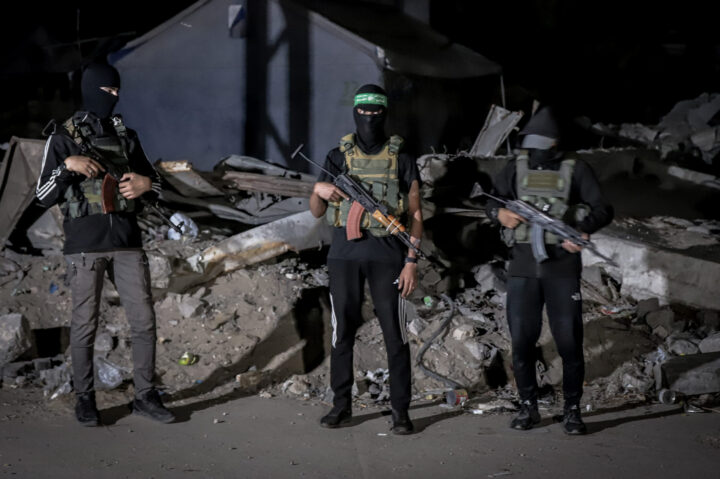
Israeli hostages are handed over to the International Committee of the Red Cross (ICRC) by the Al-Qassam Brigades, the armed wing of Hamas, as part of the ceasefire agreement in effect in Gaza City, Gaza on October 15, 2025.
The White House launched Phase 2 of President Donald Trump’s 20-point Gaza peace plan last month, intending to transition the enclave toward demilitarization, technocratic governance and reconstruction. But before those plans can move forward, the administration still needs to confront a central reality on the ground: Hamas remains armed and unwilling to cooperate.
During the World Economic Forum in Davos, Switzerland, in January, the Trump administration unveiled the National Committee for the Administration of Gaza (NCAG), a committee of technocrats intended as a post-Hamas governing authority, alongside an outline for reconstructing the enclave.
That vision, however, was quickly challenged by Hamas’ leadership. Speaking at the Al Jazeera Forum in Doha, Qatar, this past weekend, Hamas leader Khaled Mashaal, who is under U.S. indictment on terrorism-related charges, rejected the U.N. Security Council–backed plan for Gaza — a move that could complicate disarmament and Phase 2 efforts.
Experts told Jewish Insider that the administration’s expectation that Hamas can be persuaded to voluntarily hand over its weapons is detached from the group’s incentives and its perception of the war’s outcome.
“Without first disarming Hamas, progress on every other facet of Phase 2 will be minimal at best,” said Jonathan Ruhe, a fellow at the Jewish Institute for National Security of America. “The U.S. needs to adapt its strategy, which remains stuck on convincing Hamas to hand over its weapons.”
Ruhe said Hamas believes it “won the war” and therefore “can’t be incentivized to give up” power. He added that, absent voluntary disarmament, the administration may need to consider using well-vetted and tightly overseen “private military contractors” to carry out the task, a suggestion also recently put forward by former special envoy for Iran and Venezuela Elliott Abrams and JINSA’s Eric Edelman and Rena Gabber.
Other experts were similarly skeptical that Hamas would relinquish control voluntarily. Michael Koplow, chief policy officer at the Israel Policy Forum, warned that Hamas is not going to “want to voluntarily give up their weapons without real guarantees,” adding that the group’s incentive to comply is “not very high.”
“If you’re going to get [Hamas to comply with the plan], it’s going to have to involve some sort of guarantees for the group and guarantees for the leadership, which are going to be very difficult for the Israelis to swallow,” said Koplow.
Aaron David Miller, a senior fellow at the Carnegie Endowment for International Peace, said Hamas is also unlikely “to surrender the actual administrative control of Gaza.” He outlined what he described as a narrow and unattractive set of options for disarmament.
“There are only two ways to fundamentally demilitarize Hamas,” Miller said. “There are only two forces capable of doing it. One would be the IDF, and you’ve seen how that has gone over the course of the last 2 ½ years. The second would be the deployment of thousands of American combat forces, which would take a while and result in a permanent occupation of Gaza by the U.S. military. Both of these strike me as not feasible from a military point of view and certainly not practical from a political point of view.”
Miller added that any disarmament process would likely need to be accompanied by an Israeli withdrawal from additional areas in Gaza. The IDF currently controls more than half of the territory, demarcated by what officials refer to as a “yellow line.”
Until Hamas is disarmed, Miller said Israel is unlikely to permit large-scale reconstruction, given concerns that materials such as cement and metal tubing could be diverted for tunnel construction and weapons production.
Koplow also noted military means as an option for disarmament, but said the Trump administration appears to be leaning toward a “DDR” process — disarmament, demobilization and reintegration — an alternative to military force in which Hamas would give up heavy weapons first, transition away from armed activity and then reintegrate former fighters into civilian life.
“The idea is that you’re not going in and destroying the group,” Koplow said. “You’re first getting rid of their weapons, you’re then trying to transform the group itself into something different and then you’re reintegrating the group’s members back into society. Historically, that’s the way that terrorist groups like this are disarmed.”
Koplow cautioned that any such effort would be slow and contentious. “Hamas is going to make it difficult,” he said, adding that demilitarization will be “a long and drawn-out and very difficult process if it has any chance of working.”
“After all these months, the ISF still lacks a clear mandate,” Jonathan Ruhe, a fellow at the Jewish Institute for National Security of America, said. “If Hamas disarmed voluntarily, as Trump’s plan envisions, any number of countries would contribute troops for relatively safe peacekeeping duties like safeguarding humanitarian aid, police training and border patrol. But because Hamas won’t disarm peacefully, Arab and other Muslim countries consistently refuse to put their forces in harm’s way.”
Under Trump’s original 20-point plan, a U.S.-led International Stabilization Force (ISF) was envisioned as a “long-term internal security solution.” Last month, Trump appointed Maj. Gen. Jasper Jeffers as commander of the ISF, and Israeli media reported on Monday that thousands of Indonesian soldiers were expected to deploy to southern Gaza in the coming weeks as part of the first foreign contingent.
Despite those moves, experts say the ISF remains constrained. No other countries have formally joined the force, and efforts to assemble it have been complicated by reluctance among potential contributors and Israeli security concerns over which countries would be permitted to participate. Analysts also say the ISF still lacks a clearly defined mandate and could be limited to a supporting role rather than directly confronting Hamas.
“After all these months, the ISF still lacks a clear mandate,” Ruhe said. “If Hamas disarmed voluntarily, as Trump’s plan envisions, any number of countries would contribute troops for relatively safe peacekeeping duties like safeguarding humanitarian aid, police training and border patrol. But because Hamas won’t disarm peacefully, Arab and other Muslim countries consistently refuse to put their forces in harm’s way.”
Miller said the ISF would most likely deploy in areas already under Israeli control, rather than Hamas-held territory. “I see the stabilization force as exactly what its name implies,” he said. “It would be an after-the-fact deployment to monitor and stabilize. The heavy work of actually decommissioning weapons is going to take a very long time.”
Even if demilitarization were achieved, Miller said the question of whether and how Hamas members could be integrated into future governance remains unresolved. The group maintains an extensive bureaucratic apparatus in Gaza, including tens of thousands of civil servants and police officers, whose future role would need to be addressed.
“It’s probably going to involve making distinctions between Hamas fighters and Hamas bureaucrats, and making some very difficult choices about what level of reintegration, if any, you’re willing to allow for former Hamas members,” Michael Koplow, chief policy officer at the Israel Policy Forum, said.
“Hamas has 40,000 civil servants and 10,000 police,” Miller said. “Those people would be under the administration of whom?”
Koplow suggested that the group be completely dismantled and barred from maintaining governing authority.
“Hamas as a group, and certainly not as it’s currently constituted, can’t responsibly be given any role in future Gaza governance,” said Koplow.
“It’s probably going to involve making distinctions between Hamas fighters and Hamas bureaucrats, and making some very difficult choices about what level of reintegration, if any, you’re willing to allow for former Hamas members,” Koplow added. “Then the question is, does anybody who’s ever had a Hamas affiliation have to be hunted down and eliminated over time, or is there a world in which they can, as individuals, be integrated into whatever future Gaza governance and society looks like?”
Speaking at the World Economic Forum, the president said ‘we’re going to know over the next two or three’ days and weeks ‘whether or not they’re going to do it’

Harun Ozalp/Anadolu via Getty Images
President Donald Trump delivers a speech during the World Economic Forum Annual Meeting in Davos, Switzerland, on January 21, 2026.
President Donald Trump issued a stark warning to Hamas on Wednesday, setting a timeline for the terror group’s disarmament and stating that it must deliver on its agreement to demilitarize or face potential military consequences.
“Hamas has agreed to give up their weapons,” Trump said, speaking to a packed room at the World Economic Forum in Davos, Switzerland. “If they don’t do it, they’ll be blown away very quickly.”
The president has made several statements following the initial adoption in October of the Gaza peace plan, insisting that the group disarm or face consequences. During his Davos address, Trump seemed to issue a more concrete timeline for when he expects the administration to determine if Hamas has chosen to comply with the agreement.
“They’ve got to do it, and we’re going to know over the next two or three days, certainly over the next two or three weeks, whether or not they’re going to do it,” said Trump, who noted that disarmament is “not an easy thing” for Hamas, adding that group members are “born with a weapon in their hands.”
The administration is a week into the launch of Phase 2 of Trump’s 20-point Gaza peace plan, which moves from “ceasefire to demilitarization, technocratic governance, and reconstruction,” according to White House Special Envoy Steve Witkoff.
“We have 59 countries that are part of that whole peace deal, and some of those countries aren’t even near the Middle East, and they want to come in and take out Hamas,” said Trump. “They want to come in and they want to do whatever they can.”
Critics have remained skeptical over whether Hamas will comply and relinquish its weapons. The terrorist group has previously insisted that it would refuse to disarm until a Palestinian state is established.
Sen. Lindsey Graham (R-SC), who previously said Hamas is unlikely to disarm without Israeli confrontation, lauded Trump’s statement at Davos in a post on X on Wednesday.
“President Trump rightly put Hamas on a time clock for disarmament,” Graham wrote on X. “This is the right decision at the right time.”
Please log in if you already have a subscription, or subscribe to access the latest updates.
 Continue with Google

 Continue with Apple