












































































In preparing for a potential 2028 presidential run, the Pennsylvania governor said the Democratic Party must first agree that Israel has a right to exist as a Jewish state
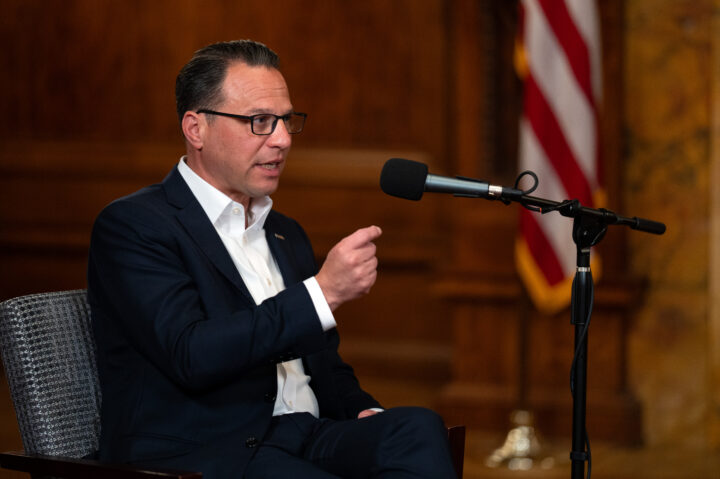
Peter W. Stevenson/The Washington Post via Getty Images
Pennsylvania Gov. Josh Shapiro sits for an interview at the Pennsylvania State Capitol on June 11, 2025.


 Add JewishInsider on Google
As Pennsylvania Gov. Josh Shapiro eyes a 2028 presidential run, he is using a series of big-name podcast interviews to refine and test out his messaging on Israel — and taking aim at California Gov. Gavin Newsom, a potential rival, in the process.
In interviews with the “Pod Save America” and “Higher Learning” podcasts that dropped in recent days, Shapiro put himself in the line of fire from interviewers with more left-wing views on the Israeli-Palestinian conflict than he holds. In response, he made the case that, as the starting point for any public political conversation about Israel, the fact of Israel’s right to exist as a Jewish state must be respected.
“I think what is dangerous here, and I’m not accusing you of this by any stretch, is for those who think Israel doesn’t have a right to exist in [the] conversation. That to me is a recipe for permanent war,” Shapiro told “Higher Learning” host Van Lathan, who said a national conversation about Israel is needed. (“Higher Learning” is part of a podcast network from the digital media company The Ringer.)
The point of the discussion seemed to be to demonstrate a kind of modeling — that Shapiro, a Jewish Democrat who has long been both a supporter of Israel and a critic of Israeli Prime Minister Benjamin Netanyahu, can show Democrats how to have a difficult yet transparent and empathetic conversation amid deep disagreements over Israel’s actions in Gaza.
Shapiro is making clear that if he runs for president, he does not intend to sidestep the party’s most fraught foreign policy debate. He intends to shape it.
In the “Higher Learning” interview, Shapiro laid out his views on Israel while taking flack from Lathan, who called Israel “one of the worst human rights violators” and said he is worried that in describing Israel as an “apartheid state,” people will think he is saying he hates Jews.
“I fundamentally disagree with your viewpoint, but I don’t think you’re an antisemite. I think that you are learning and struggling and grappling with issues that are really, really tough, and you formed an opinion, one that I disagree with, that you seemingly hold very honestly,” said Shapiro. “I don’t think that you’ve got hate in your heart toward someone because they’re Jewish. I think you’ve got different views, say, than I do about Israel or about the Middle East.”
Shapiro drilled down into the conversation he said often plays out about Israel, and drew a red line that he believes should not be crossed.
“Usually the conversation starts around the idea of does Israel have the right to exist, right? And exist as a Jewish state,” he said. “Peace to me are two nations, Israel and a Palestinian country, living side by side in peace with full recognition for one another, an acknowledgment that both have a right to exist and an acknowledgment that the goal of each country is not to wipe out the other … I think if one doesn’t recognize Israel’s right to exist, then you’re — not you, then one is in effect for really just permanent war, because you’re effectively saying Israel’s got to go, and Israel’s not going anywhere.”
Shapiro’s podcast tour came amid a similar media blitz for Newsom. Both governors recently published memoirs outlining their political origin story, a move widely seen as a first step for politicians with national ambitions.
At an event earlier this month, Newsom said that Israel could “appropriately” be described as an apartheid state.
In response to a question about Newsom’s comment from “Pod Save America” co-host Jon Lovett, Shapiro castigated the California governor — without invoking his name — for using inflammatory language.
“If we really want peace, and I believe you want that, then we’ve also got to be acknowledging that language matters here, that words matter. And that we’ve got to use words that are actually rooted in reality and are able to bring the temperature down to create a space for that peace,” Shapiro told Lovett.
“I just think we’ve got to be really thoughtful and careful and not just look for buzzwords and not just sort of follow what’s going to get maybe some likes on Twitter,” Shapiro added. “But we’ve got to be thoughtful about a debate that is really, really hard to have, and we’ve got to have it.”
On “Higher Learning,” he more directly took on the apartheid allegation.
“You use the word ‘apartheid.’ Take a look in Israel. Someone who would identify as Muslim, someone who would identify as a Palestinian Christian. They live in a society with all of the same rights and legal responsibilities as Israelis,” said Shapiro. “They get elected to the Knesset, which is their parliament. They pay taxes. They can serve in the military. They are citizens in the world in a way that a true apartheid state would not allow for.”
Public opinion polling has shown declining support for Israel among Democrats. As Shapiro’s national profile has grown, he has not shied away from his Jewish background or his support for Israel, both of which he discussed at length in his memoir, Where We Keep the Light.
The interviews with two major progressive podcasts suggest that Shapiro wants to proactively share his views on the Middle East with potential future voters — and that he does not view his position as something to hide from a Democratic base that may be less amenable to those views than in the past.
In both interviews, he outlined his staunch opposition to the policies of Netanyahu and President Donald Trump on Israel. He criticized Israel’s actions in the West Bank and the violence by some Israeli settlers targeting Palestinians. He also sought to make clear that although he is a supporter of Israel, his main goal is advancing America’s interests in the region.
“I don’t think that if you are critical of Benjamin Netanyahu, you’re an antisemite. By the way, I’m critical of Benjamin Netanyahu. And I have been for years and years and years, even predating Oct. 7. I think his approach has made Israel less safe. I think it’s undermined U.S. national security interests, which is my primary concern,” Shapiro said on “Higher Learning.”
On “Pod Save America,” Shapiro called for the Trump administration to investigate the death of Nasrallah Abu Siyam, a Palestinian-American teenager from Philadelphia who was killed in the West Bank last month, reportedly by Israeli settlers, and he said Netanyahu must take the threat of settler violence more seriously. But when Lovett asked what to do about these challenges beyond “calling for [Trump and Netanyahu] to become different people,” Shapiro responded with an argument about democracy.
“These are the leaders that each country has chosen. I’m not going to speak to what the people in Israel chose. They’ll have an election. They’ll figure that out,” he said. “Here in the United States of America, we need to have more of a check on this administration.”
The New Jersey Democrat asked, ‘Is it really worth throwing Jews under the bus to advance your political ambitions?’
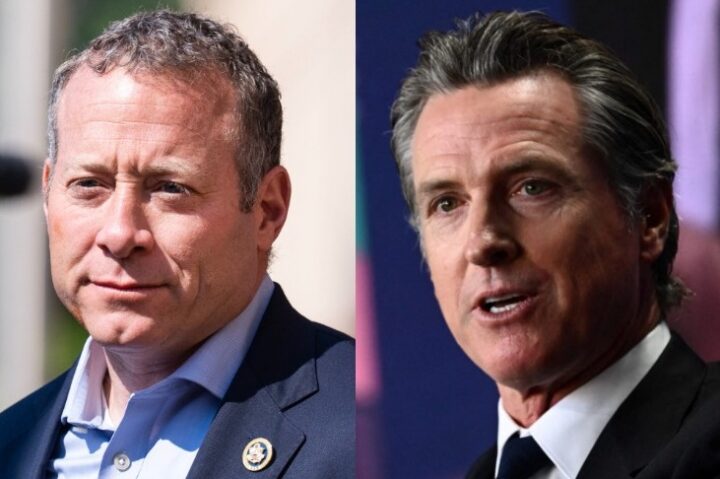
Tom Williams/CQ-Roll Call, Inc via Getty Images/PATRICK T. FALLON/AFP via Getty Images
Rep. Josh Gottheimer (D-NJ) and California Gov. Gavin Newsom
As the Democratic Party’s internal schism over Israel policy continues to deepen, Rep. Josh Gottheimer (D-NJ) called out California Gov. Gavin Newsom, a leading 2028 presidential contender, for recent comments characterizing Israel as an apartheid state and questioning future military aid.
“These comments are not only wrong, but they are dangerous and will feed more antisemitism in our country,” Gottheimer said on X this weekend. “Is it really worth throwing Jews under the bus to advance your political ambitions?”
Newsom and other 2028 contenders, including some who have strong pro-Israel voting records and close ties with the Jewish community, have increasingly shifted left on the U.S.-Israel relationship amid pressure and scrutiny from the progressive wing of the party.
Newsom, whose staff met with Jewish leaders in California after he made the comments, said subsequently that he was speaking about a potential Israeli annexation of the West Bank in reference to a February column by The New York Times’ Thomas Friedman that used the term “apartheid.”
Jack Cocchiarella’s latest guest was Gov. Gavin Newsom, as Newsom positions himself for a potential 2028 presidential run
Jack Cocchiarella/YouTube
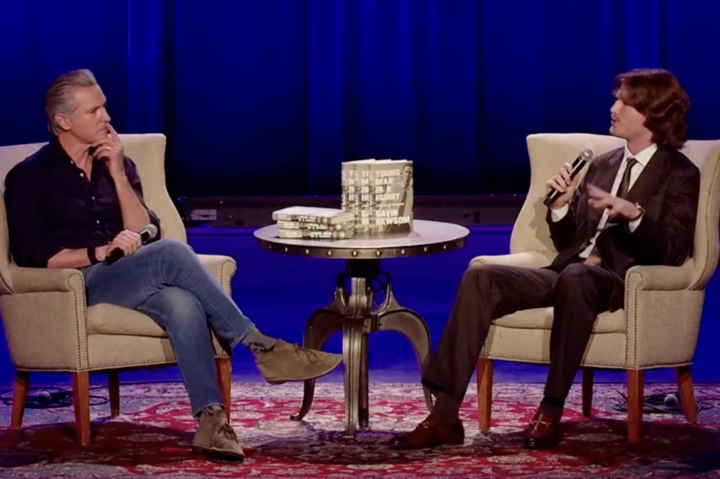
Jack Cocchiarella interviews California Gov. Gavin Newsom in New Hampshire on March 5, 2026.
As Gavin Newsom travels around the country promoting his book — a memoir widely seen as a first step on his journey toward a 2028 presidential campaign — the California governor made appearances in South Carolina and New Hampshire, two early Democratic primary states that are important stops for any likely candidate.
For a trip signaling presidential ambitions, Newsom’s choice of interviewer is revealing. On Thursday night, he was interviewed in Portsmouth, N.H., by Jack Cocchiarella, a self-described “progressive political pundit,” part of a group of Gen Z influencers with growing clout among Democratic voters.
Courting those content creators has been central to Newsom’s efforts to build an engaged national audience.
He’s adopted a go-anywhere media strategy that has put him in conversation with everyone from New York City Mayor Zohran Mamdani, a democratic socialist, to conservative Daily Wire founder Ben Shapiro. On Thursday, at the event with Cocchiarella, Newsom said he would sit for a conversation with the far-left streamer Hasan Piker, one of the most recognizable names among young political influencers — and who has an unshakeable predisposition toward antisemitism.
In recent months, Cocchiarella has adopted a stridently anti-Israel posture that mirrors some of the incendiary rhetoric frequently employed by Piker, though Cocchiarella isn’t yet as prominent as Piker.
But the Columbia University graduate has quickly gone from being a small-time digital strategist for Democratic candidates in Florida to a YouTuber who has scored interviews with some of the most important members of the Democratic Party. In the 20 months since he posted his first YouTube video, he has garnered 1.47 million subscribers, with some of his videos fetching up to 5 million views. Most of them feature Cocchiarella attacking President Donald Trump.
While Cocchiarella has developed a somewhat cheeky style drawing on Democrats’ opposition to Trump, he’s far less aggressive than Piker, and more in line with the talking points of mainstream Democrats. He’s interviewed many of them: Sens. Elizabeth Warren (D-MA), Cory Booker (D-NJ), Ruben Gallego (D-AZ) and Mark Warner (D-VA); House Minority Leader Hakeem Jeffries (D-NY); and Reps. Greg Landsman (D-OH), Robert Garcia (D-CA), Jamie Raskin (D-MD) and Eric Swalwell (D-MA) all appeared in video interviews with Cocchiarella, as did Kentucky Gov. Andy Beshear.
But against this backdrop, Cocchiarella also has a combative streak. In October, weeks after conservative activist Charlie Kirk was killed, Cocchiarella drafted a tweet responding to news that Turning Point USA, the organization Kirk created, would be putting together an “All-American” halftime show to compete with the Super Bowl’s official halftime show, where the Puerto Rican artist Bad Bunny was set to perform. “Shoot him again,” Cocchiarella wrote.
The message was never posted on X, but he shared a screenshot of the draft to a private Instagram story. “Thoughts?” Cocchiarella wrote. He did not respond to a request for comment. (A screenshot of the post was obtained by Jewish Insider.)
Israel did not appear to be an issue Cocchiarella cared much about until last year. “Also f*** Israel just to be clear,” he wrote in a post on X in October. “STOP SENDING MY F***ING TAX DOLLARS TO ISRAEL,” he wrote in December. “Israel is a terrorist state that threatens and kill [sic] Americans,” Cocchiarella posted this week, days after the U.S. and Israel began military strikes against Iran.
In December, Cocchiarella interviewed Newsom and asked him about whether he would accept money from AIPAC, the pro-Israel lobby.
“AIPAC, DMFI [Democratic Majority for Israel], the Israel lobby at large. This has become a big conversation, [for] someone like myself, and I think at this point a broad majority of Democrats are saying we don’t want candidates who are taking money from AIPAC. We don’t want candidates who are beholden to the Israel lobby,” Cocchiarella said.
In response, Newsom said he had never received financial support from AIPAC — which only contributed to federal campaigns — just like he has never accepted donations from the tobacco or oil lobbies.
On Thursday, at the New Hampshire event, Cocchiarella asked Newsom to clarify comments he had made two days earlier suggesting that Israel could be considered an “apartheid state.” Cocchiarella said some online conversation has suggested Newsom is just following the polling, that “you don’t actually believe what you said there,” that “it’s kind of like a shape-shifting move.” But he said it reminded him of Newsom’s decision in 2004, when he was mayor of San Francisco, to give out same-sex marriage licenses — much to the chagrin even of other liberal Democrats in the state who had not yet come out in support of gay marriage.
“History echoes a little bit in the same way,” Cocchiarella said.
In response, Newsom spoke about growing up deeply connected to the Bay Area Jewish community and even traveling to Israel with his family.
“I want to level set on that basis. What I can’t accept today, though, is what Bibi Netanyahu is doing in Israel, and I just can’t countenance that,” said Newsom, who compared his anger at Netanyahu’s efforts to annex the West Bank to the way he felt when same-sex marriage was not yet legal.
“I can’t sit back in the spirit of this book, in the spirit that defined marriage equality, in terms of my values and beliefs, and watch that,” said Newsom.
Before Newsom’s interview with Cocchiarella, a spokesperson said the governor often sits for interviews with people whose views diverge from his own.
“Of course the governor doesn’t agree with every statement of every person he ever sits down with,” Izzy Gardon, Newsom’s communications director, told JI. “He is proud to engage with people across the political spectrum — from Ben Shapiro to Mayor Mamdani. The governor believes in free speech and open debate, something Donald Trump, who dines with neo-Nazis like Nick Fuentes, clearly doesn’t understand.”
The California governor said Tuesday the U.S. should reconsider its military support for Israel just months after having supported continuing U.S. aid
Tayfun Coskun/Anadolu via Getty Images
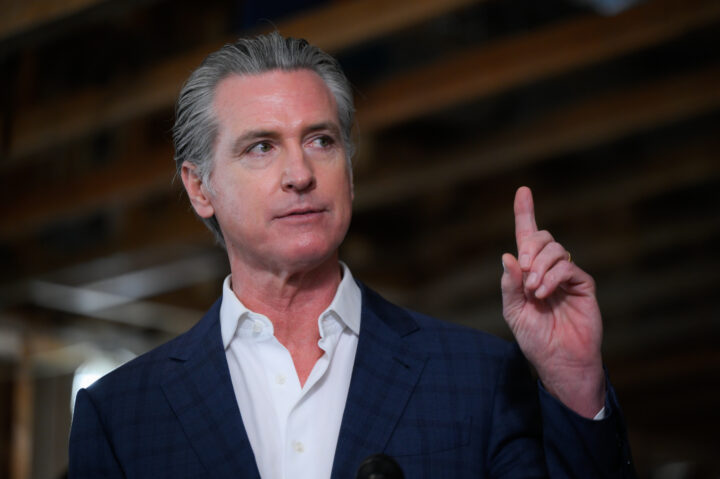
Governor Gavin Newsom criticizes U.S. President Donald Trump’s decision to strike Iran during a press conference in Hayward, California, United States, on March 2, 2026.
California Gov. Gavin Newsom said on Tuesday night on a popular liberal podcast that the U.S. should reconsider its military support for Israel, a marked evolution for a politician who traveled to Israel less than two weeks after the Oct. 7 terror attacks in 2023 and who said in an October interview that he would not consider eliminating U.S. military aid to Israel.
“Do you think, looking down the road, that the United States should consider maybe rethinking our military support for Israel?” Jon Favreau, the co-host of “Pod Save America,” asked Newsom during an event promoting the Democratic governor’s new book.
“It breaks my heart because the current leadership in Israel is walking us down that path where I don’t think you have a choice,” Newsom said in response. He also said in the conversation with Favreau and co-host Tommy Vietor, which came amid the joint U.S.-Israeli operation against Iran, that Israel could “appropriately” be described as an apartheid state.
The “Pod Save” hosts have been some of the leading voices in the Democratic Party hostile to Israel and pro-Israel groups, boosting progressive primary candidates including Graham Platner in Maine and Abdul El-Sayed in Michigan, who made criticism of Israel central to their campaigns.
Further, Newsom seemed to make the argument that military support for Israel comes at the expense of social welfare programs in the U.S.
“To say this is in America’s interest at a time when affordability is at crisis levels, where you have an administration who literally got elected saying this is exactly the opposite of what they would ever consider doing, the fact that we are in this now regional war, all these proxies,” Newsom said, before trailing off into a conversation about corruption in the Trump administration.
On Thursday, Newsom will appear in Portsmouth, N.H., for another book talk — a location sure to raise eyebrows because of the state’s importance in the presidential primary contest. He’ll be interviewed by Jack Cocchiarella, a self-described “progressive political YouTuber” who also frequently bashes Israel. Cocchiarella said in a post on X promoting the event that they will be discussing Israel. Earlier this week, the podcast host called Israel “a terrorist state that threatens and kill [sic] Americans.”
Izzy Gardon, a spokesperson for Newsom, told The New York Timeson Wednesday that he “believes in Israel’s right to exist — and its right to defend itself. Period.”
Newsom “is calling out a difficult truth,” added Gardon, saying that President Donald Trump and Israeli Prime Minister Benjamin Netanyahu are “taking Israel down a course that threatens the safety of Israel — a democracy and America’s closest Middle East ally — as well as Israelis and American Jews.” Gardon declined to comment further to JI.
Newsom’s move away from military support for Israel is a shift even from his recent positions. In October, during an interview with the “Higher Learning” podcast, Newsom said he would not support ending U.S. military aid to Israel.
“No, I’m not prepared to say that I would support a blanket exemption for military support of Israel. That said, I’ve been very vocal in my opposition to Bibi Netanyahu,” said Newsom.
He touted his decision in December 2023 to send humanitarian aid to Gaza, while also defending Israel’s right to exist.
“I am sitting here on your behalf, you’re a taxpayer,” Newsom said on the podcast, “as the only governor in the United States that sent a field hospital to Gaza and got it in through a third party country, and is disgusted by what’s happened in Gaza as a human being, as a father, who sees these children and how this war has been perpetuated by Bibi Netanyahu. I also have deep respect for the right of the State of Israel to exist and defend itself. And I thought the attack by Hamas was a terrorist attack, and we have to be clear about that as well.”
Newsom is widely considered a 2028 presidential contender, and he has been shifting his public stances on Israel to the left in recent months in response to questions from progressive interviewers.
In the days immediately after Oct. 7, Newsom lit the state capital in blue and white and unequivocally condemned Hamas’ actions. Less than two weeks later, he added a one-day visit to Israel onto a pre-planned trip to Asia.
“Despite the horror, what I saw and heard from the people of Israel was a profound sense of resilience. A commitment to community and common purpose, especially in these most difficult of times,” Newsom said afterward. He first traveled to Israel in 2008, the first sitting mayor of San Francisco to do so, on a trip organized by the San Francisco Jewish Community Federation.
Jewish allies of Newsom’s in California told Jewish Insider they disagreed with his choice of using the word “apartheid” but said his comments reflected sentiments familiar to those held by many pro-Israel Democrats who disagree with Netanyahu’s actions.
“I heard what he was saying as sort of a frustration, as, ‘I don’t want it to go there,’ but I’m hearing a lot of concerns and frustrations when he’s saying ‘it breaks my heart,’” said Andrew Lachman, a Culver City school board member and the former president of California Jewish Democrats.
Sam Lauter, a Democratic donor and activist in San Francisco, said he “would have preferred [Newsom] not use those words.”
“I don’t want the word apartheid to come up. I don’t want someone to position themselves as being open to the idea of cutting off military aid to Israel,” Lauter said. “I wouldn’t say that his position has changed or evolved. I think it’s just that the more that folks see Netanyahu and the Netanyahu government proceed down the path that they have proceeded down, the more you’re going to hear people say, this is where he’s put us.”
During his October interview with the “Higher Learning” podcast, Newsom was asked to discuss his views on AIPAC after Van Lathan, the show’s host, said he would not vote for any candidate who accepted money from the pro-Israel lobby. At the time, Newsom appeared flummoxed and did not give a substantive answer.
“It’s interesting. I haven’t thought about AIPAC. And it’s interesting, you’re, like, the first to bring up AIPAC in years, which is interesting. It’s not relevant to my day to day life,” Newsom said.
Two months later, he was asked a similar question by Cocchiarella.
“I’ve never received a dollar from them in my entire political career. So that’s sort of absolute. So I’ve had an opinion on that going back decades now,” said Newsom.
AIPAC only started spending in political races in 2022, and they have never donated to state candidates, only to congressional campaigns. But Newsom doubled down and compared AIPAC to other groups deemed politically toxic to Democrats.
“I don’t take tobacco money, oil money. I’ve never taken AIPAC money. I mean, there’s certain absolutes that are the lines that have been drawn for decades for me,” he said.
Lauter, who used to be involved with AIPAC and now sits on the board of Democratic Majority for Israel, called Newsom’s comments on AIPAC “immensely unfortunate.”
“I’m disappointed that AIPAC has become such an easy target, even for folks that we should consider friends,” Lauter told JI on Wednesday.
The meeting took place as the White House distances itself from the Muslim advocacy organization over its leader’s defense of the Oct. 7 terror attacks in Israel

California Gov. Gavin Newsom speaks to union workers and volunteers on election day at the IBEW Local 6 union hall on September 14, 2021 in San Francisco, California. (Credit: Justin Sullivan/Getty Images)
California Gov. Gavin Newsom met in December with representatives from the Council on American-Islamic Relations, an advocacy organization that has faced scrutiny in recent months for its executive director’s controversial statements celebrating the Oct. 7 terrorist attacks in Israel.
The Dec. 16 hour-long Zoom meeting, which was organized by CAIR’s California chapter and included roughly 15 Muslim leaders from across the state, was meant to address the humanitarian situation in Gaza, according to a CAIR press release. The participants also urged Newsom to call for a cease-fire in the Israel-Hamas war, now entering its fourth month.
On Oct. 7, CAIR-LA Executive Director Hussam Ayloush tweeted a prayer for Allah to “grant relief, freedom, and victory to the people of Gaza.” Three days later, he called the attack “our Warsaw Uprising moment” and linked to an Al Jazeera article praising the attack.
Newsom’s office declined to comment.
“The administration is actively engaging with Muslim and Jewish community leaders across the state to support the safety and security of California’s diverse communities,” a spokesperson for Newsom told the publication CalMatters in December after the meeting.
CAIR’s executive director, Nihad Awad, said in November that he was “happy to see” the Oct. 7 attack, which he described as “self-defense.” The White House condemned “these shocking, antisemitic statements in the strongest terms,” a spokesperson told Jewish Insider in December.
The White House pledged not to include CAIR in discussions around the White House national Islamophobia strategy, which is underway.
In 2021, CAIR San Francisco executive director Zahra Billoo came under fire from Jewish leaders after delivering a speech in which she called Jewish organizations that support Israel, including synagogues, Hillels and Jewish federations, “enemies.”
Newsom traveled to Israel in October less than two weeks after the attacks, which killed more than 1,200 people. Since then, he has directed the shipment of humanitarian aid to both Israel and Gaza.
This story was updated at 9:48 p.m. on 1/4/2024.
Please log in if you already have a subscription, or subscribe to access the latest updates.
 Continue with Google

 Continue with Apple