













































































With no more polls allowed to be released before the election, neither Netanyahu’s bloc nor the opposition is reaching the 61-seats necessary for an outright majority
Jack GUEZ / AFP via Getty Images
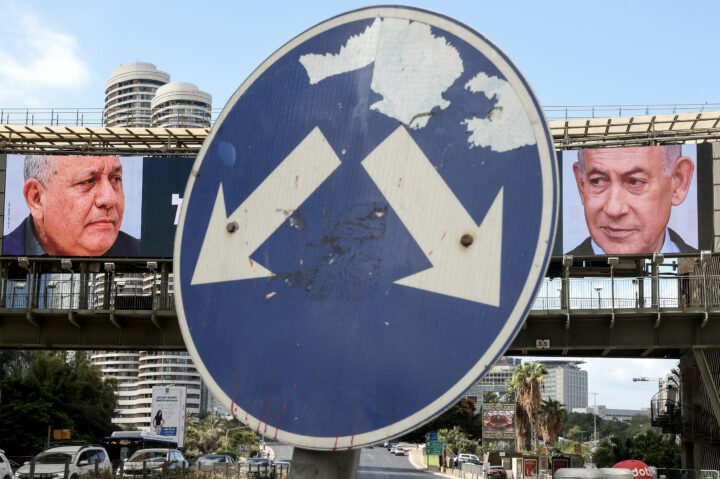
A road sign stands in front of a large billboard featuring Israel's Prime Minister Benjamin Netanyahu (R) of the Likud party and former military chief and leader of the centrist Yashar party, Gadi Eisenkot, in Ramat Gan on October 20, 2026.


 Add JewishInsider on Google
The likeliest outcome of Israel’s upcoming election is a stalemate, according to the final polls ahead of next Tuesday’s election, with neither side — Israeli Prime Minister Benjamin Netanyahu’s bloc and the bloc opposing him, led by Gadi Eisenkot — projected to reach a majority of the Knesset.
Israeli law prohibits the publication of new polls from Friday until the Oct. 27 election.
The overall polling average put the bloc led by Netanyahu ahead, with 54 seats, while the opposition would get 50 seats, both short of the necessary 61-seat majority. Netanyahu’s Likud polled at 23 seats compared to 21 for Eisenkot’s Yashar party.
However, the gap between polls from right-leaning news outlets and those from the mainstream networks and publications was significant.
In the average of six mainstream TV and newspaper polls, the Eisenkot-led bloc had more seats than the current coalition. An average of polls from the last two days showed Eisenkot’s bloc narrowly ahead, holding 52 seats to the Netanyahu bloc’s 50 seats.
Meanwhile, an average of the polls on Israel’s Channel 14 and i24 News — which rely, respectively, on Shlomo Filber, a former Netanyahu campaign aide, and Direct Polls, the firm Filber founded with former Likud strategist Tzuriel Sharon before departing last year — found Netanyahu’s coalition projected to receive a 61-seat majority of the Knesset, while Eisenkot’s bloc would only have 45 seats. Those polls have been outliers, but Direct Polls was the most accurate in the last election.
The Arab parties, the Joint List and Ra’am, are polling at an average of 14 seats, just short of their record 15 seats in 2020 when they ran together. Leading figures in both blocs have vowed not to include Arab parties in their coalition.
Arab voter turnout has hovered around the 50% mark in the last decade. However, Stat-Net, a polling institute specializing in the Israeli Arab population, has said that it may be as high as 68-69% this year, which may give the parties representing the Arab minority even more seats than projected.
Increased Arab turnout would contribute to higher overall turnout, which would increase the number of votes needed to meet the minimal threshold to enter the Knesset.
In both the general polling average and the right-leaning media’s polls, neither Amcha Yisrael nor the Reservists and Economy Party, which have hovered near the 3.25% electoral threshold in recent weeks, received enough votes to enter the Knesset. In the more left-leaning polls, Reservists and Economy, which has not pledged to recommend either Netanyahu or Eisenkot for prime minister, receives an average of three seats.
An Israel Democracy Institute poll found that Israelis would rather have another election than alternative ways of handling a stalemate. Over a third of Jewish Israelis (35%) and nearly half (46%) of Arabs preferred a repeat election, whereas 28% of Jews and 9% chose a unity government with a rotation for prime minister, and 23% of Jews and 25% chose a minority government.
Avigdor Liberman's red lines and Gadi Eisenkot's ambitions could tear apart Israel's opposition

Lihi Lapid
Yair Lapid, Gadi Eisenkot, Yair Golan, Naftali Bennett and Avigdor Liberman, September 2026.
One of the key features of this Israeli election cycle is that the math, as the meme goes, ain’t mathing.
In the average of last week’s polls, the bloc led by Prime Minister Benjamin Netanyahu wins 54 Knesset seats and the Gadi Eisenkot-led bloc receives 50. Even with the Reservists and Economic Party, who got an average of three seats in last week’s polls and have not aligned with either Netanyahu or Eisenkot, neither bloc would reach the needed 61-seat majority to establish a stable coalition.
Then there are the Joint List and Ra’am, two mostly Arab parties, with the latter being more moderate and willing to work within the system. They average a total of 13 seats, enough to bring either side to a majority. The Joint List has said they will help a coalition that can topple Netanyahu. Eisenkot has said he won’t have non-Zionist parties in his coalition, but has been less clear on whether he would rely on their votes in the Knesset to get him across the finish line to form a government.
The problem is that Eisenkot isn’t bringing in 50 Knesset seats on his own. There are three other parties in his bloc, and one emphasized repeatedly last week that relying on the Arab parties is a red line.
Yisrael Beitenu leader and former Defense Minister Avigdor Liberman laid out conditions that seem to doom the anti-Netanyahu bloc to remain in the opposition: No Arabs, no Haredim, no Bibi. He doubled down on those terms, writing on Thursday that he would not support a minority government.
Yisrael Beitenu was arguably the spoiler in the 2019 election, refusing to sit in Netanyahu’s Cabinet as long as Haredi parties were there, though Liberman had been in several such coalitions in the past. As a result of the paralysis, Israel ended up having four elections in three years.
This time Liberman has been arguing, despite all of the polls saying otherwise, that his conditions do not make it impossible for his side to reach a majority. He posited that the anti-Netanyahu bloc can win an outright majority in the Oct. 27 election.
“Stop talking about another round. Stop planning a loss. Start planning victory. With all due respect and appreciation for all the polls, victory depends first of all on turnout. If we reach 76% and up, we will win big,” he argued.
Liberman’s statements are not about basic arithmetic; they expose deep fissures within the opposition bloc. Just under a month ago, the leaders of the anti-Netanyahu parties met in former Prime Minister Yair Lapid’s basement and agreed to campaign on similar messages and not attack one another. Now, opposition insiders told Jewish Insider, Liberman is not the only one concerned that Eisenkot is going back on that agreement.
While Liberman is the only one lashing out publicly, the other parties in the bloc, B’Yachad and the Democrats, are worried that Eisenkot has moved from the strategy of working together as a bloc to trying to be the largest faction in the Knesset, with sources accusing him of targeting their voter bases to grow his Yashar party, even if it pushes them below the 3.25% threshold.
In another post from the weekend, Liberman posited that Eisenkot is “not interested in being the largest party in the bloc of those who serve [in the IDF], but to be bigger than Likud and negotiate from a position of power to be in a government with Netanyahu.”
According to Liberman, Eisenkot is “leaving the possibility of a minority government on the table to pressure Netanyahu so [Eisenkot] can be first in a rotation.”
Another scenario that opposition parties fear Eisenkot is pursuing is to form a minority coalition, meaning a coalition of under 61 seats but with the support of the Arab parties, pass a law to make it illegal for someone under indictment — i.e. Netanyahu — to be prime minister, and then call an election. The theory there is that Eisenkot would absorb many of the other opposition parties’ votes by running from the lofty position of prime minister and win, though it did not work for Lapid in 2022.
The largest party strategy only works, opposition sources noted to JI, if there are satellite parties to recommend that party’s leader to the president. If you push the parties below the electoral threshold or alienate their leaders enough, the leader of the largest party could end up as the leader of the opposition, as Tzipi Livni did in 2009, ushering in the second Netanyahu era.
The meeting marks the first known instance in which U.S. officials have met with the Yashar party leader, coming in the final stage of the high-stakes Israeli election
Jack GUEZ / AFP via Getty Images
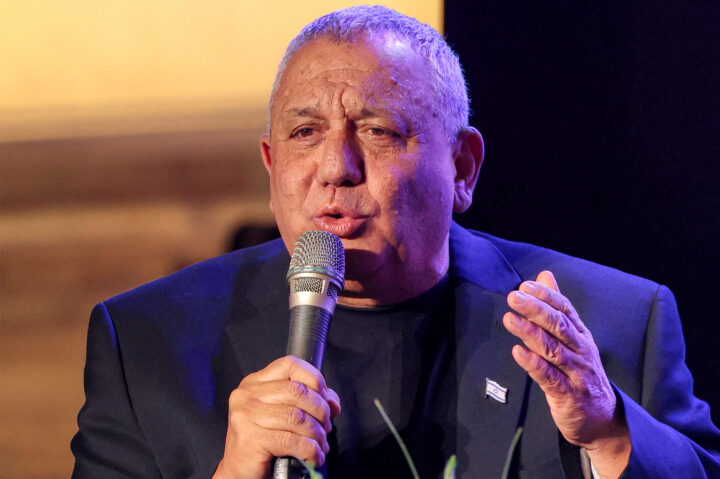
Gadi Eisenkot, former Israeli army chief of staff and head of the Yashar party, speaks during the political "Democracy Festival" in Glilot north of Tel Aviv on October 13, 2026.
U.S. Ambassador to Israel Mike Huckabee met quietly in recent days with Yashar party leader Gadi Eisenkot amid the final stretch of Israel’s high-stakes election campaign, Jewish Insider has learned, the first known time U.S. officials have met with the former IDF chief of staff, considered Israeli Prime Minister Benjamin Netanyahu’s chief rival in the contentious race.
The meeting, according to a source familiar with the matter, focused on critical security concerns, including Gaza, West Bank escalation and rising settler violence.
According to another source, the meeting went beyond formal diplomatic courtesy and served as a reconnaissance move by Washington to gauge Eisenkot’s regional outlook.
Neither side officially announced the meeting, and the Yashar party declined to comment.
News of the meeting comes less than two weeks before Israelis go to the polls, at a time when President Donald Trump has yet to endorse any of the leading candidates, including Netanyahu. Asked on Reshet Bet radio station why an endorsement hasn’t materialized, Israeli Diaspora Affairs Minister Amichai Chikli offered little detail beyond referencing Trump’s past supportive actions.
Trump’s neutral posture toward the election, despite repeated questioning, has raised eyebrows in Israel. In a recent interview with Time magazine, when asked whether Netanyahu should seek another term post-Oct. 7, Trump pointed to his own administration’s achievements for Israel, such as moving the U.S. Embassy to Jerusalem, while avoiding direct praise for Netanyahu himself. Pressed further, Trump noted he “wouldn’t underestimate Bibi,” and admitted he knew little about Eisenkot.
Meanwhile, Israeli political sources tell JI that opposition figures are actively working to blunt the political impact of any potential last-minute Trump endorsement.
With the blocs led by Netanyahu and Eisenkot neck-and-neck in the polls, whether Amcha Yisrael and the Reservists and Economy party clear the 3.25% threshold could decide who forms the next government
Lahav Harkov
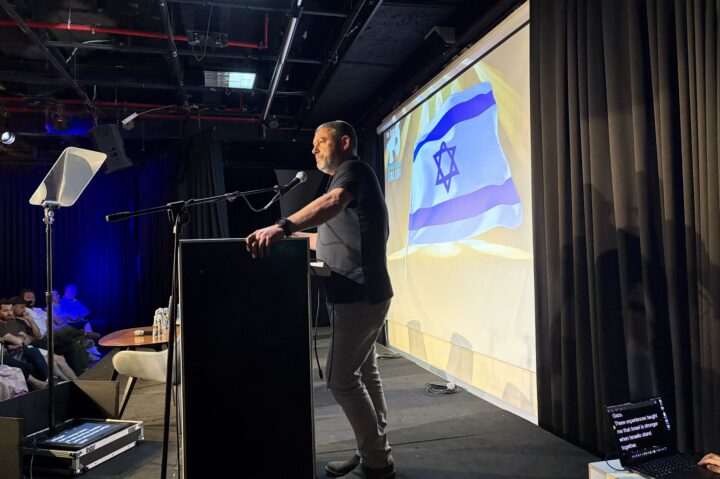
Amcha Yisrael leader Ofer Winter speaks at the Tel Aviv International Salon, Oct. 6, 2026
With the electoral blocs led by Prime Minister Benjamin Netanyahu and former IDF Chief of Staff Gadi Eisenkot running neck-and-neck in the polls only two weeks before the Israeli election, a few very small parties hovering around the electoral threshold could end up tipping the scales in favor of the prime minister or his main rival. If one or more of those small parties pass the threshold and enter the Knesset, they could end up being kingmakers.
While 10 to 12 parties have generally been represented in the Knesset in recent years, there are 38 parties running in this month’s election. Only those that receive at least 3.25% of the vote will get into the Knesset, where seats will be divided proportionally between the parties that pass that threshold.
In the last election in 2022, a party needed 154,855 votes to enter the Knesset. That year, a decisive element in the Netanyahu bloc’s victory was that two opposition parties — the left-wing Meretz party and the Arab nationalist Balad party — did not pass the threshold, though each came very close.
This year, two parties that have cleared the threshold in some polls are Amcha Yisrael, led by hawkish former Brig. Gen. Ofer Winter, and the Reservists and Economy party, a merger of small parties led by right-leaning former Communications Minister Yoaz Hendel, economist Yaron Zelekha and former Knesset member and author Einat Wilf.
While the polling average for the past week does not show either party passing the threshold, some individual polls, including Kan and The Times of Israel, put one or both parties over the 3.25% mark — though neither has ever passed the threshold in surveys conducted for pro-Netanyahu Channel 14.
Political strategist Ashley Perry, who advised Yisrael Beitenu leader Avigdor Liberman for years, told Jewish Insider that “the very possibility of forming a coalition could hinge on a few thousand votes and whether either, neither or both parties cross the threshold. Each scenario increases the chances of one or the other side’s ascendancy and possible path towards a coalition.”
Both Netanyahu and Eisenkot, head of the opposition party Yashar, which is leading the opposition in the polls, seem to have decided to try to crush the small parties.
Hendel’s eclectic list has insisted on remaining a free agent that could recommend either candidate for prime minister after the election. Winter, however, has said he will recommend that Netanyahu remain in office — but that would not preclude him from joining a coalition led by Eisenkot.
It’s that possible scenario, of Winter joining with the opposition, that is reportedly keeping Netanyahu up at night. Anonymously placed ads in the weekend papers said, “Ofer [Winter], it’s over. If you’re endangering the country, don’t run!” Perry said Netanyahu knows that Winter and Liberman have a close relationship since Winter served as Liberman’s military secretary in the Defense Ministry.
“Netanyahu is extremely concerned that Winter could be a Trojan horse and take [Likud] or [Religious Zionist Party] votes and use those seats to help the current opposition form a government,” Perry explained. (That being said, it all may be spin, since Israeli journalist Guy Lerer wrote that he has seen leaked texts, which he cannot legally publish, that indicate that Likud and Amcha Yisrael have been coordinating messaging.)
Meanwhile, Eisenkot, who for much of the campaign took a hands-off approach toward the small parties, thinking they were peeling votes away from the Netanyahu bloc, has changed his mind, according to Haaretz.
One of Likud and Yashar’s lines of attack is to say that Hendel and Winter’s parties are “wasting votes.” A similar line has been directed at former Defense Minister Benny Gantz, who is running even though his party has not crossed the threshold in any recently published polls; Gantz has faced pressure from opponents of Netanyahu who warn that by not dropping out, he could have some culpability should the prime minister stay in office. Another party that has polled at 1%-2%, likely drawing mostly from the Netanyahu bloc’s voters, is Hatzibur HaHaredi, the moderate Haredi party.
“A list that fails to cross the threshold is ‘wasted’ in the sense that it produces no parliamentary representation,” Perry said, when its voters could have helped another party that does enter the Knesset gain more seats. “However, the breadth of choice is also a strength of Israeli democracy, and no established party owns anyone’s vote.”
Perry pointed out that some may have thought that after the Oct. 7, 2023, Hamas-led attacks, Israelis may have looked for new names and faces in the Knesset, but familiar options are polling well while the new parties are struggling.
“Israelis tend to be most conservative in their voting during times of heightened security when they tend to prefer experience over promise,” he argued.
Both Netanyahu’s bloc and the opposition fall short of the votes necessary to form a coalition in most polls
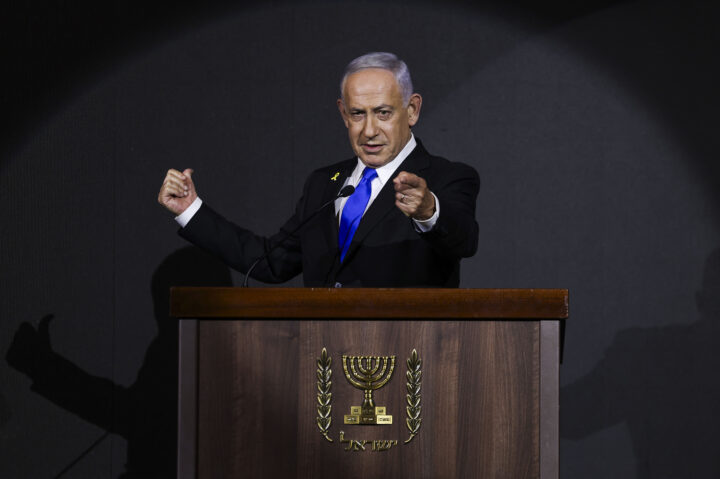
Israeli Prime Minister Benjamin Netanyahu (Photo by Ronen Zvulun / POOL / AFP) (Photo by RONEN ZVULUN/POOL/AFP via Getty Images)
The bloc of political parties backing Israeli Prime Minister Benjamin Netanyahu had its best showing of the campaign ahead of the Oct. 27 Knesset election.
In eight polls published by Israeli media outlets in the last week, the pro-Netanyahu bloc led in four and tied in two, while the opposition bloc led by Gadi Eisenkot’s Yashar party, won in two. In all polls, the bloc sizes are very close, except for two polls in which Netanyahu’s bloc leads by 12 and 18 seats, respectively.
The average of the eight polls puts Netanyahu’s bloc at 55 seats and the Eisenkot bloc at 51. Without the outlier polls, the average for Netanyahu’s bloc drops to 52 and the opposition bloc leads with 53 seats.
In a poll in the Hebrew daily Ma’ariv, taken by veteran pollster Menachem Lazar, the Netanyahu bloc tied with the center-left opposition bloc for the first time in three years, with each receiving a projected 52 seats. The Netanyahu and Eisenkot-led blocs tied in an Israel Hayom poll, as well.
The Netanyahu bloc also reached a two-year high in Channel 13’s poll, conducted by Shmuel Rosner, with 55 seats, and the opposition bloc was projected to receive fewer votes than in any of his polls in recent years, with only 50 seats.
Notably, the pro-Netanyahu bloc still did not receive enough votes to form a coalition in either poll in which Likud performed better than before. In addition, in each poll, a party that often fails to clear the 3.25% mark necessary to win seats in the Knesset cleared the threshold.
The pro-Netanyahu bloc is large enough for a governing coalition in two polls: One, conducted by former Netanyahu adviser Shlomo Filber for the pro-Netanyahu Channel 14, gives the bloc 63 seats, compared to the opposition bloc’s 45. The other, from i24 News and conducted by Direct Polls, in which Filber used to be a partner, gives the Netanyahu bloc 60 seats — a very narrow, but legitimate coalition — and the opposition bloc 48.
The Eisenkot bloc outperformed the right and religious parties in two polls: Times of Israel, in which the opposition received 55 and Netanyahu 51, and Channel 12, in which the opposition received 54 and Netanyahu 49.
Public Security Minister Itamar Ben-Gvir’s Otzma Yehudit has an average of about eight seats, while Finance Minister Bezalel Smotrich’s Religious Zionist Party averages six seats, putting them roughly at the same number of seats as they currently have and only slightly smaller than the Haredi parties. While they are much smaller than Likud, which is averaging at 23 seats, they still have significant leverage to demand senior cabinet positions, as Netanyahu will need every party in his current bloc, and more, to form a coalition. Ben-Gvir has said he will request the defense portfolio.
The Israel Hayom poll also found that the top issue for Israeli voters is the economy, with 29% saying it will determine their vote, followed by security at 23%, democracy and rule of law at 13%, Israel’s Jewish identity 9%, Haredi conscription 9%, a commitment to establish a commission of inquiry on the Oct. 7 attacks 7%, and judicial reform 4%.
Netanyahu bloc voters put security first (30%), followed by Israel’s Jewish identity (22%) and then the economy (20%), while Eisenkot bloc voters put the economy first (35%) followed by democracy and rule of law (20%), and then security (19%).
With neither the Netanyahu-led government or the Eisenkot-led opposition winning enough support for a solid majority, a governing stalemate is looking more likely — in a repeat of the 2019-2020 elections
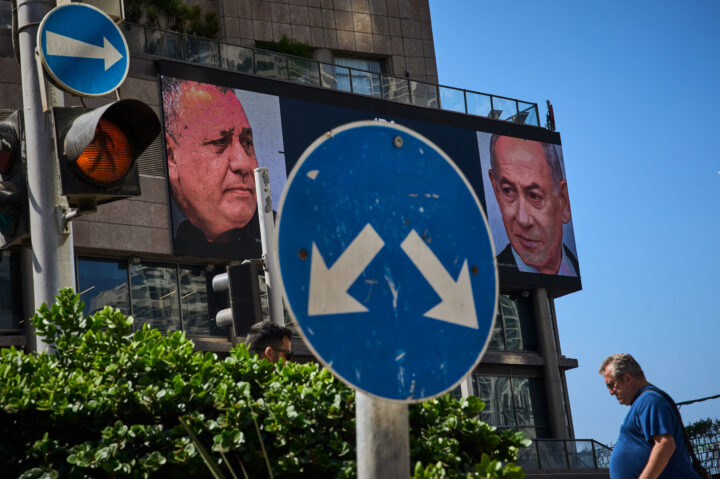
(Oded Balilty/AP)
A man walks past a television channel advertisement featuring Israeli Prime Minister Benjamin Netanyahu, right, and his main rival, opposition candidate Gadi Eisenkot, ahead of Israel's general election, in Ramat Gan, Israel, Wednesday, Sept. 23, 2026.
Welcome to 2019, electorally speaking, that is.
With the High Holy Days season now in the rear-view mirror, Israelis across the country have received postcards in the mail in recent days listing their polling place address, one of the tangible signs that election season is in the homestretch. Yet the Oct. 27, 2026, vote is taking on an unmistakable back-to-the-future feel.
Then, Prime Minister Benjamin Netanyahu was bloodied but unbowed, set to be indicted on bribery and public corruption charges, with a coalition that fell apart over a court order to resolve the issue of Haredi draft exemptions. Now, Netanyahu remains bloodied but unbowed, with a large swath of the public calling for him to take responsibility for security failings surrounding Oct. 7, 2023, and the Haredi draft issue still looms large.
Then, the leading contender to take the premiership from Netanyahu was an ex-IDF chief of staff, Benny Gantz. Now, it’s Gadi Eisenkot, who held the post from 2015 to 2019. Then, Naftali Bennett formed a new party, the New Right; now, the former prime minister is back with yet another new party. And even the libertarian iconoclast Moshe Feiglin is back in play – though he’s less focused on legalizing weed this time.
With 22 days until the election, Israelis could be forgiven if they are having flashbacks. Then, in 2019 and with the country split, Netanyahu couldn’t muster the 61 seats to form a ruling coalition. Now, the pro- and anti-Netanyahu blocs are virtually tied in most polls, and a repeat of 2019 could be inevitable, analysts say.
Netanyahu and Eisenkot are each focused on breaking the stalemate so they can form the next coalition. The way things currently stand for Netanyahu to reach a 61-seat majority, he will have to reach across the aisle, where most of the parties have vowed not to join a coalition he leads. For Eisenkot to win, he and his allied parties will have to break campaign promises not to sit with the Haredi parties, who seek to perpetuate their constituents’ exemption from military service, or — as Netanyahu’s Likud campaign has emphasized — rely on Islamist party Ra’am, which has sent mixed messages about its views on Hamas.
As was the case seven years ago, there is widespread talk among the parties of boycotting Netanyahu, Arab parties or Haredi parties. That year was the first time a new election was called without a government being formed, and it happened after the second election that year, as well. The cycle was only broken by the COVID-19 pandemic pushing Gantz into an alliance with Netanyahu — a pattern that repeated itself after Oct. 7, which has led to Gantz’s nosedive in the polls. Two more elections were held over the following two years.
But unlike in 2019, this election is being held in the post-Oct. 7 world. Hamas and Hezbollah are shells of their former selves, but the IDF is still being deployed on four fronts with tens of thousands of reservists on duty. The Abraham Accords are holding strong, but more broadly, Israel’s international relations are at a nadir. The Iranian nuclear threat has been somewhat rolled back, but the situation in the Islamic Republic remains unstable and dangerous. And then there’s the prospect of airplane hijackings making a comeback. Government paralysis is an even more dangerous possibility in 2027 than it was in 2019.
Some Israelis may have hoped that the ongoing security crises would convince the political class to put aside the games they played at the end of the last decade, but despite all the developments of recent years, they’re back at square one with many of the same pieces on the board.
Without a resolution to the ongoing tensions with Tehran, Netanyahu could find himself fighting his toughest battle yet
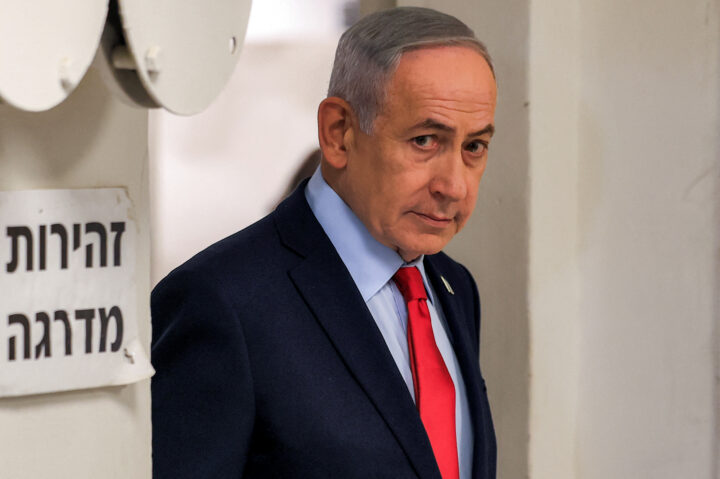
POOL/AFP via Getty Images
Israeli Prime Minister Benjamin Netanyahu arrives for a press conference in Jerusalem on March 19, 2026.
The Likud party’s statement on Wednesday confirming that Israeli Prime Minister Benjamin Netanyahu would stand on the ballot this fall put to bed long-swirling rumors that the prime minister was considering forgoing another run — potentially in exchange for the government dropping its legal case against him.
That speculation had deepened earlier in the week, when President Donald Trump publicly mused whether Netanyahu, whom Trump referred to as “a wartime prime minister,” might decide to exit politics. A survey released this week by the Israel Democracy Institute found that 61% of Israelis — including 57% of Jewish Israelis and 87% of Arab Israelis — think Netanyahu should refrain from seeking another term.
With Netanyahu ending speculation about his political future, the focus now turns to the candidates seeking to unseat him.
Gadi Eisenkot’s ascent — earlier this week, a Channel 12 poll found for the first time that more Israelis favored him over Netanyahu as prime minister — comes as the former IDF chief of staff, who lost a son and two nephews in the Hamas war, becomes increasingly critical of Netanyahu, in whose war cabinet Eisenkot sat. As Israeli journalist Nadav Eyal points out, Eisenkot “isn’t seen as aggressive toward anyone but Netanyahu.”
Meanwhile, former Prime Ministers Naftali Bennett and Yair Lapid have experienced little momentum after they announced their merger into the “Together” slate in April.
The two made a risky bet in joining forces with many months to go before the election — one that can’t easily be undone. And while their broad coalition was successful in 2021, it’s unclear if Together’s tent is big enough for all the anti-Netanyahu voters — in a changed electorate post-Oct. 7 — whom Bennett and Lapid would need to pick up.
Bennett — whose previous party was called Yamina, the Hebrew word for “right,” and who has described himself as more right-wing than Netanyahu — will have the additional challenge of convincing his potential supporters that he will not be too accommodating to the left. It’s worth recalling that their previous “Change” government was felled by breakaway members who were angry over Bennett’s concessions to his more-liberal coalition partners.
Part of the Change coalition’s success in 2021 — and also its downfall the following year — was its recruitment of Mansour Abbas’ Ra’am party. Now, Ra’am remains the one Arab party not joining forces with the three others, as efforts to form an alliance falter. And Abbas said as recently as a month ago that Eisenkot, Bennett and former Defense Minister Avigdor Liberman “are all worthy and have the experience to lead the next government” — even as all three have distanced themselves from Abbas.
But depending on how the seats are apportioned after votes are counted, the anti-Netanyahu opposition could potentially need Ra’am’s support to get to 61 seats. That possibility — though Bennett has said he will only sit with Zionist parties — could prove to be a poison pill for some right-wing voters disenchanted by Netanyahu who could otherwise be swayed to vote for Bennett in the election.
Though no election date has been set, it is increasingly likely that Israelis will cast their ballots in late October, close to the deadline mandated by Israeli law, and weeks after the anniversary of the Oct. 7 attacks, which occurred on Netanyahu’s watch.
Even in spite of the Oct. 7 attacks, Netanyahu has sought to portray himself as a strongman protecting his country. But he is increasingly seen by Israelis — and even his own supporters — as deferential to Trump (who recently proclaimed, “I call the shots” regarding Iran moves). Netanyahu’s own envoy to Washington, Yechiel Leiter, told CNN last month that Israel was a “junior partner” to the U.S vis-à-vis Iran.
Without a resolution to the ongoing tensions with Tehran — to say nothing of the recent waves of ballistic missile attacks from Iran and Yemen, and Hezbollah’s ongoing fire targeting northern Israel — Netanyahu could find himself fighting his toughest battle yet.
Please log in if you already have a subscription, or subscribe to access the latest updates.
 Continue with Google

 Continue with Apple
