














































































Three senior officials with the board are requesting $200 million from Congress to support the International Stabilization Force in Gaza
Chip Somodevilla/Getty Images
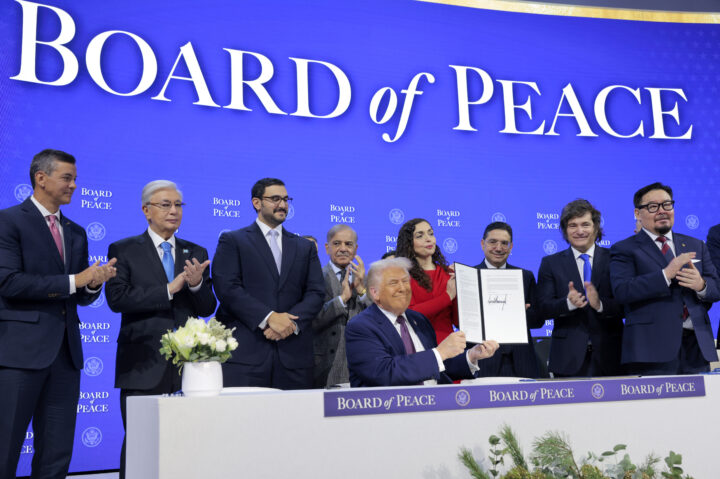
President Donald Trump holds up his signature on the founding charter during a signing ceremony for the “Board of Peace” at the World Economic Forum (WEF) on January 22, 2026 in Davos, Switzerland.


 Add JewishInsider on Google
Three senior U.S. officials connected to the Board of Peace, the Trump-led body created to resolve the conflict in Gaza, have been meeting with congressional offices this week to request $200 million for a peacekeeping force, according to two people with knowledge of the meetings. The meetings mark the first time that Board of Peace representatives have approached Congress with a funding request.
Jasper Jeffers, an American military officer serving as commander of the International Stabilization Force, the United Nations-mandated peacekeeping force created in last year’s ceasefire deal between Israel and Hamas; Board of Peace senior advisor Josh Gruenbaum; and retired Gen. Mark Schwartz, a former U.S. security coordinator for Israel and the Palestinian Authority who is now the Board of Peace’s security lead, spoke at the Capitol Hill meetings.
The ISF, which was part of President Donald Trump’s 20-point peace plan announced last September, has struggled to find backers. Indonesia, Morocco, Kazakhstan, Kosovo and Albania pledged troops to the effort, but most have not yet done so. Indonesia paused its plans in March during the Iran war. What was billed as a 20,000-troop force has fewer than 20 initial members, according to a Wall Street Journal report this week. The ISF’s goal is to demilitarize Gaza and keep Hamas out of power, and countries have voiced concerns over whether their troops would be required to militarily confront Hamas.
Gruenbaum, Jeffers and Schwartz have met or plan to meet with staff from the Senate Foreign Relations Committee, the House Foreign Affairs Committee and the national security-focused subcommittees on the House and Senate Appropriations committees. A Board of Peace official called the meetings “extensive and highly constructive.”
“The delegation shared the progress that the Board has made in recent weeks, including movement toward the establishment of a humanitarian pilot [program] in Gaza, ongoing efforts in negotiations to disarm Hamas, preparations for the Palestinian technocratic government to assume authority, the huge improvement in the humanitarian situation, the pending start of training for a civilian police and the recent and ongoing scale-up in manpower and logistics for the International Stabilization Force,” the official told Jewish Insider.
The requested $200 million for peacekeeping operations, or PKO — a specific category in the Foreign Assistance Act — is primarily intended to fund the International Stabilization Force, according to a source with knowledge of the Board of Peace’s activities.
The request is for discretionary funding, rather than a direct congressional appropriation for the Board of Peace. The Board of Peace source said conversations about congressional appropriations for the body may come later.
The Board of Peace official said the congressional meetings marked “the start of an extensive effort to work with Congress” in order to “transform Gaza into a place of peace, prosperity, economic development and reconstruction.”
Earlier in the week, Board of Peace officials met in Brussels with senior Palestinian Authority leaders, and the European Union committed to providing $1 billion toward Gaza recovery efforts.
The package would face steep hurdles in the Senate, where lawmakers have already balked at the Pentagon's initial $1.5 trillion funding request
SAUL LOEB / AFP via Getty Images
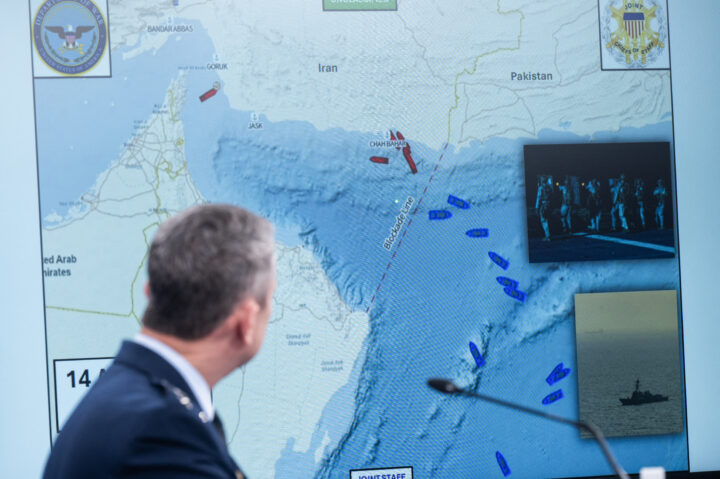
Chairman of the Joint Chiefs of Staff Gen. Dan Caine speaks as a map of the Strait of Hormuz is displayed during a press briefing at the Pentagon in Washington, DC, on April 16, 2026.
The Trump administration is planning to ask Congress to approve an $80 billion request for additional funding to replenish stockpiles and otherwise pay for the war in Iran, according to several reports.
That request comes on top of a push for a $1.15 trillion regular defense budget for 2027 as well as another $350 billion for the Pentagon that the administration wants Congress to pass through a partisan reconciliation process — a $1.5 trillion request in total that Republican lawmakers have criticized and some key Senate Republicans have described as unrealistic.
The supplemental request, too, could prove difficult to pass, requiring 60 votes in the Senate. Many Democrats declared at the outset of the war that they would refuse to pass any supplemental funding for the effort, and have further balked at the initial $1.5 trillion defense budget request.
Secretary of Defense Pete Hegseth is set to brief some House Republicans on Wednesday about the administration’s defense funding requests and the war in Iran.
Sen. Thom Tillis (R-NC) indicated he’s generally supportive of the anticipated $80 billion request, and argued that many of his colleagues could be convinced to support it if it’s primarily focused on restocking expended U.S. munitions supplies.
“It doesn’t surprise me. I think a part of what we need to do is figure out how much of that is for replenishment, that’s basically to get us the base load pre-conflict,” Tillis told Jewish Insider. “So I think the more that people spend on describing at that level, the more likely it is you’ll get support for it, and particularly if they only focus on what’s critical to get back to pre-conflict baselines. I think most members would say we got to do that.”
Sen. Mark Kelly (D-AZ), a military veteran who has generally been more moderate on defense issues than some of his more progressive colleagues, indicated he’s more skeptical of the proposal.
“I always want to make sure that the troops have what they need to do a really hard job and defend themselves especially,” Kelly said.
But, he continued, when he joined the Senate in 2022, the total defense budget was $650 billion, and the $1.5 trillion the administration is now seeking is higher than much of the rest of the world’s defense budgets combined.
He said that some of the systems the administration is asking for, such as space-based missile defense, are impractical or unneeded, “so I want to see the munitions be replaced, but let’s do it within a responsible top line of the defense bill, not this crazy, overly inflated number.”
Sen. Josh Hawley (R-MO), who had called for a prompt end to the war and has been supportive of talks with the Iranian regime, said he was withholding judgement on the supplemental request until the administration actually submits it.
Initial reports indicated the Pentagon intended to request as much as $200 billion for the war, but Pentagon officials testified last month that the costs of the war — excluding anticipated rebuilding costs of U.S. facilities in the region, came in between $20 and $30 billion.
“I don’t want to get out ahead of what the Pentagon will propose here,” Hawley said. “There’s been multiple iterations, so next week it may be something different. Let’s let them come up with something.”
Please log in if you already have a subscription, or subscribe to access the latest updates.
 Continue with Google

 Continue with Apple